Rubrics to Support Writers

Teaching

Dr. Christina Dobbs follows up her webinar with this blog to challenge instructors to create rubrics that grow writing literacy and result in positive student-teacher interaction. Read more about her at the end of the blog.


During the COVID-19 pandemic, I had planned a study of writing instruction at the university level that involved interviews with students and visits to introductory writing classes that would help understand how undergraduates had made the transition from high school to university writing.  But fate intervened and doing work to observe in class instructional spaces became complicated as we began to teach and work from home, and so I made a decision to just keep interviewing undergraduates about their experiences.  Eighty interviews later, I am so glad to have had the opportunity to talk deeply with a wide range of students about their experience of writing in school across their lives and whether and how they see themselves as writers. 

This work, alongside some other work with my colleague Chris Leider from UMass Boston, has caused me to spend time thinking deeply about the feedback we explicitly and implicitly give to students about their writing.  As a teacher, I always struggled to give feedback on writing in a timely way that still felt deeply engaged with the work, and students didn’t always use the feedback I gave them to improve their writing, which never felt good.  This new work about more effective and culturally sustaining feedback for students has helped me to understand what might have worked better in my own classroom and even in my own experience as a writer myself.

Across the work Chris and I have done with teachers over time and what I learned about feedback from my interviews with undergraduates, I have come to a new approach to feedback.  Here are two lessons learned across those projects.

Lesson #1:  Even if we didn’t know it, students remember our feedback, especially when they feel it was negative.

In talking with undergraduates about the feedback they received on their writing and times they felt proud of their writing, I was shocked by how much they remembered about feedback they had been given.  Students relayed memories from elementary, middle, and high school as well as college, and sometimes they still felt strong emotions associated with those memories.

They described memories when a teacher had made them feel as though their ideas were worth engaging and that they had written something thought-provoking.  They also described the positive experience of answering questions about their writing when feedback was given or feeling like their work inspired curiosity from the reader. 

They also relayed moments when they got feedback that made them feel like their teachers had not really engaged with their ideas.  This included times when they only got feedback on surface conventions or grammar, but it also included times when they just got a ‘good job’ or ‘great work’ too.  Somehow this insubstantial positive feedback also made students feel as though they had not written ideas worth engaging.

Most importantly, the writers often described wanting to improve their work, but feeling as though some feedback they received was not helping them to do so.  Some even described the feedback as showing them they actually would not be able to improve.  They described teachers who made them feel as though they were already supposed to know everything before they took the class and those who clearly conveyed that they could improve.

This has led to a few ideas about giving feedback that I carry forward:

  • Asking questions about the content seems to matter to many writers.
  • Encouraging writers through feedback at various levels of the work, from the overall idea to the conventions, can support students in viewing their work as substantial.
  • Telling students that they can improve, and we will help them to do so explicitly can convey our belief in students’ potential for growth.

Lesson #2:  It doesn’t matter what you say to students if your rubric says something else.

The rubrics we use to evaluate student writing often use harsh and deficit-driven language to separate students in particular categories.  Rubrics will have category labels such as ‘unsatisfactory,’ ‘below expectations,’ or ‘warning’ to delineate performance, with upper category labels with headings like ‘outstanding’ or ‘excellent.’ 

Then within categories, the statements to describe various levels of performance will have language such as:

  • Writer has little or no control over sentence structure.
  • Reasoning is incoherent or unclear.
  • The use of language fails to demonstrate skill in responding to the task. (This example is from the ACT rubric.)

The designers of rubrics such as these likely did not think they were harshly commenting on students as writers; in fact, they likely thought they were only commenting on the piece of writing at hand and how well it communicates.

But the personal nature of writing and the ways that writers use feedback and comparison to others to drive their own writing self-efficacy (Pajares, 2003; Pajares & Johnson, 1996) makes it clear that writers likely internalize some of this commentary as about themselves, even if the teacher giving feedback did not mean it as such.  Indeed, in my interviews with undergraduate students, they frequently described memorable feedback and harsh rubrics from many years earlier (going back to elementary) as drivers of whether they perceived themselves as writers in college years later. 

Chris and I developed a question framework to help guide teachers in redesigning rubrics in ways that still convey critical feedback to students in ways that feel encouraging and supportive.  We use these four questions to help teams of teachers we work with to revise rubrics to convey feedback in more supportive and equity-driven ways.  The four questions (from Dobbs & Leider, 2021) are as follows:

  • Does the rubric’s scale of values for judging responses suggest that students have room to grow?
  • Do the tools emphasize development and purpose when it comes to language use?
  • Does the rubric feedback connect student language to audience?
  • Does the tool explicitly acknowledge that students have agency in choosing which of their language resources to use?

We use these questions not to shift the feedback away from various elements of the writing that we want to give feedback about, but rather to push us to phrase our thinking in a way that treats writers in humane and supportive ways.

So, we use these framing questions to rephrase headings and sentences on rubrics.  What might have said ‘unsatisfactory’ before might say ‘still learning,’ ‘room to grow,’ or even ‘focus for next time.’  Where we might have said that ‘reasoning was incoherent,’ we might shift to say that ‘the writer’s reasons supporting their argument were challenging for the reader to understand.’ 

These sorts of changes convey to students that they can still be working on various elements of their writing, which all students are doing and is the purpose of schooling.  They can also convey that writing feedback is not a matter of knowing how to do it ‘right’ or ‘wrong,’ but it is rather a matter of whether your communicative purpose was understood by the audience.  It also conveys that students made choices about the writing they chose to put forward and that they can continue to improve that writing’s purpose, not just it’s perceived correctness on things like punctuation.

Over time, I’ve learned that giving feedback is meaningful to students in ways I had not always realized, and that making purposeful and specific choices in how to give feedback can make a huge difference in how students are able to take up the feedback we give them.  That way, years down the road when they are in college and being interviewed, they will relay memories of feeling supported and confident as writers.

References

Dobbs, C. L. & Leider, C. M. (2021). A framework for writing rubrics to support linguistically diverse students. English Journal, 110(5), 60-68.

Pajares, F. (2003). Self-efficacy beliefs, motivation, and achievement in writing: A review of the literature. Reading and Writing Quarterly, 19(2), 138-158.

Pajares, F. & Johnson, M. (1996). Self-efficacy beliefs in the writing of high school students: A path analysis. Psychology in the Schools, 33(2), 163-175.


Dr. Christina L. Dobbs is an Assistant Professor in English Education. Her research interests include academic language development, the argumentative writing of students, and professional development for secondary content teachers. She is a former high school teacher in Houston, Texas, as well as a literacy coach and reading specialist.

AI and the Art of Writing: Balancing Innovation with Tradition in Education

Teaching

We welcome Ian O’Byrne as we open our blog and webinar theme: Artificial Intelligence. Please read more about Ian at the end of the blog.


Educators are currently struggling with a significant decision: Should AI be integrated into the writing process? Some worry that it could impede students’ writing skills. This leads to an important question: Have American schools ever been successful in teaching writing? When was writing education at its best? Where is it now?  As educators, how can we strike the right balance?

There is no easy answer to these questions. The history of writing education in America is long and complex, and there have been many different approaches to teaching writing over the years. Schools now stand at a crossroads as AI-powered writing tools gain popularity. These technologies promise to enhance instruction and feedback but also raise concerns about over-reliance. To make sense of this balance, let’s first look at what exactly AI is.

What is Generative AI?

The intelligence of computers or software, as opposed to the intellect of people or animals, is known as artificial intelligence (AI). It is a branch of computer science that creates and investigates intelligent machines. Uses of artificial intelligence in the form of an agent, bot, or tool are generally labeled as AI. In the last year, we’ve seen an influx of AI in our lives as ChatGPT exploded on the scene. A far better way to view these tools is to refer to them as Generative AI and not simply as AI or ChatGPT.

Generative AI refers to advanced artificial intelligence systems that can generate new content on their own rather than just responding to user prompts. Models like GPT-3 (ChatGPT) can write entire essays, stories, and code after being trained on vast datasets. This means they may soon be capable of assisting students and teachers with writing tasks like brainstorming ideas, translating rough drafts into more polished work, answering content questions, and even providing feedback.

However, generative AI also raises challenges. Teachers will need to focus on developing original thinking skills rather than knowledge recall, and concerns around plagiarism, creativity, and voice must be addressed. When used judiciously, generative writing tools could enhance instruction and revision. But ultimately, writing education should emphasize the uniquely human aspects of imagination, analysis, and persuasive communication that AI cannot replicate.

What about writing instruction?

The history of writing education in America is a mixed bag. Some of the earliest writing instruction in America took place in one-room schoolhouses, where students were taught the basics of grammar and spelling. Teaching pupils to write included teaching them how to form letters, spell words, and have readable, if not exquisite, handwriting. Writing instruction in American schools began in the late 1800s as colleges started requiring admissions essays. This mostly focused on preparing an elite group of males with a formulaic, five-paragraph structure that developed basic literacy but limited creativity.

Students were required to master the five-paragraph essay, but this method sometimes stifled originality and expression. While it did instill basic writing skills, it may not have nurtured a deep love for writing. Some shifts came in the 1960s and 1970s as the process approach emerged, emphasizing planning, drafting, revising, etc. The National Writing Project (NWP) raised awareness about the ways that writing changes throughout a person’s life, the impact of a range of school and non-school experiences on writing, and the interactions between writing in school and these lived experiences. 

Throughout the 20th century, writing instruction continued to follow a rigid, formulaic approach, emphasizing grammar and structure over creativity and critical thinking. Some of this focus on the importance of grammar and mechanics in writing instruction was due in part to the rise of standardized testing, which required students to demonstrate their mastery of these skills. Students were inundated with topic sentences, transitional phrases, and conclusion restatements in the omnipresent five-paragraph essay. Although this method guaranteed a basic level of literacy, creativity and enthusiasm were frequently sacrificed.

In recent years, the tide seems to have turned in favor of more innovation, voice, and freedom of expression. There has been a growing movement to move away from traditional grammar-based approaches to writing instruction and to focus more on helping students develop their critical thinking and problem-solving skills. Current best practices involve process-based instruction tailored to students’ needs and interests. Assignments also incorporate more authentic, real-world writing purposes and audiences.

Yet, with this varied history in the focus, goals, and implementation of writing instruction, the teaching of writing has not changed in many schools. Debates continue around balancing process approaches with quality outcomes. Standardized writing tests have been criticized for over-emphasizing grammar at the expense of actual writing skills. Researching writing development, including spelling patterns and the connections between writing, speaking, and reading, is a constant challenge. Other ongoing issues include managing teachers’ heavy workloads, integrating technology for composition and collaboration, and closing achievement gaps for minority students. Simultaneously, some educators find it difficult to strike a balance between grammar and real-world communication possibilities.

Writing Education and Generative AI

Generative AI tools hold great promise, but they also pose risks. Over-scaffolded writing assignments might fail to teach core composition skills. Targeted AI feedback could improve self-editing and reworking while maintaining the humanity of audience awareness and personal narrative. Students can receive immediate, personalized feedback thanks to technologies like AI co-writers, grammar and style checks, and predictive text. Students could become overly dependent on AI recommendations rather than developing their own voice and style. Essay scoring algorithms even mimic the evaluation procedure. Schools should prioritize balancing rather than seeing innovation as a substitute for efficient practice.

As educators and researchers, we need to better understand the appropriate role for writing technologies. How can AI augmentation best complement time-tested instructional methods? Which specific skills should remain the focus for teachers and students? Even with the help of intelligent recommendation systems, collaborative discourse and knowledge might still be developed through writing workshops and reading circles. Both tradition and technology have their place.

There is no one-size-fits-all approach to writing instruction, and the best approach for a particular student will depend on their individual needs. It is important to note that writing is a skill that takes time and practice to develop. Students will not become good writers overnight. However, with effective instruction, all students can learn to write well. There are some key principles that we can use to help guide future explorations of writing instruction and AI. These principles include:

  • A focus on the writing process as opposed to product, from prewriting to revision
  • Opportunities for students to write for a variety of purposes and audiences
  • Feedback from teachers, peers, and other agents
  • Numerous, varied chances for students to hone their writing abilities

As leaders in literacy, we have the chance to mentor the upcoming generation of authors. When writing instruction veered too much in the direction of either freedom or structure, it went awry. We can provide kids with the best of both worlds by ethically incorporating AI as a tool for improved results. Teaching the craft, generating ideas, finding one’s voice, and fostering a lifelong love of writing continue to be our guiding values. Technology can support this objective if used wisely. We can find the ideal equilibrium if we act carefully and wisely.


Dr. W. Ian O’Byrne is an associate professor of literacy education at the College of Charleston in South Carolina. His research focuses on the dispositions and literacy practices of individuals as they read, write, and communicate in online and/or hybrid spaces. Ian is the author of many journal articles and book chapters focusing on initiatives ranging from online and hybrid coursework, integrating technology in the classroom, computational thinking, and supporting marginalized students in literacy practices. His work can be found on his website (https://wiobyrne.com/) or in his weekly newsletter (https://digitallyliterate.net/).

Writing to Learn: Strategies to Engage Students in Writing and to Deepen Content Knowledge

Teaching

As a follow up to her webinar, Brooke Hardin expands on her resources for using multi-modal writing responses to engage students in writing.


In twenty years of teaching English Language Arts, helping students discover their “writerly life” has remained a passion. To live a writerly life means that individuals write often and with a fair amount of ease, that they see their everyday ordinary lives brimming with writing topics, and that they can use writing to reflect their ideas and potentially gain new ones. In order to begin to live a writerly life, one must be motivated to write. As teachers, engaging students in writing tasks can often be a challenge, but certain elements increase both students’ motivation for writing and their efficacy for writing tasks. Student choice in topic, modeling of strategies and techniques, consistent time to share, give, and receive feedback on writing, and invitations to write in varying modes have all been identified as ways to more likely engage students in writing. This post serves to provide strategies related to the latter idea, using various modes for writing and how these modes might inspire students to write and deepen their knowledge of disciplinary content.

What is Multimodal Writing? What Might it Look/Sound Like?

Multimodal texts are print-based and digital texts using more than one mode or semiotic resource to present meaning; mode is defined as a socio culturally formed resource to make meaning (Kress, 1010; Serafini, 2015). Authors have been exploring multimodal response for over a decade and have seen its potential to engage students in personal response and critical analysis of literature, while also developing their appreciation of genres (Dalton & Grisham, 2013). Expanding students’ literacy palette to include the modes of image, video, audio, and writing offers them more choices for how to develop and express their thinking about reading. When readers write about, interpret, or respond in some fashion to their transaction with a text, a new text is produced as the reader-turns-writer; that is, a writer or creator who seeks to express that experience with the text (Rosenblatt, 1994). Writing in a poetic form or creating a digital design as an aesthetic response to the reading positions the reader-turned-writer to adopt an aesthetic stance in which the student’s attention is focused on the lived-through experience of the reading: the emotions, moods, intuitions, attitudes, and tensions connected to the ideas and characters embodied in the text (Rosenblatt, 1994). Thus, one of the benefits of multimodal writing tasks is their potential to deepen comprehension and/or content learning.

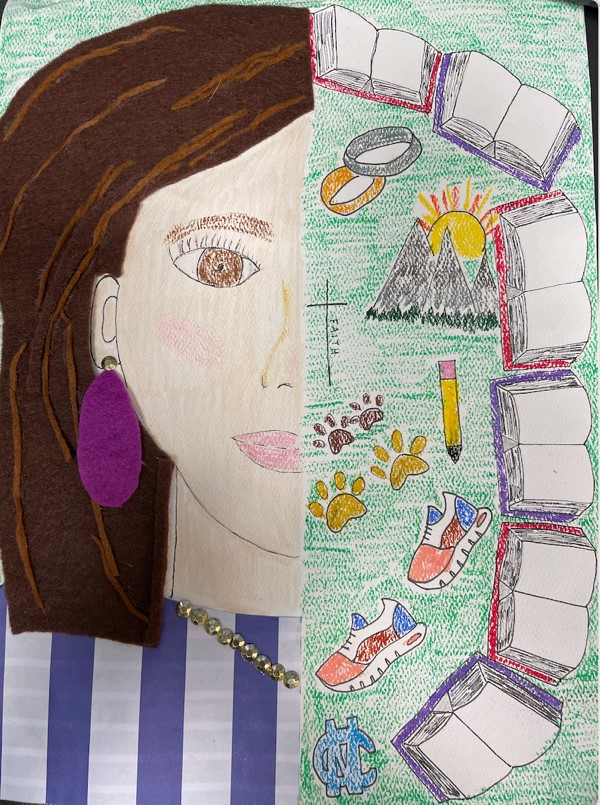
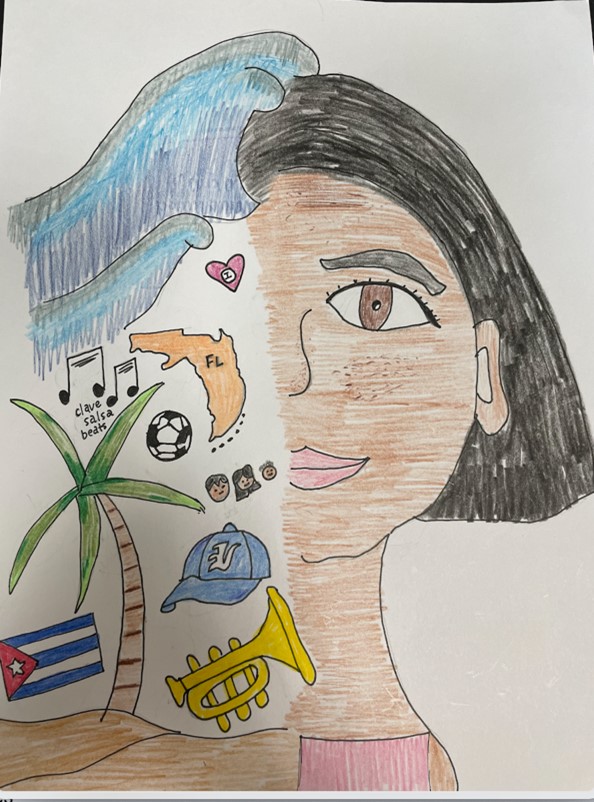
            One strategy for multimodal writing is called a half-and-half portrait (see Image 1). To create this piece, a student would first “write” the portrait about themselves. The portrait is a visual representation of an individual done by drawing one half of the person’s face using physical features (i.e., hair style, eye color, nose shape) and then filling in the other half of the face with images, quotes, or other ideas that relate to the person’s attributes, interests, life experiences. Once a student has created a half-and-half portrait about themselves, they can apply the strategy to a character from text, historical or present-day figure, or any other person. For example, the physical side of the portrait is created using the features visualized by the reader based on descriptions in the text. The other half of the character’s face uses images and other ideas related to the character and inspired by evidence from the text. For example, students might read the middle grades novel Refugee by Alan Gratz, which portrays the refugee experience of three distinct, fictional adolescent characters. Students reading this novel could further explore and demonstrate their understanding of these characters through the creation of a half-and-half portrait (see Image 2).

Image 1: Personal ½ and ½ Portrait (created by author)                  

Image 2: Isabel from Refugee (created by author)

In addition to creating the portraits, students can also create video or audio recordings that explain the thinking behind their multimodal writings. Teachers might ask students to discuss both the materials used to create the portraits and the ideas represented in the portraits. In multimodal writing using a visual art form such as this portrait, selection of materials and images or quotes used should be as intentional as word choice is in written texts. An example of my explanation for my half-and-half portrait can be found using this link.

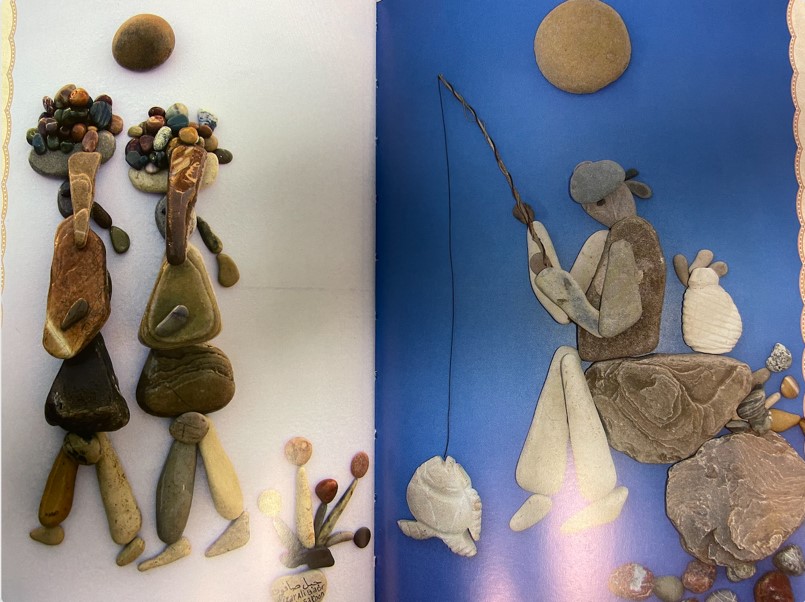
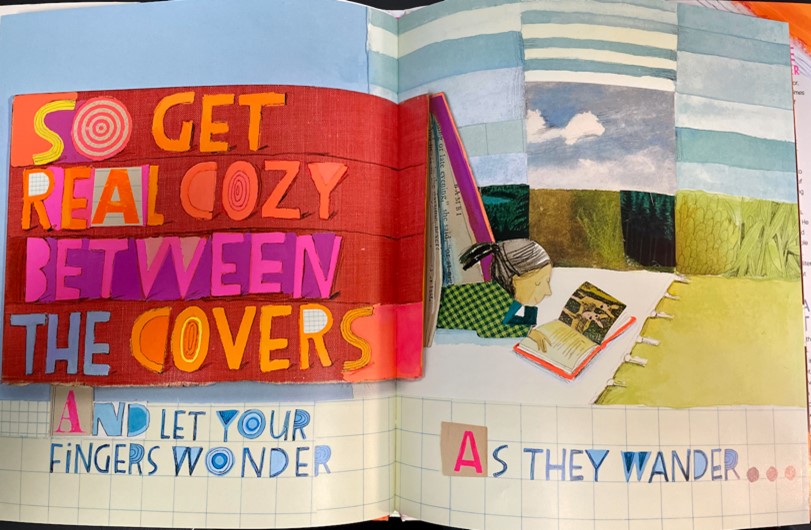
As with any new genre of writing, students need mentor texts they can reference for ideas and inspiration. Picture books, especially those that have been recognized for their illustrations, serve as some of my favorite mentor texts for multimodal writing with visual art (see Images 3 and 4).

Image 3: Illustrations made with stones in Stepping Stones: A Refugee FAmily’s Journey by Margaret Ruurs

Image 4:

Illustrations made with layered collage featuring book pages,

tattered book covers, neon paints, and cloth in How to Read a

 Book by Kwame Alexander and illustrated by Melissa Sweet

Engaging Students in Writing with Poetry

Poetry is another genre that often engages students in writing tasks. Poetry is subjective and its structure can vary. Some forms, like haiku, have a particular form, but poetry can also be as simples as a collection of a person’s favorite words. The rules of writing become more relaxed in different types of poems, which allows students to tap into their creativity and use their voice to play with words, line breaks, and the appearance of the poem. Many poems are what I call “bite-sized;” thus, they are also less intimidating to write for more reluctant writers.

Definition Poems

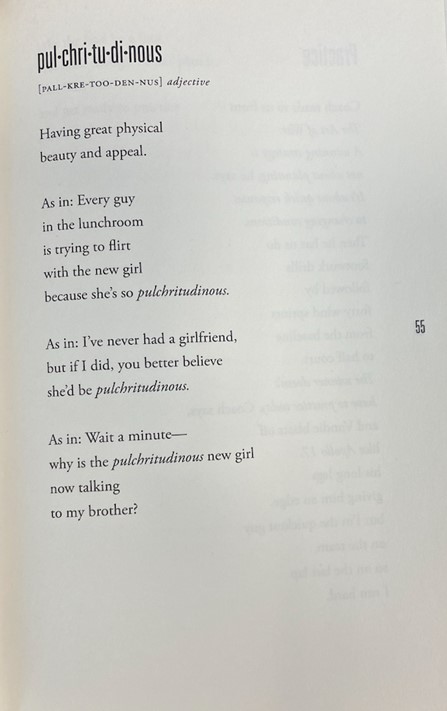
Definition poems are a specific type of poetry that follows a form but also holds space for students to use craft moves and have agency with the writing. This form of poetry is inspired by some of the pages from the middle grade novel The Crossover by Kwame Alexander (see Image 5). Written in verse, the novel features several poetic styles, including definition poems, that might serve as mentor texts for students poetic writing. The definition poem invites students to engage in writing while also enhancing their vocabulary knowledge and using learned content to create something new.

Image 5: Definition poem from The Crossover

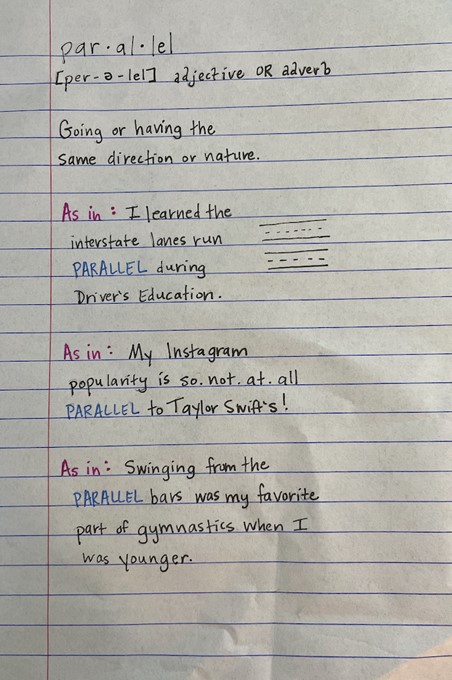
When teaching students to write definition poems, teachers should use the same principles they would use with teaching any other genre. Reference the mentor text, such as one of Alexander’s poems from The Crossover, and engage students in inquiry by asking them to take notice of how the author wrote the poem – that is, to think about and name aloud the “ingredients” used in the poem and what might be required for someone else to write the same style of poem. For example, teachers would point out how each stanza begins with “As in:” and how the vocabulary term is used in each stanza. Teachers might use a shared writing approach to co-author a definition poem with the whole class and invite students to co-author this kind of poem in pairs before they write one independently. Again, this kind of poem can be used with vocabulary from novels students read and to other content areas. See Image 6 for an example definition poem written about the math term parallel. As seen in the example, the poem offers students the opportunity to sustain their thinking about a word and its meaning and invites them to see how vocabulary terms are relevant to their lives. Additionally, these kinds of poems can serve as a piece of writing in a larger multimodal piece. For example, students might be invited to illustrate each stanza of the poem to add a visual layer.

Image 6: Example definition poem (created by author)

Golden Shovel Poems

Golden shovel poems are a poetic form created by Terrance Hayes and inspired by Gwendolyn Brooks’ poem, “We Real Cool.” To write a golden shovel poem, the writer must do the following:

  • Take a line or lines from a poem you like.
  • Use each word in the line as the end word in each line of your poem.
  • Keep the words in order.
  • Give credit to the original poet.
  • The new poem does not need to be about the same subject as the original poem, but they can be related in some way if the writer chooses to do so.

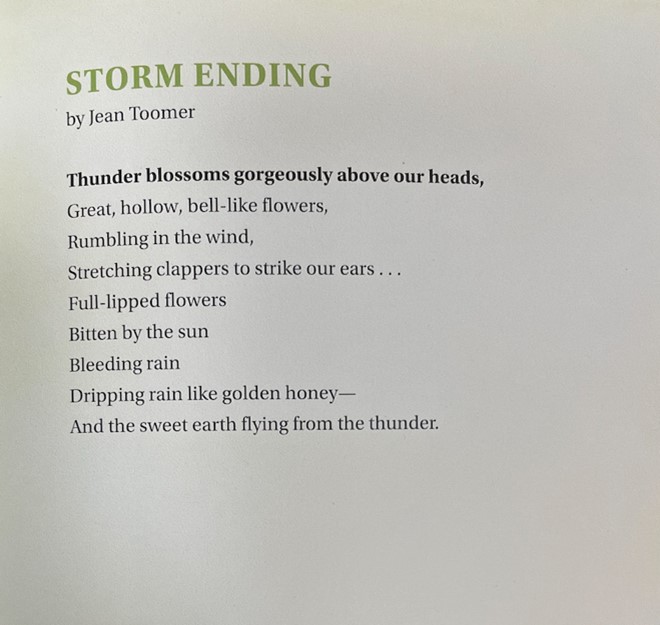
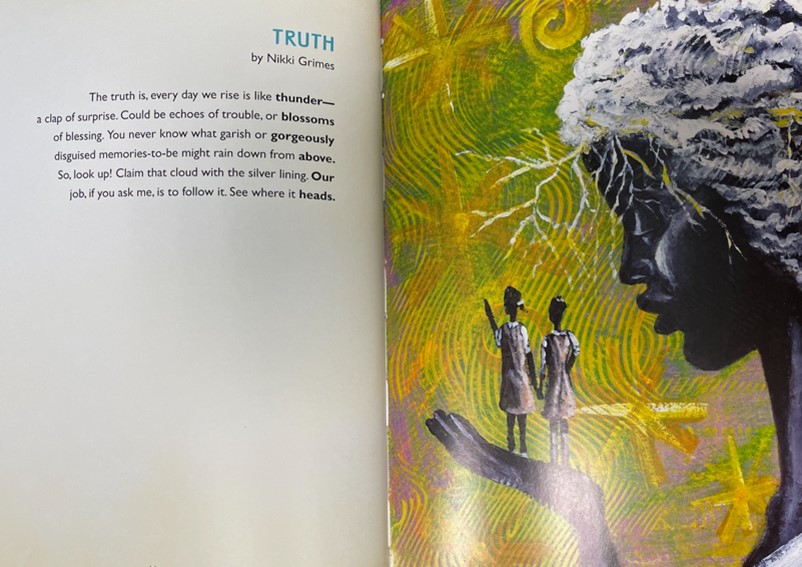
Inspired by Terrance Hayes, Nikki Giovanni wrote the book One Last Word, which is a book of golden shovel poems about the Harlem Renaissance. Using two of the poems from this book as mentor text (see Images 7 and 8), teachers can help students see how the poem is written and gain inspiration for their own writing.

Image 7: “Storm Ending” from One Last Word 

Image 8: “Truth,” a poem written by Nikki Giovanni using a line from “Storm Ending” by Jean Toomer

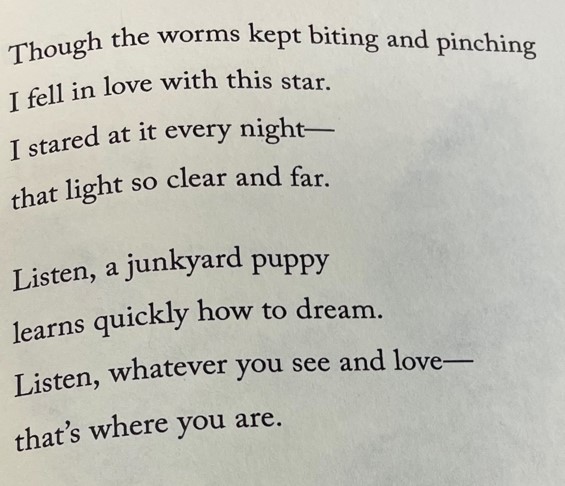
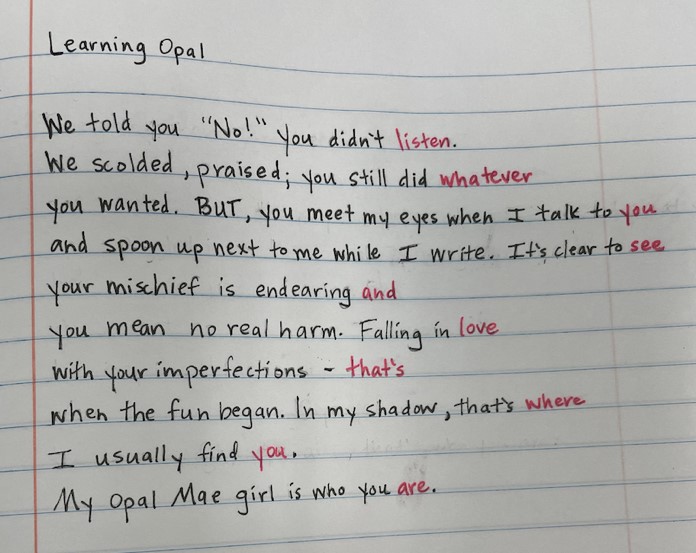
Teachers should immerse students in reading many different poems, invite them to bring in poems – including song lyrics – that they admire, to gain ideas and inspiration for writing their own golden shovel poems. Again, teachers may want to scaffold this kind of writing and co-author poems with students in a whole group setting before tasking students with writing one on their own. Golden shovel poems are complex but also provide students an opportunity to play with word choice, syntax, line breaks, and be creative in their writing. Inspired by a poem from Mary Oliver’s Dog Songs, I show students my own attempt at this poetic form (See Images 9 and 10).

Image 9: Excerpt from “Luke’s Junkyard Song” by Mary Oliver                    

Image 10: Golden shovel using the last two lines from “Luke’s Junkyard Song” (created by author)

Final Thoughts

No matter the strategy used, teachers must remember to embrace vulnerability and write alongside of students, both modeling the techniques and making the cognitive side of writing – word choice decisions, art medium choices, etc. – become evident and accessible for students. Writers need to see and hear other writers engaged in writing to discern the process and be inspired. Writers also need room for creativity. Each of the strategies offered here provides space for creativity and the opportunity for students to express themselves while also learning and showing their content knowledge.

References

Kress, G. (2010). Multimodality: A social semiotic approach to contemporary communication. London, UK: Routledge.

Rosenblatt, L. M. (1994). The transactional theory of reading and writing. In R. Ruddell et al. (Eds.), Theoretical models and processes of reading (4th ed). Newark, DE: International Reading Association.

Serafini, F. (2015). Multimodal literacy: From theories to practices. Language Arts, 92(6), 412-423.


Brooke Hardin is an Assistant Professor of Elementary Education at USC-Upstate. Her experience includes elementary and middle grades classroom teaching as as well as curriculum literacy specialist. This webinar reflects Brooke’s special interest in multi-model writing as a response to reading.

Writing to Learn: Strategies to Engage Students in Writing and to Deepen Content Knowledge

Teaching

This webinar features Brooke Hardin and provides resources for using multi-modal writing responses to engage students in writing.


Brooke Hardin is an Assistant Professor of Elementary Education at USC-Upstate. Her experience includes elementary and middle grades classroom teaching as as well as curriculum literacy specialist. This webinar reflects Brooke’s special interest in multi-model writing as a response to reading.

Action! Growing Historical Writing Skills with Video Essays

Teaching

This blog is written by Tori Young and shows us how to scaffold written essays resulting in a video essay. Read more about Tori at the bottom of her post.


Have you ever caught yourself in the never-ending rabbit hole of online video essays? Conspiracy theories, movie plot analyses, theme park history and so many more topics are explained in a thorough manner with research and analysis weaving together ideas and backgrounds you never would have put together. Even if you have not stumbled into this online phenomenon, I can assure you that your students have. Whether hour long YouTube deep-dives, or short TikTok synopsis series, students are being presented with researched information about a wide range of topics even if they do not recognize it. After noticing this for myself, I asked “why aren’t more essays like this?”

Research papers and argumentative essays are the primary form of essay writing used in my history classroom. I want my students to know how to be informed citizens and communicate their ideas and beliefs in a way that is grounded in historical truth and facts. I typically scaffold this process throughout the year using activities based on the content. Typically, I start out with an exit ticket asking students to pick a side on a tough topic (no in between!) and tell me why they chose their stance. Nothing formal just to get them to practice how to take a stance. Slowly I will make them add facts from a document we read in class to back up their positions and eventually start teaching the research process by having them look for reliable sources of their own to support their side. Eventually, all that information can be used to organize and create a well-written paper for social studies.

The broad goals of this process are to teach students how to make informed decisions and communicate their ideas effectively. While a traditional essay is an excellent way to practice those skills, many teachers like me have seen the difficulties for students that come with that ultimate step of writing the paper. For many students, the formal language or length of the writing assignment can be daunting to approach, causing them to shut down before trying. But we look at them confused; they have already practically written the paper with their summaries and research. Why can’t they just fill in the gaps with just a few sentences?

I found myself asking these questions every year. When I asked my students to verbalize their answers, I got great insight and connections to the content from them. They know this content, in fact many of them get passionate about it when it is time for them to argue. As I pondered this, I concluded that most of my students will only share their research and findings about topics verbally in their futures. Why am I not adding a verbal layer of assessment to this process?

This is where the wonderful world of video essays came into play for me and my classes. A video essay takes on the same structure as an essay but uses visual aids and commentary to present the information. Just like a good historical essay, it begins with background information on the topic and a clear thesis. It is then followed by key points that are supported by examples. And lastly, the video concludes with the creator’s main idea and the topic’s historical impact. Video essays help students practice research skills, organizing ideas and examples, but instead of writing, they are practicing presentation skills! 

An example of this in my high school US History classes is during our unit on the Antebellum era. There are a lot of names of important people during this period; abolitionists, women’s rights activists, and politicians. I let my students pick from a list of key figures to research to share their life story. I give loose parameters on the assignment, asking students to provide the background of the person’s life, their contributions to Antebellum America, and their lasting impact on the United States. Some students may need more guidance, so it may be helpful to provide examples of information you are looking for such as their birthplace, career, and writings to name a few possibilities. I then ask students to record a two-minute video using WeVideo or Screencastify to present their findings using media to support their discussion. 

I have seen my quietest students speak without hesitation in these videos, presenting on topics with great care and speaking skills. The key is that I do not show them in front of the class. Once the fear of being judged by their peers is taken away, students become comfortable with the process. They also begin to get creative with their media. Many will create a PowerPoint to display and follow along with for their video. However, I have seen animations, skits, and eulogies come out of this assignment as students begin to find their creativity with this medium. 

Students are still practicing all the skills I need them to learn for my goals, but by incorporating video essays I have seen higher levels of engagement with historical content. This is not meant to take away from the importance of formal writing. While not all our students will go on to university and academia, they will still need to write important emails and apply for jobs. Formal writing is an important skill, but if you also notice students needing an extra step in scaffolding the writing process in social studies then consider video essays. Students will even surprise themselves with how much they know!

Images courtesy of Pexels


Tori Young is a high school social studies teacher in Anderson, South Carolina. She is currently working on her Master’s in Instructional Design and Learning Technology at Anderson University.

Mentor Texts for Disciplinary Writing Instruction–Not Just for ELA Teachers!

Teaching

This post is written by Jenelle Williams. Learn more about Jenelle at the bottom of this post.


As educators, many of us can identify mentors–people who have supported us along our educational journey. To mentor someone is both a sacred task and a tall order. In classrooms, text can serve as mentors as well. The purpose of this blog post is to clearly define what we mean by a disciplinary mentor text and to consider implications for effective disciplinary writing instruction. So let’s get started!

This is an exciting time to be an educator, as notions of text are expanding as time and technology move forward. For the purposes of this blog post, let’s agree that text includes anything with encoded meaning. This, of course, can mean printed words on a page, but it can also include many other things, such as symbols, musical notation, football play diagrams, dance performances, videos, audio recordings, podcasts, graphs, charts, and more. In this expanded definition of text, we must also expand our definitions of what it means to read, write, and be literate. For our purposes, being literate in a particular context means a person can consume the encoded meaning of a text, comprehend the meaning, and communicate in ways that are valued by that particular academic discipline or profession.

What is a mentor text?

Mentor texts are typically short, engaging texts provided to students for a particular purpose, including (but not limited to) the following:

  • Acting as a foundation to learn or imitate a specific writing form
  • Teaching students to read with a writer’s eye (e.g., sentence structure or word choice)
  • Demonstrating what good writers do
  • Helping students take risks in their writing and develop their skills (from Teachstarter.com)

The role of multimodality and representation

As educators select mentor texts to use as part of instruction, it is important that, in addition to expanded notions of what qualifies as text, they intentionally include multimodal texts. Multimodal refers to something occurring or being communicated through multiple media of communication or varying forms of expression. For example, a campaign video may have images, music, text, and data all presented in one multimodal text. Students regularly interact with multimodal texts (videos with embedded audio text, for example), and need instruction and practice in order to be critical consumers of these texts.

There is an additional (and necessary) challenge as educators select texts that serve as mentors for students’ disciplinary writing–how to ensure that they are attending to issues of representation. To what extent are authors of various ethnicities, cultures, backgrounds, and perspectives represented? How might we be more intentional to include authors representing historically marginalized populations? To be sure, this requires more time and effort on the part of educators, but it is well worth the effort, as it can provide students with a connection and entry point to learning.

Authentic purpose in mentor texts for writing

In order to truly engage secondary students in authentic inquiry with mentor texts, it is vital that educators provide an authentic purpose for students to engage in mentor texts beyond simply being assigned to do so. It must be clear that the mentor text will serve a purpose and will eventually allow students to communicate their ideas with an audience greater than themselves and the teacher. The following lists some examples of authentic inquiries that would require students to engage with a wide range of texts (including mentor texts):

  • Why does a lot of hail, rain, or snowfall at some times and not others?
  • How can we use mathematical and statistical knowledge and analysis to monitor and predict the spread of disease and use our findings to make and evaluate decisions made at the personal, community, state, and national levels?
  • How can we use poetry to promote social justice in our community?
  • How can we as historians uncover and share stories about our community? Whose stories are often left untold?

Once we have identified authentic purposes for students to engage with disciplinary mentor texts for writing, we need to consider instructional approaches that leverage the power of those texts. Just as we needed to define the term “text”, it is vital that we hold a shared understanding of what we mean by the term “writing”–or, at the very least, a shared understanding of what we mean by writing instruction:

Let’s begin with some non-examples of writing instruction. They include the following:

  • Writing instruction is NOT assigning writing
  • It is NOT over-emphasizing grammar, spelling, and punctuation
  • It is NOT requiring rigid structures (i.e. telling students exactly how many sentences, what kind of sentences, and in what order)
  • It is NOT valuing the writing product over the writing process
  • It is NOT copying notes from lectures or PowerPoints, definitions of vocabulary words, answers to questions straight from the textbook, or formulas for writing

When we are working with educators to strengthen their writing instruction, we emphasize the following practices:

  • Modeling the process of preparing to write, drafting and revising writing, and reflecting on writing
  • Using writing as a tool to support learning and reflection
  • Providing support before and during writing in class
  • Valuing the process of writing just as much as the product

Disciplinary writing begins with an authentic purpose for writing. Members of various academic disciplines and professions use both informal and formal writing in order to process or organize ideas; communicate and share ideas; evaluate ideas; develop and support a claim; explain a phenomenon, process, or solution; entertain; record data, evidence, and observations; solve a problem; and much more. Middle- and high-school students can be apprenticed into these types of disciplinary writing with intentional support.

For example, students in an eighth-grade Social Studies class might engage in inquiry on the following question: What was the human toll during the Civil War? As part of their inquiry, they may read the following disciplinary texts: photographs of soldiers preparing to go to war, data tables on Civil War casualties, and first-person accounts from soldiers’ diaries. Students may engage in informal writing such as annotating texts; note-taking in response to readings, discussions, or teacher-presented information; and constructing an outline and then a first draft of a historical account or explanation. Formal writing may be a historical account or evidence-based argument about the human toll of the Civil War that is shared with an appropriate audience beyond the teacher.

Essential Instructional Practice 4 & additional helpful resources

Essential Instructional Practice 4 from the Essential Instructional Practices in Disciplinary Literacy document is a great place to start for teachers that are interested in strengthening their support of students’ disciplinary writing. Teachers may read the General Practices at the beginning of the document, or they may be interested in selecting the content area section that best aligns with their work. Additional helpful resources are also suggested in the table below.

Multidisciplinary
Learner Variability Navigator
ELAMathematicsScienceSocial Studies
Michigan Middle School English Language Arts UnitsWriting in Mathematics – Annenberg LearnerScaffolding Students’ Written Explanations | AST Beyond Writing to Learn, The Science Teacher (NSTA)Read.Inquire.Write
The New York Times MS HS Writing Curriculum
MusicPhysical Education & HealthVisual ArtsHeritage & World Languages
Lesson Idea | MAEIAWritingAthletes.comLesson Idea | MAEIAThe Nature of L2 Writing | Foreign Language Teaching Methods

The great news is that secondary educators do not have to be writing experts (or even published authors) in order to teach students how to write effectively within and across disciplines. As long as we keep expanded notions of text, multimodality, and representation in mind, along with an authentic purpose for students to engage with a disciplinary mentor text, we are well on our way to modeling and scaffolding students as they create disciplinary texts of their own. We are lucky as well that we have free, widely available resources that can help us shift toward effective pedagogical moves. Let’s get writing, everyone!


Jenelle Williams is a Literacy Consultant within the Leadership and Continuous Improvement unit at Oakland Schools, an intermediate school district supporting the 28 districts in Oakland County, Michigan. She joined the organization in 2017 following 18 years of experience in public schools at the elementary, middle, and high school levels. She has served as a classroom teacher, IB Middle Years Programme Coordinator, teacher leader, and educational technology coach. An IB Educator and Examiner since 2013, Jenelle leads professional learning workshops and marks e-assessments for the International Baccalaureate Organization. She holds an Education Specialist in Leadership degree and a Master’s degree in Reading and Language Arts through Oakland University. In addition, Jenelle serves as an Adjunct Professor in Grand Valley State University’s Graduate Program and a co-editor of The Michigan Reading Journal, a publication from the Michigan Reading Association. Jenelle is passionate about supporting teachers, building leaders, and central office administrators in the area of secondary literacy, and she is especially excited to be able to support Michigan’s work around disciplinary literacy through her role as Co-Chair of the statewide Disciplinary Literacy Task Force. She can be reached at jenelle.williams@oakland.k12.mi.us, and on Twitter at @JenelleWilliam6 and @GELN612Literacy.

Cover Photo by Desola Lanre-Ologun on Unsplash

Writing Learning into Shape: Using Concrete Poetry to Explore & Reflect Content Knowledge

Teaching

This post is written by Brooke L. Hardin. To learn more about Brooke, please visit the bottom of this post.


What Is Concrete Poetry?

Concrete poetry, sometimes called shape poetry, is poetry whose visual appearance matches the subject of the poem. The words of the poem form a shape or shapes which illustrate the poem’s topic in visual form as well as through their literal meaning. This type of poetry has been used for thousands of years since the ancient Greeks began to enhance the meanings of their poetry by arranging their characters in visually pleasing ways back in the 3rd and 2nd Centuries BC (Nesbitt, 2023).

In the 1950s, a group of Brazilian poets known as the Noigandres developed a manifesto to define the work of concrete poetry and give us the name. The manifesto states that concrete poetry communicates its own structure: structure = content (Eppley, 2015).

How to Write Concrete Poetry

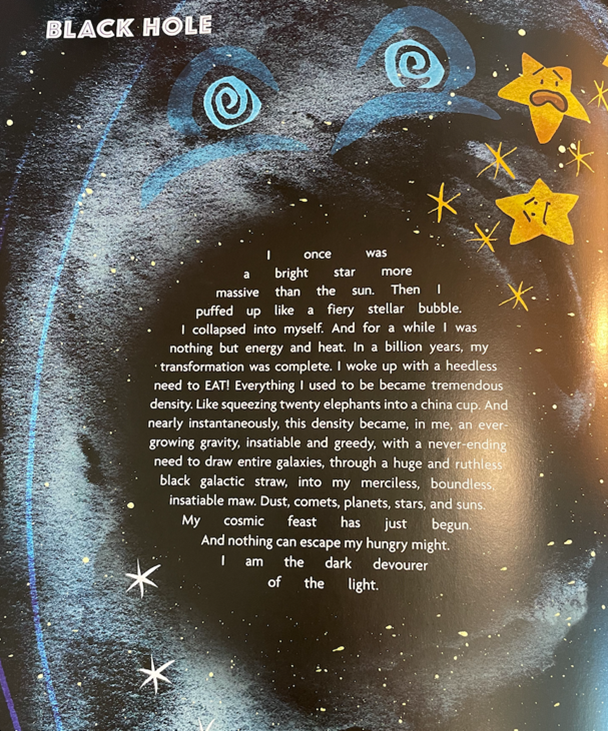
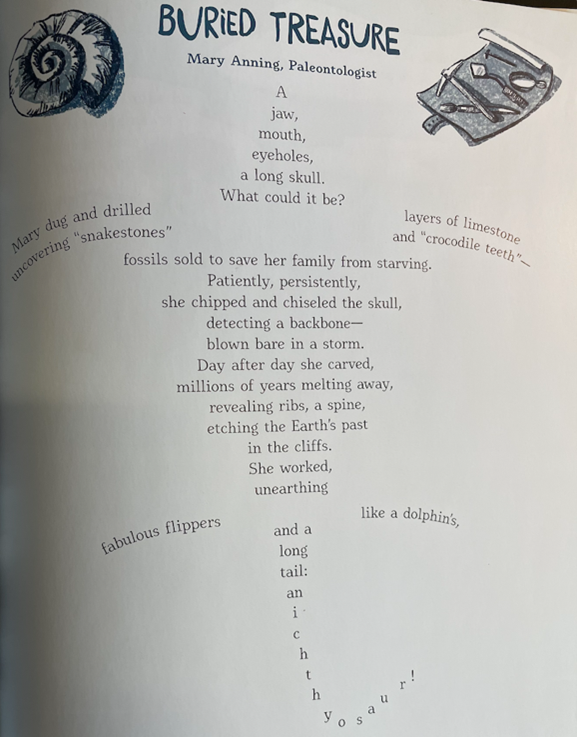
There are two main ways to create a concrete poem. The first is referred to as an “Outline Poem.” The writer creates an outline of the subject of the poem or of an object that relates to the subject and fills in the outline with words or phrases. The words or phrases used to fill in the outline usually describe the subject or how it makes the writer feel in some way, provide information connected to the subject, or possibly tell a story related to the subject. Some examples of this technique for concrete poetry are provided in Figures 1 and 2.

Figure 1: Black Hole

Note. From The Day the Universe Exploded My Head: Poems that Take You Into Space and Back Again, by Allan Wolf, 2019, Somerville, MA: Candlewick Press

Figure 2: Buried Treasure

Note. From Shaking Things Up: 14 Young Women Who Changed the World, by Susan Hood, 2018, New York, NY: HarperCollins.

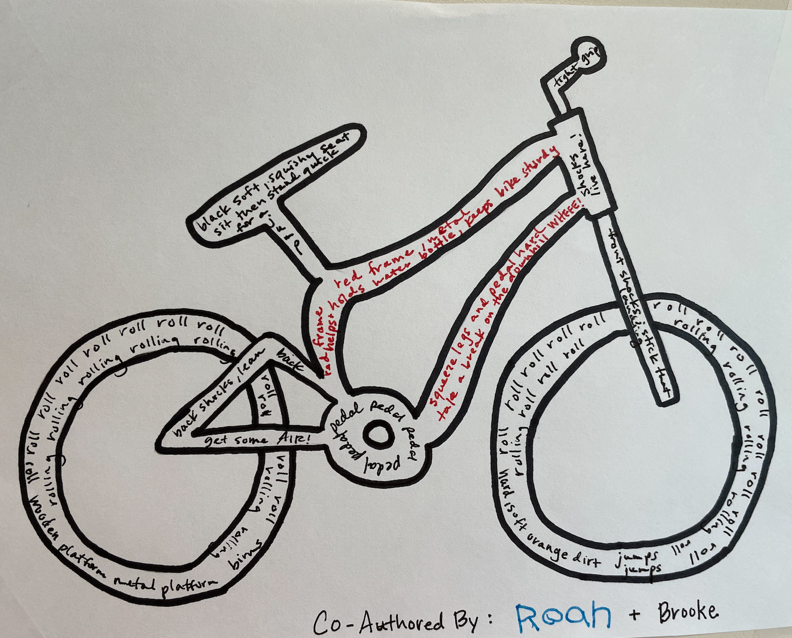
My son and I recently spent an afternoon at a local bike park. Following the trip, he and I co-authored a concrete poem using the “Outline” technique. The video embedded below shows how I used questioning to help him come up with the words and phrases for the poem while I acted as a scribe. Image 3 shows the final poem we created.

Figure 3: Mountain Bike

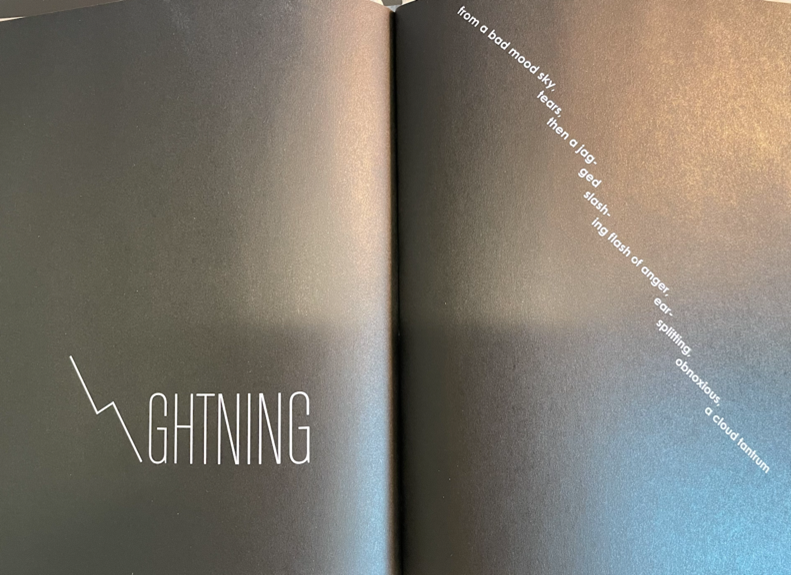
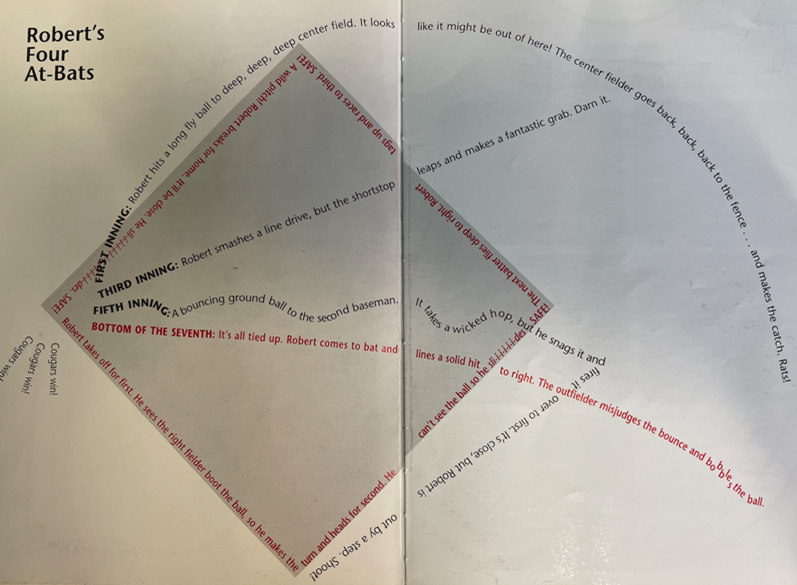
Another technique for creating concrete poems is to use the lines of words to make the lines of a drawing. One thing to note about this technique is that the subject does not have to be an object, but it does need to be something that can be drawn with “stick” figures. Examples of these poems are below.

                                                Figure 4: Lightning

Note. From Wet Cement: A Mix of Concrete Poems, by Bob Raczka, 2016, New York, NY: Roaring Brook Press.

Figure 5: Robert’s Four At-Bats

Note. From Technically, It’s Not My Fault: Concrete Poems by John Grandits, 2004, New York, NY: Clarion Books.

Instructional Considerations for Concrete Poetry

When teaching students to write concrete poems, whether using the outline or drawing technique, consider these reminders.

  • Model, model, model! Planning instruction with the Gradual Release of Responsibility (Pearson & Gallagher, 1983) in mind will help students better understand the cognitive and physical aspects of composing concrete poems.
    • Use inquiry to analyze some exemplars like the ones provided above or those found in books listed in the references to help students take notice of the elements of concrete poems.Select a topic as a class and write a concrete poem together, with students offering the words and their arrangement while the teacher acts as a scribe. Use questioning, such as the type seen in the video above, to help students think about their subject and form written ideas from those thoughts.Invite students to co-author a concrete poem as a pair or small group.
    • Finally, provide opportunities for students to independently write concrete poems, get feedback from peers, and share their final drafts.
  • Concrete poems do not need to rhyme.
  • Concrete poems can be written on traditional paper or digitally. If using paper, suggest to students that they use a pencil when drafting the poems. This allows them to erase and move words around where needed.
  • Encourage students to play with the size, color, and shape of their letters to better capture the essence of the poem’s subject (e.g., I might write the word TTEEEETHH in different shapes and font sizes when writing about a shark). This helps to reinforce the reciprocal nature of reading and writing by providing students a chance to consider the purpose of their craft moves.

Writing Concrete Poetry to Reflect Content Area Learning

Writing to learn and writing about learning are necessary in content-area classrooms. While many argue and I can agree that these are different notions, writing concrete poems can accomplish the aim of both.

Writing, as discussed above, must involve a discussion of ideas, leveraging the social side of learning where knowledge is co-constructed, and misunderstandings can be clarified. Additionally, when and where questions arise to inform written ideas, further research may occur; thus, more learning takes place during the writing process. For example, a student in a 7th-grade science classroom is drafting a concrete poem about a cell as part of a Life Science unit. They may refer to class notes, talk with a partner, or watch a video about cells to (1) draw the outline of a cell and/or (2) write a line about the nucleus – possibly drawing it inside another shape that is made of letters spelling out “membrane,” given that the nucleus is enclosed in a membrane. The writing of the concrete poem has the potential to reinforce learning that has occurred, provide new content, and/or inspire ways to show learning.

Both the reading and writing of concrete poems present teachers in discipline-specific classrooms with innovative methods for motivating students to engage in the content. Given their interesting appearance and brief lines, concrete poems as supplementary texts in units of study to teach a specific topic (see Image 1 about the Black Hole and Image 2 about the female paleontologist Mary Anning, who, in the early 1800s, found complete fossils that laid the foundation for Darwin’s theory of evolution) may appeal to students who are reluctant to engage with textbooks and other longer documents. As an alternative to traditional analytical research papers and essays, writing concrete poems related to learning may motivate students to take a deeper interest in the content to present their learning in a creative way. I would also maintain that crafting a line of concrete poetry deepens comprehension and calls upon sophisticated critical thinking; taking a line from prose (e.g. an article or textbook) and rewriting it in one’s own words to fit a poetic style is rigorous cognitive work. With regards to standards related to research skills and speaking and listening, I would further suggest that students provide a reference list to accompany the poems and give presentations where they explain craft moves and inspiration for certain lines.

As a former middle grades ELA/Social Studies educator, I can attest that using concrete poetry in a content area classroom allows students to reimagine learned content creatively and critically while deepening and extending their understandings and knowledge. Give it a try and share your poems with me!

References

Eppley, C. (2015, January 21). Concrete Poetry of the Noigandres, 1958-1975. Retrieved from http://avant.org/event/noigandres/

Nesbitt, K. (2023). How to Write a Concrete Poem. Retrieved from https://poetry4kids.com/lessons/how-to-write-a-concrete-poem/

Pearson, P. D., & Gallagher, M. C. (1983). “The Instruction of Reading Comprehension,” Contemporary Educational Psychology, 8, pp. 317-344.

Children’s Literature References & More to Consider

Grandits, J. (2004). Technically it’s not my fault: Concrete poems. Clarion Books.

Grandits, J. (2007). Blue lipstick: Concrete poems. Clarion Books.

Hood, S. (2018). Shaking things up: 14 young women who changed the world. HarperCollins.

Raczka, B. (2016). Wet cement: A mix of concrete poems. Roaring Brook Press.

Wolf, A. (2019). The day the universe exploded my head: Poems to take you into space and back again. Candlewick Press.


Brooke Hardin is an Assistant Professor of Elementary Education at the University of South Carolina Upstate. Her research interests include writing development and instruction for intermediate and middle grades students, teaching and learning through technology and new literacies, literacy professional development and teacher education, and interdisciplinary approaches to reading, writing, and the utilization of Children’s Literature. Her years of experience as an elementary and middle grades classroom teacher and curriculum literacy specialist frame her research interests and commitment to teacher education.

Photo by Valentin Salja on Unsplash

Literacy Behind Bars: Addressing Incarcerated Youth’s Literacy Needs

Research

Literacy in the Disciplines, 6-12 (LiD) is pleased to announce our next webinar.

Literacy Behind Bars: Addressing Incarcerated Youth’s Literacy Needs

Despite the fact that our country has less than 5% of the world’s inhabitants, we house almost 25% of the total prison population. As educators, we need not only to be aware that we are living in the “age of incarceration” (Hill, 2013), but also recognize the need to develop constructive responses to it. As educators, we have a social responsibility to design curriculum and pedagogy that expands literacy instruction in correctional facilities. This webinar will discuss a fourteen-year-old summer reading partnership between a university and the Department of Juvenile Justice. The presenter will share what she has learned from teaching and working with incarcerated youth.

When: This webinar was held on Thursday, May 18, 6:00 – 7:00 pm ET.

The video recording of this session is available below.

Cost: Free. LiD6-12 is funded by the South Carolina Middle Grades Initiative.

This session featured Dr. Mary Styslinger.

Dr. Styslinger is a professor of English and literacy education at the University of South Carolina where she directed the Midlands Writing Project and served as secondary program coordinator. She is a past president of the South Carolina Council of Teachers of English and currently co-edits South Carolina English Teacher. Her research interests include interweaving literacy into the English curriculum, teaching English for democracy and justice, and serving marginalized and at-risk youth. She is the author of Workshopping the Canon and co-editor of Literacy Behind Bars as well as articles published in English Journal, Voices from the Middle, Language Arts, and Journal of Adolescent and Adult Literacy. Her new book, Workshopping the Canon for Democracy and Justice, will be published by NCTE this summer.

Please share this professional learning opportunity with your colleagues.

Follow and like Literacy in the Disciplines, 6-12 on Twitter.

Photo by Boudewijn Huysmans on Unsplash

Where I’m From

Teaching

This post will discuss how “Where I’m From” poetry helped provide a scaffold to better understand multilingual students and their evolving identities. This post is written by Emily Graham. Read more about Emily at the bottom of this post.


The question “Where are you from” is one often heard by multilingual learners (MLs). Although all the MLs at my school could answer this question simply by naming their birth country as either the US, Mexico, or Guatemala, this answer gives little information about each student’s identity. Through her poem, “Where I’m From”, George Ella Lyon shows us how we can tap into the more complex answer to this question. Lyon links together memories of special places, people, sayings, and stories from her past to tell us who she is, and this can serve as a powerful model for reflection and exploration of the rich and diverse identities among students.

In a poetry unit built from Lyon’s ideas, structure, and themes, my MLs explored and shared their own identities. Students’ poems and thoughts gave me a small window into my students’ past and present lives and their critical and creative thinking abilities. The “Where I’m From” Poetry Project allowed me to build a deeper, more complex understanding of who my students are and “where they are from” beyond just a geographic place.

There are countless get-to-know-you activities that require students to answer categorical questions such as: “What are your favorite foods?”; “What are your favorite songs?”; “Who is in your family?”; or “What do you like to do when you are not at school?” While I believe these questions are important, their answers do not always provide great insight into our students’ lives. Often these questions are asked and answered without much thought or reflection. Students may say: “My favorite foods are tamales”; “I don’t know my favorite song”; “I live with my dad, aunt, uncle, and sister”; and “I watch T.V.”, but there is little depth or passion to these responses.

When we use poetry to elicit these responses, we can reframe these questions in a way that requires reflection and deep thinking. When the questions are reframed to: “What are the family, foods, thoughts, and stories that make you who you are?” a teacher can gain a much deeper understanding of students and their unique identities. “Where I’m From” Poems provide a frame and an artistic lens for students to respond to those questions about identity.

Here is an example of how one student’s poem provided me with a glimpse into his rich and unfolding identity. Looking at his identity from a more reflective perspective helped me build an understanding of the student’s home life, language, family, and interests that I had not slowed down to see before.

Jimmy, a 3rd-grade multilingual student, was born in the United States and struggled with academic language and literacy. Although he was born in the US, he did not begin learning English until he started school in kindergarten. The first language, the language used most often, and the language that he used with the people he loved, was Spanish. Jimmy was considered a student who “struggled” in school.  He often put his head down in class, he refused to work independently, and said things like, “I’m not smart” or “I can’t read.” Sometimes he participated in whole group discussions but more often seemed disengaged. Jimmy’s class was starting a unit on poetry, and I anticipated resistance from Jimmy. I decided to teach a unit to build background knowledge and confidence in poetry.

Jimmy initially seemed disinterested in the idea of studying and writing poetry. But that slowly started to change through the process of a close read of Lyon’s “Where I’m From.”  At first, we looked at the literal meaning of Lyon’s words through translations, pictures, and discussion. Jimmy was able to confidently define big words from Lyon’s poem such as “carbon tetrachloride” and “forsythia bush”. He was able to explain how someone might lose a finger to an “auger”. He also was able to discuss big ideas like nostalgia and memories.  In later readings, Jimmy stated Lyon’s voice reading her poem sounded like a ghost. He said Lyon talked about the past and memories like a ghost would. Jimmy seemed to enjoy building on the ideas of his group members. He was not afraid to share his opinion on the meaning of certain phrases and his thoughts about word choice. I was surprised by Jimmy’s desire to build an argument and support a claim in the discussion. He said, “I think the author likes to play in the dirt under her porch. Maybe she liked to hide there because that is what I do. My dogs also like to hide under the porch because it is cool, and they feel safe.” I was also impressed by Jimmy’s critical thinking and questions.  He said, “I wonder why she said the ‘it tasted like beets.’ Maybe she is talking about when she was a little kid because little kids always put stuff in their mouths. They are curious and that is how they explore.”

Jimmy was not initially thrilled about the task of writing his own poem. He needed some support organizing his ideas. With the support of graphic organizers, help in spelling, and some motivation from a YouTube student example, Jimmy wrote. Here is his poem:

I am from fish tanks and from dirt

and my dog DJ

I am from broken glass in my backyard

I am from my broken T.V.

From Roblox and road trips

I am from sunflowers and bamboo

I am from tag with my brother and helping my mom

from Joseph and Marissa

I am from the sad puppies and Llama the puppies mama

from swings and broken pinatas

I am from my dad’s Honda

with a big engine

I am from my mom’s Hyundai

it has a push button to start

from riding my bike and making my own adventures

I am from digging holes and making traps

I am from inventions

Jimmy’s poem was a powerful representation of his identity, and his word choice was beautifully poetic. He was able to infuse his poem with alliteration and repetition, imagery, and emotion. He juxtaposed happy and sad memories, and purposefully ended his poem with positive attributes about himself. He talked about both joyful and upsetting times with his family. Times where they celebrated together — “broken pinatas” — and times of trouble — “broken T.V.” From reading and talking about Jimmy’s poem, I learned about ways Jimmy interacted with his family, some challenges in his life, and personal characteristics that he was proud of. Jimmy was proud to explain how he helped his mom with daily chores and sometimes would go to work with his dad. He talked about his dog Llama having puppies and the irresistible sad look on the puppies’ faces. He found joy in playing with the puppies. He talked about being devastated when some of the puppies got sick and died. He said he felt so bad for Llama, the puppy’s mama. Jimmy sometimes showed insecurities in the classroom but spoke with complete confidence when discussing his adventures and inventions outside of the classroom. He talked about his positive attributes like creativity, curiosity, and bravery. Jimmy took pride in his poem, so much so that he wanted a copy to take home and read to his family

Jimmy’s poem and the conversations that resulted from discussing poetry helped me shift from focusing on Jimmy’s struggles to identifying and sharing his strengths Before, I might have shared my frustrations on Jimmy’s lack of motivation or refusal to do work in my class. Now I had something so much more powerful and beneficial to share with other teachers — Look what Jimmy wrote, look what Jimmy can read, but most importantly look at some of the things that make Jimmy who he is! Through poetry I learned more about his academic abilities — Jimmy could craft meaning from metaphor and explain his theories about themes and lessons hidden in poems. I also learned about his interests and motivators. I discovered Jimmy’s empathy for others, passion for inequalities in his community, and desire to help others. Jimmy’s poem allowed me to understand his uniqueness and make connections to my own childhood curiosities and adventures. I felt the same empathy for animals and dreams of a more peaceful and equitable world.

I had the same kind of revelations and connections with my other students. I learned Alexander had a job caring for sheep in Mexico through his lines: “I am from a big river where the sheep used to cross” and “from a scary ram who chased me all day.” I learned Veronica’s older brother always said to her “sup bro and dap me up, bro.” I learned about Marta’s memories of Guatemalan cuisine: “tortilla’s (sic), tortas, tamales, and tacos.” Each poem was beautiful and unique and a window into my students’ lives. These poems provided voice for my students and a platform to share the individual identities that they were proud of. This background was both unique and unifying. The poems gave students an opportunity to be more clearly seen and heard.

Sometimes we want to get to know our students, but we don’t know the right questions to ask. The question “Where are you from?” seems simple on the surface but does not have a simple answer. Studying George Ella Lyon’s poem with my elementary multilingual learners helped me slow down and deepen my understanding of Lyon’s words and, more importantly, my students’ words.  Although my initial purpose of the poetry unit was to provide academic background knowledge for my students, a more beautiful and poetic thing happened — poetry provided background knowledge for my students for me. The poems provided a space for me to do the learning and for my students to do the teaching. The format provided a space to merge home life and home language with school life and language. “Where I’m from Poems” allowed us to celebrate each student’s beautiful and unique identity.  

Lyon, G. E. Where I’m from, a poem by George Ella Lyon: Writer and teacher Subtitle. http://www.georgeellalyon.com/where.html


Emily Graham is from Johns Island, South Carolina. She currently teaches grades K-5 as a Multilingual Learner Specialist in Charleston County Schools. She is a certified elementary educator and has served in several different teacher roles including as a Multilingual Learner Program Specialist, a second grade teacher, an English teacher abroad, a substitute teacher, and a teacher’s assistant. She speaks Spanish and enjoys traveling, creating, and being in nature. She lives with her husband, 8-month-old girl, and two rowdy rescue dogs.

Cover Photo by Vidar Nordli-Mathisen on Unsplash

Overcoming writer’s block with free-verse poetry

Teaching

All writers are familiar with the brain-freezing sensation of staring at a blank page or screen without the slightest clue of how to start a daunting writing task.  This writer’s block symptom is intensified for struggling writers such as multilingual learners, students with un/diagnosed reading/writing disorders, or speakers of dialects who experience Standard English as a foreign language. When they consider themselves writing failures, free-verse poetry writing opportunities in any subject area are one effective way to remediate the problem and release debilitating emotional stress (Bullock, 2021). Most striving writers battle: (1) what to write about; (2) how to structure ideas for longer, multi-paragraph texts; and/or (3) how to use academic language structures in full sentences with grammatically and linguistically correct word use, grammar, and punctuation.

What is free-verse poetry?

Free-verse poetry writing does not present these challenges. It allows for associative writing with spoken language characteristics of words, phrases, or sentences without specific rhyme schemes or metric systems. There are no rules for line breaks, stanza divisions, or paragraph structures. Some free verse poetry looks like narrative writing without having to follow syntactic rules or to require punctuation. Free-verse poetry often creates images and focuses on sensory detail with figurative speech like similes (i.e., water as soft as coconut oil), metaphors (i.e., rain comes down in spaghetti strings), or idioms (i.e., fluttering butterflies in my stomach) (Craven 2021).

The following is a free-verse poem to remember that Natrium Chloride is salt:

Nate and Claire and NaCl

                        Nate Natrium wants a girlfriend

                        Through his binoculars from his Natrium castle

                        He spots Claire Chloride

                        In a hammock

                        Reading a romance novel

                        Humming a song

                        Nate’s heart bursts

                        His feet fly down the hill with a drumming heart

                        To Claire

                        And the rest is history

                        They have children

                        All with salty lips and skin

                        This family helps us spice our food

                        And give minerals to animals, humans and plants

                        Their license plate says NaCl-Salt

What makes free-verse poetry beneficial for striving writers?

The features of free-verse poetry described above allow writer’s block moments to gradually diminish because students can concentrate on what they have to say without grammatical and syntactical confinements of text passages. Students engage in short, creative writing tasks that provide them with growing confidence to express knowledge or feelings without being judged for writing conformity errors, especially when spelling errors are not considered. Consequently, students can creatively and meaningfully play with language and enjoy the process while engaging with content in a pressure-free, reinforcing way (Bullock, 2021).

When to implement free-style poetry writing?

At any time in any content area, teachers can implement 5-15 minute free-verse poetry writing opportunities: (1) prior to a topic to activate pre-knowledge and motivate for a topic; (2) during a unit/lesson; (3) after a unit/lesson to assess gained knowledge; or (4) as a general writing task with prompts such as a title (i.e. mountain bikes, my favorite singer), pictures, or music to engage students in free-verse writing to express their feelings and thoughts stimulated by the prompt.

What are some ideas for grades 6-12?

Providing routine writing opportunities with appropriate support while integrating students’ interests, strengths, and knowledge is crucial in breaking down writing barriers. When first introducing free-verse poetry writing, teachers use ‘think aloud’ techniques to model how to write such a poem. Then, students work in pairs to create a free verse poem before creating them individually. Students can compare each other’s poems and discuss what they learned from different poems. This reinforces the purpose and versatility of free-verse poetry writing in content areas. Students collect their free-verse poems in a writing journal or keep them with their content topic to help them study.

Additionally, a cloze text with open spaces to insert an association or sentence frames along with vocabulary banks can assist striving writers in focusing on writing free-verse poetry.

The following concrete suggestions for different content areas can be supported by thought-provoking pictures, video or film clips, or music to foster paired-up or individual free-verse poetry writing.

English Language Arts:

  • Relate to/ describe a character in a book.
  • Reflect on characteristics of a literary feature or term (i.e., idiom, climax), or jobs/functions of punctuations, capitalizations commonly mis/used.
  • Characterize features of standard English, dialect, or code-switching along with when each is beneficial.

Science:

  • Summarize characteristics of chemical procedures or elements such as H2O (water) or NaCl (salt); or components/purposes of cells or body parts.
  • Describe/reflect on the importance of the processes of the water cycle, polarity, electricity, or planetary systems

Mathematics:

  • Summarize the sequence of steps to take for a certain operation.
  • Describe the characteristics, roles, or properties of concepts or terminologies such as common denominators, geometric structures, or negative/positive numbers.

Music education:

  • Characterize/compare famous musical periods, instruments, musicians, or songs of certain periods.
  • Describe strategies to play certain instruments or to be successful in a choir or band.

Physical/health education:

  • Reflect on the benefits of particular nutrition items (i.e., protein, carbohydrates, water, food pyramid).
  • Describe the interaction of certain nutritional components in the human body or the benefits of exercise and the dangers of sedentary life.

Social Studies:

  • Reflect on/describe the roles of historical characters or their emotions and feelings during a time period (i.e., Anne Frank, Harriet Tubman, Malcolm X).
  • Reflect on/describe the roles of government branches or features of democratic, authoritarian, fascist, or socialist government structures
  • Present a timeline of events that lead to a certain historical event

Conclusion

In sum, brief, free-verse poetry writing is one creative, student-engaging approach to help promote a sense of growing confidence and creativity among striving writers at a low-risk level in grades 6-12. Nobody can go wrong. Every creative contribution counts and matters. Success at that level encourages students to tackle longer writing tasks while also reinforcing the disciplinary content they need.

References

For some examples of free-verse poetry by established authors, see:

Bullock, O. (2021). Poetry and trauma: Exercises for creating metaphors and using sensory detail, New Writing, 18(4), 409-420,  DOI: 10.1080/14790726.2021.1876094.

Craven, J. (2021, February 15). An Introduction to Free Verse Poetry. Retrieved from https://www.thoughtco.com/what-is-a-free-verse-poem-4171539.

Bullock, O. (2021). Poetry and trauma: Exercises for creating metaphors and using sensory detail, New Writing, 18(4), 409-420,  DOI: 10.1080/14790726.2021.1876094.

Craven, J. (2021, February 15). An Introduction to Free Verse Poetry. Retrieved from https://www.thoughtco.com/what-is-a-free-verse-poem-4171539.


Macintosh HD:WINTHROP:FALL 2022_classes & tasks:IDA proposals for F22:BIO PIC Elke.png

For the past 20 years, Dr. Elke Schneider has been a professor of literacy, special
education and multilingual learner education at Winthrop University, Rock Hill, South Carolina.