Literacy Behind Bars: Addressing Incarcerated Youth’s Literacy Needs

Research

Literacy in the Disciplines, 6-12 (LiD) is pleased to announce our next webinar.

Literacy Behind Bars: Addressing Incarcerated Youth’s Literacy Needs

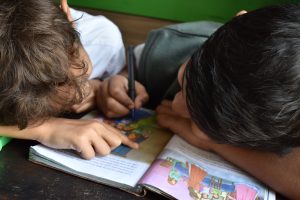
Despite the fact that our country has less than 5% of the world’s inhabitants, we house almost 25% of the total prison population. As educators, we need not only to be aware that we are living in the “age of incarceration” (Hill, 2013), but also recognize the need to develop constructive responses to it. As educators, we have a social responsibility to design curriculum and pedagogy that expands literacy instruction in correctional facilities. This webinar will discuss a fourteen-year-old summer reading partnership between a university and the Department of Juvenile Justice. The presenter will share what she has learned from teaching and working with incarcerated youth.

When: This webinar was held on Thursday, May 18, 6:00 – 7:00 pm ET.

The video recording of this session is available below.

Cost: Free. LiD6-12 is funded by the South Carolina Middle Grades Initiative.

This session featured Dr. Mary Styslinger.

Dr. Styslinger is a professor of English and literacy education at the University of South Carolina where she directed the Midlands Writing Project and served as secondary program coordinator. She is a past president of the South Carolina Council of Teachers of English and currently co-edits South Carolina English Teacher. Her research interests include interweaving literacy into the English curriculum, teaching English for democracy and justice, and serving marginalized and at-risk youth. She is the author of Workshopping the Canon and co-editor of Literacy Behind Bars as well as articles published in English Journal, Voices from the Middle, Language Arts, and Journal of Adolescent and Adult Literacy. Her new book, Workshopping the Canon for Democracy and Justice, will be published by NCTE this summer.

Please share this professional learning opportunity with your colleagues.

Follow and like Literacy in the Disciplines, 6-12 on Twitter.

Photo by Boudewijn Huysmans on Unsplash

Blending Practices, Skills, and Content in Teaching and Learning

Research

In our educational spaces, we often break our areas of expertise down into specific subject matters. We educate, train, and certify classroom teachers in terms of grade bands and content or disciplines. Students in schools spend time blocked off in different subjects where they receive instruction in a content area and earn grades that signify their level of expertise and competence in that area.

We separate our time in the educational pathway into grade levels and content areas to make it a bit easier to certify and support educators as they work with youth. But, these artificially designed pieces end up creating silos where educators and students set up camp and develop expectations about what, why, and how we learn. This raises the question about whether we need to erase the boundaries between disciplines, or do we need to—in a sense—harden them so that students learn where they start and end and are therefore better prepared for their futures?

A transdisciplinary lens challenges educators and researchers to consider the spaces in which learning occurs and overcome established paradigms and competition within and between disciplines. 1 This post will examine the ways that education tries to carve out a space for collaboration and ambiguity between the disciplines and suggests there is a need to deconstruct assumptions made about educational structures and systems to de/re-territorialize teaching, learning, and assessment. 2

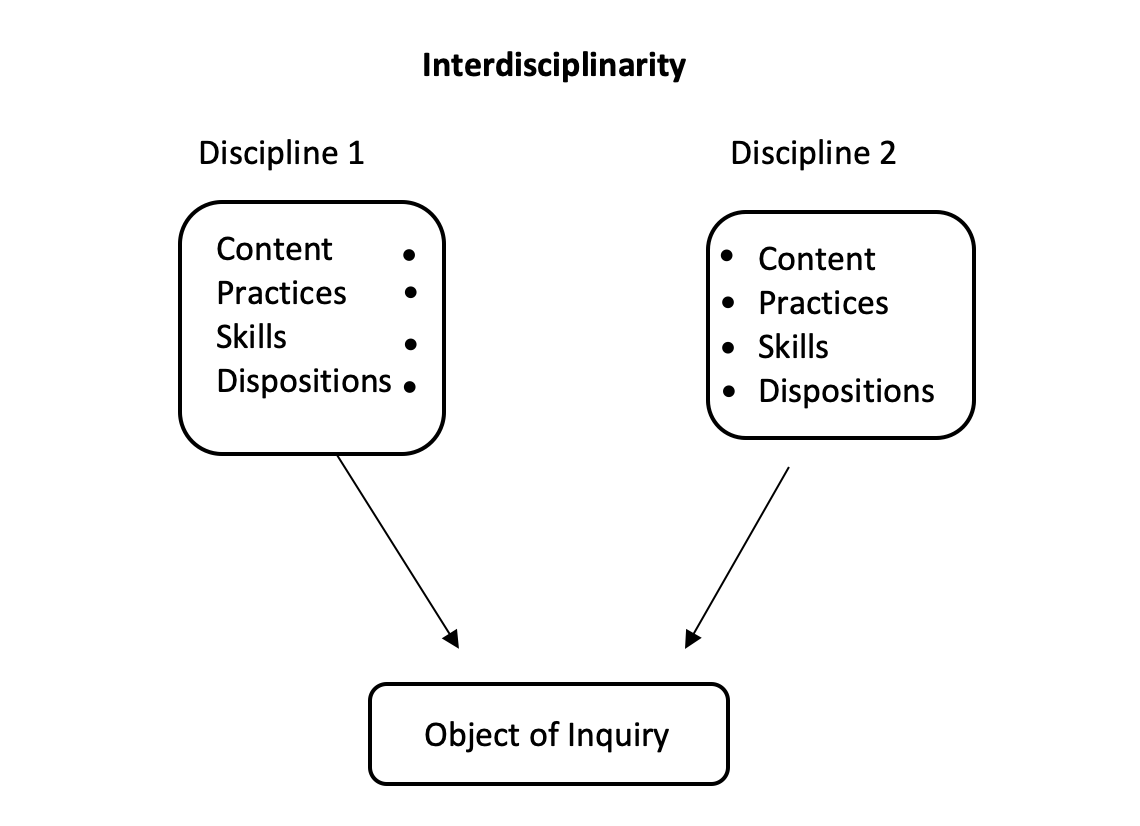
Interdisciplinarity

Some theories of education shift the focus from understanding of formal concepts to meaning-making to encourage students and educators to cross disciplinary connections. 3 As instruction moves away from traditional understandings of content areas and disciplines to craft new blended content areas (e.g. Humanities, STEM, STEAM), there is an opportunity to find content area literacies in context in other disciplines. 4 A desire to study across “individual attributes, at the nexus of institutional and material practices and textual cultures, instrumentality, and the production of agency and identity.” 5 Educators seek not for disciplinary purity and isolation, but to explore knowledge, discourse, and literacy practices around mutual areas of inquiry. 6 Instruction may also focus on teaching strategies that integrate multiple domains of knowledge into a single unit of study, such as authentic learning 7 or project-based learning. 8

In the graphic above, you can see two disciplines with their own sets of practices, skills, content, and dispositions. In an interdisciplinary perspective, educators and the content work together synergistically to understand an object of inquiry.

One way to consider this is to think about a science teacher and an art teacher working together on a unit with students. The science teacher would consider the content and curriculum they are teaching. The art teacher would think about their content and curriculum. The process or product of the interdisciplinary unit might have students use art to illustrate or creatively express content of the other discipline. This is not a bad thing, but we’re reminded of Aristotle who stated, “The aim of art is to represent not the outward appearance of things, but their inward significance.”

Metadisciplinarity

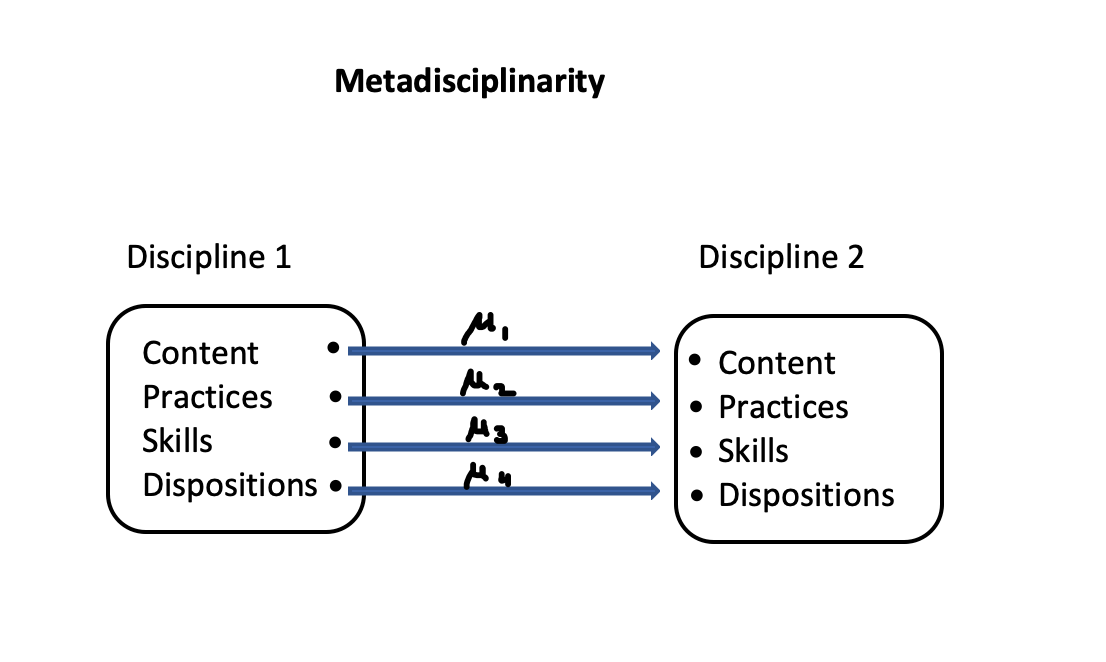
Metadisciplinarity is the understanding of the structure of a discipline, “of what the discipline is, what it tries to accomplish, and how it tries to accomplish its aims.” 9 Metadisciplinarity goes beyond one discipline into the structural understanding of various disciplines in order to make comparisons and connections between disciplines. 11 The elements of metadisciplinarity include practices such as defining notions, generalizing ideas, drawing parallels, developing classifications, choosing proper classification grounds and criteria; to find out causal relationships, building logical reasoning and making (inductive, deductive, analogical) conclusions. 12

In the graphic above, metadisciplinarity finds the connections, or correspondence (marked with “μ”) between subsets of practices, skills, content, and dispositions  from one discipline to the other.

One way to think about this is using our example of a science and an art teacher working on a collaborative unit. Teachers and students would examine and compare the similarities and differences between the two content areas. They may consider the affordances of each of of the disciplines.

Transdisciplinarity

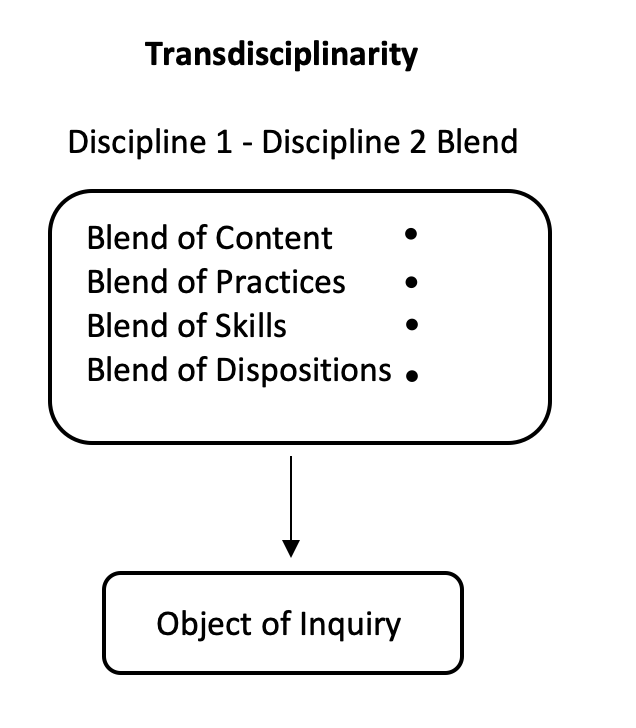
As detailed above, educational research and practice can be framed as a spectrum starting from content area silos and a disciplinary focus to more of an integrated interdisciplinary connection that includes multidisciplinary associations. The concept of transdisciplinarity is slippery, in flux, and has a plurality of definitions. 13 One of the features of transdisciplinarity is blurring and transcending disciplines. These spaces have been shown to provide fertile grounds for exploring patterns of change, transformations, and invariants in and across content areas. 14 Transdisciplinarity breaks down the silos and pro-
vides an enriched experience that is more true to life in that disciplines are experienced
simultaneously rather than in isolation. 15

In the graphic above, transdisciplinarity involves the blending of disciplines by blending of practices, skills, content, and dispositions from one discipline to the other.

One way to think about this is with our example of a science and art teacher working together on a unit. They consider the concepts, expressions, and forms shown in art, science, and in-between. They study gardens as heterogenous assemblages where art, science, and people meet. They consider how the plants need water and cultivating in order for the garden to prosper. In their work, they include elements of art, science, and beyond. But, their work process and product is an iterative assemblage as they consider where the living sciences, and abstract nature of art meet.


This post was written by Nenad Radakovic and Ian O’Byrne. This was originally posted here. Portions of this content from our publication titled Toward Transdisciplinarity: Constructing Meaning Where Disciplines Intersect, Combine, and Shift.

Photo by Ashkan Forouzani on Unsplash

Use digital spaces and poetry to share a walk in your world

Research

The #WalkMyWorld project started as a community focus on poetry and multimodal exploration; it then developed into a community of inquiry. Participants explored the experiences of others by responding to and authoring multimodal poetry. In #WalkMyWorld, educators and students created a social space of engagement to explore civic uses of social media. This exploration served as an opportunity to consider the media literacies at play as the group participated as a community of writers. 

Guided by carefully-crafted learning events, participants took photos, authored short pieces, and filmed small glimpses of their lives. At weekly intervals, they documented their “walks” using photo and video capture tools that easily allow users to share content with others. By collecting snippets of their worlds that seemed trivial one at a time, participants experienced the magic that, when strung together, these digital “gatherings” presented narratives of very human things: pain, beauty, joy, friendship, and wonder. 

During the project, instructors were able to target specific educational objectives revolving around (but not limited to) explorations with poetry. With the understanding that creating and sharing digital content in online spaces might be a novel and even scary experience, instructors also charged participants to grapple with what to share and how. This raises questions between educators and learners as they contemplate how and how much to share. Accordingly, thoughtful experimentation online, connection with digital texts and tools, and play ultimately serve as valid, if not crucial, educational outcomes. 

This project encouraged educators and students in elementary school through higher education to engage in social scholarship practices. Social scholarship utilizes the Internet and other communication technologies to evolve the ways in which scholarship is conducted. Like many other social scholarship projects #WalkMyWorld connected formal scholarship with informal Internet-based social practices while embodying specific values (e.g., openness, collaboration, transparency, access, sharing). #WalkMyWorld evolved into a space that allowed participants to explore the characteristics of online information and educational opportunities by allowing them to share and develop (a) writing lifeworlds, (b) communities of inquiry, (c) media literacies and (d) expanded perspectives of narrative writing. These skills have proven to be integral to the way teachers view themselves as professionals in online and hybrid educational spaces.

The trailer shared above was created for a session on the project released at the K12 Online website. The full video for the session is available below.

Work with the 2014 version of the #WalkMyWorld Project was printed in the MIT Civic Media Reader.

Results from the 2015 iteration of the #WalkMyWorld Project were also presented at the annual conference of the Literacy Research Association. Work from this session by Wise and O’Byrne was later published in the Literacy Research: Theory, Methods, and Practice journal.

The #WalkMyWorld Project was also highlighted in a publication by Rish and Pytash in NCTE’s Voices from the Middle and the accompanying podcast.

Lastly, in 2017 this project served as a motivating factor in this chapter on mentored open online communities (MooCs) as a third space for teaching and learning in higher education.

DEVELOPING STUDENTS AS SELF-ASSESSORS

Research

BY: Laura Greenstein, ED.D.

When I was asked to problematize assessment, I was puzzled. Does that mean to turn something that is not a problem into one, or rather, quantifying students’ mistakes and pursuing accountability?  Turning assessment into a problem implies that something has gone wrong when in truth, it has merely gone astray from its Latin root “Assidere,” which means to sit nearby and guide. Regrettably, assessment has been taken out of the hands of educationalists who accentuate improvement and have been replaced by periodic testing that quantifies learning and generates numerical comparisons. As of yet, scoring technologies cannot distinguish between a learner’s lack of knowledge and their misinterpretation of the question, nor can they provide advice on remediation. Below are 3 steps that can.

STEP 1: REVISIT FUNDAMENTAL IDEAS and PRINCIPLES OF ASSESSMENT


While some believe tests and assessments mean the same thing, the definitions below illuminate noteworthy differences in purpose and process. 

Photo by Annie Spratt on Unsplash

TESTs are periodic procedures that establish the capacity or performance of someone or something (Merriam-Webster). They are explicit strategies to ascertain and verify a learner’s skills and knowledge (Wikipedia). Tests tend to be more standardized, analytical, and judgmental.

ASSESSMENTS are processes used throughout teaching and learning to check for understanding, monitor progress, identify lingering gaps, and guide improvement. They rely on varied practices to gauge learning such as rubrics, exit slips, fix the mistake, student reflections, and progress trackers. They are more adaptable and personalizable than tests (Assessment Network).

STEP 2: INCORPORATE STUDENT SELF-ASSESSMENT to DEEPEN, ENRICH, and develop OWNERSHIP of  LEARNING

Photo by Karla Vidal on Unsplash


Classroom assessments generally offer more insights into learning than standardized tests. Student self-assessment further illuminates competencies and leads to higher-level thinking, problem-solving, and self-efficacy (Panadero, Jonsson, and Botella, 2017). 

Learners engaged in their own assessment increase self-awareness. Prompts such as “I used to think__, but now I know__.” encourage insights into learning. As Anisha, a 6th grader, says, “I used to think communication was just talking and writing, but now I know it also includes listening, looking, thinking, AND patience.” 

Students rarely take tests once they exit the education system, but they continue to be evaluated on their proficiencies, initiative, productivity, and more. The ability to gauge, reflect, and modify thoughts and actions is indispensable at work and home, throughout the lifespan. 

STEP 3: HELP STUDENTS “SOAR” AS SELF-ASSESSORS


Have you ever said or heard something like this? “I know you believe you understand what you think I said, but I’m not sure you realize that what you heard is not what I meant” (Attributed to Allan Greenspan). Assessment can be like the Tower of Babel, where it is not easy to disentangle ever-changing and contradictory dialects. Mary Ann Burke and I have designed a straightforward and actionable acronym to support all learners as self-assessors. We call it S.O.A.R. 

The  SOAR model connotes Student Ownership and Agency leads to Results. It puts Students at the center of assessment by purposefully transferring Ownership to them and facilitating their Agency in ways that improve the Results and outcomes of learning. Here’s how it works:

  1. Put STUDENTS at the center of assessment by helping them clarify and visualize what they will be learning, compare that to what they already know and can do, describe how they plan to learn, and ways they can use their learning. In Practice: Students complete an expanded KWL chart that includes: What I think we will learn, What I know now, What I want to know, How I will find out, How can I show/use my learning. 
  2. Offer opportunities for students to take OWNERSHIP of their learning purpose, process, and products. For example, let them decide how to organize, summarize, and display their learning using words, visuals, or performances. In Practice: Rely on coherent rubrics, sequenced through the taxonomy, that align with learning intentions. For example: Explain the main idea in your own words, elaborate on the significance of 3 key steps/events, draw conclusions or critique it, and design/produce original products and ideas.
  3. When students become AGENTS of assessment, they take greater charge/responsibility of their path, become participants in the learning process, and strengthen self-reliance. As learners develop deeper understanding, they gain self-confidence and become resources for each other. In Practice: Learners explain or demonstrate their understanding of the main ideas, how the author captures the reader’s attention and extends learning for deeper meaning. They may also defend a position or suggest improvements. 
  4. The RESULTS of students being at the center of their own assessment become evident in learning outcomes. In Practice: As traditional measures evolve into student-owned assessment, they take increasing responsibility, seek to alleviate problems, and generate original ideas and solutions.  Rather than relying solely on traditional test questions, learners can better reflect, investigate, analyze, and formulate ideas. 

Using the SOAR sequence develops every students’ life-long self-assessment skills. In doing so, they become more accountable for their learning outcomes, analyze, can explain their misunderstandings, identify knowledge and skills in need of improvement, and self-correct their own learning. Indeed, these skills support all students in moving from academic distress to confident and successful learners.

References

Greenstein, L., and Burke, Mary Ann (2020)  Rowman and Littlefield, “Student-Engaged Assessment: Strategies to Empower All Learners

Assessment Network: Toolbox and Blogs https://www.assessmentnetwork.net/blog/  and also https://www.assessmentnetwork.net/2017/02/5-assessment-myths/

Greenstein, L. (2018) MUSTs of Assessment: in Restorative Assessment, Corwin, 2017 https://us.corwin.com/en-us/nam/restorative-assessment/book258057 

Panadero, E., Jonsson, A., & Botella, J. (2017). Effects of self-assessment on self-regulated learning and self-efficacy: Four meta-analyses. Education Research Review, 22, 74–98. 

Boyer, M. (2019). Balancing Skepticism and Utility in Machine Scoring.  https://www.NCIEA.org/blog/essa/balancing-skepticism-and-utility-machine-scoring

About the Author

Laura is a lifelong learner and educator who has taught and assessed from preschool to graduate school, across subject areas. Her passion for educational assessment began with her dissertation and is evident throughout her work as an author of 5 books on the topic, founder of and blogger at the Assessment Network, and mentor to many teachers and learners. Through her workshops, she brings fresh ideas on a range of assessment topics from standardized to classroom, including formative, authentic, multicultural, differentiated, brain-friendly, and balanced. (Sometimes, she even talks about standardized tests.)

The Advantages of Inquiry: Equity and the Economy

Research

By: Dr. Britnie Delinger Kane, Assistant Professor at the Citadel

In education, inquiry has long been considered foundational to all four major disciplines (e.g., Dewey, 1927)—English, social studies, science, and math—and it has been motivated and defended from a number of theoretical backdrops (i.e., critical literacy; social constructivist theories of learning; disciplinary literacy; engagement theory; and on and on). Others might choose a different conceptual framework from which to understand the place of inquiry in classrooms, but—for my money—I prefer to understand its utility from the standpoint of social constructivist theories of learning. This stance helps us to see connections between inquiry-oriented instruction, disciplinary literacy, and even more equitable forms of instruction.

The term “constructivist” teaching is often bandied about, but it’s a deeply complex and potentially misleading term. If you have never read Marc Windschitl’s (2002) review of the research on “constructivist” or “student-centered” instruction, you should. It will change the way you think about every piece of educational research you happen across —not to mention every blog with ten tips for integrating into the classroom Chromebooks or SeeSaw or Lucy Calkins’s writing curricula. Windschitl’s main argument in that piece is that the field has been unfair to teachers in advocating for a nebulous idea of “constructivist” teaching. He then, in detailed and clear ways, distinguishes between two broad orientations to theories of learning, cognitive constructivism (think Piaget) and social constructivism (Vygotsky), which continue to inform thinking in the learning sciences. 

So far, many of you may be nodding, straining to remember that Ed Psych class long ago where you kept getting the words assimilation and accommodation mixed up and someone asked you to make a poster about Vygotsky’s ZPD (only rarely have I been in a School of Ed that wasn’t plastered with posters of the ZPD). The point that Windschitl (2002) highlights is that humanity can file the articulation of coherent theories about human learning on its list of invaluable accomplishments of the last 100 years. However—and this is the clincher—theories of learning are NOT theories of teaching: Just because we know boatloads more about the ways that people learn does not necessarily mean that we can fill the same boats with our understanding of effective teaching. Windschitl proceeds to outline what—from a social constructivist standpoint—constitutes great teaching. He calls this ambitious instruction—or, how to teach in ways that will support what we understand, broadly, about the social nature of learning. The whole bullet-pointed list could sustain career-long consideration, but here’s my favorite line:

[When students are engaged in rich opportunities for conceptual learning, they are] routinely asked to apply knowledge in diverse and authentic contexts, to explain ideas, interpret texts, predict phenomena, and construct arguments based on evidence, rather than to focus exclusively on the acquisition of predetermined “right answers” (Windschitl, 2002, p. 137).

Windschitl calls such teaching ambitious, because it supports social constructivist forms of learning. Ultimately, Windschilt and other learning theorists seem to agree that ambitious instruction can support the rich forms of conceptual learning that students will need in order to succeed in our knowledge economy. Learning theorists have highlighted that such expertise involves not just memorization of important facts and procedures, but “a deep conceptual understanding of complex concepts and the ability to work with them creatively to generate new ideas, new theories, new products, and new knowledge” (Sawyer, 2014, p. 5). Indeed, it is a repeated finding of educational research that, by addressing complex, authentic, and relevant questions, students can learn to use their procedural and conceptual knowledge flexibly in order to solve novel problems while evaluating and communicating arguments clearly (Sawyer, 2014, p. 5).

In short, rich learning requires that students inquire into authentic and relevant problems, and so bringing inquiry into classrooms can be an important framework for teaching ambitiously. Of course, as a literacy person, I cannot think about discipline-specific forms of inquiry without also thinking about disciplinary literacy. Disciplinary literacy is about apprenticing students into the ways that experts use reading, writing, speaking, listening, and thinking in specific disciplines to inquire into questions of import to particular fields. At the heart of disciplinary literacy is the idea that students must learn both the content and processes through which knowledge is constructed in particular disciplines (Moje, 2007). As Moje (2007) emphasizes, understanding the processes through which knowledge is constructed is central to equitable forms of pedagogy—not only because understanding these processes helps students to reconstruct them and use them in their own lives, but because understanding those processes can support students, ultimately, in critiquing them. To my mind—understanding the processes through which knowledge is constructed in particular disciplines is about…well, inquiry. Spires and her colleagues (2016) agree. They have used inquiry as a means of supporting students’ disciplinary literacy, calling their framework for this work project-based inquiry (PBI). In their framework, PBI has five phases:

  1. ask a compelling question, 
  2. gather and analyze sources, 
  3. creatively synthesize claims and evidences, 
  4. critically evaluate and revise, and 
  5. share, publish, and act
Photo by Cristian Palmer on Unsplash

Early evidence suggests that, by focusing on disciplinary literacy within an inquiry paradigm, teachers and students are able to deepen their understanding of disciplinary literacy and engage in deeper, authentic, relevant, and engaging content-specific learning (Spires et al., 2016). 

As research on disciplinary literacy centrally highlights, however, the processes through which disciplinarians construct knowledge—or, the modes of inquiry they use—are, of course, discipline specific (Dobbs, Ippolito & Charner-Laird, 2017; Moje, 2007; Shanahan & Shanahan, 2008; Spires et al., 2016). A number of articles, including those cited here, have written about this in great depth, so I will limit myself to a single example. In the PBI framework that Spires and her colleagues suggest, inquiry across disciplines begins, of course, with a compelling question. Students then gather and analyze sources. However, the ways in which they analyze these sources are different: literary critics deconstruct literary and rhetorical devices, such as irony and metaphor; scientists attend to an author’s credential and authority within the field; and historians contextualize primary sources, paying attention to both the author, purpose, audience, and time period in which the piece was written or created; mathematicians analyze the logic of an argument without attending as closely to the context of the author (Spires et al., 2016, p. 153). Thus, all disciplines inquire, but they do so differently. 

Photo by Brett Jordan on Unsplash

In short, inquiry is a powerful framework for ambitious teaching, and it can be an important vehicle for supporting disciplinary literacy and content-area learning. By bringing inquiry projects into the classroom, students have opportunities to participate in disciplinary work, which can support students’ development of disciplinary literacy, as well as the content and processes that disciplinarians use to build knowledge. There are two major advantages to this: (1) inquiry can support students to develop the kinds of rich, flexible conceptual knowledge they will need in order to find success in the knowledge economy (Sawyer, 2014); and (2) inquiry allows students to participate in approximations of processes of discipline-specific knowledge construction, which is foundational to equitable teaching (Moje, 2007; Behrman, 2006).   

References

Behrman, E. H. (2006). Teaching about language, power, and text: A review of classroom practices that support critical literacy. Journal of Adolescent & Adult Literacy49(6), 490-498.

Darling-Hammond, L. (2016). Research on teaching and teacher education and its influence on policy and practice. Educational Researcher, 45(2), p. 83-91.

Dewey, J. (1927). The public and its problems. Athens, OH: Shallow. 

Dobbs, C., Ippolito, J. & Charner-Laird, M. (2017). Investigating disciplinary literacy: A framework for collaborative professional learning. Cambridge, MA: Harvard Education Press.

Moje, E.B. (2007). Developing socially just subject-matter in- struction: A review of the literature on disciplinary literacy teaching. Review of Research in Education, 31(1), 1–44. doi:10. 3102/0091732X07300046001 

Sawyer, R. K. (2014). Introduction: The new science of learning. The Cambridge Handbook of the Learning Sciences. 2nd ed. Cambridge: Cambridge University Press. (pp. 1-18).

Shanahan, T. and Shanahan, C. (2008). Teaching disciplinary literacy to adolescents: Rethinking content-area literacy. Harvard Educational Review, 78(1), 40–59.

Spires, H. A., Kerkhoff, S. N., Graham, A. C. K. (2016). Disciplinary literacy and inquiry: Teaching for deeper content learning. Journal of Adult and Adolescent Literacy, 60(2), p. 151-61. Windschitl, M. (2002). Framing constructivism in practice as the negotiation of dilemmas: An analysis of the conceptual, pedagogical, cultural, and political challenges facing teachers. Review of Educational Research, 72(2), 131–175.

About the Author

Britnie Delinger Kane is an assistant professor of literacy in the Zucker Family School of Education at The Citadel in Charleston, SC. Dr. Kane’s teaching and research focuses on how teachers learn to teach ambitiously. Her work has focused on a number of content areas, including mathematics, writing, and computer science. This focus has led to her interest in disciplinary literacy, to which she brings a learning science perspective. She has studied teachers’ professional learning across their careers, from preservice teachers’ involvement in simulations of professional work to in-service teachers’ participation in teacher workgroups to instructional coaching. 

Where Does It All Begin?

Research

By: Dr. Kavin Ming, Winthrop University

For the month of August, our blogs addressed a variety of topics related to the idea of using culturally responsive teaching with English Language Learners.  Specifically, we identified strategies to strengthen culture-sensitive instruction; highlighted the importance of allowing students to use their first language, and determined key questions to ask ourselves as we implement culturally sustaining pedagogy.  The root of these positive practices starts with cultural competence. 

What is Cultural Competence and Why Does It Matter?

Cultural competence is the ability to successfully teach students from cultures other than one’s own.  This requires a deep understanding of complex awareness and sensitivity, a wide body of knowledge, and a set of skills that, when taken together, produces effective cross-cultural teaching.  One key element is acquiring this capacity is having a keen awareness of one’s own culture and the culture of others. I once read where an author said that you cannot truly teach students if you don’t really know them.

Photo by sydney Rae on Unsplash

An awareness of one’s own culture and the culture of students impacts the types of books read, the kinds of materials selected, the variety of strategies used, and the evaluation practices implemented.  Culturally competent educators use their cultural competence as a guide for action when working with students, parents, and members of the community.

Culture Matters

Student achievement continues to be at the forefront of all educational entities, including district, state, and federal organizations.  The poor performance exhibited by large groups of diverse students in many areas around the country leaves many asking what can be done to move these students to higher levels of achievement.  As the demographics of schools have changed, teaching and learning has not followed the same evolutionary pace.  For a number of educators, traditional methods of instruction have predominated, and these methods do not reflect a genuine consideration for effective instructional methods and the impact of culture on teaching and learning.  Thus, one of the most significant implications of professionally developing cultural competence is the basic understanding that culture does impact learning, and by adapting a different stance, based on an understanding of the significance of culture, students from diverse backgrounds can make academic gains. 

Knowing Your Students Begins with Introspection

Photo by Taylor Smith on Unsplash

Teachers who look within analyze their own feelings towards those who are culturally different, determine how those feelings relate to the dominant culture, and think about what frame of reference influences these feelings.  Key factors in understanding diverse students include learning about each person, and taking a personal interest in establishing positive relationships.  It also includes continuously questioning one’s self in order to clarify salient issues.  Teachers can engage in introspection as part of the planning or preparation period on a daily, weekly, or monthly basis.  This frequency ensures that it is an ever-present part of their teaching routines.

Coupled with learning about one’s students, and questioning one’s self, teachers can develop cultural competence through personal development.  Reading and seeking to understand the profiles and experiences of different cultures introduces teachers to contexts that help them identify similarities and differences within and across groups.  A starting point is for teachers to purchase or borrow books that are written by people of color, including history, literature, and education.  Some of these books include:

  • Women of Silk by Gail Tsukiyama
  • The Circuit: Stories from the Life of a Migrant Child by Francisco Jimenez
  • I, Too, Am America by Langston Hughes
  • Song of Solomon by Toni Morrison
  • Cry, the Beloved Country by Alan Paton

It’s Personal

In order to teach students, teachers must first reach them.  Teaching starts with the heart.  The best laid lesson plans will not amount to much if teachers don’t really know who are the students sitting in front of them.  When students know that teachers care about them, and are interested in them as individuals, they will open themselves up to hearing what the teacher has to say.  Culture matters, and effective teachers recognize this importance and strive towards achieving cultural competence. 

References

Aceves, T. C., & Orosco, M. J. (2014). Culturally responsive teaching (Document No. IC-2). Retrieved from University of Florida, Collaboration for Effective Educator, Development, Accountability, and Reform, Center website: http://ceedar.education.ufl.edu/tools/innovation-configurations/.

Au, K. (2009). Isn’t culturally responsive instruction just good teaching? Social Education, 73(4), 279-183.

Diller, J. V., & Moule, J. (2005).  Cultural competence: A primer for educators. Toronto, CA: Thomson Wadsworth.
Howard, T.C. (2003). Culturally relevant pedagogy: Ingredients for critical teacher reflection. Theory into Practice, 42(3), 195-202.

Pang, V. O. (2001). Why do we need this class? Phi Delta Kappan, 76(4), 289-292.

About the Author

Dr. Kavin Ming is a Professor at Winthrop University in Rock Hill, SC.  She is currently serving as the Department Chair in the Department of Curriculum and Pedagogy.  She teaches undergraduate literacy methods courses and graduate content area literacy and practicum courses.  Kavin’s research interests include at-risk student populations, culturally responsive pedagogy, content area literacy instruction, and multisensory teaching of literacy skills.  Kavin can be contacted at mingk@winthrop.edu.

Culturally Responsive Instruction to Improve English Learners’ Academic Oral Language Development

Research

By: Dr. Elke Schneider

What is culturally responsive instruction and why is it important?

Culturally responsive instruction (CRI) refers to teaching any content area in a way that infuses and honors knowledge about learners’ socio-culturally, linguistically, ethnically, racially, religiously, and socio-economically unique backgrounds. It not only makes the purpose of learning about specific content learner-relevant by connecting it to their cultural and linguistic frame of reference but also provides necessary language support and cultural explanations in interactive, authentic and carefully structured learning opportunities.  In CRI, cultural, verbal and nonverbal components are made explicit to help diverse learners succeed. Therefore, the strategies below address these aspects.

Non-native speakers of English or English learners (ELs) present the fastest growing group of students in the US and in the Carolinas and are part of an increasingly diverse student population that requires CRI.  Such instruction provides ELs with explicit guidance on how to orally communicate effectively in social and academic settings.

Photo by iMattSmart on Unsplash

Effective CRI is based on a strong rapport with ELs. It unlocks EL’s motivation to overcome challenges based on language and acculturation needs.  In collaboration with ESOL teachers, one can find out about ELs’ schooling background, home life, and possibly any key experiences ELs may have had prior to entering a content area teacher’s classroom that may impact learning success such as traumatic experiences coming to this country or any non-academic strengths that could be utilized to motivate learning content.

Why is it important to focus explicitly on oral language development?

 Oral language skills provide the basis for proper development of all other academic skills including listening, reading, and writing skills.  Native speakers develop oral language skills during the first five to six years of their lives before learning to read and write. However, ELs moving into the new culture later in life, must acquire oral, reading and writing skills fast all at the same time and are forced to participate in state testing from the start without any accommodations.

What constitutes oral language skills?

Developing social and academic oral language skills includes culture-specific verbal and nonverbal skills that require years to reach native speaker quality.  It takes approximately 2-3 years to develop social oral language skills needed to engage properly in social settings such as recess, or after school experiences. Academic oral language needed to verbalize and reflect on academic content takes at least seven to nine years. Both types of oral language skills require not only proper command of vocabulary and sentence structures but also of culturally specific nonverbal skills like gestures, postures, eye contact, proper pausing, body distance from speakers, and tone and volume of voice to make oral communication effective.

The following selected strategies are specifically geared towards ELs and focus on academic language skills development but can be implemented with all learners.

Strategies for culturally responsive academic oral language instruction

  • Make the purpose of an oral exchange about a topic clear and relate it to ELs’ world of reference. Ways to do that are:  (1) Start a motivating dialog about a picture or short film clip that is relevant to ELs and thus prompts personal connections and opinions about a topic; (2) Ask students to share a personal experience to help them see the purpose of a content area task; (3) Show concrete items or ask students to bring in an item that represents something that helps them relate to a topic in dialog with peers. 
Photo by Charlein Gracia on Unsplash
  • Plan for routine pair and group discussions prior to or after listening to  teacher presentations, viewing or reading tasks

Routinely infusing oral academic dialog opportunities allows ELs to practice those structures. Generally, infuse 5 minutes of oral processing for every 3 minutes of teacher talk. Cooperative learning dynamics as offered in think-pair-share orally or think-pair-share orally-write, think-write-pair-share orally or view (picture, video clip)- pair- draw information- share orally allow ELs to critically process information with their multicultural and multilingual frames of reference. For more details, see Zwier (2019).

  • Explicitly teach effective dialog features and allow oral pair or small group practices. On posters and personal handouts for students, flow charts display academic dialog features. Among them are gestures and language structures to: (1) demonstrate active listening skills (2) ask for more details or clarifications, (3) share culturally comparative information, (4) make sure everyone has contributed a comment, (5) keep dialog partners on task, (6) Compare and contrast information, and(7) summarizing what was saidFor details, see Zwiers (2019). Also, explicitly discuss how such oral features differ by allowing ELs to share how dialog patterns compare to their cultures. Highlight also how dialog structures change when talking to person of authority versus a peer.
Photo by Brett Jordan on Unsplash
  • Explicitly teach vocabulary in common phrases and sentence structures along with nonverbal communication features.

After analyzing what key vocabulary and associated phrases are needed for ELs to engage in proper academic dialog about a topic such as the water cycle or facts that led to the Civil War, allow ELs to practice saying these key words before using them in context. For instance, ELs will not participate in dialog about the photosynthesis, if they are not comfortable saying the word. Therefore, repeated syllable-by-syllable practice of the word is important. The entire class can be engaged in doing so chorally.  Teachers have students repeat a word like photosynthesis syllable by syllable. In the intonation and speed modeled by teachers, students repeatedly add one syllable to the next until they can say the entire word fluently. Then, it is used in common phrases (successful photosynthesis, failed photosynthesis) and sentences (A photosynthesis requires…, A photosynthesis occurs when….).Such essential vocabulary with common sentence structures are then collected on content specific vocabulary cards that allow ELs to draw mnemonic devices and references to their first language as needed (i.e. photo and foto mean the same in Spanish as in English). Other words with the same component (photograph, photographer) can be added to help expand vocabulary.

  • Explicitly teach nonverbal communication features

Given that non-verbal communication constitutes about 85% of in person information exchanges, teaching non-verbal communication features explicitly along with the language structures is paramount. Brief role plays in which one student asks questions and the other one answers them can serve as a practice for verbal and nonverbal oral language features. Students can prepare written scripts or work from brief notes on cards. Such performance can to demonstrate gained knowledge while implementing proper eye contact, gestures, postures, tone and volume of voice. Students can role play interviews of experts on science facts, a historic civil rights movement leader or a character in a novel or a writer. For each scenario, proper nonverbal skills such as eye contact, tone of voice, gestures, or body language can be practiced.

The following resource offers many specific suggestions for content area
instruction including evaluation charts:

Zwiers, J. (2019). Next steps with academic conversations. New ideas for improving learning through classroom talk.

Information about different specifics about language characteristics of over 30 language:

Swan, M. & Smith, B. (2001). Learner language: A teacher’s guide to inferences and other problems. London, UK: Cambridge University Press.

About the Author

Elke Schneider (PhD) is professor for Literacy, Special Education, and Second Language Learning at Winthrop University and has worked in this field for 25 years. She has supported regional and statewide efforts in training teachers at all grade levels and content areas in meeting learning needs of English learners with research-evidenced practices.

Culturally Sustaining Pedagogy for Emergent Bilingual Students

Research

By: Daniel Stockwell, Clemson University PhD Student

Who Are Emergent Bilinguals, and What is Culturally Sustaining Pedagogy?

I was once an emergent bilingual (EB) student. My family moved to Ukraine right before I entered first grade, and while I spoke English at home, the language of school was Ukrainian. My first experiences with public education were in a Ukrainian school roughly one month after arriving in the country. I did not speak the language, and I did not know much about the cultural norms of the classroom, but I needed to be engaged in authentic, meaningful learning. Instead, the teacher gave me toys and told me to sleep whenever I wanted to. 

Emergent bilingual (EB) students in the United States are those who speak a language other than English at home and are learning English at school but are not considered proficient in English. These students are often referred to as English Language Learners (ELLs). García and Kleifgen (2010) argued that they should be referred to as emergent bilingual students to highlight their linguistic strengths, not what they lack, and I completely agree with them.

Photo by Belinda Fewing on Unsplash

The languages a person speaks are essential components of their culture, so EB students bring with them unique linguistic strengths and cultures into the classroom. To engage these students, as we should engage all students, in rigorous academic instruction and participation, educators will need to implement culturally sustaining pedagogy (CSP) in their classrooms. The James A. and Cherry A. Banks Professor of Multicultural Education Django Paris (2012) explained that CSP is part of the “struggle toward an education that honors and extends the languages and literacies and practices of our students and communities in the project of social and cultural justice” (p. 96). CSP is no single list of practices or strategies. Rather, to implement CSP, teachers must learn about and value their students’ unique cultures and ways of knowing and doing. Teaching practices that implement CSP stem from this knowledge of individual EB students.

What Questions Can I Ask Myself as I Implement Culturally Sustaining Pedagogy with Emergent Bilingual Students?

Good teachers reflect on the instruction they provide, they look at formative and summative assessment data, and they ask themselves questions as they strive to improve and work to engage students in meaningful learning. This is a never-ending process because educators are life-long learners. No list of questions (or strategies) can cover everything educators could or should think about as they implement CSP with EB students. All students are different and unique. EB students come from diverse cultural backgrounds, nationalities, and families, who all have their own ways of using language to learn. So, educators will need to keep asking questions. The list that follows is meant to help educators begin thinking about how they can implement CSP with their specific EB students. It is a start that emphasizes the hard questions we all have to ask ourselves, over and over again.

How do I view my EB students?

Do you have deficit perspectives of EB students? Do you find yourself unconsciously associating their limited English proficiency with their intelligence? Do you think their culture is somehow inferior to your own? 

Photo by Josh Calabrese on Unsplash

If educators have deficit perspectives of their EB students, teachers will likely have lower expectations for their academic achievement, which has long-lasting consequences for these students.

Imagine trying to apply to college if you were tracked and placed in lower-level courses based on your perceived proficiency in a different language. Many EB students are schooled in contexts that do not give them access to advanced placement (AP) courses while they maintain the label of English Language Learners. In these settings, the language needs of EB students are placed above their academic needs. Unfortunately for these EB students, the most important predictor of student persistence in obtaining a baccalaureate degree is the academic rigor of their high school courses (Wassmer et al., 2004). EB students have a right to rigorous academic engagement. Do you think your EB students are ready for the kind of instruction they deserve?

Who does the accommodating in my classroom?

Do your EB students have to do all the accommodating necessary for learning and teaching to take place? Do they always have to change the ways they talk and think? How they interact with authority in the classroom? How they learn? How they view schooling and their role in their own education? 

EB students and their parents want to be involved in their learning and in the culture of the classroom, but they should not have to change everything about themselves in order to participate fully. Also, parents who do not speak English want to help their children with homework assignments; are you making it possible for them to be involved? 

Nieto and Bode (2018) advocate for teachers to participate in mutual accommodation. This means educators need to be willing to make some accommodations themselves to help EB students achieve academic success. Schools, parents, and students need to work together. Teachers need to make sure to accommodate their instructional practices so that they are culturally sustaining. Teachers need to affirm the languages, cultures, and ways of knowing and doing that their EB students bring into the classroom. 

What counts as official knowledge in my classroom? Who counts as knowledgeable?

How do you view your role as the teacher? Is it up to you to fill the students minds with as much content as possible? Or do you see your classroom as a place for you and your students to build knowledge together? If so, what counts as knowledge? Whose knowledge is valued and whose is ignored? 

Photo by Andrew Ebrahim on Unsplash

Teachers can plan times for their EB students to teach the class so that they can be the experts for a while. Allowing EB students to share elements of their culture, creative ways of thinking about a problem, or ways of knowing and doing that are different from the dominant group’s shows the entire class that all students have knowledge that is official and valuable. This is culturally sustaining; it communicates to EB students that their cultures are not just acknowledged by schools but are welcomed and valued.

Is my classroom “English Only”?

Do you tell your EB students to speak or write only in English in your classroom? Are they allowed to read in the language they use at home, or only in English? 

Martínez (2010) studied EB middle school students in East Los Angeles to explore how they used Spanglish daily in their English language arts and social studies classes. While some use the term Spanglish in the pejorative sense, I do not. Martínez, other researchers, and I use this term to refer to the skillful and creative use of features of both Spanish and English to communicate. Martínez demonstrated that the EB middle school students used Spanglish in ways that met the California state standards for listening, speaking, and reading. Teachers should consider allowing other languages to be used in class to give students access to rigorous academic engagement and to give them practice with using language to communicate in meaningful ways. 

Teachers can allow their students to engage in translanguaging. Researchers and educators have a few different conceptions of what translanguaging is; one understanding is that translanguaging is “the deployment of a speaker’s full linguistic repertoire without regard for watchful adherence to the socially and politically defined boundaries of named (and usually national and state) languages” (Otheguy et al., 2015, p. 283). When EB students can use their complete linguistic repertoires, they feel valued and that their knowledge matters. Also, this allows them to engage in higher-order thinking because they can analyze, evaluate, and create more easily when they are not restricted to one language. Furthermore, when it comes to writing, teachers should consider the purpose of writing. Who are EB students writing for? Why are they writing? Teachers know that the process of writing, not the product, is when most learning takes place (Velasco & García, 2014). Allowing EB students to translanguage as they work on their writing assignments engages them in rigorous instruction; even if their English writing skills are not at grade level, their thinking can be. Translanguaging opens up doors of opportunity for their advancement as writers. 

What are my goals for EB students? Do you have high expectations for them? Does your school measure their success with EB students based on how many are reclassified out of the English Language Learners program? Is your highest goal for them to be able to graduate from high school one day? 

A Final Question

Photo by Emily Morter on Unsplash

This last question is about asking yourself, “What are the goals of my EB students for themselves?” If we do not know the personal goals of our EB students and their families, we probably are not teaching in ways that are culturally sustaining. 

If EB students’ linguistic skills and cultures are valued and incorporated into the official curriculum in schools, EB students will be able to pursue their own goals, and we will be better positioned to help them. 

References

García, O., & Kleifgen, J. A. (2010). Educating emergent bilingual students: Policies, programs, and practices for English language learners. Teachers College Press.

Martínez, R. A. (2010). “Spanglish” as literacy tool: Toward an understanding of the potential role of Spanish-English code-switching in the development of academic literacy. Research in the Teaching of English, 45(2), 124–149.

Nieto, S., & Bode, P. (2018). Affirming diversity: The sociopolitical context of multicultural education (7th ed.). Pearson.

Otheguy, R., García, O., & Reid, W. (2015). Clarifying translanguaging and deconstructing named languages: A perspective from linguistics. Applied Linguistics Review 6(3), 281–307.

Paris, D. (2012). Culturally sustaining pedagogy: A needed change in stance, terminology, and practice. Educational Researcher, 41(3), 93–97.

Velasco, P., & García, O. (2014). Translanguaging and the writing of bilingual learners. Bilingual Research Journal, 37(1), 6–23.

Wassmer, R., Moore, C., & Shulock, N. (2004). Effect of racial/ethnic composition on transfer rates in community colleges: Implications for policy and practice. Research in Higher Education, 45(6), 651–672.

About the Author

Daniel is a Ph.D. student in the Literacy, Language, and Culture program at Clemson University. Before entering this program, he was a high school English teacher in Greenville, South Carolina.

Culturally Responsive Instruction for Non-Native Speakers of English

Research

By: Dr. Elke Schneider, Winthrop University

What is culturally responsive instruction and why is it important? 

How would you feel if you involuntarily had to leave all you knew and were comfortable with, and found yourself in a completely new environment, including a school where everyone spoke a language you could not understand, and where people interacted differently than you are used to seeing happen in the culture you came from? How would you feel, if you did not even know how to ask for a bathroom break, or were not sure if it was safe to eat the unfamiliar food that you saw served in the school cafeteria? For some of us who have never moved far from the environment and home culture of our initial upbringing, this might be really hard to imagine. It would probably come close to a nightmare that you wished you could wake up from and forget.  

Such experiences are common for non-native speakers of English, or English Learners (ELs) who represent the fastest growing community of learners in our public schools nationwide as well as within the state of South Carolina. Many of them have recently moved into our state and only know themselves in their home language and culture. Coupled with this newness, ELs have to participate in state standardized testing without integration time, and their school performance is part of annual school report cards. All this puts pressure on content area instructors to have strategies at hand that help ELs succeed quickly.

ELs, along with their classmates, present a potpourri of diverse learner backgrounds due to different socio-cultural, ethnic, religious, linguistic, and socio-economic experiences. Teaching in a culturally responsive way actively integrates these differences into instruction in which a) a culture of respect for differences and diversity is fostered as an enrichment and asset for all, b) common life challenges are seen as connecting anchors amidst apparent differences, and c) knowledge is built in such a way that every student has the same fair chance to succeed. 

Photo by Sandy Millar on Unsplash

Specifically, culturally responsive instruction thus provides explicit opportunities for students to link the newly learned content with what they already know. It infuses a variety of different, multisensory, carefully structured learning opportunities that occur often through cooperative learning interactions. These allow ELs to learn in the context of natural exchanges with peers and teachers. Such instruction requires teachers to model different learning and problem-solving strategies explicitly and to make academic language structures and associated nonverbal behavior patterns explicit. 

The interconnectedness of acculturation and language acquisition

Acculturation refers to the process of integrating a representative of a minority culture into a majority culture. This includes accepting and learning social interaction patterns and the language of the majority culture. Acculturation and language acquisition are therefore tightly interrelated. This means for ELs in the school culture that the safer and more socially integrated ELs feel, the faster and more successful is their learning progress. This is true for all learners with language and cultural experiences different from those of the main culture. While this blog focuses only on ELs, many of the shared strategies can be considered for the integration of learners of other minority groups.

Strategies to strengthen culture-sensitive instruction of ELs

Helping ELs understand the American school culture

Photo by Sam McGhee on Unsplash
  • Create video clips about essential features of the school culture (i.e., school nurse, bus or morning routines, homework assignments) or routine tasks and expectations in your content area (i.e. science lab procedures, history project) in collaboration with colleagues and administration. These, both ELs and their parents (i.e., during parent conference times) can watch repeatedly until they understand the shared routines or procedures when the oral explanations are provided in several most commonly used languages. Each can be saved separately so they can be shared among teachers as needed.

Activating ELs’ unique contributions to the learning community

  • Allow ELs to use their native language to make connections with the content presented in English. Canadian multilingual learning researcher Jim Cummins stresses the importance of allowing the use of ELs’ first language in school because, if denied, an essential part of ELs’ identity and livelihood is squelched. This in turn impacts the learning progress negatively. 
  • Examples could be a) providing space on graphic organizers to note a realization in the first language, b) allowing ELs to use their native language as they figure out tasks or work together with others by using a bilingual dictionary and translation digital devices, c) pairing up several ELs with native speakers so clarifications can occur naturally in two languages.  
  • Prior to any topic, activate ELs’ prior knowledge by eliciting experiences from their home culture where appropriate (i.e., wild life, weather, socio-cultural routines, historic sites, historic events, or how basic math skills were taught in the home culture).

Infusing culturally and linguistically sensitive content instruction

Photo by NeONBRAND on Unsplash
  • Provide repeated opportunities for ELs to orally repeat essential academic language structures used with a content through whole or small group choral response. This builds ELs’ confidence in using academic language when engaging in natural group interactions with peers. Such oral practice also provides the basis for subsequent writing tasks. 
  • Provide Illustrations in handouts, posters, and/or on PowerPoint presentations with subtitles in English for each step-in procedural task (i.e., math task, science project, history report). This makes content more comprehensible and allows ELs to participate in community learning tasks more successfully.

Building culturally sensitive relationships and understanding

  • If something does not feel right in the communication process (verbal and/or nonverbal), do not ignore it, rather seek clarification in a way that allows an EL to keep his/her face. Often ELs do not feel comfortable asking questions or acknowledging confusion, especially not in front of peers. Therefore, it is the teacher’s responsibility to seek clarification, best one-on-one. 
  • Teach all students about how to be a culturally responsive citizen. This includes building empathy for differences and practice of conflict resolution through explicit reflective dialog and role play as needed. It also includes clarifying what bullying is and what the consequences are for such behavior in the classroom learning community and during recess. It also includes teaching all students how to act respectfully towards each other. Positive behavior reinforcement of appropriate interactions can provide meaningful incentives.

Assessing ELs’ acquisition of academic knowledge

  • Preteach test language and response structures for different test tasks. This is important because American common test types may not be familiar to ELs nor may they have the language capacity. Collaborate with ESOL teacher/s on this as well.
  • Provide alternative assessments. ELs who cannot present their knowledge with proper academic language yet need to share their knowledge via projects that allow them to illustrate or gesture what they know or label graphic images with what they know. Provide word banks to use for responses, and simplified sentence structures and number of response choices in test tasks. 

These are just a few ideas to infuse culturally and linguistically responsive strategies for ELs into content area instruction. The following three sources provide a variety of research-evidenced instructional practices beneficial for ELs to be culturally and linguistically integrated into the American education system.

Additional resources to investigate are:

a) Go to Strategies retrievable from: http://www.cal.org/what-we-do/projects/project-excell/the-go-to-strategies

b) 50 strategies for teaching English language learners by Adrienne Harrell and Michael Jordan (6th edition)

c) For more project-based content instruction see Dinah Zike’s foldables resources on the internet for math, science, social studies, math

About the Author

Elke Schneider (PhD) is professor for Literacy, Special Education, and Second Language Learning at Winthrop University and has worked in this field for 25 years. She has supported regional and statewide efforts in training teachers at all grade levels and content areas in meeting learning needs of English learners with research-evidenced practices.

New Literacy Studies: For What It’s Worth…

Research

By: Dr. Todd Lilly, University of South Carolina

(For what it’s worth, this blog is peppered with a few hyperlinks to entertain the reader and to illustrate New Literacy Studies… for what it’s worth. Enjoy!)

Here’s a scene you might recognize: Everyone is concerned about the mental health of the young prince. The father of his fiancé finds him alone in a room in the castle, absorbed in a book. “What do you read, my lord?” The prince stops reading, flips through his book as if to try to find an answer to this most-important question. Then, as if making an astonishing discovery, he answers: “Words. Words. Words!”

I know what you’re thinking: “I’m not an English teacher! What’s this got to do with me?” Well… In the context of New Literacy Studies…Plenty. For what it’s worth, there was certainly a whole lot more in the prince’s book than words, and that should interest all of us.

Our house backs up to a popular public recreation area, so our Home Owners’ Association (HOA) posted signs: “Private Property/ No Trespassing!”

Many third graders would have no trouble sounding out the words:

“Pr…Pr… Pr  as in Pretzel”

“Tr…Tr…Tr… as in Truck”

Hmmmm… I have no idea why the ‘ATE’ in “ PRIVATE” shouldn’t be pronounced like “8” or why the ‘ei’ in “eight” should. What exactly is a ‘ə’ anyway? “I’m not a reading teacher!” Anyway, that’s the gist of old literacy studies.            

So, maybe we secondary teachers don’t actually know all that much about Old Literacy Studies, but still, we get the idea: If kids know enough rules to sound out words, they can read just about anything we give them, whether it’s a social studies text book or Hamlet. It’s an autonomous design: Learn to decode and you have power. It’s that simple.

Well… actually, no, it’s not that simple. And neither are the literacy events and practices we expect students to engage in when they enter our classrooms. That’s where New Literacy Studies gets interesting.

About 30 years ago, just about the same time as “You’ve got mail!” several out-of-the-box smart people from a few English-speaking countries got together and kicked around the idea that literacy was more than decoding, semiotics, and semantics. In the mid-1990s they saw how the rise in popularity of digital technology had the potential to radically change the way people produced and consumed all kinds of texts. They got so excited about this “New” idea that they made plans to meet in a small New England town, New London, New Hampshire, just to talk about it. And they did. They came to be known as “The New London Group.” What was their conclusion?

This might be a good time to get up, stretch, visit the bathroom and/or the refrigerator, maybe do a little yoga… Ok, here goes:

They decided that literacy is a social event embedded in a complex web of power-laden social and technological contexts that all revolve around texts and language. (Yes, English teachers; that’s what Pygmalion, written a century ago was all about… “Duh!”). Another way of looking at it is that literacy exists by means of some technology (a book, a sign, a billboard…) in a social space between a producer and a consumer. It involves ways of speaking, thinking, acting, and believing, which would mean that one’s identity and membership in social groups can and does affect meaning. This mutation from literacy as merely decoding to literacy as a social practice was coined “the social turn.”

So there. Move over Gutenberg!

That’s pretty much what they could agree upon. I can imagine the discussion got a bit contentious when they started thinking about the definition of “text.” Is an embroidery of birds on a pillowcase a text? Seriously, that’s an important question in the context of multiliteracies, but we’ll save that for another blog.

For now, let’s consider the “No Trespassing” sign above as a text. It’s not a Falkner novel or a Shakespeare play, “but ’tis enough, ’twill serve.”

Someone created the sign, someone nailed it to a tree, and there are indeed people who have come along and read it. The sign successfully transfers an idea from the sign’s producer to the consumer: “Keep off OUR property!” The literacy event is accomplished. What more might these New Literacy folks say?

Well…plenty. They would point out that that the posting and reading of the sign was but an event, part of a larger practice that brought together myriad social and power connections. The sign was initially a reaction to a legal context. At our annual HOA meeting, our lawyer noted that if we hadn’t posted these signs, we would be liable for any damages incurred by anyone who stepped onto our property. (Don’t you just LOVE lawyers?)

There’s also, of course, a power dynamic. Who are these potential trespassers? We can only imagine them happening by and reading our message: We own something/ you don’t/ you can’t have it/ We deserve it/ You don’t. Nanananana…  “The sign said you got to have a membership card to get inside…Ugh!”

I’m sure y’all noticed the graffiti on the sign, probably a tag, a unique form of literacy that a certain group of people (in this case, graffiti writers) use to identify their work: Loosely translated, it says: “Hey, I’m somebody too!” And am I wrong to deduce a bit of anger and animosity?

If literacy, then, is all about contexts and social memberships, who gets to decide meaning? ELA teachers have heard this refrain before; it’s not new.

Student: “Mr. Lilly, I think Robert Frost’s ‘Stopping by Woods on a Snowy Evening’ is about Santa Claus.”

I can’t remember my reply, but now in my current life, I call forth the literacy gurus:

Louise Rosenblatt would have said, “Ok, a reader has a right to make meaning out of otherwise meaningless symbols.”

E.D. Hirsch might exclain: “Hogwash! Go ask Frost!”

Michel Foucault would look up from his bath: “Go for it kid ‘cuz Robert Frost is dead!”

Here’s some song lyrics that were a bit more popular than Frost when I was a kid:

“Paranoia strikes deep. Into your life it will creep. It starts when you’re aways afraid. You step out of line, the man come and take you away.”

–Stephen Stills

In the words of the great Yogi Berra: “It’s like déjà vu all over again.” For you youngins (“Ok, Boomer…”), long before Post Malone, Lizzo, Chance, JayZ/ Beyoncé; long before Justin and Taylor, even before Back Street Boyz and still further back before AC/DC there was the Buffalo Springfield. Band member Stephen Stills, in 1967, during the tumultuous years of the Vietnam War and Civil Rights, immortalized these words in his “For What It’s Worth” which rocketed to #7 on the Billboard Hot 100 chart.

Ok, what’s it about? Vietnam Protests? The Generation Gap? Was it a precursor to NWA? “Words, words, words.”

Nope, it was about an event in which riot police confronted a large gathering of young people who came together to protest a curfew in Hollywood, California. But to hundreds of thousands, it represented a division in America, an anti-establishment movement that exists to this day. If you don’t recognize the lyrics, I’ll bet if you click on the above link, you’ll recognize the tune. And if so, is the tune an integral part of the text? (If you actually click on that link, you’ve officially become involved in New Literacy Studies!)

Ok, that’s cool, but here’s the kicker: What happens to a text when it becomes older than the generation for which it was written? In the 1990s, about the same time the New London Group met in New Hampshire, the Buffalo Springfield band members (minus Neil Young, of course) all in middle-age, allowed their song to be used in a Miller Beer commercial. What?! An anthem of protest converted into an anthem of capitalism?! “Something’s happenin’ here. What it is ain’t exactly clear…

Well, actually, it is quite clear. The baton had been passed to a new generation. The context, the setting, the medium, the identities and power dynamics of the producers and consumers had changed from social injustice to quaffing a cold one. If you think about it, it’s much like what kids experience when they march from math to social studies to ELA and to lunch, all in the course of a typical morning. Everything changes. Students might read the same word in each class’ lesson, (“plot,” for example), but it will have a totally different meaning as the bell rings and students march from one class to another. The fact that they can pull this off day after day demonstrates remarkable sophistication. No science teacher is going to accept a lab report written as a rhetorical composition. As soon as students cross the threshold into the science room, they abandon the aesthetics of poetry that defined the day’s ELA class and magically conform to the inductive reasoning espoused by Francis Bacon, whoever he was.

Where old school technology goes to die-
Alex Watson, CC.org

Nothing is benign; a literacy event is always at the intersection of competing contexts (identities, histories, cultures, purposes, technologies) that can wax and wane over time. While in the course of a single day, we demand students think like a historian, think like an artist, think like an author, think like a scientist, think like a mathematician, think like a musician; all of which require a different literacy practice.

This past March, those kids were sequestered to rooms in their home “castles” somewhere in the village or in places even Verizon won’t go. And at the flip of a switch we were found alone at our laptop at our kitchen table desperately trying to replicate the old literacy practices of a face-to-face classroom and project it onto the new, unseen, unfamiliar contexts of the students’ existence. We tapped out words that were meant to convey the same curriculum and the same standards, but we all sensed the inevitable: “Something’s happening here/ What it is ain’t exactly clear.” More than a few of us have been confronted students’ equivalent of “No Trespassing/ Keep Out;” maybe not in so many words,

This could be a very long, very hot summer!

Robert Davy “Protest” Licensed through Creative Commons

“What a field-day for the heat. A thousand people in the street. Singing songs and carrying signs. Mostly say, “Hooray for our sign!’…You step out of line, the man come and take you away. It’s time we stop, children, what’s that sound? Everybody look what’s going down…”

For what it’s worth, this New Literacy Studies stuff never gets old.

“It’s only words and words are all I have to take your heart away” –Shakespeare  (Just kidding; it was the Bee Gees, and if that makes a difference to you, welcome to New Literacy Studies!)

About the Author

Todd Lilly has been a teacher for over 40 years, the majority of which was invested in middle and high school ELA and theater classes in and around Rochester, NY. Over the past 10 years he has served on undergraduate and graduate faculties in Wisconsin and currently at the University of South Carolina. He earned his Ph.D. in Curriculum and Instruction at the University of Wisconsin-Madison. His research interests include out-of-school literacy practices and the stories of marginalized, disenfranchised students. He is married to Dr. Catherine Compton-Lilly who holds the John C. Hungerpiller chair in the College of Education, University of South Carolina