The Power of the Pen:  Poetry as the Bridge to Liberation

Teaching

This post is written by Darius Phelps. You can read more about Darius at the bottom of this post.


As bell hooks argued, some forms of writing create “a space where we are able to confront reality in such a way that we live more fully.” Having been an educator for thirteen years, I believe that teaching students to write should be a practice that comes from the soul, especially if we want to foster a true connection between ourselves, our students, and the intimacy of writing. For me, growing up, poetry had been a sanctuary, the space in which words were the only thing that brought me comfort. As a young man of color, I found solace in the work of Korean rapper, and author, TABLO of the Korean hip-hop group Epik High who spoke out on issues such as struggling with mental health, depression, assimilation, and even struggling to experience joy as a young man. Inspired and enamored by his work, I began to write poetry myself, letting the words and emotions flow as they came, without restriction.

Dr. Maxine Greene (2000) argues that we must advocate for the inclusion of arts in the classroom in order to help foster a deep understanding and foundation for imagination. She stresses that there are multiple voices and multiple realities for, “We must now allow the enthusiasm for publicity about changed methods of reading instruction to obscure the facts of exclusion and neglect.” (p 36) Writing is part of the conversation,  and through these crucial conversations, we foster dialogue.  In Chapter 9 of Releasing the Imagination, titled “Writing to Learn”, Greene (2000) reinforces this idea When teaching writing, more specifically narrative writing, I use my own personal narrative as a guide/model for my students, showing them that there is power in being vulnerable and sharing what lies on their hearts. I remember the days when I was a student, especially in elementary school; I didn’t have a connection with writing inside of school because I didn’t see myself reflected in the prompts or discussions we would regularly have.

Once I became a classroom teacher, I discovered that diving into writing and teaching as a way to express ourselves via social-emotional learning helps us become better teachers for our students, even challenging us to face our own struggles head-on. With it, we learn to speak well and with emotion, to emulate that emotion, and to be more attentive to words and the emotions that they convey. (Storey, 2019) The power of the pen is one that is truly immaculate, and I feel that can be combined with the implementation of SEL. Social Emotional Learning (SEL) is a lifelong process for both the teacher and the student. In order to develop self-awareness, self-control, interpersonal skills, and all the intangibles that are paramount of work, school, and life, both adult and child must be willing to do the inner work that is necessary to allow these areas to manifest into something that they can apply to real-life, everyday situations. I believe that the process of doing that inner work requires honest self-examination, painful self-excavation, and restorative healing.

Effective educators use various strategies to improve their pedagogy and to reach their students. It is crucial for teachers to not only understand where their students come from culturally but also truly see them as individuals.  Anyone can be/become a culturally relevant teacher no matter what age group, area, or subject you are teaching.  Ladson Billings (2009) stresses that the key is to go in with an open mindset and see your students for who they are and what they are capable of doing; don’t focus on the negative. As we instruct them in both literature and writing, we must truly believe each and every one of our students can and will succeed. In order to transform them as students, we must be willing to instill this in them and show that we care, and I believe that poetry can be that bridge to vulnerability.

“In My Shoes”

by Darius Phelps

If you only knew

what it was like

to walk in my shoes

You’d know my steps 

marched to the beat

of different tunes

Music, art, and poetry

all different clues

Pieces of the puzzle

to my past

The weight of the world

heavy like a stack

of cement bricks 

But nothing

and no one

would hold me back

from overcoming life’s tricks and turns

Bruised.

Broken.

but never… burned

In my shoes,

You wouldn’t last a day

Surviving Hell’s fire

Like a blistering summer in May

No matter the trauma, the heartache, or the pain

I’ve come out stronger, better, and wiser with much more to gain

For even flowers bloom, after April’s rain

If you only knew

what it was like

to walk in my shoes

When we share our emotions, we foster meaningful discussions that are applicable in students’ day to day lives. I encourage teachers to challenge their students to think critically and outside the box, encouraging them to tackle emotions such as depression, grief, perfectionism, and even abandonment with various forms of discussion. Each person comes with a unique understanding of life, love, freedom, and emotions. Emotions equal freedom because you can’t control when a certain emotion washes over you or rises up, within you. If schools are built on deep relationships, and consent is embedded in the framework of relationship-building, we truly learn how to be self-aware, to recognize how others want to engage with us, and to face our own demons. (Hooks, 2021)

“Where I Am from” 

By Darius Phelps

I am from the pages of battered book

From fiery passion and grit

I am from the daily prayers of my grandmother

Loved endlessly, protected, and cared for

I am from the falling petals of a sunflower

radiant, yellow, and soft like the sun

I am from dinner on Sunday’s and hard work

From Mattie and Eddie, raised by my grandparents

I am from their loving and selfless hearts, the purest love I’ve ever know

From playing outside and using my imagination to dream endlessly

I am from the early Sunday mornings at church and praying before bed

I am from Riverdale, Georgia

From chocolate cake and sweet potato pie

From the endless nights watching grandma bake

The early mornings watching mom leave for work

photograph by photograph

Snapshots of my childhood memories

That slowly fade as time passes by

These are the memories that I hold closest

Where I am from, appreciating what is now gone, remembering that place I used to call home

Where I am from, will never compare to where I am headed

I am Darius Phelps

In the classroom, teachers can utilize poetry prompts such as Georga Ella Lyons “I Am” or “Where I am From” or even ask students to write about their experiences with a day in their life of being in “In Their Shoes.”  In doing so, we both create and provide a safe space for students to come openly with their trauma, pain, and grief and freely express their significant losses in their writing while paying homage to where they come from and light the path to where they are here.

The world of poetry opens our minds to explore our own voice and even find a new one in the process, especially when using it to discuss a wide variety of topics.  Poetry can teach us about ourselves and others in a deep and meaningful way. Instead of writing or reading a generic story about us or someone else, poetry provides the freedom for the writer to not only feel but to fully experience exactly what the writer went through, in a way that honors both their voice and experience. During that journey, the reader’s experience becomes enhanced with the use of similes, metaphors, alliterations, imagery, foreshadowing, and other literary devices. These factors that poetry can offer are what makes our writing that much more personal, and what’s personal for us can end up being a universal message for our readers and our students, allowing them to give their ancestors’ stories a voice, a reason, and a platform to be shared, heard, and acknowledged by all.

We must prioritize freedom of expression through writing opportunities moving forward both in the home and school settings so that children can begin to form relationships, especially the ones with themselves. Dr. Rudine Sims-Bishop’s significant framing of multicultural literature as providing windows and mirrors into lived experiences and Morrell’s (2005) call for critical English education open opportunities for excavation in the classroom. I believe that with vulnerability comes authenticity for “Understanding and identifying trauma among students should be grounded in the context, while also considering the range of experiences for diverse individuals within the context.” (Alvarez, 2017)

To do so, we must lead by example, meaning, we as educators must be open and honest about our trauma, struggles, and grief for students to write and formulate their own personal narratives through whatever method speaks to them.  It is through our vulnerability that they will lead towards the liberation of their own respective experiences. If there is anything I want my students to know, it is that writing is about freedom of expression. Be you, regardless of anyone else’s opinion. You are destined to change the world, don’t ever forget that, and let your let shine.


Darius Phelps is a doctoral student at Teachers College, Columbia University. He is an adjunct professor at CUNY Queens, Hunter College, Teachers College, and intern at Brooklyn Poets.  An educator, poet, spoken word artist, and activist, Darius writes poems about grief, liberation, emancipation, reflection through the lens of a teacher of color and experiencing Black boy joy. His poems have appeared in the NY English Record, NCTE English Journal, Pearl Press Magazine, and ëëN Magazine’s The 2023 Valentine Issue.  Recently, he was featured on WCBS and highlighted the importance of Black male educators in the classroom. Darius can be contacted via email at: dmp2219@tc.columbia.edu.

Using graphic organizers to help break down content into manageable chunks

Teaching

This post is written by Schyler Anderson. Read more about Schyler at the bottom of this post.


While teaching science one day, I gave my students what I thought would be a simple task – read an article and answer questions afterward. In my lesson plans, I wrote this as a “warm-up” activity which was only supposed to last about ten minutes. Ten minutes passed and to my dismay, the majority of my students weren’t even attempting the assignment. I walked around the room to check in with students and see what the issue was. The students who weren’t attempting the assignment asked me to read it to them. Once I did, we went through the questions and they were able to answer them with no problem. 

The situation listed above occurred frequently in my classroom. In the beginning, I played the blame game and felt that teaching middle schoolers how to read was out of my control and not my job. After seeing my students continue to struggle, I realized this was an area of my teaching that I needed to revisit. I believed that literacy was at the core of science and integral to the success of my students. When researching, I came across the strategy of using graphic organizers. I found that one of the reasons middle school students struggle so much with science literacy is because they have had little exposure to expository writing. Expository writing is filled with complex vocabulary, structured by topics, and has no clear beginning, middle, and end, unlike the narrative writing they were more used to. Graphic organizers help students break down the content into manageable chunks and ensure they grasp what’s most important. 

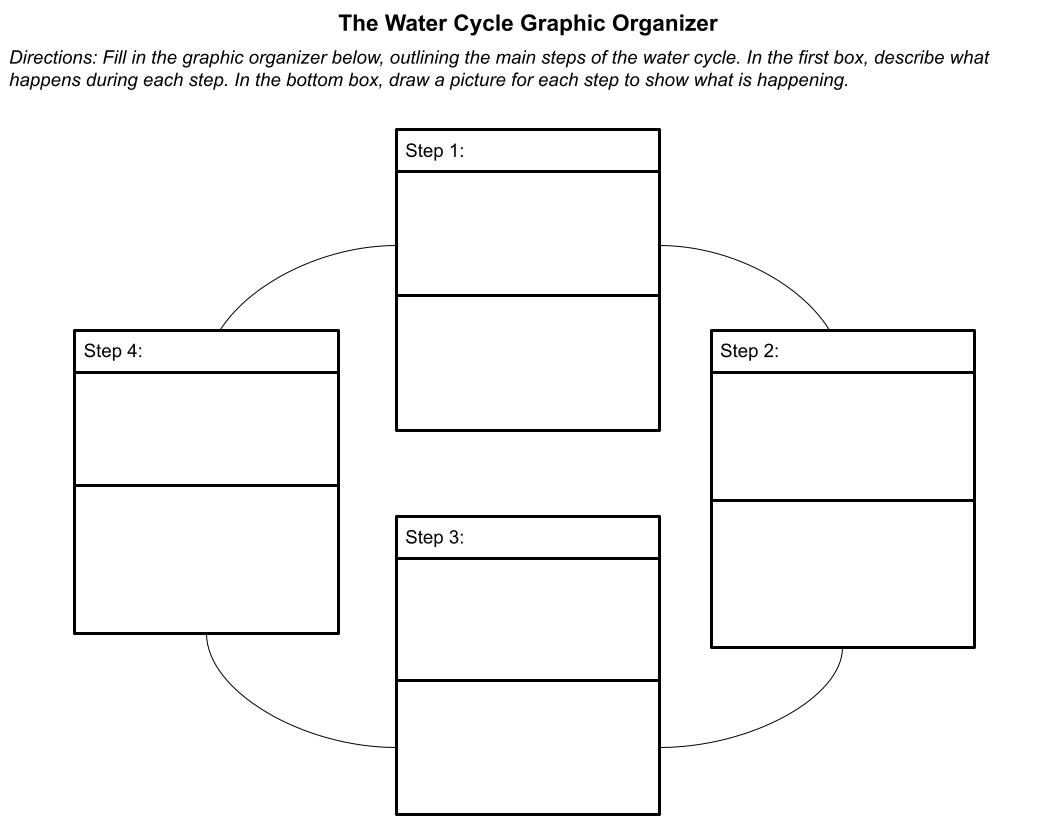
Once I decided this strategy was worth implementing, I approached implementation with a science brain where I created a control group and an experimental group. Both groups took the same pre- and post-assessments. The experimental group learned using graphic organizers and the control group relied on traditional reading comprehension strategies such as skimming and scanning the text, looking at bold words or phrases and reading the questions before reading the text. The groups switched to the next unit so that each group had experience learning content with and without graphic organizers. I was ultimately comparing the growth between each group to see if this strategy really helped improve students’ reading comprehension skills. I created my own graphic organizers based on each topic like the one sampled in the image below. I decided to follow the basic templates of hierarchical, cyclical, conceptual, and sequential graphic organizers where I added titles and phrases to help students understand the organization better. 

When looking at the data, I found that this strategy was helpful to my students, particularly those who categorize themselves as poor readers and/or those who were low achievers in science (D or F grade range). Survey data showed me that 67% of my students from Class A and Class B felt that using graphic organizers helped them understand content from the textbook better. They also provided written explanations stating that when using graphic organizers:

  • “It helped me because it breaks down everything.” 
  • “It helped me because it is more organized.”
  • “The content is simplified.”
  • “It is easier to find the answer.” 

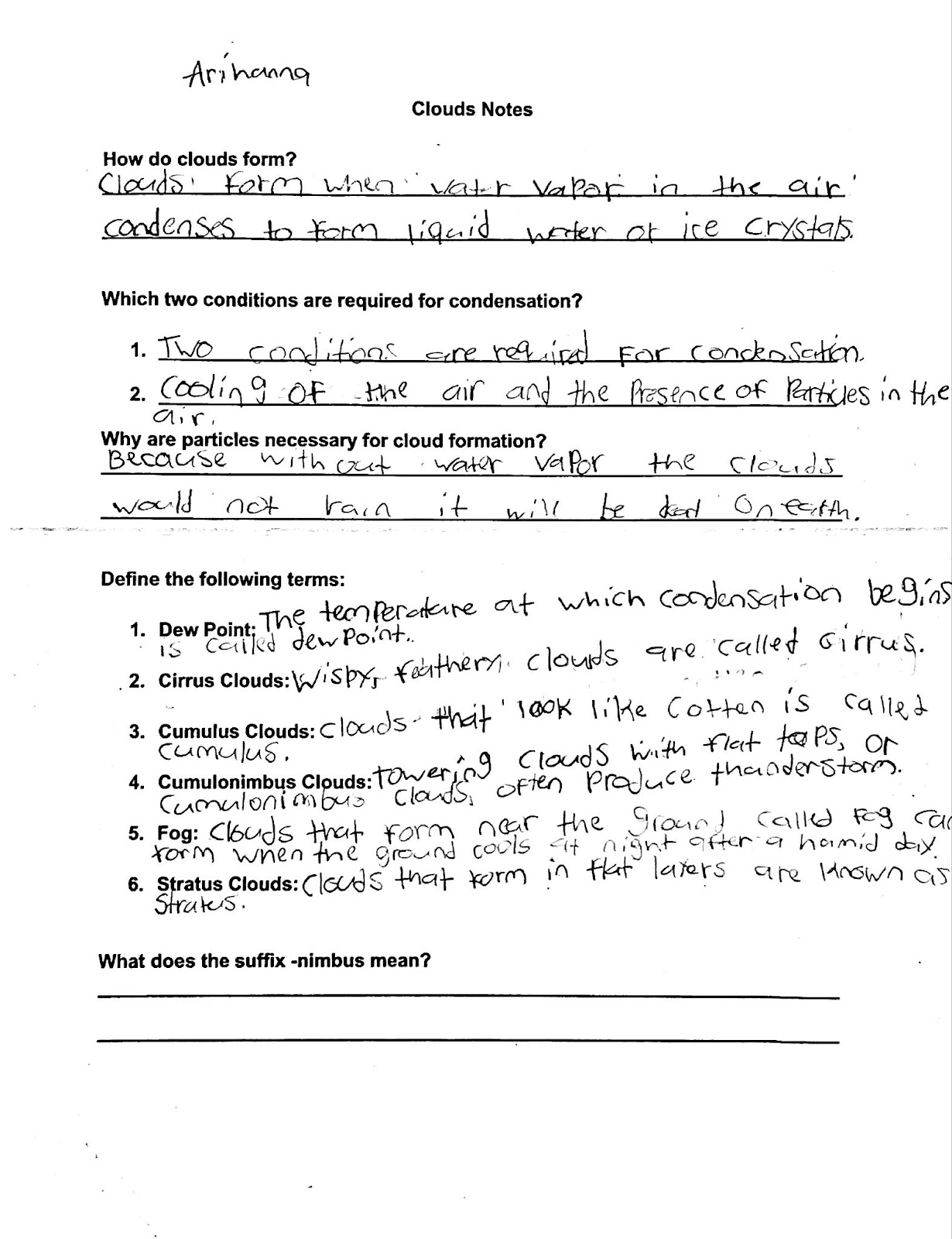
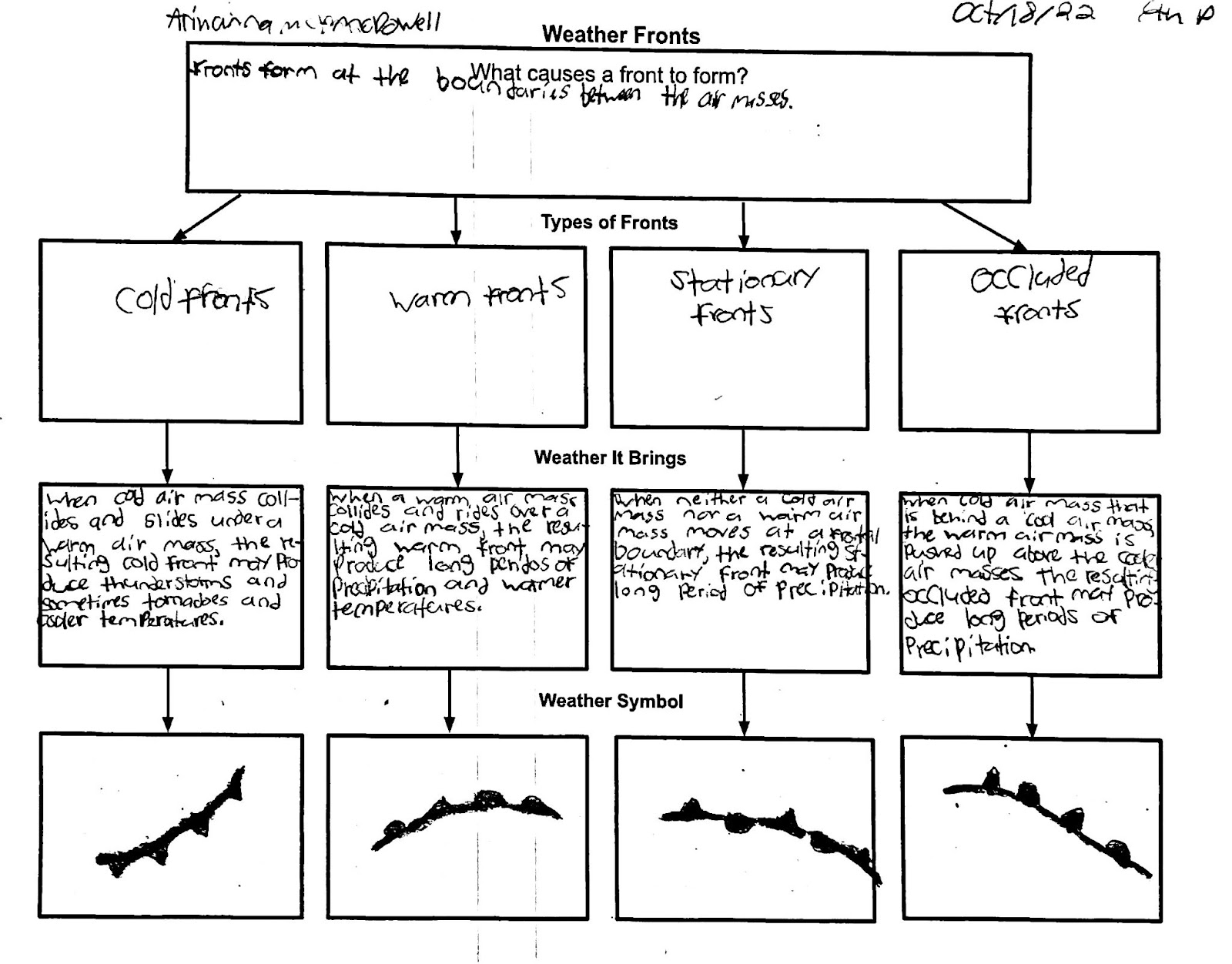
I also noticed that my low-achieving students experienced the most growth between the pre-and post-assessment while in the experimental group. For example, the two low-achieving students I focused on experienced a growth of 60 and 40 points when using the graphic organizers. This group of students also responded the most enthusiastically to the strategy. Before graphic organizers, the two focus students loathed completing written work. They both rated themselves as poor readers who are insecure about their reading ability. When comparing this behavior with their behavior during the use of the strategy, it was a 180-degree difference. These two students were writing down and completing the assignments. They were complaining that class was ending too quickly. They became more confident in the short time that I tried this strategy out. You can see for yourself the comparison between the work of my focus student, Ava, below: 

Ava’s Guided Note Sheet

When looking at the notes above, you can see that Ava did not complete the note sheet entirely. The answer to the question, “Why are particles necessary for cloud formation?” is answered incorrectly showing a lack of understanding. The final question is not answered so the notes lack some details. Now compare this with the graphic organizer completed below. Notice that the graphic organizer is entirely complete. Ava took the time to draw out each symbol and color it in. The definitions provided give enough details that Ava could use these notes to help her study or complete an assignment. 

Ava’s Graphic Organizer

While my foray into the world of graphic organizers was short, I find this strategy to be a promising one. This strategy is first and foremost easy to implement. There are numerous templates online or you can create your own using Google Slides or Google Drawings as I did. Simply print them out, explain what goes where, and see how your students do. The second plus to this strategy is that it teaches students how to pull out the important information within a wordy article and how to actually use this information when needed. Finally, this strategy was most effective with my struggling readers and I don’t know about you but If I can find a strategy that helps my struggling students become more successful I will. In conclusion, give graphic organizers a try today or tomorrow and see how they will help your students become better readers of science – and other expository – texts. 


My name is Schyler Anderson. I am an educator located in Sumter, SC. This will be my 4th year teaching 6th-grade science. I am a proud USC alumna. I got my bachelor’s degree in middle-level education with a concentration in math and science and my master’s degree in teaching with a focus on PBL.

Cover Photo by Jess Bailey on Unsplash

Why is poetry important in the classroom?

Teaching

As a future educator and a current student, I find poetry an amazing outlet for students to express themselves. I, personally, use poetry to release these great big emotions I feel. In my high school, we had a lot of mental health concerns in our student body with little to no action. I was a high schooler losing two to three friends each school year. High school was hard enough but this on top of everything else made it 10x harder. Around this time is when I started writing poetry. My English teacher had a whole unit on poetry where we had to write poetry, research poets, and end with slam poetry where I read a poem by Maya Angelou. I still remember the whole poem. This unit really pushed me to think differently about the power of poetry. This is when I bought myself a new journal and started writing my own. 

Writing poetry helped me a lot with processing my emotions and help me through my high school years. Even in class when we had free writing time, I would write poetry. I still do this, not as much, I’ll randomly think of a thought and start writing off that thought. It is a great way for a student to relieve stress and express themselves without talking about it. This is why I found it reliving, I didn’t have to vocalize why I was upset or why I was happy… I could just write.   

As educators, it is important for us to use this tool as well. Providing a way for us to express and reflect is vital, considering we ask our students to do the same. By allowing our students to write poetry in the classroom, we are creating a space where students can communicate their emotions or thoughts. This is vital because some of our students may not be allowed this opportunity often. You may be the first person to encourage your students to do this openly. By allowing your students to do this, you are creating a welcoming environment in your classroom. In my classroom, having a welcoming environment for students is very important for me. This means being welcoming to new ideas, understanding, and backgrounds. In my classroom, breaking the stigma around mental health will be a must and I believe poetry is a great way to start. 

Mental health is a growing problem in our schools, our student’s academics and extracurricular activities are evidence of this. As educators, we spend more time with these students than most parents or guardians. This grants us the opportunity to talk about mental health in a productively and openly way. Instead of running from this concern of mental health, let’s embrace this time to create a warm and meaningful connection with our students. Poetry opens the doors to this. Even having five minutes set aside in class for your students to write could mean the world to them. 


This piece is written and submitted by Caroline Graham.

Caroline Graham (she/her/hers) is currently a College of Charleston student majoring in Secondary Education and English. She is a South Carolina Teaching Fellow at the College serving as the President. You can see more of Caroline on her website:  https://cgaggraham.wixsite.com/website 

Cover image by kyo azuma on Unsplash

Like painters, writers can stir the mind

Teaching

This piece is written and submitted by Dr. Angela M. Cozart.


I have to admit, I hated poetry when I was in school. I hated having to figure out what an author was saying. Why couldn’t they just come out and say what they wanted us to see and hear?  I remember reading ‘The Windhover’ by Gerard Manley Hopkins and being completely confounded. Understanding poetry was like trying to solve a jigsaw puzzle without having seen what the completed picture was supposed to look like.

In college I studied William Wordsworth and Langston Hughes. For the first time, I read poetry that was easy to understand and yet beautiful. Its simplicity did not detract from the beauty of form and content. Because I didn’t feel defeated from the start, I began to read other kinds of poetry, the kind that had turned me off to poetry while in high school. I wish I had come to a greater appreciation of poetry while in K-12. I had missed out on so much. But what had I missed out on? Why should children read and learn about poetry?

Poetry helps us to see the world through someone else’s eyes. We can do the same with essays, short stories and novels, but poetry is life and experiences in concentrated form; it doesn’t take long to read a poem, yet an author can concentrate emotions and feelings that would take pages to convey in a novel or poem. Teenagers with  angst can find relief when they read a poem to find out others have shared their own experiences. Thus, poetry can be personal and powerful, but its impact can also be felt on a national or global level.

Just how powerful and impactful is poetry in the world of politics? It is so impactful that Stalin caused Anna Akhmatova to memorize and then destroy all her personal written poems, all so Stalin could not silence her poetic voice. Like painters, writers can stir the mind, but sometimes more importantly, they can stir the heart and passions, especially when rousing people to a cause.  Students can come to appreciate the power of words, how a poem can rally people to a cause; there are poems of resistance, protest, and empowerment. Certainly students should be exposed to such words and ideas.

Poetry writing empowers students and builds their confidence. Writing an essay can be daunting for some students, but when they are introduced to and encouraged to write simple poems such as acrostics, they usually eagerly embrace the challenge. 

Poetry helps students to appreciate the beauty of subtlety, how so much can be said indirectly. They can come to appreciate the power and beauty of words. It can build vocabulary and encourage abstract thinking. Poetry encourages students to analyze what they are reading. It exposes them to other cultures and beliefs. 

Why study poetry? Poetry empowers, arouses. Poetry helps students to put ideas and feeling on paper.

Poetry can stimulate the mind, and it can help students to get in touch with their own feelings. One year,  I had a student say the following to me in a letter. “I always thought poetry was for sissies. All my life I’ve suppressed my feelings, but this class has made me change my mind. I’ve come to understand that as a male I can embrace and express my feelings.” Those words were music to my ears.


Dr. Angela M. Cozart is a Professor Emerita in the Department of Teacher Education at the College of Charleston.

Photo by nikita velikanin on Unsplash

Use digital spaces and poetry to share a walk in your world

Research

The #WalkMyWorld project started as a community focus on poetry and multimodal exploration; it then developed into a community of inquiry. Participants explored the experiences of others by responding to and authoring multimodal poetry. In #WalkMyWorld, educators and students created a social space of engagement to explore civic uses of social media. This exploration served as an opportunity to consider the media literacies at play as the group participated as a community of writers. 

Guided by carefully-crafted learning events, participants took photos, authored short pieces, and filmed small glimpses of their lives. At weekly intervals, they documented their “walks” using photo and video capture tools that easily allow users to share content with others. By collecting snippets of their worlds that seemed trivial one at a time, participants experienced the magic that, when strung together, these digital “gatherings” presented narratives of very human things: pain, beauty, joy, friendship, and wonder. 

During the project, instructors were able to target specific educational objectives revolving around (but not limited to) explorations with poetry. With the understanding that creating and sharing digital content in online spaces might be a novel and even scary experience, instructors also charged participants to grapple with what to share and how. This raises questions between educators and learners as they contemplate how and how much to share. Accordingly, thoughtful experimentation online, connection with digital texts and tools, and play ultimately serve as valid, if not crucial, educational outcomes. 

This project encouraged educators and students in elementary school through higher education to engage in social scholarship practices. Social scholarship utilizes the Internet and other communication technologies to evolve the ways in which scholarship is conducted. Like many other social scholarship projects #WalkMyWorld connected formal scholarship with informal Internet-based social practices while embodying specific values (e.g., openness, collaboration, transparency, access, sharing). #WalkMyWorld evolved into a space that allowed participants to explore the characteristics of online information and educational opportunities by allowing them to share and develop (a) writing lifeworlds, (b) communities of inquiry, (c) media literacies and (d) expanded perspectives of narrative writing. These skills have proven to be integral to the way teachers view themselves as professionals in online and hybrid educational spaces.

The trailer shared above was created for a session on the project released at the K12 Online website. The full video for the session is available below.

Work with the 2014 version of the #WalkMyWorld Project was printed in the MIT Civic Media Reader.

Results from the 2015 iteration of the #WalkMyWorld Project were also presented at the annual conference of the Literacy Research Association. Work from this session by Wise and O’Byrne was later published in the Literacy Research: Theory, Methods, and Practice journal.

The #WalkMyWorld Project was also highlighted in a publication by Rish and Pytash in NCTE’s Voices from the Middle and the accompanying podcast.

Lastly, in 2017 this project served as a motivating factor in this chapter on mentored open online communities (MooCs) as a third space for teaching and learning in higher education.

Photo by Murat Onder on Unsplash

Supercharging our Content Teaching with Language Objectives

Teaching

By: Samantha Rainwater, South Carolina High School English Teacher

Back to the Basics

Like every teacher during March of 2020, life threw me quite a difficult curveball: in the course of a few days, I needed to scrap all of the plans and dreams I established with my students and reimagine the rest of the year virtually. I don’t know how y’all handled it, but I was at a complete loss. My very organized book clubs, the brand new unit on The Kite Runner we had just launched, the highly-technical argument unit and Convince Me project we were in the thick of, all of it, upended. I had to start thinking about what—with my very limited time—I would focus on with my students. Ultimately, I decided that literacy through interesting and meaningful reading and writing would be my primary focus for the rest of the year. 

I bring this up specifically to discuss how, even as an English teacher, I have a lot of content that doesn’t fall under the “reading skills” category. However, literacy is the key to our students’ ability to access our content. If I wanted my students to be prepared for the next school year, the task was not to continue my content-heavy units or teach all the figurative terms they would encounter in English 3, but to make sure that students’ literacy skills continued to develop.

We’ve heard it all before, maybe from a district official or an administrator at the beginning of the year: We are all reading teachers. But let’s be real. We have standards and pacing guides and benchmark assessments and end-of-course tests and the list goes on. For content-area teachers, how can we possibly add on the task of developing students’ literacy? After all, they take ELA.

The Case for Disciplinary Literacy

I had a major revelation this year when it came to literacy, and I think in many ways my background as an English teacher kept me from this revelation sooner. Secondary education relies on literacy skills as a means of accessing content knowledge; however, literacy isn’t just literacy. There are two major theories regarding how literacy works: content-area literacy, which suggests reading strategies transfer between content areas (Vacca, Vacca, and Mraz 2011), and disciplinary literacy (Shanahan & Shanahan, 2012), which suggests and “acknowledges that different disciplines contain different purposes for language, ways of communicating, and requirements for precision” (Croce, 2017). While it’s important to understand that some reading strategies do transfer, it is also important to acknowledge the merits of disciplinary literacy. It’s not like kids learn to read, then immediately their literary lives are unlocked, and they can henceforth access all written knowledge presented in all subject areas. Each academic discipline has its own discourse styles and structures that students have to learn and master because they are so unique and different from the typical ways we engage and use language socially. The literacy and discourse structures that are taught in the ELA classroom might not be sufficient for students dealing with the very specific types of literacy present in the science or math classrooms. For this reason, the very best teachers of literacy in content-area classes are the content-area teachers themselves! I know, what does an English teacher have to say about literacy in other disciplines? But hear me out. It might even make teaching your content more effective.

An Example: Disciplinary Literacy in the Science Classroom

Science teaching, for example, depends on informational texts to communicate content knowledge, to teach facts to students. However, what happens when a student’s observations of the world around them do not match the facts being presented in the scientific texts they are reading? What understandings of the scientific method and peer review process do students have to understand in order to comprehend and learn from these texts? Consider the words of Croce (2017): 

“According to conceptual change theory, a number of conditions need to be met in order for a student to change his or her mind about a science concept. Would a student be considered a poor reader if those conditions were not met and the student did not change his mind (in other words, learn a concept) after reading the text? I would argue that a student is not a poor reader if he or she does not immediately change his or her mind about a science topic after reading a text. This is because when we assess students as readers of science, it is impossible to separate who a student is as a scientist from who he or she is as a reader (emphasis added) (Croce, 2015).”

Being an effective scientist depends on being literate in scientific discourse styles, specifically. If we expect students to learn how hurricanes are formed through reading a text, we have to approach the reading of that text as scientists, which requires different literacy foundations than what is required in their English class (and reading in science, math, and social studies often has different goals than in ELA). Scientific texts also have unique language patterns (i.e. cause and effect relationships in scientific sequences) that need to be explicitly taught to students. Students reading in their literature classes may never encounter those specific language patterns. When students are taught these discourse styles, they are then able to make sense of the content presented in these texts. 

First Steps: Introducing Language Objectives

I don’t think that we necessarily have to be reading specialists on top of our content-area and pedagogical expertise. I do think, though, that we need to be aware of how our disciplines use language and provide instruction for our students so language isn’t a barrier to learning the content. One of the most meaningful ways that I’ve started doing this in my own classroom is through language objectives. Language objectives are similar to content objectives in that they articulate what students’ will be able to achieve by the end of a lesson or period of time. The only difference is that while content objectives describe what students will know and be able to do, language objectives describe how students need to use language in order for the content to be accessible. If you need a place to start in terms of understanding how language should be used at different proficiency levels, I recommend viewing WIDA’s Can Do statements. 

As you are planning a lesson, ask yourself a few questions: What discipline-specific and general academic vocabulary do my students need to know to meet the content objectives? How is language functioning in this lesson (Are we listening to a speech made by an historical figure? Recording observations in a science experiment? Describing? Predicting? Comparing? What language styles and structures do we need to employ to do these things?) What language structures or grammatical features are common in this lesson? (Are we reading an academic text with frequent passive voice? Imperatives? Does the organization of the text need to be understood for students to comprehend it better?) What functional language is used during this lesson? What do I observe about my students’ needs when it comes to language? 

By doing this, we will become more aware how language works in our disciplines, and we can then work to lower the linguistic hurdles students need to overcome to understand and excel in our content. We can also take the answers to these questions and design focused objectives and direct instruction related to the language of our disciplines. The beauty of designing language objectives is that it occurs alongside the teaching of our content objectives; we don’t pause our instruction to teach language and grow literacy. This can happen with small mini-lessons embedded in the larger instruction for the day. For example, in a high school chemistry lesson, the language objective might be that “Students will be able to use adverbs of time in their lab report to describe their observations (first, next, later)” (Echevarria et. al, 2011). Maybe, in a math lesson, students need to understand the language of conditionality in order to solve a word problem. From there, you would design a language objective. This might take all of 10 minutes, but it will enable students to meet the task of writing their scientific observations within their lab reports. 

Developing and strengthening literacy specific to our disciplines is not a separate, full-time job. Instead, we can use language objectives to make our content teaching even more effective.

About the Author

Samantha Rainwater is the current English department chair at Richland Northeast High School in Columbia, South Carolina. She has eight years of teaching experience in the ELA classroom and is currently working to complete her ESOL certification. 

We Need S’More Literacy from the Library!

Collaboration

By: Amanda Harris, South Carolina High Media Specialist

I love reading books, cataloging and shelving books, shopping for books, and placing books in readers’ hands, but as a high school media specialist, all that fun with books is only a small portion of my actual job. As a highly qualified educator who shares my literacy instruction skills with students and colleagues every day, my role goes far beyond the library stacks.

Since it’s summertime and I’m a girl who loves chocolate, indulge me for a few minutes and let me explain the library’s role in school-wide literacy instruction as an ooey, gooey, warm, melty, delicious s’more. 

The Graham Cracker

The foundation of a s’more is the graham cracker, providing support and structure on both sides to hold the entire concoction together. My goal as a media specialist is to provide resources and support for all content areas so that all teachers can be more effective in guiding students to content-specific literacy. Even though my district has 1:1 Chromebooks and students may think they can just Google everything for research, someone still has to teach them how to wade through their search results! One of the most important items on my to-do list in this graham cracker part of my job is to actively recruit teachers to share their classes with me. Once I have led them to realize how desperately they needed to schedule time for co-teaching (sometimes with free coffee involved in the persuasion), I make a point of threading my info literacy standards and skills over and over through every unit I teach across the curriculum. 

When I’m handing out the metaphorical graham crackers for the s’mores, I have to be intentional with teacher relationships, creative with my curriculum ideas, and even a little bit repetitive with teaching the skills to students, but without these graham crackers, the whole s’more falls apart and students lose opportunities for big-picture literacy application across the curriculum. 

Mmmm…Chocolate

My favorite part of the s’more, of course, is the chocolate, and my favorite part of being a school media specialist is definitely the fun library offerings: student book clubs over Chick-fil-a lunch boxes, faculty book clubs with grown-up conversation over breakfast snacks, author visits, makerspace crafting days, games and Legos out on the tables, and independent choice reading checkouts. These are the pieces of the school-wide curriculum puzzle that make the whole idea of literacy more enjoyable. 

Photo by Allie on Unsplash

The obvious sticking point here is that by the time students reach high school, very few of them are going to seek pleasure reading opportunities or spend their free time hanging out with a book club. How do I offer chocolate for the s’mores of students who are reluctant readers? I’m grateful to have some fantastic colleagues (not just in the English department!) who value choice reading enough to bring their students to me for independent reading checkouts. Sometimes they have target genres, sometimes they have target themes, and sometimes they want students to just pick anything that looks interesting.

During this past year, we blocked off a weekly time with some of the English 1 and 2 classes to just come into the library for a routine sustained reading period. Their classroom teacher, my fellow media specialist, and I all sat down with them on the couches and modeled reading for fun, too! (Well, that was the plan. I actually spent more of my time up out of my seat, in the stacks, helping students find their next books to read, but that was fine with me!) When we suddenly switched to distance learning, I missed all of my students, but these two classes were the ones I most desperately wished to see.

Pleasure reading and finding a book to enjoy is the chocolate in the middle of the school-wide literacy s’more, and while I do love chocolate with all my heart, seeing reluctant readers find books they like and seeing students come to the library for fun in their free time brings me more joy than an entire one-year supply of my favorite Harry & David dark chocolate truffles.

Sticky Marshmallows

Photo by Rebecca Freeman on Unsplash

Finally, I must address the sticky, fire-roasted marshmallow that holds everything together between the graham crackers. At my school, this is the part of my media specialist role that doesn’t exactly fit the typical mold, but it just makes sense. If the library is the heart of the school and the media specialists should be dabbling in teaching with every department in the building, why not have your media specialist(s) serve as writing instructional lead teachers? 

I’m on a flex schedule and my teaching calendar does fill up with research projects and other library lessons. However, because there are two of us serving as full-time media specialists, we are able to schedule time to actively help teachers with writing instruction. We conference with teachers during their planning periods, or we go to their classrooms and help with a writing lesson or student writing conferences. The best part about this role is that sitting down to brainstorm a writing assignment with a teacher gives me an easy opportunity to market the library’s resources. 

I’ll be honest: Writing can sometimes be the stickiest part of school-wide literacy. Sure, everybody can fit more reading into their classrooms, but writing? Writing takes time to assess! Writing takes time to actually do in the classroom, precious time that is also needed to teach content-specific skills! Some students just don’t want to write, and it’s just more painful for everyone involved! Yes, yes, and yes. I totally get it, especially after 10 years in the English classroom and many hours of sleep lost to essay grading, but that doesn’t mean that writing instruction can just be swept aside. Writing = thinking, and it’s a critical part of the learning process.

Photo by Josh Campbell on Unsplash

Helping teachers regularly include more quality writing in their daily classroom routine has challenged me. I have had to study and learn more about how content literacy should look different across the departments, and I have had to lead some tense meetings, but I have also been able to see the exciting success my colleagues are having. To return to the marshmallow comparison, sometimes I accidentally drop my actual literal marshmallow in the fire, so I have to toss it and try again. Sometimes I don’t leave it in the fire long enough, so I have to try again. In the big literacy picture, writing instruction is the marshmallow, and sometimes we have to toss what we did and try again. Isn’t that what drafting and revising is all about? In the end, while the marshmallow is challenging to get just right, the finished s’more just isn’t complete without it.

Are you ready to go make some s’mores yet? If you want to get started on some figurative s’mores, go ahead and email your media specialist to get started on ideas for collaboration this year. If you want literal s’mores, keep the campfire far, far away from the library books.

About the Author

Amanda has twelve years of teaching experience and is beginning her third year as a high school media specialist at Walhalla High School.

What Can We Do To Support Our Students’ Trauma And Our Own During These Uncertain Times?

Teaching

By: Dr. Rachelle Savitz, Clemson University

Navigating Your Own Trauma

Photo by Katarzyna Kos on Unsplash

As the past weeks have unfolded, like many of my students and colleagues, the uncertainty of tomorrow, next week, the fall, and the world have caused me to struggle. I find myself experiencing life in a new way that consistently revolves around questioning my surroundings. For instance, when I went to the grocery store weeks ago, the amount of people walking around without a mask, coughing on others, and even one person sweating profusely caused my alarm bells to ring. I rushed home and realized I was in a state of panic; immobilized by fear of the unknown and fear of this potentially fatal disease. This traumatic experience continues to stay with me, and in fact, I have only gone back to the grocery store one additional time. Although my second experience made me feel safer because so many were wearing masks and there were limits on how many people were in the store, I was still worried and overcome with the feeling of sadness. Such a regular day-to-day situation, going to the grocery store, or any closed in space, has now become an immediate concern for me and a risk that I am not comfortable taking.

These same feelings continue as I watch news sources and read friend’s threads on social media about the loss of so many. When friends share their inconsolable grief at being unable to say goodbye to their loved one, or when I see the extremely long and growing lines at local food banks and the unparalleled call to support our communities, all of these experiences and moments leave me breathless with a sense of sorrow. These secondary traumatic experiences, and my own circumstances can easily lead to little hope. I often find myself critically reflecting, asking questions, and wondering how to get past this fear and enter a sense of calm and understanding. I wonder how others, students, friends, and colleagues are coping through these uncertain times. I am curious as to their feelings when going out in public, to restaurants or even getting a haircut. I question if I am being overly cautious, too cautious, or if my feelings and precautions are “normal.” Most importantly, I wonder when I will feel safe again. Sadly, none of these questions have immediate and definite answers.

As each day passes, I am constantly attempting self-care, as Kathleen Pennyway described in her post last week. For me this means taking time to get lost in a good book, catching up on a recorded tv show, or calling a friend to share experiences. I quickly learned that by sharing my experiences – my fears, my successes, my failures, and my daily situation, I felt a better sense of hope and calm. I was able to understand that although my experiences are my own, many can relate. Some offer words of wisdom and others relate their own experiences. None provided judgment. This relates to what Elizabeth Dutro shared in her post, and in her very important book, the concept of reciprocal witnessing. Although I did not know this term until recently, I have always understood the power of sharing our stories (testimonies) and having others listen – really listen and provide empathy, is powerful. 

Navigating Student Trauma: The Importance of Connection to Heal

In our book, Teaching Hope and Resilience for Students Experiencing Trauma: Creating Safe and Nurturing Classrooms for Learning, Doug, Nancy, and I discuss how teachers can leverage literacies as tools to help our students navigate their lives, building capacity to respond to troubling times. We share how collaborative and meaningful discussions, using texts, and writing can build children’s and adolescents’ resilience. These ideas not only allow teachers to support students’ well-being and social-emotional learning, but they also address required content. But what could this look like in an online environment?

Ways to Leverage Literacies as Tools to Help Students Navigate Their Lives

Discussion to build

Of utmost importance when implementing any of these, is the ability to be a warm-demander, building upon already created teacher-student relationships in an online format. Peer relationships are just as important online, as in person, too. Although different, community can be built and developed. Salena Davis discussed in her post the importance of communication. This not only relates to what Dutro shared, but also aligns with the need for discussion with our students and for them to discuss with their peers. This may relate to sharing their stories, but we can also encourage discussion related to our own content and what they are learning or reading. For instance, I use Voicethread to share my lesson, embedding additional material, such as links to videos. On each slide, I provide my lecture, but add specific questions related to the content or ways to promote connection among the group. Students can respond to me or one another via audio, video, or text. These discussions are asynchronous but allow students to continue building community. Often, my students bring up their own personal connections to the material and relate it to their own lived experiences.

Reading to relate

Photo by Seven Shooter on Unsplash

Another way to support student learning and choice is within our text selection. I recently had a teacher ask me about what book she could assign to her students now that they were remotely learning. My quick response was “what do they want to read?” If there are specific types of analysis questions that this teacher wanted to use, then she could provide an open theme or topic and let students choose their book. By giving her students options in what they read, she can still focus on analysis, the main goal, but also support student motivation to continue reading. Her students could synchronously meet with her and their classmates weekly (more or less) and share pieces of their book that has excited them, things they questioned as they read, or even how the student may have related to the situation, events, or characters. For instance, maybe a student reads about a character facing the death of a loved one. The student may share her own experiences that relate. Or, another student may read about inequities and ask questions of her peers (and the teacher) related to the inequities in her own life or within this current pandemic. Inquiry-based learning is a great way to provide choice in research for classrooms that do not use literature.

Writing to remember

Over the past few weeks, I have had quite a few students, all current teachers, wanting, more importantly, needing to share their experiences. Some created a running online journal with me, where they record their thoughts, feelings, and questions, and then I either respond, ask my own questions, or share my experiences. This may not work for all students, and it could be time consuming for a teacher to journal with all students. Therefore, we can encourage our students to support their own healing through private autobiographical writing. They can then choose if/when to invite other adults or peers to listen. As Kathleen Pennyway mentioned, having an open door, or in these days, an open email policy, is important. We want to ensure that our students and colleagues have a way to reach out and share, ask questions, or tell their stories.

Outside experts and a plan

While we want to communicate to our students that their voices count and can create constructive change, not accepting unjust realities, we must also remember that topics may inadvertently trigger memories or reactions related to additional traumas. It is important to have a plan to monitor students’ unease or if the topic may be too much in the moment. It is important to remember what we learned from Guy Ilagen’s post – our school counselors are available. As educators, we need to keep in mind our state’s mandated reporter requirements as we continue monitoring our students and their situations. If there is reason for concern, we need to reach out to our more trained peers. More importantly, we can reach out to our fellow colleagues and check in on them.

Where do We go From Here?

Photo by Vicky Sim on Unsplash

As I wrap this up, I want to emphasize that we can promote student empowerment and agency. I have found that by asking my students what they want or need is powerful. Through these discussions, we co-constructed knowledge and negotiated ways for students to demonstrate their learning and growth. Our students faced many hardships and traumatic experiences prior to this pandemic. Now, we are all experiencing this together. It is vital that we provide the time and space for our students to safely share their concerns and be human. This process starts by first sharing a bit of ourselves. I will never forget the moment of relief I noticed in my students when I shared my grocery store experience. It was like a huge weight was taken away from each of them. Although this did not allow for immediate conversation related to content, I found that these teachers needed to download their fears and connect with one another. These teachers shared their fears, connected and asked questions about transitioning their own classrooms to online, and ultimately realized the similarities and differences occurring across lives. Although all of my students were adults, they needed to know that the proverbial door was open.

Finally, I feel it important to thank all of my friends, colleagues, peers, fellow teachers and students for all that they are doing during these unstable times. Most importantly, I want to thank everyone reading this for bearing witness to my own traumatic experiences as I shared a piece of my story. I want every person reading this to know that it is okay to feel uncertain. I challenge each of you to reach out to someone and share your thoughts and feelings, inviting them to reciprocate.  

About the Author

Dr. Rachelle S. Savitz is an assistant professor of adolescent literacy at Clemson University having been a K-12 literacy coach/interventionist and high school reading teacher. She is the recipient of Association of Literacy Educators and Researcher’s Jerry Johns Promising Researcher Award, American Reading Forum’s Gary Moorman Early Career Literacy Scholar Award, finalist for International Literacy Association’s Timothy and Cynthia Shanahan Outstanding Dissertation award, as well as Secondary Reading Council of Florida’s Reading Teacher of the Year award. She has published articles on inquiry-based learning, analysis and use of young adult literature, and response to intervention.