As an incredibly extroverted third year principal I have really taken inventory of my thoughts and feelings about this new reality that we are all attempting to adjust to. I always knew that I drew my energy from people and depended heavily upon my daily interactions with hundreds of people, but I had no idea just how much. So, as I am racking my brain to figure out new and creative ways to interact safely with my people while practicing “social distancing,” I can’t help but wonder how the isolation is impacting our students and their families. Whether we draw our energy from interactions with others or if those same interactions take all of our energy from us, we ALL still benefit from being in community and actively participating in face-to-face interactions.
I am not a psychologist or sociologist and have really no research for my thoughts, other than observations of others and limited interactions with others. The word that seems to be coming up over and over is frustration.
Everyone just seems to be frustrated!
The teachers are working overtime to meet the needs of all students by creating countless video lessons, trouble-shooting technology issues, ensuring that their students basic needs are being met, while also following up with parents of students that have not checked in or completed an assignment in a while. The parents are frustrated. Not only are they dealing with the stress and uncertainty that this virus has added to their work-life and financial future, but they are also adapting to the new reality that they are now a full time, home-based teacher and were given less than 24 hours notice to make the necessary preparations to accept this new role. School and district level administrators are attempting to be in constant communication with everyone to ensure that we are heading to a point of equilibrium and sustainability as we are all starting to understand that this could be our reality for the foreseeable future.
I have no doubt that we will adapt. Human beings have been adapting to new situations since the beginning of time. I guess my concern is what if we actually do adapt? What if our new reality is one without handshakes, high fives, and fist bumps? What if “social distancing” is our new reality? It is my fear that social and personal interaction will go down and that technology consumption will go way up.
One thing that is very important to me, as a middle school principal, is that we are constantly embedding those very important social emotional skills. We teach the students how to make good eye contact while delivering a strong and confident handshake. We teach our students how to take a welcoming and non-threatening posture while involved in a conversation. We understand there are still plenty of opportunities to practice good social skills while social distancing but the prospect of this new reality is really hard to think about.
About the Author
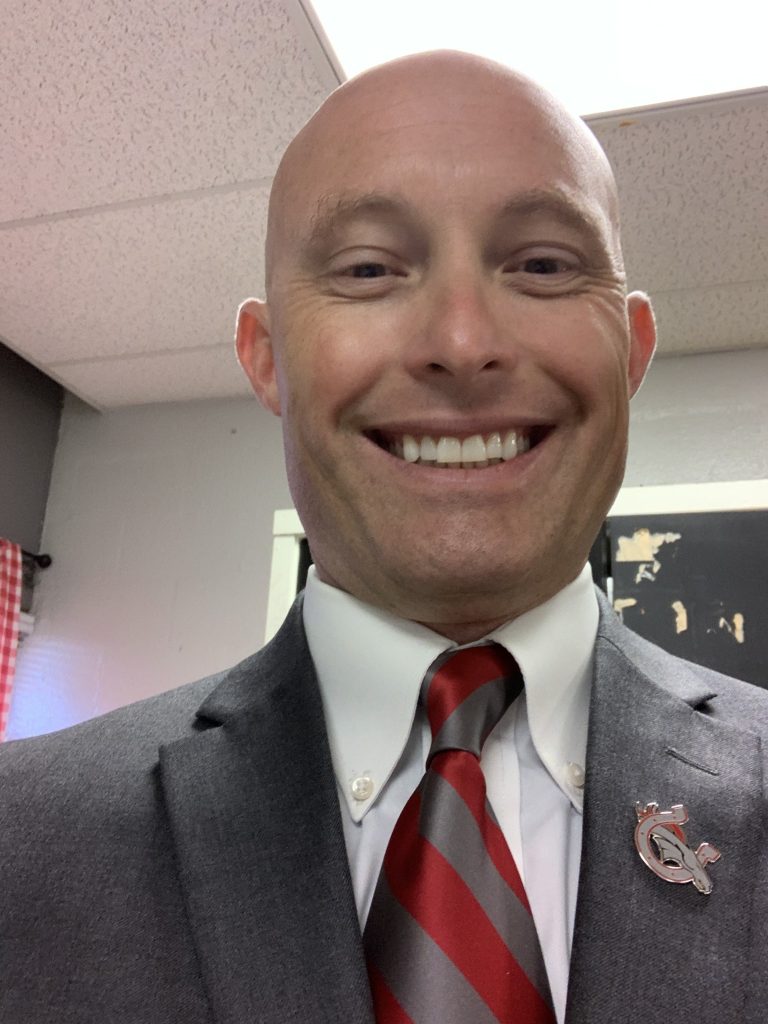
Jason McCauley is the Principal of Palmetto Middle School. He is wrapping up his fifteenth year in education. Jason served as a Spanish teacher for five years, assistant principal for seven years, and just finished his third year as principal at Palmetto Middle School. During his time as an educator, Jason coached baseball and football. He has been married to his wife, Amanda, for fifteen years and they have two sons; Wyatt and Briggs.
By: Addie Laney, South Carolina High School Student
Perspective. Many of us learned this word in art class when we were younger, but didn’t quite understand how it would apply to our lives on a broader scale, not yet. I thought it was an art term, then I learned this word is more than an art term. Perspective is the opinion form around a topic and how you choose to view issues. When thinking about the Coronavirus, the first thing to come to mind are negative thoughts, which is natural. As the cases rise, so does the fear, and so does the trauma that some people experience.
There are questions we never thought we would be asking, like: “What if i get it?” “What if my loved ones get it?” “When will I see my friends again?” Now those are questions we hear everyday. It’s okay to feel this way. No one knows what the next steps are involving the world’s peculiar situation right now.
Even though the level of uncertainty is so high involving the Coronavirus, one thing we can be certain of and have control over is our perspective.
I asked my friends to share negatives and positives they have found during this time of quarantine and social distancing. The video proves the undeniable truth and power of perspective. During this time we can choose to focus on how the stores aren’t open, how we can’t see all of our friends, or even how much we miss stepping into a school building everyday to learn. Or, we could focus on the good. We can spend more time with our families and reconnect with them again. We can focus on other values we have in life, like religion. We can learn new hobbies that help us find out new stuff about ourselves. Most importantly, we can learn how to truly appreciate what we have.
This is how we can view not only the situation involving the Coronavirus, but any situation life throws at us. Focusing on the negative, in a time like this, isn’t going to change anything or how anyone is feeling, it just feeds our trauma. We can choose to turn what could be a traumatic experience into a good, life changing experience and instead choose to heal ourselves, better ourselves and support ourselves. I choose to smile and stay safe. I hope you will too by focusing your perspective not on the negative, but on the positive.
About the Author
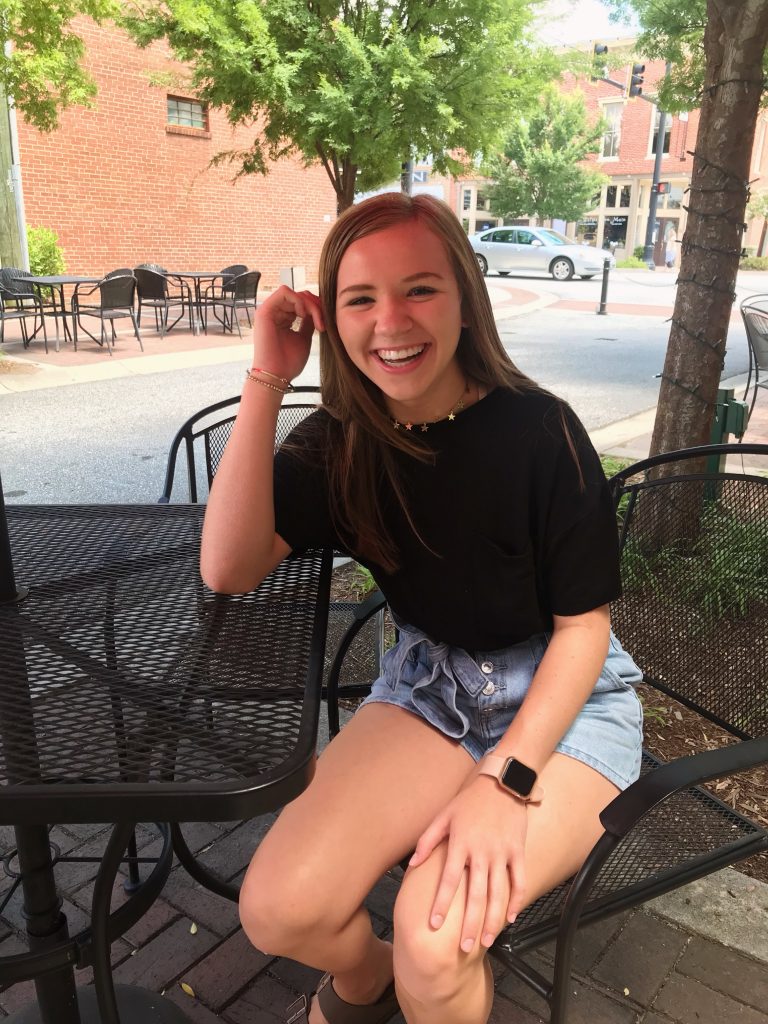
Addie Laney is a rising junior. She is the Fine Arts Chair of Student Council, President of Fellowship of Christian Athletes, a member of Future Farmers of America, a member of Youth Leadership for her county of residence and the Public Relations Chair for National Honor Society. She is also a member of her high school tennis team and a member of the senior dance in dance academy. She aspires to attend USC and become a therapist.
As the past weeks have unfolded, like many of my students and colleagues, the uncertainty of tomorrow, next week, the fall, and the world have caused me to struggle. I find myself experiencing life in a new way that consistently revolves around questioning my surroundings. For instance, when I went to the grocery store weeks ago, the amount of people walking around without a mask, coughing on others, and even one person sweating profusely caused my alarm bells to ring. I rushed home and realized I was in a state of panic; immobilized by fear of the unknown and fear of this potentially fatal disease. This traumatic experience continues to stay with me, and in fact, I have only gone back to the grocery store one additional time. Although my second experience made me feel safer because so many were wearing masks and there were limits on how many people were in the store, I was still worried and overcome with the feeling of sadness. Such a regular day-to-day situation, going to the grocery store, or any closed in space, has now become an immediate concern for me and a risk that I am not comfortable taking.
These same feelings continue as I watch news sources and read friend’s threads on social media about the loss of so many. When friends share their inconsolable grief at being unable to say goodbye to their loved one, or when I see the extremely long and growing lines at local food banks and the unparalleled call to support our communities, all of these experiences and moments leave me breathless with a sense of sorrow. These secondary traumatic experiences, and my own circumstances can easily lead to little hope. I often find myself critically reflecting, asking questions, and wondering how to get past this fear and enter a sense of calm and understanding. I wonder how others, students, friends, and colleagues are coping through these uncertain times. I am curious as to their feelings when going out in public, to restaurants or even getting a haircut. I question if I am being overly cautious, too cautious, or if my feelings and precautions are “normal.” Most importantly, I wonder when I will feel safe again. Sadly, none of these questions have immediate and definite answers.
As each day passes, I am constantly attempting self-care, as Kathleen Pennyway described in her post last week. For me this means taking time to get lost in a good book, catching up on a recorded tv show, or calling a friend to share experiences. I quickly learned that by sharing my experiences – my fears, my successes, my failures, and my daily situation, I felt a better sense of hope and calm. I was able to understand that although my experiences are my own, many can relate. Some offer words of wisdom and others relate their own experiences. None provided judgment. This relates to what Elizabeth Dutro shared in her post, and in her very important book, the concept of reciprocal witnessing. Although I did not know this term until recently, I have always understood the power of sharing our stories (testimonies) and having others listen – really listen and provide empathy, is powerful.
Navigating Student Trauma: The Importance of Connection to Heal
In our book, Teaching Hope and Resilience for Students Experiencing Trauma: Creating Safe and Nurturing Classrooms for Learning, Doug, Nancy, and I discuss how teachers can leverage literacies as tools to help our students navigate their lives, building capacity to respond to troubling times. We share how collaborative and meaningful discussions, using texts, and writing can build children’s and adolescents’ resilience. These ideas not only allow teachers to support students’ well-being and social-emotional learning, but they also address required content. But what could this look like in an online environment?
Ways to Leverage Literacies as Tools to Help Students Navigate Their Lives
Discussion to build
Of utmost importance when implementing any of these, is the ability to be a warm-demander, building upon already created teacher-student relationships in an online format. Peer relationships are just as important online, as in person, too. Although different, community can be built and developed. Salena Davis discussed in her post the importance of communication. This not only relates to what Dutro shared, but also aligns with the need for discussion with our students and for them to discuss with their peers. This may relate to sharing their stories, but we can also encourage discussion related to our own content and what they are learning or reading. For instance, I use Voicethread to share my lesson, embedding additional material, such as links to videos. On each slide, I provide my lecture, but add specific questions related to the content or ways to promote connection among the group. Students can respond to me or one another via audio, video, or text. These discussions are asynchronous but allow students to continue building community. Often, my students bring up their own personal connections to the material and relate it to their own lived experiences.
Another way to support student learning and choice is within our text selection. I recently had a teacher ask me about what book she could assign to her students now that they were remotely learning. My quick response was “what do they want to read?” If there are specific types of analysis questions that this teacher wanted to use, then she could provide an open theme or topic and let students choose their book. By giving her students options in what they read, she can still focus on analysis, the main goal, but also support student motivation to continue reading. Her students could synchronously meet with her and their classmates weekly (more or less) and share pieces of their book that has excited them, things they questioned as they read, or even how the student may have related to the situation, events, or characters. For instance, maybe a student reads about a character facing the death of a loved one. The student may share her own experiences that relate. Or, another student may read about inequities and ask questions of her peers (and the teacher) related to the inequities in her own life or within this current pandemic. Inquiry-based learning is a great way to provide choice in research for classrooms that do not use literature.
Writing to remember
Over the past few weeks, I have had quite a few students, all current teachers, wanting, more importantly, needing to share their experiences. Some created a running online journal with me, where they record their thoughts, feelings, and questions, and then I either respond, ask my own questions, or share my experiences. This may not work for all students, and it could be time consuming for a teacher to journal with all students. Therefore, we can encourage our students to support their own healing through private autobiographical writing. They can then choose if/when to invite other adults or peers to listen. As Kathleen Pennyway mentioned, having an open door, or in these days, an open email policy, is important. We want to ensure that our students and colleagues have a way to reach out and share, ask questions, or tell their stories.
Outside experts and a plan
While we want to communicate to our students that their voices count and can create constructive change, not accepting unjust realities, we must also remember that topics may inadvertently trigger memories or reactions related to additional traumas. It is important to have a plan to monitor students’ unease or if the topic may be too much in the moment. It is important to remember what we learned from Guy Ilagen’s post – our school counselors are available. As educators, we need to keep in mind our state’s mandated reporter requirements as we continue monitoring our students and their situations. If there is reason for concern, we need to reach out to our more trained peers. More importantly, we can reach out to our fellow colleagues and check in on them.
As I wrap this up, I want to emphasize that we can promote student empowerment and agency. I have found that by asking my students what they want or need is powerful. Through these discussions, we co-constructed knowledge and negotiated ways for students to demonstrate their learning and growth. Our students faced many hardships and traumatic experiences prior to this pandemic. Now, we are all experiencing this together. It is vital that we provide the time and space for our students to safely share their concerns and be human. This process starts by first sharing a bit of ourselves. I will never forget the moment of relief I noticed in my students when I shared my grocery store experience. It was like a huge weight was taken away from each of them. Although this did not allow for immediate conversation related to content, I found that these teachers needed to download their fears and connect with one another. These teachers shared their fears, connected and asked questions about transitioning their own classrooms to online, and ultimately realized the similarities and differences occurring across lives. Although all of my students were adults, they needed to know that the proverbial door was open.
Finally, I feel it important to thank all of my friends, colleagues, peers, fellow teachers and students for all that they are doing during these unstable times. Most importantly, I want to thank everyone reading this for bearing witness to my own traumatic experiences as I shared a piece of my story. I want every person reading this to know that it is okay to feel uncertain. I challenge each of you to reach out to someone and share your thoughts and feelings, inviting them to reciprocate.
About the Author
Dr. Rachelle S. Savitz is an assistant professor of adolescent literacy at Clemson University having been a K-12 literacy coach/interventionist and high school reading teacher. She is the recipient of Association of Literacy Educators and Researcher’s Jerry Johns Promising Researcher Award, American Reading Forum’s Gary Moorman Early Career Literacy Scholar Award, finalist for International Literacy Association’s Timothy and Cynthia Shanahan Outstanding Dissertation award, as well as Secondary Reading Council of Florida’s Reading Teacher of the Year award. She has published articles on inquiry-based learning, analysis and use of young adult literature, and response to intervention.
My classroom was fully invested in the practice of trauma-informed teaching. I was confident in my ability to build relationships with students that were based on honesty, listening, and mutual respect. I used those relationships to strengthen my students’ academic and social-emotional abilities. We had regular meditation practice in my room for all of my students. I had a couch in the corner that students frequently used to calm down if they needed to decompress from a stressful situation, and snacks in my office if anyone had forgotten breakfast. There were signs in my room celebrating diversity and respect for all, and my students regularly had conversations about race, police brutality, sexism, gender and sexuality, and other issues of social justice. I had agreements with other teachers in the school that if they needed a student to cool down for a second, they could send that student to me. Each of these strategies was designed to center my students’ needs, and to help them to deal with traumas such as violence, home instability, and poverty.
My students frequently commented the drama room was the place they felt safe, and I wore that accolade with as much honor as the awards we won at state competition. And there were many teachers at my school who were doing these things – I was only one part of a committed group of teachers who were working towards trauma-informed practice as our goal. Our school was making leaps forward, with plans for student and teacher wellness rooms, a good amount of teacher buy-in, and successful professional development opportunities. In short, there was momentum building in trauma-informed practice.
And then, the virus charged through our country and ripped apart everything that we had built.
I don’t know that I have ever felt as lost as an educator as I have during the past six weeks. I felt I was working harder than I have ever worked, and simultaneously I was failing at my job in reaching students. There were many times when I felt like giving up in despair. But I didn’t. As educators, our mantra is monitor and adjust, so I did. I made many mistakes over the course of learning how to teach theatre virtually, but I believe I have arrived back where I belong, with trauma-informed practice at the center of my teaching.
Here’s what I have learned.
1.Keep relationships at the center of your job
In the normal world, my classroom is constantly filled with of young people. From before the first bell rings, to long after everyone else in the building has left, there is theatre happening in Room 133. But more than that, I have worked hard to make the drama room a space where my students feel comfortable and safe. Whether kids needed a nap on my futon, a minute in the costume closet to cool down, or a chat in my office, they came to the drama room to find it.
Part of trauma-informed practice is creating a physical space that helps students relax and be able to learn. The loss of the physical space of my room left me without a huge tool to check in on students who are struggling academically and emotionally. The relationships built in school are grounded in the physical space of our classrooms. In a COVID-19 world, reduced to Zoom meetings and virtual assignments, our ability to connect and build relationships suffered. One of the things I miss the most about school is the ability to connect with my students easily and naturally on a human level. To say “Hey, I read that book you told me about,” or “What did you think of this scene in a play?” or “Have you heard about the new video game?” and hear about their interests and their dreams and who they are as people.
As online teachers, we need to be more intentional than ever in our efforts to build and maintain relationships with our students. Some of the things I did to maintain those relationships included starting weekly Instagram posts where I would pose a silly theatre related question that students could respond to. I hosted watch parties of plays on Zoom and virtual “lunches” in the drama room. And I started reserving time in our Zoom classes to ask my kids to share things that were going on with them – what they were watching (a lot of Tiger King), whether they missed school (surprisingly yes) and whether they were sleeping on a normal schedule (definitely not). These non-academic pursuits brought back several of the students who had gone no-contact, and I was able to use them to convince some of those same students to complete some of their academic work.
It is easy, in the world of eLearning, to reduce a teacher’s job to academics. This is a trap, and we dare not fall prey to it. For many of our students, we are a stable and welcome presence in their lives they may not find at home. This presence is as valuable as the content we teach. I know many of us are worried about test scores, the summer slump, AP Exams and college preparedness. I understand this worry, but it cannot take precedence over our relationships with our students.
2. Encourage self-care in your students, and practice it yourself
Students and teachers alike are experiencing some sense of anxiety, loss, grief or trauma right now. The news of the virus alone is enough to keep anyone awake at night. Many of our students are experiencing economic hardship due to the pandemic as well. And there are losses that are small to adults but loom huge in the lives of our students. Prom. Graduation. Spring performances.
These are losses and your students deserve to grieve them. When a student tells me about something they are upset about, I don’t placate or tell them there are people who are worse off. I don’t tell them they shouldn’t feel the way they feel. Learning to recognize and regulate our feelings is an important part of trauma-informed practice. I frequently tell my students feelings are never right or wrong, and controlling what we do with our feelings is more important than the feelings themselves.
At the same time, we need to make certain we are practicing what we preach. As I mentioned earlier, I had an extremely difficult adjustment to eLearning. There were times when no matter how hard I struggled, I barely felt like a teacher. In addition, I was caring for a 5-year-old and a 2-year-old who were also experiencing some regression due to the pandemic. My spouse and I were both working from home, and there were many days where I felt like a failure as both a teacher and a mother.
I eventually came to the realization that I was allowing my students flexibility that I did not allow myself. I needed to make changes – adjusting my Zoom schedule to coincide with my younger child’s nap schedule, for example, or creating time to do yoga and work in my garden. Many teachers have strong senses of empathy, and teachers who work with students who are dealing with trauma can suffer from secondary-PTSD. In addition, many teacher families are dealing with the same stressors that our students are dealing with. It is important to build routines of self-care so that we can maintain the emotional stamina to help our students. Our students deserve no less than our very best effort, and we cannot give them our best if we do not take care of ourselves.
3. Create hope, and involve students in a plan for the future
My students have many questions I cannot answer. Will we go back to school in the fall? Will we be able to do a musical? Will we be able to perform next year? It hurts my heart to have to tell them I don’t know. All students, but particularly students who have experienced trauma, need routine and structure to feel safe. So many of our routines are gone now. Nonetheless, I respect them too much to lie to them and promise them everything is going to be okay.
I cannot tell my students what the future holds, but I can give them some control over some of their circumstances. My student leadership board is currently in the process of choosing scripts for next year, as well as coming up with alternate plans in case the virus decides to make a resurgence. Young people are capable of coming up with those plans, and they deserve to have a seat at the table when those decisions are being made. There is very little we can control at this point in time, but offering our students the chance to help plan our future is one way we can give them some measure of certainty and agency. COVID-19 has transformed our reality in a matter of months, but one thing that has not changed is that we as teachers must put our students at the center of our practice. Whether we teach in classrooms or in packets or through Zoom, we can use trauma-informed strategies such as relationship building, self-care, and student-centered processes to better serve our students and ourselves as teachers.
About the Author
Kathleen Pennyway has been a professional drama educator, actor, and director for the past thirteen years, working for such organizations as the Windy City Players, the Lyric Opera of Chicago, and Childsplay. She has taught and performed in nine different states and worked with hundreds of young people. Ms. Pennyway graduated with a BA in Theatre from Northwestern University, and received her MFA in Theatre for Youth from Arizona State University. She currently teaches theatre at Dreher High School, and lives in Lexington with her husband Dee, her children, Harrison and Rosie, and her dog, Lily.
By: Salena Davis, South Carolina High School Social Studies Teacher
It’s spring, and I have to say that I’m missing the spring sounds of school—you know, prom chatter… concerts and plays…baseball… Instead, I’m sitting at home in my “new normal” pjs with every commercial reminding me about these “times of uncertainty” while I try to figure out how they are going to put fewer kids on busses, how it will affect my class sizes and will the students be able to take off their masks, if they end up eating in my classroom? Yes, I am way past sensory overload.
It has, however, helped me appreciate how difficult e-learning has been for my students. My daughter told me this week that she had over 1,300 school emails in her inbox—800 of them she never even opened. (We agreed that “delete” is an awesome button, and we could go look through the trash if there really was an email she desperately needed.)
Even the youngest among us are not immune. My elementary son brought me his school Chromebook this morning with at least ten tabs opened trying to figure out what was due today. It’s Monday…10:00am. I’m pretty sure I didn’t schedule our mental meltdowns until at least Tuesday afternoon this week.
Literacy during Covid-19
Many of our educational challenges have been logistic—do my students have a computer? Internet access? Printer? This week’s packet? If those were our only challenges, we would be doing pretty well. Unfortunately, it’s not that simple. I would argue that our most significant challenges have been directly tied to literacy.
Literacy is more than defining terms and understanding of syntax. Literacy is first communication. Communication is easier when we are with our students. They can decode our messages through our expressions, animation and feedback. Our proximity and interaction help keep their minds focused and in sync with the material. With distance learning, they lose the audible, tangible, visual aspects of communication and have only the words to process—a skill which requires more mental focus and more self-discipline.
Comprehension occurs in the quiet of the mind. Students flit from texts to Instagram to Snapchat to whatever else pops up on their screen. They need a teacher (or parent) to actively keep them focused in order to understand what they are learning, especially if it is a skill they don’t necessarily desire of their own accord. It would be interesting—perhaps horrifying—to know when they last sat quietly and did one thing—whether that was playing an instrument or reading a book or painting a picture.
What can we do to help students with these literacy challenges as they navigate their own trauma?
Now add a layer of COVID-crisis—with parents losing jobs, and social distancing, and caring for siblings, and worrying they may catch the virus… No wonder they’re struggling. They have lost their normalcy and much of their support network. We need them to discipline their minds and create routines, yet many of them have never done so without the structures of school and don’t know where to start.
Ask them how they are doing. Many of them they need the encouragement of knowing that someone cares before they are willing to do the hard work. (ex. https://bit.ly/2zemIjb )
Give them options. In a time when people lose control in some aspects of their lives, the ability to make a choice can help alleviate discomfort. (ex. https://bit.ly/3cz2cYU )
Limit communications. This may seem counterintuitive, but remember those 1,300+ emails in my daughter’s inbox? When people are feeling overwhelmed, less can be more. Consider doing one post with all of the assignments. The visual impact of having one new item in Google Classroom can be less discouraging than five new items for each class each week.
Encourage students to make a hand-written checklist or calendar to organize their assignments. Tabbing through multiple screens adds anxiety to students who are already feeling overwhelmed.
Remember they may be facing more hardship with fewer coping mechanisms. One of my students has not turned in any assignments, but she did fill out my “Checking In” Google Form. She told me she’s been a little busy—her grandmother, who was her only guardian, passed away. Maybe social studies isn’t going to be at the top of her list right now.
I believe this experience gives us the opportunity to reevaluate our goals for our students. While we may be in a temporary period of coping with COVID, the lessons we are learning can help us re-commit to our literacy goals for our students. When we go back this fall and get to hear those beautiful sounds of school again, let us continue to help our students learn how to find the sweet spot of their minds where they can focus, engage, learn, persevere and grow.
About the Author
Salena Davis has taught social studies and communication courses for 26 years on the elementary, middle, high, and post-secondary levels. She holds three Masters degrees in Secondary Educational Leadership, Political Science with a Comparative Government emphasis, and Dramatic Productions.
Toward the end of 2019, I was invited to write a column on the theme of teaching in troubled times. Sitting down to write that piece, I felt overwhelmed. I write often about the complexity of trauma in K-12 schools and the kinds of relationships, witnessing, and advocacy that difficult life experiences demand in literacy classrooms. So, it is not as though I hadn’t written about hard times before. But, that day, given all that had been and was occurring in the US, the troubles felt too heavy, the inequities too stark, the governmental accelerations of injustice too horrific to convey in words on a page. I think back to that time and try to reabsorb the explicit, violent, and policy-driven racism, xenophobia, and economic precarity that was already impacting so many youth and families. Trauma, inflicted by human-created systems, was all around us (while, whiteness, once again, like it always does, shielded me). Eventually, I moved my fingers across the keyboard and got some words on the page for that column about seeking hope and justice in teaching during troubled times. That was just a handful of months ago. We had no inkling of what was coming for us.
Now, here we are, and how do we even begin to approach the idea of trauma in a pandemic that is wreaking havoc on our communities, states, nation, and world? Trauma is always a complicated term that defies singular definitions. But, now, as teachers, students, and families face the emotional, financial, and physical devastations and anxieties of COVID-19, considering trauma is all the more crucial and all the more complex.
Literacy educators will need to think together about questions such as: What varied kinds of challenges are students bringing to their learning? How do we acknowledge and harness the pandemic as a shared experience, while recognizing the very different impacts it has inflicted? How is trauma both personal and political and how does that help us think about issues of justice in our classrooms, schools, and larger educational systems? How can we craft classroom communities that center compassion and care? How are teachers being positioned in discussions of students’ trauma during this time of crisis?
Positionality of teachers in discussions of students’ trauma
These are all questions I’m anxious to consider with fellow literacy educators over the coming weeks and months. For this post, though, I’ll turn to that last one, as I feel its importance in my bones as this crisis unfolds and see it in teacher colleagues’ eyes in our conversations on my screens.
By virtue of living through this time, teachers are facing overwhelm, fear, and anxiety. In addition, many are facing loss, grief, and financial upheaval. So, when we ask how teachers are being positioned in discussions of trauma and schools right now, teachers’ own humanity has to be integral to that question. One thing we know about many approaches to trauma-informed schooling is that teachers are often positioned as healers and helpers.
Being deemed a healer implies that it is students who are the wounded. We, of course, know this is a false dichotomy. We know through our own lives and our friends’ and colleagues’ experiences that teachers bring pain, sorrow, fear, and struggle to our work. It couldn’t be any other way. No one goes through life unscathed.
But, teachers are often told that trauma is something students bring to school. No wonder it can be hard to shake the idea that, as teachers, we are expected to convey only that we are fine, we are well, and our sole vigilance is toward students’ lives and learning. No wonder the focus on trauma can and does exacerbate pathologizing narratives about students. It is not that those messages of needing to be attentive to students’ traumas are false, but it is that those messages are simplified and incomplete. Indeed, the healer vs. wounded ethos surrounding teaching and trauma is so entrenched, in part, because so many teachers are so committed to supporting students that acknowledging one’s own struggles can feel self-indulgent or inappropriate. But, I believe we have to wrest free of that dichotomy because it is harmful for anyone, teacher or student, to be stuck on either side of it. We can embrace a more reciprocal approach to what it means to witness one another.
So, how might teachers reframe how they position themselves and students in relation to trauma?
In my book on centering trauma as powerful literacy pedagogy, I share an analogy related to this question that I have found helpful in my own thinking and teaching. I’ll share a version of it here.
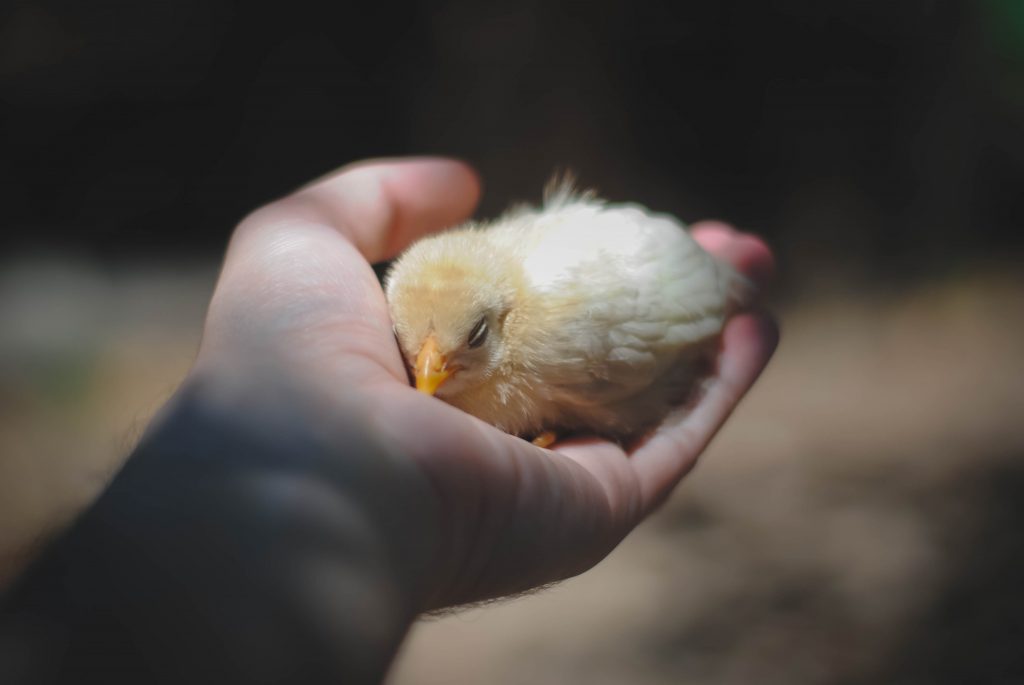
At times throughout my life, I’ve had a chance to be around recently hatched baby chicks. And when invited to hold one, I don’t hesitate—I didn’t as a 5-year-old and I don’t now. I step up and hold my hands out, cupped and ready to cradle the tiny, fragile, cheeping ball of yellow fluff. My heart leaps a little with what it will require—care, gentleness, keen attention. It is a moment suffused with responsibility. Yet with some coaching and support from those who surround me, even 5-year-old me can step up, willingly, and nurture, not harm. And given the chance, I could do that every day. Each time would require the exact same measure of care and attention. But it would, at the same time, become more familiar, something I could come to expect and assume as part of my everyday experience.
At this point in my description of this metaphor, I need to be clear: students in our classrooms are not the baby chick. The chick is the difficult experiences, the traumas, that anyone in the classroom community carries into that shared space. To position students as the fragile creature is central to the problem of how students and teachers are often positioned in relation to trauma. Viewing students as the chick implies an adult as the only participant with agency; an adult who, in this metaphor, is not only the strong one, but also looms largest as the protagonist in the story. One reason I include my child self in this image is to emphasize students as active subjects in reciprocally sharing and witnessing the kinds of hard stories that will accumulate for them and their teachers during this crisis. In being allowed to witness teachers’ vulnerability—their stories of challenge, fear, grief—students will know those stories belong in school and that their experiences will matter in how they are seen, heard, and valued in the classroom. The students, and the teacher, are the hands that gently, but without trepidation, cradle those stories in their classroom.
In being allowed to witness teachers’ vulnerability—their stories of challenge, fear, grief—students will know those stories belong in school and that their experiences will matter in how they are seen, heard, and valued in the classroom.
In whatever capacity teachers and students are together next year, everybody that enters the literacy classroom or accesses a screen will be bringing stories that require critical care and humanity. Some of those stories will be shared in explicit ways through discussions, writing, art, digital creations, one on one connections with between students and teachers. Other stories will be shared through an empty desk, a bowed head, a missed login, a quavering voice or trembling hand, a simmering sense of rage. And, as we know, some stories from students’ lives are shared and circulated in schools in ways beyond a students’ view or control. As literacy classrooms fill with stories of this crisis, let’s ensure that teachers’ experiences are present too—as signal of reciprocal witnessing, as opportunity and invitation to bring lived knowledge to school literacies, as source of connection and humanity, as acknowledgement that it can be hard to focus when feelings are overflowing, and as reminders of the far-from-equitable impacts of this crisis.
About the Author
Elizabeth Dutro is professor and chair of Literacy Studies at University of Colorado Boulder and former K-12 classroom teacher. She collaborates closely with teacher colleagues and youth in her research on the intersections of students’ lives and literacy classrooms, particularly critical approaches to trauma, and issues of justice and equity in K-12 classrooms, teacher education, and policy. She is the author of the recent book, The Vulnerable Heart of Literacy: Centering Trauma as Powerful Pedagogy (Teachers College Press). She would love to connect at Elizabeth.dutro@colorado.edu; elizabethdutro.com; or @lifeasstory on Twitter.
By: Dr. Guy Ilagan, Associate Professor of Counselor Education at the Citadel
It has been about 40 days since Ms. West learned that her workplace closed due to the COVID-19 pandemic. Ms. West is an experienced school counselor in a middle school. She is married and has three young children. She is known and respected as a humble, helpful, effective school counselor. She is active in her state organization for school counselors and is beloved by her peers and the graduate students she has mentored along the way. She loves her students and her school and reports that she has an effective relationship with the school principal.
I asked Ms. West to reflect on her experiences since the school closures and specifically about the most difficult aspects. She said her biggest concerns were for her student’s unmet needs, e.g., “availability of food, abuse, neglect, and witnessing domestic violence.” She paused and added, “when we return, we’ll be dealing with their concerns and trauma. Right now I have no control, no real way to help them.” As she spoke these words she paused and added, “and there will be no decrease in workload when we return, and see the results of these concerns.”
Ms. West also cited concerns about the suicide risk assessment (SRA) process. Ms. West and her peers have noticed that when conducting risk assessments via teleconference, caregivers are not always willing to permit the students to have privacy (by leaving the room) for parts of the risk assessment. Thus, they have little control over the assessments, especially where privacy is concerned. Also, some schools require a second counselor or staff member to be present during the SRA, which adds a time consuming logistical layer. Whereas, at the school they can promptly find a second staff member and ask caregivers to step outside for a moment. Also, district administrators currently send messages over weekends and after hours that a student needs a “check-in.” Check-ins are prompted by keywords in search or communication functions of their school-provided tablets.
Ms. West is connected to other school counselors via peer groups. She is in a peer group with peers from across the US. She also connects with local school counselor colleagues throughout the week. Some of her peers found support groups on social media or initiated informal local groups. In her peer group she noticed one school counselor in another state was told not to talk to students or do anything else. Otherwise, Ms. West’s US peers are all working harder now. Some of them are micromanaged. Many are required to call each student who is not completing their academic work.
Office hours for Ms. West are set from 8:00AM to 4:00PM. She emailed each household about office hours and contact information. She was also required to provide social emotional curriculum to students and continue to conduct Individual Graduation Plans (IGPs). Throughout the closure, Ms. West stated other school counselors she had spoken with described their current roles as “vague, having received minimal direction” and an “open-ended hot mess.” Many of her peers feel “pretty lost,” especially with connecting and collaborating with peers.
“If this continues into the Fall semester, I cannot mentally sustain,” she confessed with a laugh. She told me about her usual process of figuring out who will watch the kids when she and her spouse have conference calls at the same time. She knows she is deep into compassion fatigue. Compassion fatigue is a secondary traumatization that affects our mood, health, and regard for our students and work. Providing empathy and understanding to students in crisis can lead to compassion fatigue. “There is just not enough time in the day,” she said. “I’m not on my A game, more like a C game.” Without hesitation she said that due to her workload she has been unable to assist her own children in completing their school work.
When asked what has sustained her in her work thus far, she paused and referred to her support group with peers. She also said “finding breaks from the kids (her own).” In one of our video chats, I noticed a very human and touching moment when one of her children came into view. The child did not want to be apart from her mother at that moment. Finally, she said with a look of accomplishment that working out and eating healthy has helped her keep her mood up. She seemed pleased that she was using the time at home to boost her wellness and restart a few good habits.
Ms. West was relieved to have her real name excluded so that she could feel more freedom to discuss her experiences.
About the Author
Guy teaches graduate students in The Citadel’s Counselor Education Programs. He earned a PHD from Clemson University, Master’s Degree from The Citadel, and Undergraduate Degree from College of Charleston. Guy has been a counselor in a variety of educational and community settings and has published studies on counselor effectiveness, suicide prevention, and the mental health effects of wilderness backpacking on college women. Guy, his wife Jill, and their dog Dottie reside in Charleston, SC and enjoy riding bikes, going to the beach, watching TV, and camping.
An English teacher friend of mine who plans to retire at the end of the year with 40 years texted me: “School closed. My career might end like this !”
Wait! End like what? What just happened? Suddenly, nothing is normal, and there is no assurance that it will ever be again.
So I emailed my graduate students, “What’s going on?”
About 15 years ago, I left the high school classroom to teach in the ivory towers of higher education. A few years ago, my wife and I joined the University of South Carolina where I reside in the virtual ivory tower of on-line learning. I’ve been practicing “social distancing” living vicariously through my graduate students who are all teachers and administrators in real classrooms… at least they were until a few days ago. So… let me share what they’ve been telling me and you can think about how their stories compare to your situation.
From a teacher up in Maryland: “So far, absolutely nothing is occurring in my school district… along with what I assume is the rest of the state. We have been given explicit directions not to communicate with classes, issue assignments, or post grades. We may have one-on-one communication with students via Canvas, but classroom instruction in any manner cannot occur because the school district is afraid of violating FAPE. Our schools are closed until 4/24.”
This was a recurring theme. Teachers told me they’ve been instructed to focus on remedial learning rather than introducing new material. This is to buy districts and states time to bring the new learning situations into compliance with the laws regarding the rights of students with exceptionalities.
One South Carolina special education teacher expressed her passionate concern: “We place a greater emphasis on the accountability than we do on the lessons that life provides.” She was not the only respondent to say how much she missed her students. I’m sure they miss her too.
Literacy is not a stand-alone skill; it is a practice that is always situated in a context, and this time, the context changed literally overnight.
There has always been a disconnect between what the public thinks teachers do and what they actually do: Teachers spend all their after-school time on Facebook, sharing brownie recipes (with pictures). One parent scornfully asked on Facebook: “Are teachers still getting paid?”
We can forgive parents in their time of frustration, but the responses I have received these last few days tell the true story: Both administrators and teachers are… well… overwhelmed. It merely went from “barely bearable” to “impossible.” More than one teacher used the word “triage.”
An administrator in Florence, SC acknowledged this when she reported: “I work at our central office and we have been working tirelessly to support teachers who are working 10 or more hours each day preparing, grading, and holding a minimum of four office hours to answer students’ questions. Those were the guidelines for week one. In week two, add teacher created videos at least once per week. It is definitely harder this week, not just for teachers creating and executing these magnificent virtual lessons but also for our students who are definitely missing their teachers and friends.”
From Pennsylvania comes this teacher lament: “Ineed a break from education things. With the distance teaching, I feel I’m on call 24/7 and [constantly] feel obligated to check on my students.”
Another teacher wrote: “You know, when I first got your email I felt a little bit like ‘one more thing.’ However, when I started [writing], I couldn’t stop. It was an outlet I didn’t realize I needed. It was a lot like writing in a diary and very cathartic.”
She went on to talk about how her district (as of March 30) “… has been assigning Chromebooks to students (yesterday and today) and Comcast is offering 2 months of free WiFi. Now, the teachers have been told by our association that we must have Chromebooks in case we are ever subpoenaed for something relating to Special Education. There aren’t enough Chromebooks! I don’t even know about the WiFi. Some teachers, like myself, don’t want to go out to the school and risk getting sick to get a Chromebook. In this case, I wish someone would have just promised some sort of protection. … I’m in charge of making sure my department of 16 understands protocols for reporting child abuse and adhering to legislation concerning special needs students. The last text I sent them was at 10 pm last night and the first was at 6:30 am. Our central office updates us as much as they can but they are doing triage as well.”
In the last couple weeks, literacy practices have gone way beyond the technology of pen and paper, and may never return. How does a parent go about contacting Comcast or AT&T Mobile or Spectrum? What are the restrictions? What are their rights? Obviously, for such dramatic concern, people are recognizing that on-line learning is not quite the same as its cinder block counterpart.
Teachers are discovering there is a whole new set of literacy skills that needs to be learned to make this work, and that takes time and more than a bit of self-confidence. By now, all of us have had to confront the reality that there’s more to moving on-line than merely having the equipment.
An Orlando science teacher makes the following observations:
1) A common concern of teachers has been “how do we stop the students from just Googling answers?!?” My thought has often been “why are we asking students questions that have answers that can be found on Google?”
2) Another common barrier teachers have found is “How will students learn without a face to face lesson and me explaining the information to them?”
3) My personal greatest barrier transitioning online is how to generate effective, authentic, and meaningful dialogue in an asynchronous online course. How can we get students to engage, debate, revise their own understanding of content, and push the knowledge base of the collective whole forward in an online course?2) Another common barrier teachers have found is “How will students learn without a face to face lesson and me explaining the information to them?”
An upstate South Carolina STEM teacher talked via video about the “pressure teachers are now putting on themselves to mimic their synchronous, daily lessons and pedagogy in an asynchronous, virtual space.” He states that what he intends is not to be the “content giver,” but rather his plan is to provide his students with activities, including those provided by web applications such as, The Physics Aviary, during which he can “go in and comment multiple times, giving feedback [during the process].” Scott prefers “open world” simulations that are not as linear as other platforms that are more prescribed and restrictive.
He talked about his future plans of investigating the multimodal options that digital literacy offers. This is an important literacy topic that deserves its own blog, hopefully in the near future on this site. If this caught your attention and you want to know more, check out this article.
What Scott and several of the other teachers have in common is that they are in the first generation of “digital natives” who are now of an age in which they are no longer novice teachers. Digital natives, those born into the digital age, never had to learn the required technical skills that are now so much in demand as we are forced headlong into cyberspace. Digital natives merely acquired this form of 21st Century literacy by living it. We older folks have had to learn it, much like having to learn a new language. Learning is a whole lot harder and more time-consuming than acquiring, but it can work just as well in the end.
So what might this look like in practice? Teachers are incredible problem-solvers; there are no limits to what you can create when presented an impossible situation.
Here are a few more things teachers couldn’t wait to tell me about:
A middle-school ELA teacher is using The Diary of Anne Frank as model for their own diary/journal/memoir, much like a pastiche. “For my seventh grade ELA classes, I modified an idea from Kelly Gallagher. Students are reading Anne Frank: The Diary of a Young Girl as a text and using Google Slides to write daily journal entries to record this historical event from their perspective. Their creativity has been endless. They are writing poetry, posting links to news stories and videos, sharing acts of kindness, creating videos, and inserting pictures, selfies, and memes to the entries. I am hoping they find therapy in this opportunity for self-expression.”
This teacher clearly recognizes and encourages her students’ expanded repertoire of literacy practices that transcend the traditional definition of literacy:
As we go into more social isolation, you might write reviews of movies, television shows, podcasts, video games to share with your classmates.
Post pictures that you find in the media and/or your personal photos that share your experience.
Respond to any seed about the crisis you find interesting. A “seed” can be an article, a broadcast, a Ted Talk, a tweet, a photograph, a podcast, a film, an Instagram (or another online) post, a TikTok video, a political cartoon, a photograph—anything that spurs some thinking about the crisis.
An urban social studies teacher offered a litany of apps she had to master over a weekend: “Students are expected to use email, the school website, Canvas, and Google Classroom to submit assignments and [for teachers to] deliver instruction. We use various apps such as Remind, Flipgrid, Zoom, Loom, Screencastify, etc. that allow teachers and students to interact in real-time. I’ve had to learn to use flipgrid, commonlit, zoom, Edpuzzle, Newslea and make sure I understand how to do audio/video via Schoology.”
A South Carolina administrator wrote: “My daughter is writing short plays for theater class and selecting musical pieces for band based on the scores. She is learning to read difficult pieces of music and is looking forward to a Google hangout practice session next week. I find it ironic that most of her writing takes place in theater and hardly any in her English and social studies classes at the moment.”
Hmmmm….
Several teachers wrote about the boredom their own children are enduring. From the Atlanta suburbs, a middle schooler amused herself (and now us) with her own artistic creation.
Teachers seem to love tapping into students’ creative energies. A North Carolina high school art teacher joyfully exclaimed, “I’m LOVING this!” She went on to gush about her students “…experimenting with abstract forms of art production to produce compositions of still life items at home. [One class is creating ‘altered books’ [as an example of an] interesting approach to literacy… which requires students to use visual literacy as well as your normal reading and writing. This project also requires sequencing which is yet another form of literacy. They turn their third story in tomorrow through a video platform and the entire finished project in two weeks. I can add you to my digital class so you can see their work if you’d like…”
Yes, I think we’d all like that…
She then alluded to the elephant in the room: What about THOSE kids: “We have been required to provide 8 weeks of online and ‘pencil and paper’ packets of instruction in 2-week blocks [for students without Internet access]. The packets should be as similar as possible to the electronic lessons and allow for the same learning goals to be achieved… Students with no internet pick up packets at a drive-through at the school and every two weeks come to school to pick up more work and drop off what they have completed in a dropbox. Paperwork must be quarantined for 2 days before teachers can [touch] it…”
A high school social studies teacher added: “The district had to set up a plan to distribute food (breakfast and lunch) in grab-n-go methods…”
As responses keep trickling in, it’s clear that there’s been more than one elephant sheltering in place in our classrooms. Students who refuse to comply have been set free. They’re out there some place, and they might not come back: “I have had 3 of 90 students submit/complete any assignments on a daily basis. No more than ten of the 90 have yet logged into the system.”
I suspect it’s more about Herb Kohl’s “I Won’t Learn from You” than Shakespeare’s “… whining school-boy, with his satchel and shining morning face, creeping like snailunwillingly to school.” It’s a critical literacy issue that we (including you) will need to take up on this page sometime soon. We can’t end like this.
About the Author
Todd Lilly has over 40 years of teaching experience, the majority of which was invested in middle and high school ELA and theater classes in and around Rochester, NY. Over the past 10 years he has served on undergraduate and graduate faculties in Wisconsin and currently at the University of South Carolina. He earned his Ph.D. in Curriculum and Instruction at the University of Wisconsin-Madison. His research interests include out-of-school literacy practices and the stories of marginalized, disenfranchised students. He is married to Dr. Catherine Compton-Lilly who holds the John C. Hungerpiller chair in the College of Education, University of South Carolina.
For educators and families across the nation, life as we knew it changed in the blink of an eye. Schools closed and immediate actions were taken to make sure learning continued in the midst of a crisis. Educators responded by developing distance learning plans, packets, tool-kits, and virtual class schedules for families to use at home. Then, parents began facilitating learning from home.
Judging by the response in the media, this remote learning thing was a little more difficult than expected. On day one, parents were posting elaborate schedules for students to follow and some teachers committed to virtual office hours, while others began teaching the entire school day. A few days later, the enthusiasm was gone! We began to see posts like these:
Been homeschooling a 6-year old and 8-year old for one hour and 11 minutes. Teachers deserve to make a billion dollars a year. Or a week.
Almost at the end of week 3 of isolation and I can confidently say there has not been a single minute I have been bored or have had any free time. #tiredteacher
Teachers have always been awesome, but now the nation can see just how much patience, love, care, and hard work goes into teaching.
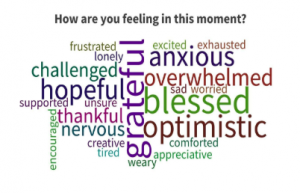
In the midst of all that is going on, I wanted to check on District Teacher Leaders. So, I set up a web meeting with the South Carolina State Teacher Forum. In an effort to capture the feelings of each teacher we asked, “How are you feeling in this moment?” We created a Word Cloud to capture responses. As we watched the screen, the first word to appear was overwhelmed. That word grew larger and larger, indicating that many teachers had also typed overwhelmed. Then, all of a sudden, words like hopeful, blessed, and optimistic started showing up. In the end, the largest word that formed in the middle of the cloud was grateful.
By simply giving ourselves a moment to share how we were feeling, it reaffirmed that we are not alone in this. Processing our emotions together resulted in a rejuvenating meeting. It is my desire that this Word Cloud created by teachers can serve as a symbol of hope and positivity for educators and families across our state and nation. A reminder that in this challenging time, we all need to take a breath, and use gratitude to center our lives.
Why Gratitude?
According to Harvard Health Publishing, “In positive psychology research, gratitude is strongly and consistently associated with greater happiness. Gratitude helps people feel more positive emotions, reduce stress, relish good experiences, improve their health, and deal with adversity.” As we continue teaching during COVID-19, let’s make gratitude part of our daily routine!
Here are a few tips to incorporate gratitude into your day:
1. Write or record messages of gratitude. Thank those who are working daily to ensure children are fed, such as bus drivers and cafeteria workers. Thank people on the frontlines during this pandemic, such as healthcare workers, first responders, and essential workers. Last but not least, thank teachers, students, family members, and friends. Try leaving notes or sending messages once or twice a week.
2. Make a wall of gratitude. Use notecards, post-it notes, colored paper, or any paper that you have around the house to display what you are grateful for. Make it a family activity or part of your virtual class agenda.
3. Practice gratitude while washing your hands. During this crisis, it is recommended that we wash our hands frequently. So while washing your hands, begin to mentally express gratitude for people who have done something nice for you, your loved ones, or those helping others in need.
4. Practice mindfulness or pray with gratitude. During your quiet time, whether it is at the start of your day or end of the day reflection, make time to include what you are thankful for. My mom calls this counting your blessings.
5. Make gratitude part of your daily lessons with your family and students. During COVID-19, many companies have offered free resources for educators and families. Take a moment to check out the suggested resources and activities below to start your journey.
What we do all day– Family Gratitude Activities (includes many activities for families)
Mercy House Global– Free Gratitude Bundle (includes 24 global lessons for families)
Happy Humble Homes-Thankful All Year Resources (includes articles and resources)
As we navigate these uncertain times instead of being overwhelmed by stress, anxiety, fear, worry, or doubt, choose to be overwhelmed with gratitude. I am grateful for all of the amazing teachers, parents, and guardians who are continuing to educate students each day. Hang in there, we are all in this together!
About the Author
Chanda Jefferson is the 2020 South Carolina Teacher of the Year and a Secondary Science teacher in Fairfield County School District.