May’s webinar was a teacher panel discussion on Equitable Assessment featuring Alicia Leonard, Olivia Monroe, and Kelli Madkins. Thanks to our panelists for your insight. Stay tuned for each panelist’s blog coming soon.
Connect on social media:

May’s webinar was a teacher panel discussion on Equitable Assessment featuring Alicia Leonard, Olivia Monroe, and Kelli Madkins. Thanks to our panelists for your insight. Stay tuned for each panelist’s blog coming soon.
Connect on social media:

By: Elinor Lister, Glenview Middle School English Teacher
One year at the start of the school year, a student asked “Do I really have to read and write?” I think my response was “Umm, yes, this is English class.” I’ve also answered this sort of question before with something like, “No! Not at all. This is only school. We don’t do those things too much here.” My sarcasm is definitely why I teach eighth grade and above!
Many children would rather do anything else besides read and write. So many of the rules and regulations of our education system have beaten the love of either out of them.
– Elinor lister
Despite the humor and our eye rolls at these questions, lies a real truth – one that is disappointing and frightening. Many children would rather do anything else besides read and write. So many of the rules and regulations of our education system have beaten the love of either out of them. Teachers have to prepare students for benchmarks, MAP testing, SLO tests, standardized tests, etc. To do this, we often give students things to read that we wouldn’t want to sit down and read ourselves, if we didn’t have to do so. We make them write nothing but what will help them answer a discussion question well or respond to a writing prompt correctly. All of these expectations have removed the one thing that is vital to a student truly receiving a good education – the desire to learn.
As educators it is our job to handle the mandates and requirements of assessments while finding ways to help students want to learn, love to read, and desire to write. Piece of cake, right? As easy as putting out a house fire with a water bottle! And yet, teachers do it every day because they are awesome and dedicated and refuse to stop trying.
In my career, I have run across some tools that I have used or seen used with success in helping students enjoy reading and writing. Most of these transcend content and can be great practice in any classroom.

This isn’t new, but it has fallen by the wayside. I know the argument some use saying that students sit there staring at a book and do not actually read. There may always be a few who are harder to reach than others, but don’t take the experience away from the majority.
Colleagues and I have found the best success with SSR when students can truly pick what they want to read – books, magazines, graphic novels, newspapers, informational texts, etc. I’ve even allowed children’s books. Does it really matter what they are reading, if they are interested in reading it? I never found success forcing students to keep a reading log or write about what they read each day. We should give them time to read what they want to read. Let them rediscover the joy in reading, and learn that reading doesn’t have to have strings attached to it. As adults, we read because we want to and because it’s entertaining or informative. Why can’t students experience that too?
These documents are a wonderful way to pull a variety of literacies together for one topic. A hyperdoc moves students through their work, it can take them to different articles, videos, images, and websites. Students read and process through so many varying texts to learn, analyze, and produce results. Hyperdocs are a fantastic way to engage students while having them read, write, think, and produce. If you are unfamiliar with the term, Google it, and you will find so many examples and help guides. You’ll be glad you did! I use some form of a hyperdoc now for almost every unit.
Current. Relevant. Now. Typical curriculums rarely involve reading this type of work. There is amazing and interesting literature out there to be read, enjoyed, and used in classrooms. I am not suggesting we get rid of pieces that have age, history, or formality to them, but those are primarily taught in English classes. English classes don’t need to be the only classes reading, and English classes can certainly bring in some current reading as well now and then. Teachers don’t need to spend their valuable time searching for material, though. There are several sites that have wonderful articles and materials that span various contents, themes, topics, and reading levels.
Students have to learn to complete academic writing. They need that knowledge for all parts of school from upper elementary through college. In teaching that, however, we often forget that students need to experience freedom in writing. It is creative, therapeutic, and enlightening. We can learn so much about our students from their writing, but we rarely feel that we can allow them this time. A way I find to give them this opportunity is through blogs. I set up a Google Site (either with multiple pages or with embedded Docs) and allow students to make it their own. They can write about anything on their mind or any topic they are interested in; they just have to write. I try to give them twenty minutes two to three times per week. I have ninety minute classes, so that works for me.
I have had students write about recipes, makeup tips, sports, extra-curricular activities, traveling, hobbies, friends, drama, dating, video games, etc. They can add pictures, videos, you name it. You can also have blogs that are specific to topics so that students write about content but in a less formal way. This could be books they’re reading, reviews of things, or thoughts on characters or chapters. Blogs would work in any content area, and they are a real-world type of writing that allows students to feel heard in their own way, not through a formal essay.
I firmly believe that one of the greatest ways to utilize students’ strengths and make learning relevant is in allowing students to have choice. It could be choice in a topic, choice in a project medium, choice in a partner, anything – just give them choice. Let them take ownership! Students can learn information and be able to share that they have mastered it in so many different ways. Capitalize on that. As teachers, we often get worried about giving away control. Our control doesn’t often create engagement and expand student literacy. Set up parameters, give guidelines, create a rubric, and let students go. You will be amazed at what they can create!

Allow students to write books with Slides, Forms, or websites like Storyjumper. Let them create a comic strip with a website like Pixton. Give them the freedom to write a script and film a video. Provide a topic to research and tell them to present that information in any form such as a Prezi or a Powtoon to so many other websites that are free and available. Here’s a short list of some favorites: Adobe Spark, Canva, Smore, TES, Padlet, Flipgrid, Screencastify, Thinglink, and Emaze. I even have a colleague who walked students through scientific research and then let them create podcasts! They were fantastic.
Our students live in a world of constant technology. They are immersed in it. We need to let that spur them into renewing their reading and their writing.
We have so many tools at our disposal, so many ways to enrich our students’ literary skills. They live in a world of technology; it is all around them. We can use that to our benefit to help renew their desire to read and write. We can also remind them that reading and writing should be more important to them than just fulfilling academic requirements. Once we can hook them, the academic success will follow.

Elinor Lister has taught high school and middle school English for twenty years and currently teaches eighth grade English in Anderson, South Carolina, at Glenview Middle School. She was the District Teacher of the Year for Anderson Five for the 2018-2019 school year. Elinor holds a Bachelor’s in English from Erskine College, a Master’s in Educational Technology from Lesley University, and a Master’s in Administration from Gardner Webb University.

By: Dr. Todd Lilly, University of South Carolina
Is it time to sell the school building? Is this the end of school as we know it? They’re coming back, aren’t they?
Like… when this is over, things will go back to normal… right? RIGHT???

An English teacher friend of mine who plans to retire at the end of the year with 40 years texted me: “School closed. My career might end like this !”
Wait! End like what? What just happened? Suddenly, nothing is normal, and there is no assurance that it will ever be again.
So I emailed my graduate students, “What’s going on?”
About 15 years ago, I left the high school classroom to teach in the ivory towers of higher education. A few years ago, my wife and I joined the University of South Carolina where I reside in the virtual ivory tower of on-line learning. I’ve been practicing “social distancing” living vicariously through my graduate students who are all teachers and administrators in real classrooms… at least they were until a few days ago. So… let me share what they’ve been telling me and you can think about how their stories compare to your situation.
From a teacher up in Maryland: “So far, absolutely nothing is occurring in my school district… along with what I assume is the rest of the state. We have been given explicit directions not to communicate with classes, issue assignments, or post grades. We may have one-on-one communication with students via Canvas, but classroom instruction in any manner cannot occur because the school district is afraid of violating FAPE. Our schools are closed until 4/24.”
This was a recurring theme. Teachers told me they’ve been instructed to focus on remedial learning rather than introducing new material. This is to buy districts and states time to bring the new learning situations into compliance with the laws regarding the rights of students with exceptionalities.
One South Carolina special education teacher expressed her passionate concern: “We place a greater emphasis on the accountability than we do on the lessons that life provides.” She was not the only respondent to say how much she missed her students. I’m sure they miss her too.
Literacy is not a stand-alone skill; it is a practice that is always situated in a context, and this time, the context changed literally overnight.
There has always been a disconnect between what the public thinks teachers do and what they actually do: Teachers spend all their after-school time on Facebook, sharing brownie recipes (with pictures). One parent scornfully asked on Facebook: “Are teachers still getting paid?”
We can forgive parents in their time of frustration, but the responses I have received these last few days tell the true story: Both administrators and teachers are… well… overwhelmed. It merely went from “barely bearable” to “impossible.” More than one teacher used the word “triage.”
An administrator in Florence, SC acknowledged this when she reported: “I work at our central office and we have been working tirelessly to support teachers who are working 10 or more hours each day preparing, grading, and holding a minimum of four office hours to answer students’ questions. Those were the guidelines for week one. In week two, add teacher created videos at least once per week. It is definitely harder this week, not just for teachers creating and executing these magnificent virtual lessons but also for our students who are definitely missing their teachers and friends.”
From Pennsylvania comes this teacher lament: “I need a break from education things. With the distance teaching, I feel I’m on call 24/7 and [constantly] feel obligated to check on my students.”
Another teacher wrote: “You know, when I first got your email I felt a little bit like ‘one more thing.’ However, when I started [writing], I couldn’t stop. It was an outlet I didn’t realize I needed. It was a lot like writing in a diary and very cathartic.”
She went on to talk about how her district (as of March 30) “… has been assigning Chromebooks to students (yesterday and today) and Comcast is offering 2 months of free WiFi. Now, the teachers have been told by our association that we must have Chromebooks in case we are ever subpoenaed for something relating to Special Education. There aren’t enough Chromebooks! I don’t even know about the WiFi. Some teachers, like myself, don’t want to go out to the school and risk getting sick to get a Chromebook. In this case, I wish someone would have just promised some sort of protection. … I’m in charge of making sure my department of 16 understands protocols for reporting child abuse and adhering to legislation concerning special needs students. The last text I sent them was at 10 pm last night and the first was at 6:30 am. Our central office updates us as much as they can but they are doing triage as well.”
In the last couple weeks, literacy practices have gone way beyond the technology of pen and paper, and may never return. How does a parent go about contacting Comcast or AT&T Mobile or Spectrum? What are the restrictions? What are their rights? Obviously, for such dramatic concern, people are recognizing that on-line learning is not quite the same as its cinder block counterpart.
Teachers are discovering there is a whole new set of literacy skills that needs to be learned to make this work, and that takes time and more than a bit of self-confidence. By now, all of us have had to confront the reality that there’s more to moving on-line than merely having the equipment.
An Orlando science teacher makes the following observations:
1) A common concern of teachers has been “how do we stop the students from just Googling answers?!?” My thought has often been “why are we asking students questions that have answers that can be found on Google?”
2) Another common barrier teachers have found is “How will students learn without a face to face lesson and me explaining the information to them?”
3) My personal greatest barrier transitioning online is how to generate effective, authentic, and meaningful dialogue in an asynchronous online course. How can we get students to engage, debate, revise their own understanding of content, and push the knowledge base of the collective whole forward in an online course?2) Another common barrier teachers have found is “How will students learn without a face to face lesson and me explaining the information to them?”
An upstate South Carolina STEM teacher talked via video about the “pressure teachers are now putting on themselves to mimic their synchronous, daily lessons and pedagogy in an asynchronous, virtual space.” He states that what he intends is not to be the “content giver,” but rather his plan is to provide his students with activities, including those provided by web applications such as, The Physics Aviary, during which he can “go in and comment multiple times, giving feedback [during the process].” Scott prefers “open world” simulations that are not as linear as other platforms that are more prescribed and restrictive.
He talked about his future plans of investigating the multimodal options that digital literacy offers. This is an important literacy topic that deserves its own blog, hopefully in the near future on this site. If this caught your attention and you want to know more, check out this article.
What Scott and several of the other teachers have in common is that they are in the first generation of “digital natives” who are now of an age in which they are no longer novice teachers. Digital natives, those born into the digital age, never had to learn the required technical skills that are now so much in demand as we are forced headlong into cyberspace. Digital natives merely acquired this form of 21st Century literacy by living it. We older folks have had to learn it, much like having to learn a new language. Learning is a whole lot harder and more time-consuming than acquiring, but it can work just as well in the end.
So what might this look like in practice? Teachers are incredible problem-solvers; there are no limits to what you can create when presented an impossible situation.
Here are a few more things teachers couldn’t wait to tell me about:
A middle-school ELA teacher is using The Diary of Anne Frank as model for their own diary/journal/memoir, much like a pastiche. “For my seventh grade ELA classes, I modified an idea from Kelly Gallagher. Students are reading Anne Frank: The Diary of a Young Girl as a text and using Google Slides to write daily journal entries to record this historical event from their perspective. Their creativity has been endless. They are writing poetry, posting links to news stories and videos, sharing acts of kindness, creating videos, and inserting pictures, selfies, and memes to the entries. I am hoping they find therapy in this opportunity for self-expression.”

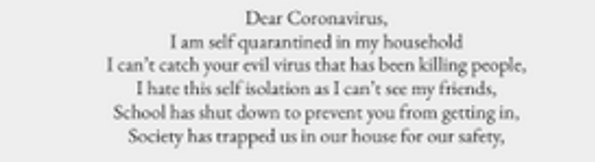
This teacher clearly recognizes and encourages her students’ expanded repertoire of literacy practices that transcend the traditional definition of literacy:
An urban social studies teacher offered a litany of apps she had to master over a weekend: “Students are expected to use email, the school website, Canvas, and Google Classroom to submit assignments and [for teachers to] deliver instruction. We use various apps such as Remind, Flipgrid, Zoom, Loom, Screencastify, etc. that allow teachers and students to interact in real-time. I’ve had to learn to use flipgrid, commonlit, zoom, Edpuzzle, Newslea and make sure I understand how to do audio/video via Schoology.”
A South Carolina administrator wrote: “My daughter is writing short plays for theater class and selecting musical pieces for band based on the scores. She is learning to read difficult pieces of music and is looking forward to a Google hangout practice session next week. I find it ironic that most of her writing takes place in theater and hardly any in her English and social studies classes at the moment.”
Hmmmm….
Several teachers wrote about the boredom their own children are enduring. From the Atlanta suburbs, a middle schooler amused herself (and now us) with her own artistic creation.
Teachers seem to love tapping into students’ creative energies. A North Carolina high school art teacher joyfully exclaimed, “I’m LOVING this!” She went on to gush about her students “…experimenting with abstract forms of art production to produce compositions of still life items at home. [One class is creating ‘altered books’ [as an example of an] interesting approach to literacy… which requires students to use visual literacy as well as your normal reading and writing. This project also requires sequencing which is yet another form of literacy. They turn their third story in tomorrow through a video platform and the entire finished project in two weeks. I can add you to my digital class so you can see their work if you’d like…”
Yes, I think we’d all like that…
She then alluded to the elephant in the room: What about THOSE kids: “We have been required to provide 8 weeks of online and ‘pencil and paper’ packets of instruction in 2-week blocks [for students without Internet access]. The packets should be as similar as possible to the electronic lessons and allow for the same learning goals to be achieved… Students with no internet pick up packets at a drive-through at the school and every two weeks come to school to pick up more work and drop off what they have completed in a dropbox. Paperwork must be quarantined for 2 days before teachers can [touch] it…”
A high school social studies teacher added: “The district had to set up a plan to distribute food (breakfast and lunch) in grab-n-go methods…”
As responses keep trickling in, it’s clear that there’s been more than one elephant sheltering in place in our classrooms. Students who refuse to comply have been set free. They’re out there some place, and they might not come back: “I have had 3 of 90 students submit/complete any assignments on a daily basis. No more than ten of the 90 have yet logged into the system.”
I suspect it’s more about Herb Kohl’s “I Won’t Learn from You” than Shakespeare’s “… whining school-boy, with his satchel and shining morning face, creeping like snail unwillingly to school.” It’s a critical literacy issue that we (including you) will need to take up on this page sometime soon. We can’t end like this.

Todd Lilly has over 40 years of teaching experience, the majority of which was invested in middle and high school ELA and theater classes in and around Rochester, NY. Over the past 10 years he has served on undergraduate and graduate faculties in Wisconsin and currently at the University of South Carolina. He earned his Ph.D. in Curriculum and Instruction at the University of Wisconsin-Madison. His research interests include out-of-school literacy practices and the stories of marginalized, disenfranchised students. He is married to Dr. Catherine Compton-Lilly who holds the John C. Hungerpiller chair in the College of Education, University of South Carolina.
