Where I’m From

Teaching

This post will discuss how “Where I’m From” poetry helped provide a scaffold to better understand multilingual students and their evolving identities. This post is written by Emily Graham. Read more about Emily at the bottom of this post.


The question “Where are you from” is one often heard by multilingual learners (MLs). Although all the MLs at my school could answer this question simply by naming their birth country as either the US, Mexico, or Guatemala, this answer gives little information about each student’s identity. Through her poem, “Where I’m From”, George Ella Lyon shows us how we can tap into the more complex answer to this question. Lyon links together memories of special places, people, sayings, and stories from her past to tell us who she is, and this can serve as a powerful model for reflection and exploration of the rich and diverse identities among students.

In a poetry unit built from Lyon’s ideas, structure, and themes, my MLs explored and shared their own identities. Students’ poems and thoughts gave me a small window into my students’ past and present lives and their critical and creative thinking abilities. The “Where I’m From” Poetry Project allowed me to build a deeper, more complex understanding of who my students are and “where they are from” beyond just a geographic place.

There are countless get-to-know-you activities that require students to answer categorical questions such as: “What are your favorite foods?”; “What are your favorite songs?”; “Who is in your family?”; or “What do you like to do when you are not at school?” While I believe these questions are important, their answers do not always provide great insight into our students’ lives. Often these questions are asked and answered without much thought or reflection. Students may say: “My favorite foods are tamales”; “I don’t know my favorite song”; “I live with my dad, aunt, uncle, and sister”; and “I watch T.V.”, but there is little depth or passion to these responses.

When we use poetry to elicit these responses, we can reframe these questions in a way that requires reflection and deep thinking. When the questions are reframed to: “What are the family, foods, thoughts, and stories that make you who you are?” a teacher can gain a much deeper understanding of students and their unique identities. “Where I’m From” Poems provide a frame and an artistic lens for students to respond to those questions about identity.

Here is an example of how one student’s poem provided me with a glimpse into his rich and unfolding identity. Looking at his identity from a more reflective perspective helped me build an understanding of the student’s home life, language, family, and interests that I had not slowed down to see before.

Jimmy, a 3rd-grade multilingual student, was born in the United States and struggled with academic language and literacy. Although he was born in the US, he did not begin learning English until he started school in kindergarten. The first language, the language used most often, and the language that he used with the people he loved, was Spanish. Jimmy was considered a student who “struggled” in school.  He often put his head down in class, he refused to work independently, and said things like, “I’m not smart” or “I can’t read.” Sometimes he participated in whole group discussions but more often seemed disengaged. Jimmy’s class was starting a unit on poetry, and I anticipated resistance from Jimmy. I decided to teach a unit to build background knowledge and confidence in poetry.

Jimmy initially seemed disinterested in the idea of studying and writing poetry. But that slowly started to change through the process of a close read of Lyon’s “Where I’m From.”  At first, we looked at the literal meaning of Lyon’s words through translations, pictures, and discussion. Jimmy was able to confidently define big words from Lyon’s poem such as “carbon tetrachloride” and “forsythia bush”. He was able to explain how someone might lose a finger to an “auger”. He also was able to discuss big ideas like nostalgia and memories.  In later readings, Jimmy stated Lyon’s voice reading her poem sounded like a ghost. He said Lyon talked about the past and memories like a ghost would. Jimmy seemed to enjoy building on the ideas of his group members. He was not afraid to share his opinion on the meaning of certain phrases and his thoughts about word choice. I was surprised by Jimmy’s desire to build an argument and support a claim in the discussion. He said, “I think the author likes to play in the dirt under her porch. Maybe she liked to hide there because that is what I do. My dogs also like to hide under the porch because it is cool, and they feel safe.” I was also impressed by Jimmy’s critical thinking and questions.  He said, “I wonder why she said the ‘it tasted like beets.’ Maybe she is talking about when she was a little kid because little kids always put stuff in their mouths. They are curious and that is how they explore.”

Jimmy was not initially thrilled about the task of writing his own poem. He needed some support organizing his ideas. With the support of graphic organizers, help in spelling, and some motivation from a YouTube student example, Jimmy wrote. Here is his poem:

I am from fish tanks and from dirt

and my dog DJ

I am from broken glass in my backyard

I am from my broken T.V.

From Roblox and road trips

I am from sunflowers and bamboo

I am from tag with my brother and helping my mom

from Joseph and Marissa

I am from the sad puppies and Llama the puppies mama

from swings and broken pinatas

I am from my dad’s Honda

with a big engine

I am from my mom’s Hyundai

it has a push button to start

from riding my bike and making my own adventures

I am from digging holes and making traps

I am from inventions

Jimmy’s poem was a powerful representation of his identity, and his word choice was beautifully poetic. He was able to infuse his poem with alliteration and repetition, imagery, and emotion. He juxtaposed happy and sad memories, and purposefully ended his poem with positive attributes about himself. He talked about both joyful and upsetting times with his family. Times where they celebrated together — “broken pinatas” — and times of trouble — “broken T.V.” From reading and talking about Jimmy’s poem, I learned about ways Jimmy interacted with his family, some challenges in his life, and personal characteristics that he was proud of. Jimmy was proud to explain how he helped his mom with daily chores and sometimes would go to work with his dad. He talked about his dog Llama having puppies and the irresistible sad look on the puppies’ faces. He found joy in playing with the puppies. He talked about being devastated when some of the puppies got sick and died. He said he felt so bad for Llama, the puppy’s mama. Jimmy sometimes showed insecurities in the classroom but spoke with complete confidence when discussing his adventures and inventions outside of the classroom. He talked about his positive attributes like creativity, curiosity, and bravery. Jimmy took pride in his poem, so much so that he wanted a copy to take home and read to his family

Jimmy’s poem and the conversations that resulted from discussing poetry helped me shift from focusing on Jimmy’s struggles to identifying and sharing his strengths Before, I might have shared my frustrations on Jimmy’s lack of motivation or refusal to do work in my class. Now I had something so much more powerful and beneficial to share with other teachers — Look what Jimmy wrote, look what Jimmy can read, but most importantly look at some of the things that make Jimmy who he is! Through poetry I learned more about his academic abilities — Jimmy could craft meaning from metaphor and explain his theories about themes and lessons hidden in poems. I also learned about his interests and motivators. I discovered Jimmy’s empathy for others, passion for inequalities in his community, and desire to help others. Jimmy’s poem allowed me to understand his uniqueness and make connections to my own childhood curiosities and adventures. I felt the same empathy for animals and dreams of a more peaceful and equitable world.

I had the same kind of revelations and connections with my other students. I learned Alexander had a job caring for sheep in Mexico through his lines: “I am from a big river where the sheep used to cross” and “from a scary ram who chased me all day.” I learned Veronica’s older brother always said to her “sup bro and dap me up, bro.” I learned about Marta’s memories of Guatemalan cuisine: “tortilla’s (sic), tortas, tamales, and tacos.” Each poem was beautiful and unique and a window into my students’ lives. These poems provided voice for my students and a platform to share the individual identities that they were proud of. This background was both unique and unifying. The poems gave students an opportunity to be more clearly seen and heard.

Sometimes we want to get to know our students, but we don’t know the right questions to ask. The question “Where are you from?” seems simple on the surface but does not have a simple answer. Studying George Ella Lyon’s poem with my elementary multilingual learners helped me slow down and deepen my understanding of Lyon’s words and, more importantly, my students’ words.  Although my initial purpose of the poetry unit was to provide academic background knowledge for my students, a more beautiful and poetic thing happened — poetry provided background knowledge for my students for me. The poems provided a space for me to do the learning and for my students to do the teaching. The format provided a space to merge home life and home language with school life and language. “Where I’m from Poems” allowed us to celebrate each student’s beautiful and unique identity.  

Lyon, G. E. Where I’m from, a poem by George Ella Lyon: Writer and teacher Subtitle. http://www.georgeellalyon.com/where.html

Emily Graham is from Johns Island, South Carolina. She currently teaches grades K-5 as a Multilingual Learner Specialist in Charleston County Schools. She is a certified elementary educator and has served in several different teacher roles including as a Multilingual Learner Program Specialist, a second grade teacher, an English teacher abroad, a substitute teacher, and a teacher’s assistant. She speaks Spanish and enjoys traveling, creating, and being in nature. She lives with her husband, 8-month-old girl, and two rowdy rescue dogs.

Cover Photo by Vidar Nordli-Mathisen on Unsplash

Overcoming writer’s block with free-verse poetry

Teaching

All writers are familiar with the brain-freezing sensation of staring at a blank page or screen without the slightest clue of how to start a daunting writing task.  This writer’s block symptom is intensified for struggling writers such as multilingual learners, students with un/diagnosed reading/writing disorders, or speakers of dialects who experience Standard English as a foreign language. When they consider themselves writing failures, free-verse poetry writing opportunities in any subject area are one effective way to remediate the problem and release debilitating emotional stress (Bullock, 2021). Most striving writers battle: (1) what to write about; (2) how to structure ideas for longer, multi-paragraph texts; and/or (3) how to use academic language structures in full sentences with grammatically and linguistically correct word use, grammar, and punctuation.

What is free-verse poetry?

Free-verse poetry writing does not present these challenges. It allows for associative writing with spoken language characteristics of words, phrases, or sentences without specific rhyme schemes or metric systems. There are no rules for line breaks, stanza divisions, or paragraph structures. Some free verse poetry looks like narrative writing without having to follow syntactic rules or to require punctuation. Free-verse poetry often creates images and focuses on sensory detail with figurative speech like similes (i.e., water as soft as coconut oil), metaphors (i.e., rain comes down in spaghetti strings), or idioms (i.e., fluttering butterflies in my stomach) (Craven 2021).

The following is a free-verse poem to remember that Natrium Chloride is salt:

Nate and Claire and NaCl

                        Nate Natrium wants a girlfriend

                        Through his binoculars from his Natrium castle

                        He spots Claire Chloride

                        In a hammock

                        Reading a romance novel

                        Humming a song

                        Nate’s heart bursts

                        His feet fly down the hill with a drumming heart

                        To Claire

                        And the rest is history

                        They have children

                        All with salty lips and skin

                        This family helps us spice our food

                        And give minerals to animals, humans and plants

                        Their license plate says NaCl-Salt

What makes free-verse poetry beneficial for striving writers?

The features of free-verse poetry described above allow writer’s block moments to gradually diminish because students can concentrate on what they have to say without grammatical and syntactical confinements of text passages. Students engage in short, creative writing tasks that provide them with growing confidence to express knowledge or feelings without being judged for writing conformity errors, especially when spelling errors are not considered. Consequently, students can creatively and meaningfully play with language and enjoy the process while engaging with content in a pressure-free, reinforcing way (Bullock, 2021).

When to implement free-style poetry writing?

At any time in any content area, teachers can implement 5-15 minute free-verse poetry writing opportunities: (1) prior to a topic to activate pre-knowledge and motivate for a topic; (2) during a unit/lesson; (3) after a unit/lesson to assess gained knowledge; or (4) as a general writing task with prompts such as a title (i.e. mountain bikes, my favorite singer), pictures, or music to engage students in free-verse writing to express their feelings and thoughts stimulated by the prompt.

What are some ideas for grades 6-12?

Providing routine writing opportunities with appropriate support while integrating students’ interests, strengths, and knowledge is crucial in breaking down writing barriers. When first introducing free-verse poetry writing, teachers use ‘think aloud’ techniques to model how to write such a poem. Then, students work in pairs to create a free verse poem before creating them individually. Students can compare each other’s poems and discuss what they learned from different poems. This reinforces the purpose and versatility of free-verse poetry writing in content areas. Students collect their free-verse poems in a writing journal or keep them with their content topic to help them study.

Additionally, a cloze text with open spaces to insert an association or sentence frames along with vocabulary banks can assist striving writers in focusing on writing free-verse poetry.

The following concrete suggestions for different content areas can be supported by thought-provoking pictures, video or film clips, or music to foster paired-up or individual free-verse poetry writing.

English Language Arts:

  • Relate to/ describe a character in a book.
  • Reflect on characteristics of a literary feature or term (i.e., idiom, climax), or jobs/functions of punctuations, capitalizations commonly mis/used.
  • Characterize features of standard English, dialect, or code-switching along with when each is beneficial.

Science:

  • Summarize characteristics of chemical procedures or elements such as H2O (water) or NaCl (salt); or components/purposes of cells or body parts.
  • Describe/reflect on the importance of the processes of the water cycle, polarity, electricity, or planetary systems

Mathematics:

  • Summarize the sequence of steps to take for a certain operation.
  • Describe the characteristics, roles, or properties of concepts or terminologies such as common denominators, geometric structures, or negative/positive numbers.

Music education:

  • Characterize/compare famous musical periods, instruments, musicians, or songs of certain periods.
  • Describe strategies to play certain instruments or to be successful in a choir or band.

Physical/health education:

  • Reflect on the benefits of particular nutrition items (i.e., protein, carbohydrates, water, food pyramid).
  • Describe the interaction of certain nutritional components in the human body or the benefits of exercise and the dangers of sedentary life.

Social Studies:

  • Reflect on/describe the roles of historical characters or their emotions and feelings during a time period (i.e., Anne Frank, Harriet Tubman, Malcolm X).
  • Reflect on/describe the roles of government branches or features of democratic, authoritarian, fascist, or socialist government structures
  • Present a timeline of events that lead to a certain historical event

Conclusion

In sum, brief, free-verse poetry writing is one creative, student-engaging approach to help promote a sense of growing confidence and creativity among striving writers at a low-risk level in grades 6-12. Nobody can go wrong. Every creative contribution counts and matters. Success at that level encourages students to tackle longer writing tasks while also reinforcing the disciplinary content they need.

References

For some examples of free-verse poetry by established authors, see:

Bullock, O. (2021). Poetry and trauma: Exercises for creating metaphors and using sensory detail, New Writing, 18(4), 409-420,  DOI: 10.1080/14790726.2021.1876094.

Craven, J. (2021, February 15). An Introduction to Free Verse Poetry. Retrieved from https://www.thoughtco.com/what-is-a-free-verse-poem-4171539.

Bullock, O. (2021). Poetry and trauma: Exercises for creating metaphors and using sensory detail, New Writing, 18(4), 409-420,  DOI: 10.1080/14790726.2021.1876094.

Craven, J. (2021, February 15). An Introduction to Free Verse Poetry. Retrieved from https://www.thoughtco.com/what-is-a-free-verse-poem-4171539.


Macintosh HD:WINTHROP:FALL 2022_classes & tasks:IDA proposals for F22:BIO PIC Elke.png

For the past 20 years, Dr. Elke Schneider has been a professor of literacy, special
education and multilingual learner education at Winthrop University, Rock Hill, South Carolina.

The Power of the Pen:  Poetry as the Bridge to Liberation

Teaching

This post is written by Darius Phelps. You can read more about Darius at the bottom of this post.


As bell hooks argued, some forms of writing create “a space where we are able to confront reality in such a way that we live more fully.” Having been an educator for thirteen years, I believe that teaching students to write should be a practice that comes from the soul, especially if we want to foster a true connection between ourselves, our students, and the intimacy of writing. For me, growing up, poetry had been a sanctuary, the space in which words were the only thing that brought me comfort. As a young man of color, I found solace in the work of Korean rapper, and author, TABLO of the Korean hip-hop group Epik High who spoke out on issues such as struggling with mental health, depression, assimilation, and even struggling to experience joy as a young man. Inspired and enamored by his work, I began to write poetry myself, letting the words and emotions flow as they came, without restriction.

Dr. Maxine Greene (2000) argues that we must advocate for the inclusion of arts in the classroom in order to help foster a deep understanding and foundation for imagination. She stresses that there are multiple voices and multiple realities for, “We must now allow the enthusiasm for publicity about changed methods of reading instruction to obscure the facts of exclusion and neglect.” (p 36) Writing is part of the conversation,  and through these crucial conversations, we foster dialogue.  In Chapter 9 of Releasing the Imagination, titled “Writing to Learn”, Greene (2000) reinforces this idea When teaching writing, more specifically narrative writing, I use my own personal narrative as a guide/model for my students, showing them that there is power in being vulnerable and sharing what lies on their hearts. I remember the days when I was a student, especially in elementary school; I didn’t have a connection with writing inside of school because I didn’t see myself reflected in the prompts or discussions we would regularly have.

Once I became a classroom teacher, I discovered that diving into writing and teaching as a way to express ourselves via social-emotional learning helps us become better teachers for our students, even challenging us to face our own struggles head-on. With it, we learn to speak well and with emotion, to emulate that emotion, and to be more attentive to words and the emotions that they convey. (Storey, 2019) The power of the pen is one that is truly immaculate, and I feel that can be combined with the implementation of SEL. Social Emotional Learning (SEL) is a lifelong process for both the teacher and the student. In order to develop self-awareness, self-control, interpersonal skills, and all the intangibles that are paramount of work, school, and life, both adult and child must be willing to do the inner work that is necessary to allow these areas to manifest into something that they can apply to real-life, everyday situations. I believe that the process of doing that inner work requires honest self-examination, painful self-excavation, and restorative healing.

Effective educators use various strategies to improve their pedagogy and to reach their students. It is crucial for teachers to not only understand where their students come from culturally but also truly see them as individuals.  Anyone can be/become a culturally relevant teacher no matter what age group, area, or subject you are teaching.  Ladson Billings (2009) stresses that the key is to go in with an open mindset and see your students for who they are and what they are capable of doing; don’t focus on the negative. As we instruct them in both literature and writing, we must truly believe each and every one of our students can and will succeed. In order to transform them as students, we must be willing to instill this in them and show that we care, and I believe that poetry can be that bridge to vulnerability.

“In My Shoes”

by Darius Phelps

If you only knew

what it was like

to walk in my shoes

You’d know my steps 

marched to the beat

of different tunes

Music, art, and poetry

all different clues

Pieces of the puzzle

to my past

The weight of the world

heavy like a stack

of cement bricks 

But nothing

and no one

would hold me back

from overcoming life’s tricks and turns

Bruised.

Broken.

but never… burned

In my shoes,

You wouldn’t last a day

Surviving Hell’s fire

Like a blistering summer in May

No matter the trauma, the heartache, or the pain

I’ve come out stronger, better, and wiser with much more to gain

For even flowers bloom, after April’s rain

If you only knew

what it was like

to walk in my shoes

When we share our emotions, we foster meaningful discussions that are applicable in students’ day to day lives. I encourage teachers to challenge their students to think critically and outside the box, encouraging them to tackle emotions such as depression, grief, perfectionism, and even abandonment with various forms of discussion. Each person comes with a unique understanding of life, love, freedom, and emotions. Emotions equal freedom because you can’t control when a certain emotion washes over you or rises up, within you. If schools are built on deep relationships, and consent is embedded in the framework of relationship-building, we truly learn how to be self-aware, to recognize how others want to engage with us, and to face our own demons. (Hooks, 2021)

“Where I Am from” 

By Darius Phelps

I am from the pages of battered book

From fiery passion and grit

I am from the daily prayers of my grandmother

Loved endlessly, protected, and cared for

I am from the falling petals of a sunflower

radiant, yellow, and soft like the sun

I am from dinner on Sunday’s and hard work

From Mattie and Eddie, raised by my grandparents

I am from their loving and selfless hearts, the purest love I’ve ever know

From playing outside and using my imagination to dream endlessly

I am from the early Sunday mornings at church and praying before bed

I am from Riverdale, Georgia

From chocolate cake and sweet potato pie

From the endless nights watching grandma bake

The early mornings watching mom leave for work

photograph by photograph

Snapshots of my childhood memories

That slowly fade as time passes by

These are the memories that I hold closest

Where I am from, appreciating what is now gone, remembering that place I used to call home

Where I am from, will never compare to where I am headed

I am Darius Phelps

In the classroom, teachers can utilize poetry prompts such as Georga Ella Lyons “I Am” or “Where I am From” or even ask students to write about their experiences with a day in their life of being in “In Their Shoes.”  In doing so, we both create and provide a safe space for students to come openly with their trauma, pain, and grief and freely express their significant losses in their writing while paying homage to where they come from and light the path to where they are here.

The world of poetry opens our minds to explore our own voice and even find a new one in the process, especially when using it to discuss a wide variety of topics.  Poetry can teach us about ourselves and others in a deep and meaningful way. Instead of writing or reading a generic story about us or someone else, poetry provides the freedom for the writer to not only feel but to fully experience exactly what the writer went through, in a way that honors both their voice and experience. During that journey, the reader’s experience becomes enhanced with the use of similes, metaphors, alliterations, imagery, foreshadowing, and other literary devices. These factors that poetry can offer are what makes our writing that much more personal, and what’s personal for us can end up being a universal message for our readers and our students, allowing them to give their ancestors’ stories a voice, a reason, and a platform to be shared, heard, and acknowledged by all.

We must prioritize freedom of expression through writing opportunities moving forward both in the home and school settings so that children can begin to form relationships, especially the ones with themselves. Dr. Rudine Sims-Bishop’s significant framing of multicultural literature as providing windows and mirrors into lived experiences and Morrell’s (2005) call for critical English education open opportunities for excavation in the classroom. I believe that with vulnerability comes authenticity for “Understanding and identifying trauma among students should be grounded in the context, while also considering the range of experiences for diverse individuals within the context.” (Alvarez, 2017)

To do so, we must lead by example, meaning, we as educators must be open and honest about our trauma, struggles, and grief for students to write and formulate their own personal narratives through whatever method speaks to them.  It is through our vulnerability that they will lead towards the liberation of their own respective experiences. If there is anything I want my students to know, it is that writing is about freedom of expression. Be you, regardless of anyone else’s opinion. You are destined to change the world, don’t ever forget that, and let your let shine.


Darius Phelps is a doctoral student at Teachers College, Columbia University. He is an adjunct professor at CUNY Queens, Hunter College, Teachers College, and intern at Brooklyn Poets.  An educator, poet, spoken word artist, and activist, Darius writes poems about grief, liberation, emancipation, reflection through the lens of a teacher of color and experiencing Black boy joy. His poems have appeared in the NY English Record, NCTE English Journal, Pearl Press Magazine, and ëëN Magazine’s The 2023 Valentine Issue.  Recently, he was featured on WCBS and highlighted the importance of Black male educators in the classroom. Darius can be contacted via email at: dmp2219@tc.columbia.edu.

Literacy Leadership Lessons Learned: Post-Pandemic Professional Learning

Teaching

This post is written by Jenelle Williams. You can read more about Jenelle at the bottom of this post.


I have served in public education since 1999, and I can attest to the fact that this school year has been a doozy. I have served as a middle school and elementary teacher, an instructional coach/coordinator, and now I am serving as a consultant. Working both regionally and across the state of Michigan with secondary teachers, building principals, and central office administrators, it’s easy for me to get lost in all of the challenges. Despite this reality, I have been lucky enough to witness positive momentum in the schools and districts I serve across Oakland County, Michigan. Working as a secondary literacy consultant for the 28 individual school districts in my county provides me with endless variety–though my area of focus is adolescent literacy, each district within my service area represents a wide array of contexts, sizes, strengths, and needs. 

Working with other content-area colleagues, we developed a plan of support around disciplinary literacy in our region for this school year. As is the case with most educational contexts, we began planning while still in the midst of the previous school year, so there were many unknowns. Would we experience another surge of COVID? How would districts navigate large teacher turnover? Would educators even be ready to re-engage with a shared professional learning focus? Despite the unknowns, we built a service plan based on the following beliefs:

  1. Care for the System: If districts are committed to taking up disciplinary literacy as a continuous improvement goal, they must engage in self-reflection and goal-setting around district systems–not just focus on a few professional learning days. The Essential School-Wide Practices in Disciplinary Literacy (2020) provide a basis for our learning.
  2. Break Down Silos: It is essential to have a variety of roles represented on a disciplinary literacy leadership team. At its core, disciplinary literacy is about simultaneously breaking down silos while honoring the unique elements of each discipline. Our plan would need to also break down hierarchical silos that often exist within the continuous improvement, i.e. central office leaders name the area of focus, building principals then try to interpret what that means for their building, and teachers receive the message later in the communication cycle. In order to avoid a continuous improvement “telephone game”, we wanted to bring representatives from a variety of roles to navigate the “messy middle” of implementing disciplinary literacy together.
  3. Center the Learners: Disciplinary literacy also requires that we center our learners and are willing to step back from an expert stance. If we are asking educators to make this shift, we (as the facilitation team) would also need to make this shift. One way to accomplish this is to ask each of our participating districts to host our monthly, half-day network meetings at one of their buildings. Another way is to regularly make space for participating districts to highlight their work in our monthly District Spotlight. As much as we might want additional time for shared learning around research, we know that our participating districts often learn best from each other.
  4. Plan for Tight and Loose Construction: As we know from Everett Rogers’ Diffusion of Innovation model, we can anticipate people’s reactions to innovation–whether it is disciplinary literacy or something else–to fall along a predictable bell curve (Hubbard, 2007). As much as we wish we could somehow convince all educators that our innovation is THE thing they should focus on, we know that is not possible. For this reason, our service plan was built around a “cohort of the willing”–nine districts that expressed interest in bringing a team together for a yearlong network. As part of our network series, we also encouraged districts to take this “cohort of the willing” approach to heart, supporting educators who were ready and interested in stretching their instructional practice, while gently encouraging others forward. For participating districts, this meant they were navigating a “tight and loose” construction for their implementation of disciplinary literacy: tight, in that there was clear messaging around the district’s goal; and loose, in that individual educators and departments could articulate specific areas for learning within that goal.

What can this look like? In one district, the “tight and loose” construction has looked like having multiple professional learning sessions for all educators throughout the year–use of district professional learning days and staff meetings has provided opportunities to bring middle- and high-school teachers together, both in disciplinary and interdisciplinary groupings. The Essential Instructional Practices in Disciplinary Literacy (2019), originally drafted by Dr. Elizabeth Moje at the University of Michigan and refined over the years by statewide experts, is a foundational document that has provided this district (and all districts in our network) with possible areas for professional learning. After gathering teacher perception data and engaging in data dialogue conversation, leaders in this district decided to begin professional learning with a focus on Essential Instructional Practice 2, which calls for the development of abundant, diverse disciplinary texts and reading opportunities.

The loose part in this district’s implementation involved optional Study Group sessions on other Essential Instructional Practices in Disciplinary Literacy, with an opportunity for participating educators to share their learning with staff later this Spring. For a more in-depth discussion of how professional learning can allow for a shared focus AND teacher autonomy, we recommend Investigating Disciplinary Literacy: A Framework for Collaborative Professional Learning by Christina Dobbs, Jacy Ippolito, and Megin Charner-Laird (2017).

Keeping our core beliefs at the forefront of our thinking, my colleagues and I created a predictable structure for network meetings. We asked participating districts to select a month when they would like to host the meeting. One of us acted as a point of contact, gathering necessary information about the location and communicating with the network. Each network meeting would last for three hours, and hosting districts could select whether to hold the meeting in the morning or afternoon. This structure made it more possible for all participants to attend due to time constraints and a lack of substitute teachers. Each district could select its team–some started with just a few central office administrators, some came with representatives from all levels, and some consisted of one instructional coach. All were welcome. Meetings always began with introductions and agendas, norms, and a connector. Especially at the beginning, we used the connectors as a way to build relationships across districts. As we moved through the year, one of the most popular portions at the start of the meeting was our District Spotlight–the planning team would intentionally reach out to one of the districts with a specific ask, such as, “Can you tell the network about how you’ve been engaging in instructional rounds?” Next, consultants would lead the group in shared learning around portions of the School-Wide Practices for Disciplinary Literacy. Areas of focus were selected based on the time of year and the types of decisions that districts make at those times. For example, as we moved into Spring, it made sense to focus on School-Wide Practice 7, which outlines systemic approaches to evaluating instructional materials. Perfect timing as central office leaders begin making budget decisions! Finally, each meeting ended with at least one hour of team time. Each district was assigned two consultants who would serve as points of contact for any necessary support. Finally, though the planning team had absolutely no expectations in this area, we started to find that each hosting district was excited to outdo the others–specifically as it related to food! In one district, food service employees created a magnificent spread of snacks. The next month, the hosting district asked their Foods teacher (and his students) to create an array of tasty treats. What a way to highlight teacher (and student) excellence!

As I think back, I am sure there were many more beliefs guiding our plan for supporting these participating districts, but the ones described above have been a driving force throughout the year. So what have we learned after engaging with this network since September 2022? And why am I so encouraged? First, we have learned that you don’t have to be a “perfect” district or school in order to get started with this work. What is necessary is a shared vision, passion, and commitment to the work. In one district, nearly all central office administrators are new this year. They have certainly had quite the learning curve as they become familiar with the strengths and needs of their district. However, they have committed to attending network meetings, along with individual consulting sessions with me, to craft a multi-year plan that fits their context. More importantly, we are seeing positive changes: teachers are talking with department colleagues about instruction, staff are using common terminology around disciplinary literacy, and building leaders are seeing the value in having a shared goal across multiple buildings.

We have also learned that despite everything they have experienced over the past few years, educators are just as interested in honing their craft as they have always been. In fact, some are even more concerned than ever before–they want to shake up their approaches in order to engage all learners. Even more heartening is that when provided the chance to invite colleagues and leaders into their classrooms to observe and debrief their practice, middle- and high-school teachers have been willing to open their doors. Debrief sessions from these observations highlight just how reflective and growth-minded classroom teachers continue to be.

The future is bright as we begin service planning for the upcoming school year. Participating districts are overwhelmingly positive about continuing with this work in year two, and several additional districts have expressed interest in joining in the work. We have an incredible array of resources to offer–most importantly, we will continue to make space for the most important resource–each other.

References

Hubbard, W. G., & Sandmann, L. R. (2007). Using diffusion of innovation concepts for improved program evaluation. Journal of Extension, 45(5), 1-7.

Dobbs, C. L., Ippolito, J., & Charner-Laird, M. (2017). Investigating disciplinary literacy: A framework for collaborative professional learning. Harvard Education Press.

Michigan Association of Intermediate School Administrators General Education Leadership Network Disciplinary Literacy Task Force. (2019). Essential instructional practices for disciplinary literacy: grades 6 to 12. Authors

Michigan Association of Intermediate School Administrators General Education Leadership Network Disciplinary Literacy Task Force. (2020). Essential school-wide practices In disciplinary literacy: Grades 6 to 12. Authors


Jenelle Williams is a Literacy Consultant within the Leadership and Continuous Improvement unit at Oakland Schools, an intermediate school district supporting the 28 districts in Oakland County, Michigan. She joined the organization in 2017 following 18 years of experience in public schools at the elementary, middle, and high school levels. She has served as a classroom teacher, IB Middle Years Programme Coordinator, teacher leader, and educational technology coach. An IB Educator and Examiner since 2013, Jenelle leads professional learning workshops and marks e-assessments for the International Baccalaureate Organization. She holds an Education Specialist in Leadership degree and a Master’s degree in Reading and Language Arts through Oakland University. In addition, Jenelle serves as an Adjunct Professor in Grand Valley State University’s Graduate Program and a co-editor of The Michigan Reading Journal, a publication from the Michigan Reading Association. Jenelle is passionate about supporting teachers, building leaders, and central office administrators in the area of secondary literacy, and she is especially excited to be able to support Michigan’s work around disciplinary literacy through her role as Co-Chair of the statewide Disciplinary Literacy Task Force. She can be reached at jenelle.williams@oakland.k12.mi.us, and on Twitter at @JenelleWilliam6 and @GELN612Literacy.

Photo by Felicia Buitenwerf on Unsplash

How Can School Leaders Support Disciplinary Literacy?

Teaching

This post is written by Jacy Ippolito, Christina Dobbs, Megin Charner-Laird. You can read more about these authors at the bottom of this post.


When talking with school leaders interested in supporting disciplinary literacy (DL), one question we often ask is: “What kind of holding environment are you able and willing to establish for your teachers as they learn about and pilot disciplinary literacy practices?” Note that this question touches on three critical components: 1) the notion of a holding environment for teachers; 2) a focus on professional learning and piloting of DL practices; and 3) what leaders are able and willing to do to support these efforts. In our experience, we have found that all three components are necessary to foster rich disciplinary literacy work within and across content area classrooms. Let’s take a moment to explore each component in turn.

  • Holding Environments for Adult Learning

First, it is important for school leaders to understand that just as we establish and maintain holding environments for students to learn within classrooms, adult educators also need holding environments to support their professional learning. A holding environment is “a nurturing context in and out of which we grow, and can be a relationship, a series of relationships, carefully designed collaborative practices, or a complex organization like a school” (Drago-Severson & Blum-DeStefano, 2017, p. 52).

An effective holding environment meets learners where they are, and it also nudges them to grow and shift at a rate they can handle. In the words of school change researcher Michael Fullan (2016), an effective holding environment applies pressure and support. School leaders are well-positioned to provide both support and pressure within the larger context of a disciplinary literacy professional learning initiative. In terms of support, leaders can provide time, stipends, and resources (e.g., books, workshops, consultants, etc.) to jumpstart DL professional learning efforts. Regarding (gentle) pressure, leaders can incorporate DL questions and frameworks into their informal and formal evaluation efforts (e.g., “In your classroom, what does it mean to read/write/communicate like a historian, literary critic, mathematician, scientist? How have you made this explicit to students?” [Ippolito & Fisher, 2019, p. 54]). For more on how leaders can craft/incorporate DL-related questions into their informal and formal classroom observations and conversations, see “Instructional Leadership for Disciplinary Literacy” (Ippolito & Fisher, 2019).

  • Supporting Collaborative DL Professional Learning & Piloting of Practices

Second, school leaders need to be cognizant of helping to establish an effective holding environment (i.e., relationships and collaborations among teachers) that supports invention, adaptation, and risk-free piloting of new practices. Given that disciplinary literacy is still a young field of research and practice, very few codified ways of working have been established and backed by research. Thus, school leaders can set the tone for the work by encouraging teachers to form content-specific or cross-content area professional learning communities (PLCs). These PLCs can be led and facilitated by teacher leaders who have deep expertise in the content area standards and traditional practices. These teacher leaders can take on the role of lead learners (Charner-Laird et al., 2016). They can use discussion-based protocols to support looking at student work, tuning new DL lesson plans, and making sense of emerging student data. Furthermore, these teacher leaders can support colleagues, within PLCs, to engage in collaborative inquiry around new DL practices (Ippolito et al., 2019).

By encouraging the adaptation of existing practices, and the invention and piloting of new practices, school leaders can signal to teachers that they don’t expect perfection or mastery immediately. Instead, the leadership expectation is focused on teachers delving deeply into the reading, writing, and communication habits of minds and norms of practices within their disciplinary areas of expertise (e.g., biology, chemistry, world history, etc.). The essential question becomes: “How can we apprentice students into these discipline-specific ways of reading, writing, and communicating?” Teachers can also be encouraged to delve into their own students’ cultures, languages, and out-of-school ways of reading, writing, and communicating, in service of both bridging towards discipline-specific practices and perhaps at times reinventing those practices to more fully include students’ own funds of knowledge (Moje, 2015; Moll, 2015).

  • What Are Leaders Able and Willing to Do to Support?

Third, leaders need to consider a larger arc of professional learning than simply purchasing a book, setting up a one-time workshop, or encouraging PLCs to form and then stepping away. Wise leaders will consider establishing a cross-role committee of teachers, leaders, coaches, and specialists to design a DL professional learning initiative that might unfold over a period of a year or more (Dobbs et al., 2017). The initiative might include some initial shared learning experience (e.g., a summer institute or series of workshops led by an outside expert or district-based literacy leader). Following initial learning experiences about DL research and practice, teams of teachers might collaboratively inquire into new instructional practices as part of PLCs led by teacher leaders (Charner-Laird et al., 2016). Finally, new practices might be piloted, assessed, refined, and then shared more widely across teacher teams within and across content areas in a school or even across a district (Ippolito et al., 2019).

Leaders who are invested in this work will participate in all stages of this professional learning arc—from dipping into initial workshop learning experiences, to observing and participating in a few PLCs, to observing new classroom practices, to supporting the wider sharing of work across the school and district. Leadership participation signals the importance of the work and aligns informal and formal observations and evaluations with professional learning efforts.

Understandably, this work takes time and resources. Yet the results are worth it. As one middle school principal who led DL professional learning and teaching efforts across the pandemic recently noted: Disciplinary literacy work is meant to “activate and engage students as doers” as opposed to being “passive receivers of content.” His essential question to teachers became: “How do we begin to use disciplinary literacy as a way to strengthen students as doers in our disciplines?” By providing summer professional learning time with outside consultants, and then devoting whole-school and departmental faculty meeting time to collaborative DL professional learning, teachers made strides in adopting, adapting, and piloting DL practices. In this way, leaders can work alongside teachers to make disciplinary literacy a reality in K-12 classrooms.

References

Charner-Laird, M., Ippolito, J., & Dobbs, C. L. (2016). The roles of teacher leaders in guiding PLCs focused on disciplinary literacy. Journal of School Leadership, 26(6), 975-1001.

Dobbs, C. L., Ippolito, J., & Charner-Laird, M. (2017). Investigating disciplinary literacy: A framework for collaborative professional learning. Harvard Education Press.

Drago-Severson, E., & Blum-DeStefano, J. (2017). Tell me so I can hear you: A developmental approach to feedback for educators. Harvard Education Press.

Fullan, M. (2016). The new meaning of instructional change (5th ed.). Teachers College Press.

Ippolito, J., Dobbs, C. L., & Charner-Laird, M. (2019). Disciplinary literacy inquiry and instruction. Learning Sciences International.

Ippolito, J., & Fisher, D. (2019). Instructional leadership in disciplinary literacy. Educational Leadership, 76(6), 50-56.

Moje, E. B. (2015). Doing and teaching disciplinary literacy with adolescent learners: A social and cultural enterprise. Harvard Educational Review, 85(2), 254-278.

Moll, L. C. (2015). Tapping into the “hidden” home and community resources of students. Kappa Delta Pi Record, 51(3), 114-117.

Cover photo by Hannah Busing on Unsplash


Jacy Ippolito is a professor of literacy and leadership in the McKeown School of Education at Salem State University (Salem, MA), where he currently co-directs the graduate programs in Educational Leadership and is the co-founder and co-leader of the Center for Educational Leadership at the University (CEL@SSU). Jacy has worked as a reading specialist and literacy coach, and his research, teaching, and consulting focus on the intersection of coaching, leadership, adolescent/disciplinary literacy, and school reform. For more about Jacy’s books and articles, or to connect with him, visit www.visualcv.com/jacyippolito or www.twitter.com/Jippolito.

Christina L. Dobbs is an assistant professor and director of the English Education for Equity and Justice program at Boston University. Her research interests include language diversity and the language of schools and disciplinary communities, the argumentative writing of students, teachers’ beliefs about language, and professional learning for secondary teachers. Additionally, she writes about being a woman of color in the academy. She is a former high school English language arts teacher, as well as a literacy coach, reading specialist, creative writer, and native Texan. To connect with Christina, please find her at https://twitter.com/drcdobbs.

Megin Charner-Laird is a professor of elementary education and educational leadership in the McKeown School of Education at Salem State University (Salem, MA). She currently co-directs the graduate programs in Educational Leadership and is the co-founder and co-leader of the Center for Educational Leadership at the University (CEL@SSU). Megin worked primarily as a fifth-grade teacher, and she carries those experiences into her teaching, which focuses on teachers’ professional learning, teacher leadership, formal school leadership, and school change. To connect with Megin, please find her at www.twitter.com/drcharnerlaird.

Using the Four States of Competence as a Framework for Unpacking our Literacy Practices

Teaching

This post is written by Jennifer D. Morrison. Read more about Jennifer at the bottom of this post.


Over the past twenty years that I have served as an instructional coach, staff development specialist, teacher educator, and National Board candidate mentor, it has been clear to me how important it is to engage in being not only a reflective practitioner but also a professional capable of clearly unpacking my practice. Zeichner and Liston (2014) point out that excellent teachers, and by extrapolation excellent educational leaders, are often not aware of what they have learned and how they enact their practices. They have “tacit knowledge” that is known but not articulated; enacted but not explained. While it may be acceptable for teachers and educational leaders to operate in day-to-day spaces with this tacit knowledge, it does not foster growth of the self or others. If leaders cannot clearly understand and articulate the curricular, instructional, pedagogical, and relational decisions they are making as well as provide the rationale for those decisions, they cannot effectively serve in the leadership capacity needed to facilitate change within a school environment.

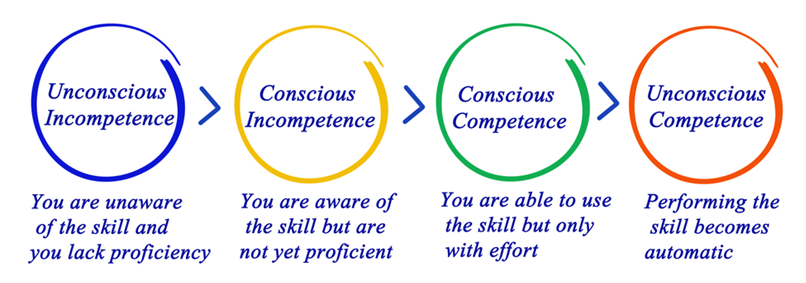
Burch (1974) developed a model of the Four States of Competence to help explain the processes in which an individual engages as s/he learns new skills.

As preservice teachers, we are unconsciously incompetent — we don’t know what we don’t know.  We stumble through our teaching, not knowing what we should be doing, if we are doing it right, or even what questions to ask.  As we begin to acknowledge our lack of knowing, we move into being consciously incompetent; we now know exactly how little we understand about the subject. It then becomes our mission to learn more, try more, figure out what works and what doesn’t in our attempts to improve. As we seek answers and help, practice, make adjustments, and are acutely aware of our growth, we shift to conscious competence. We know what we are doing and why we are doing it. We have grown; we now know things, and it shows.  When these practices gain a level of automaticity — where we no longer have to think about every little action we take and why — we become unconsciously competent.  “Right” is now a feeling, a sense that has developed with thought and practice. Any time we move into a new learning space, such as being a literacy coach or administrator, we begin the process again.  

This is usually where discussion of Burch’s model ends. However, I advocate for another step. In all my leadership roles, it has been necessary for me to step back into the conscious competence space. Why? Because when I am coaching a teacher in how to differentiate a lesson or teaching adult students about implementing a literacy strategy, it is not enough for me to say: “Yeah, I just do it, and it’s right. Here, watch me.”  That does not encourage growth in those with whom I am working.  I have to unpack what I am able to do automatically and make it transparent. I have to show that what I am doing is not by accident but the result of many years of experience, lots of reading and reflecting, and lots of corrected mistakes. I have to be able to say: “This is how you do it, and this is why it works.”  If I am unconsciously competent, I am not able to provide that form of instruction; and afterall, effective leaders are ultimately teachers. My ability to consciously understand my competence assists others in their moving from incompetence to competence. In order to be reflective teachers and effective literacy leaders, it is important for us to deconstruct the places where we are unconsciously competent.  We must be able to understand what we are doing, why we are doing it, how we can improve it, and what might happen if we did it differently.  We need to look at what we do automatically with the eyes of an outsider, “making the familiar strange” (Mills, 1959).

What might this look like? This means first, reflecting on our processes and how we engage with literacy learning ourselves. Early in my teaching career, I was assigned an SAT/ACT prep class. My students overall did not do well on the reading comprehension sections of tests. At the same time, I was preparing for the GRE exam to apply for graduate school, and I regularly rolled out near perfect scores on the reading comprehension. For me to better help my students, I had to step back into conscious competence and metacognitively consider what exactly I was doing in my reading of these passages and in my answering of comprehension questions that led me to a successful outcome. How was I engaging with the text? What was I thinking as I read? What kinds of predictions was I making? How did I process the questions? What did I do with vocabulary I didn’t know? Where was I rereading, where was I paraphrasing, and why? Once I unpacked my own process, I could then effectively convey to my students what I did and why through think alouds and walking through examples.

The same can be said when working with preservice and inservice teachers. In workshops or professional learning sessions, it is not enough to provide the formula of how to do a particular technique or strategy; it is imperative to also provide the theoretical reasons and reflective process that undergird the strategy. For example, I often begin my courses by having students complete a literacy autobiography, an activity they can easily enact in their own classrooms. While we do the activity, however, I also parallel the steps with rationales and explanations for what we are doing and why. I walk them through the assignment by modeling my own autobiography first. I show not only what my literacy experiences have been but also how they have shaped me as an individual now. This includes delineating my resultant strengths, challenges, and biases. As we work through their autobiographies, I model for them the unpacking process. What was it like for them to read and write in different subjects when they were younger? Who influenced their literacy habits and preferences? What life experiences influenced their literacy habits and preferences? How have these experiences impacted their views of literacy now? How do these preferences, or reticences, impact the way they interact with literacy now? How can they move beyond the fear, shame, or negative feelings that might have accompanied literacy experiences? How might their experiences impact interactions with students who do or don’t view literacy in the same way they do? For individuals with literacy affinities, the questions help them to see why they have positive dispositions toward reading and writing and to unpack the tacit literacy knowledge that has become automatic. This is important because not only can they better recreate some of the experiences for their students, they are also better able to see the correlation between their experiences and how they view reading and writing, and why other people, including many of their students, may not have the same perspectives. I share with them that Bourdieu (2013) argues our habitus shapes our understanding of the world, our ways of knowing (epistemologies), and the attitudes/beliefs/biases we carry into relationships with others and our teaching spaces. In order to be able to teach children, we have to know where we come from, why we believe what we believe, and consider how we can interrupt the transmission of our unconscious biases, which can be done through engaging in conscious competence and reflexivity. Otherwise, we can inadvertently create environments filled with microaggressions toward particular students, which can deeply impact student learning.

Stepping back into conscious competence and engaging in reflection is, in many ways, emancipating (Zeichner & Liston, 2014).  By engaging in thoughtful, conscious teaching and leadership, we free ourselves, our teachers, and our students from the blind following of established routines, policies, and plans. It gives us the freedom — and responsibility — to question, to wonder, to consider, to criticize, to advocate, and to defend. Thinking is a political action, and “teaching is a subversive activity” (Postman & Weingartner, 1971). Reflective teaching and conscious competence empower us to be change agents within our own educational spheres, whether that is in our classrooms, schools, districts, or at home with our own children. We learn to be critical consumers of curricula and policy, and we find our voices to change the status quo. This is how we change the currently negative national narrative for our profession — one child, one classroom, one teacher at a time.

References

Bourdieu, P. (2013). Outline of a Theory of Practice. Cambridge Press. DOI: https://doi.org/10.1017/CBO9780511812507

Burch, N. (1974).  The learning stages model. Solana Beach, CA: Gordon Training International.  

Mills, C.W. (1959). The Sociological Imagination. New York: Oxford University Press. (40th anniversary edition, 2000).

Postman, N. & Weingartner, C. (1971). Teaching as a Subversive Activity. Delta Publishing.

Zeichner, K. & Liston, D. (2014). Reflective teaching: An introduction. Second edition. Erlbaum.

Dr. Jennifer D. Morrison is a Clinical Assistant Professor at the University of South Carolina and a National Board Certified Teacher in AYA/ELA. She earned her Ph.D. from the University of Nevada, Reno, in Language, Literacy, and Culture. She worked as a middle and high school English teacher and instructional coach for 19 years. Her research agenda focuses on teacher induction, literacy attainment (particularly digital and multimodal), and teacher inquiry processes. She has been published in such journals as English Journal, Journal of Adolescent and Adult Literacy, Talking Points, Principal Leadership, and Educational Leadership.

Cover Photo by Lindsay Henwood on Unsplash

The Millennium Project

Teaching

This post is written by Miriam Necastro. Read more about Miriam at the bottom of this post.


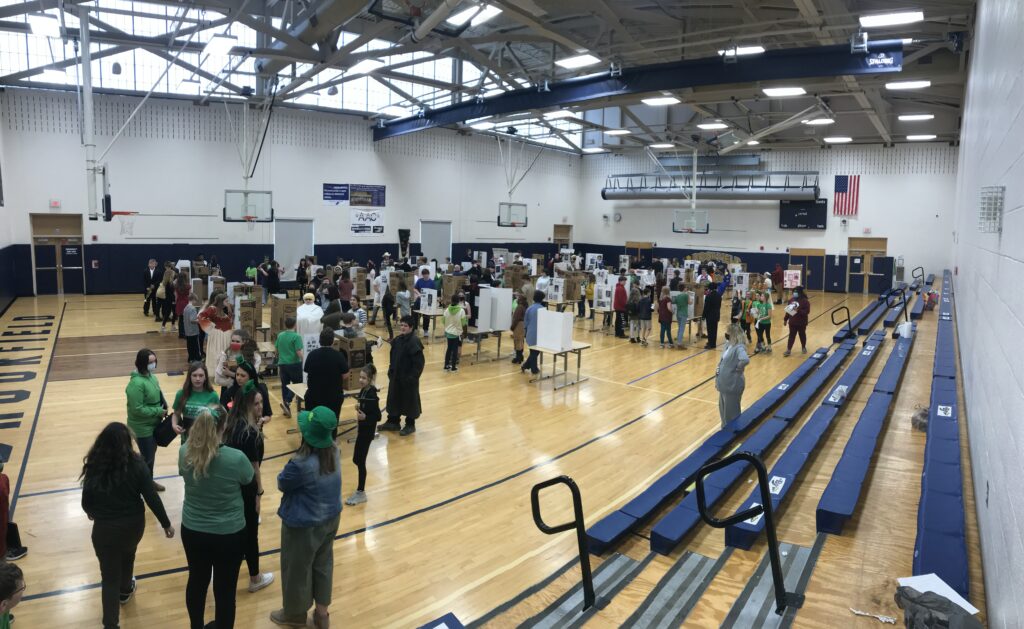
They say you can’t go home again. However, in the case of myself and some of my colleagues, we did by returning for round two at Brookfield Middle School; this time as teachers. At the beginning of the previous school year, our principal had set a goal for us to conduct more cross-curricular collaborations. When we were turned loose for common planning time with our grade-level teachers, we began brainstorming what we could integrate seamlessly across the curriculum divide. My colleague Brad, who teaches 7th grade World History, is also an alum of Brookfield. We started to reminisce about the different cross-curricular projects we completed during middle school. We both agreed that it was as if most of our classes back then were involved in these instructional projects. The other element we remembered was the excitement–our teachers were excited, which made us excited.

The project in question was known as the “Millennium Project.” At this time, during the early 2000s, A&E Biography released the program “100 Most Influential People of the Millennium.” In our World History class, our teacher wrote each of those individuals on slips of paper, and during class, we drew a name out of a cup. The name of the influential person we drew was the person we would be researching during classes, writing an informational essay, first-person biographical speech, creating a visual display, and portraying this person during the Night at the Museum presentation. What if we brought this project back to life after a seventeen-year hiatus?

We started by creating a dual Google Classroom page where we sectioned off different topics for all the project materials, examples, and assignment drop boxes. He covered the history assignments while I did the Language Arts ones. For example, areas of historical research would be covered by history, while ELA would cover the biographical essay. Based on the event date that was scheduled on the school calendar, we then collaborated on due dates for essential project assignments, agreeing that these would be flexible, if need be, once the unit got underway. Since the students had never completed a large project of this nature, covering two of their core classes, we knew this would be a learning experience for everyone. The fun part came first– having the students select the influential person they would be portraying for the project. The list of influential people ranged from Gandhi to Diana, Princess of Wales to Jane Goodall, Tomoe Gozen, George Washington, Jackie Robinson, Neils Bohr, Dolly Madison, and others.

The best collaboration tool we utilized was Google Classroom. Creating a joint classroom page specifically for this project assisted us in making sure that all students had the same information and materials in one central location. For example, research database websites were organized in their separate section, and my colleague and I would add links if we found a new site that would benefit student research. From an ELA and World History standpoint, we emphasized the importance of credible resources for research, especially when in seventh grade, Wikipedia is so convenient. Our students knew the ‘Research Resources’ section of Google Classroom as their one-stop shop. In an effort to not only conserve paper but also lessen the chances of lost materials, everything was digital. Students printed out their visual presentation text elements when constructing their museum board. As with Google Classroom, we could see student progress on the different parts and pieces of the project, so we could differentiate our instruction in our respective classrooms.

We know students always like to ask the question, “when am I going to use this outside of class?” We felt this project was the perfect opportunity to answer that question and put it to practice. Even though this was considered a history project at first look, the majority of the project was rooted in ELA. Without the Language Arts/writing skills, the students would not have been able to complete the project. The biographical essay that the students completed for their influential person aligned with the Ohio State Test Informative Writing Rubric, and used the research they completed in history class. In both classes, we expressed the importance of not just copying and pasting information from their research sources into their essay; they must use their personal voice. In doing so, not only did it save them from plagiarism, but it also proved to us that they understood the information. They read the information, processed it, decided how it fit into the boundaries of the project, then, put it in their own words. Historical research plus writing and grammar skills combined in these areas of the project: historical research outline, biographical essay, visual display title, biographical timeline, key facts, word cloud, and fake social media page. ELA standards also include goals for speaking and listening. Students fulfilled this standard by using points from their biographical speech to write a speech from the perspective of their historical person to deliver during the “Night at the Museum” event when someone came up to their station.

The culminating event took place during school hours, where our seventh-grade students dressed as their historical person, stationed in front of the visual display they created, celebrating and sharing their knowledge acquired in both history and ELA over the last months. This project proved that lines between curricula don’t have to be so definite. If we combine our areas of expertise as teachers, we can maximize student learning.

Miriam Necastro has 6 years teaching experience and is the 7th grade ELA & Reading teacher at Brookfield Middle School; Brookfield, Ohio. She is currently pursuing an M.Ed in Literacy from Clemson University.

Photo by Skye Studios on Unsplash

The Power of Parallel Reading

Teaching

This post is written by Charlene Aldrich. For more about Charlene, please visit the bottom of this page. The webinar recording for this material is embedded at the bottom of post.


How do we get students to read at home? We probably have to require it. We know in lower school, students are asked to read 15-20 minutes every evening. Students have free choice; parents monitor the requirement by initialing a document. But how can that requirement morph into a habit that positively affects the student’s academic future?  “Let them choose” becomes the mantra. When given open choices, it’s human nature to struggle. 

BUT when we provide themes, topics, or text sets to choose from, we make a choice manageable. It’s then that students fulfill our targeted purpose for outside reading. It’s then that students look at titles as a way of previewing the content of the text. It’s then that they engage in ‘reading to find out.’ It’s a win-win.

“I don’t have time to hunt down reading selections and/or books!” cry many content-area teachers everywhere.  And maybe teachers won’t have the extra time during their first or second year of teaching. Or the first or second month of the year.  HOWEVER, when teaching and planning become automatic, time becomes available to investigate the themes and text sets curated and available online. Content-area teachers can introduce reading selections of all genres; these support the ELA curriculum and provide background, cultural understanding, or applications of specific content-area curriculum.  This is where the idea of parallel reading emerged – collaborating across the content areas in ways that grow overall literacy proficiency AND reinforce content-area learning.

Parallel – side by side, never touching. Reading – the crosstie that connects content areas. Juxtaposed with another discipline, text is a way to connect things that would otherwise run side by side. Through parallel reading, teachers approach their content from a literacy mindset. Take math, for example.  One might say that reading is not necessary to do the math.  However, knowing ‘pi’ is essential, but where did it come from?  WHO first used it for achieving a measurement?  WHEN did it come about? WHY was it necessary? A planning question becomes, “Who were the movers and shakers beginning at the onset of mathematical thinking and going forward?”

How do you implement your new mindset?

  1. Review the major topics of your curriculum.  OR
  2. Look at the calendar for events or holidays. OR
  3. Look at the school calendar for half-days and identify a theme, especially those that are more social than curriculum related.
  4. Ask students what ideas they would like to explore, then factor their ideas into your curriculum and text set search.
  5. Ask the librarian to identify a wide range of texts and genres that connect to your theme or topic. 
  6. Search in the following text set resources for reading selections connected to the theme or topic.
  7. Construct your curated list for your students to choose an interest to read and share.
  8. Most of all, limit the rabbit holes that you might find yourself in as you realize the plethora of choices that you can provide to your students.  

Arousing curiosity and satisfying it with reading develops a positive attitude toward reading.  It empowers students to read to ‘find out why’. While the answers to those questions are easily found with a Google search, connecting to the culture of the times happens best when biographies or primary sources are available for reading.

Text of all kinds becomes the primary connection between every content area. Students who read first-hand accounts of the Jim Crow era have a deeper understanding of the literature of that time. The struggle of the Indigenous people has a more significant impact when seen through their eyes in diaries, songs, and poetry. Understanding the building process of the pyramids or the Roman aqueducts connects math with sociology or history.

I alluded to curated text sets above and encourage you to investigate some of my favorite resources. NewsELA, ReadWorks, CommonLit are just a few places to find digital text sets created and classified by readability, theme, topic, holiday, and current events. One of my favorite articles is in NewsELA regarding Halloween and how much money is spent: nine billion dollars in 2018! Each of the above resources contains a wide variety of stand-alone reading/writing projects for those short classes on short days where there’s no time for an entire lesson!

Your teaching librarian can also curate book sets that support your curriculum. Other grade-level teachers may welcome the opportunity to collaborate on reading and writing assignments. Making connections across content-areas strengthens learning and increases the likelihood of creating lifelong learners.

Ponder my truisms about lifelong learning:

  • Learning requires reading from diverse perspectives.
  • Linking new learning to prior learning lays a foundation for future application.
  • Social consciousness is developed when empathy is aroused.
  • Citizenship has a whole new meaning when students discover that the ‘yous’ of this world are more important than the “I”. 

Parallel reading projects grow a body of students who will begin thinking outside of their high school, content-area silo. That is certainly how they will live upon graduation. Stereotype book reports don’t have to be the outcome of parallel reading. How would your students like to communicate their reading experience to others? Encourage them to move beyond summaries (which can be found online) to how their perspectives have shifted because of the reading selection.  

Try it. Identifying the selections is half of the fun! What’s the other half? Sharing them with your students.  Through themes and topics, students can connect with text in ways outside of a required curriculum text. They can take ownership of their reading which just might result independent readers and learners.   

Photo by Johannes Plenio on Unsplash


Charlene Aldrich is an instructor in the Office of Professional Development at the College of Charleston. While content-area literacy is her specialty, she also teaches Assessments in Reading, Foundations in Reading, and Instructional Practices as required by South Carolina for recertification. She serves as the Treasurer of LiD 6-12.

Complicated, and Worth It: Fashioning Links in Literacy

Teaching

This post is written by Jason D. DeHart, PhD. Read more about Jason at the bottom of this post.


Were I to conduct a thematic analysis of my career in literacy so far, “I don’t like to read” would rise to prominence as an often-stated reality.  Even if students feel that they are capable readers, they do not always express connection and engagement with the texts that they encounter in school settings.

This was true in my time as a middle school teacher, it is a theme that has inspired my scholarship, and it is a mantra that continues to resonate in the K-12 setting in which I am working now. When I consider the types of texts that continue to be honored – voices from hundreds of years ago, many of which include problematic language related to ethnic, racial, and gender identities – it is no small wonder that instant buy-in is so rare.

While there are many potential solutions to discuss, the word that also comes to mind in my thematic thinking is linking. This notion of linking speaks directly to the work of Literacy in the Disciplines in terms of thinking about the strands of critical inquiry that can be fashioned between and among content areas and types of texts. As I start a new semester, I am continuing to revisit the ways I can make content rich and relevant for my students through thoughtful connections between and among content areas, types of texts, and voices old and new.

The Rising Voices

Text selection is a key part of this process. When I first began teaching my students, they were reading Steinbeck’s outsider report of migrant farm workers in Of Mice and Men. That same year, in 1937, a book called Their Eyes Were Watching God was published. I was fascinating by this cultural dichotomy and struck by the opportunity to find a voice from the intersections of gender and ethnicity that could broaden my students’ perspectives about the lived experiences of people in the past. Zora Neale Hurston was, famously, an anthropologist, and her attention to ethnographic detail shows up in her writing.

I then worked with students across my courses to trace this literary journey to Alice Walker, who was instrumental in bringing attention once more to Zora Neale Hurston’s work in more recent times. This conversation between authors across time was one that I could discover and share with my students, linking to their current stories as part of American culture(s). It is both a linking of time and a critical inquiry that travels through a chain of inspiration.

In addition to Hurston and Walker, we read Jason Reynolds, Jericho Brown, and additional contemporary voices who have shared about facets of America that are simply not discussed in many canonical works. It is also important to me to choose works not simply because I am drawn to them personally, but as a way of filling in a gap that exists in what students might have discovered in literature so far.

Critical Analysis and Honest Stance

At one time, suggesting that a revered work of literature contains problematic content would have caused me insecurity. I desperately wanted to be a “good English teacher”, and I thought that meant holding the classics up on clouds. At this point in my teaching career, I recognize the value of honestly evaluating the limitations of thought and experience represented by literary canonical figures. In this way, I can be clearly critical about what it means to be an inside or outside voice related to a particular topic or way of being, and I can invite my students to think critically about these questions of authorship, as well.

I feel that this approach honors my students’ intelligence and acumen in noting these inconsistencies in human stories, as well as their awareness of the absence of some stories in what they have discovered in curriculum so far. This critical stance is not only possible in English class, but can lead to inquiry in history and social studies courses, discussions of equity and equal access in science and health care, and questions of ethics in technology courses, to note a few possibilities.

Asking students to evaluate an author biographically, not to simply suggest that they did not know better than to use language at a certain period in time, but to consider authors’ biases and positionalities is part of deep thinking and ethical work. This need not be a full lecture on the author’s history, but rather a point-by-point glimpse at some major details about them, considered historically alongside literature.

Ways of Reflecting

Finally, all of this critical work requires some kind of outlet. I cannot imagine teaching a class about virtually any topic and not having my students respond in some way each day, either in a paragraph, a sentence, or a few take-away words. I embrace videoed content as students have created zeitgeist poems and adapted key narrative scenes in groups, using their cell phones as one-stop shops for moviemaking. I embrace the visual, not just in thinking about remembering vocabulary words, but in sharing multimodally and symbolically about reading and viewing experiences.

A question stem to encourage this kind of response might be something like: Locate or create three images that represent your thinking about the representation of political unrest in Before We Were Free by Julia Alvarez, or Create an infographic to help us understand the setting and context of Elie Wiesel’s Night.

In this way, students can explore links between and among stories that have existed for some time, as well as those that need to be (re)told. Moreover, as I have explored in this post, students can become aware of, critique, and even compose links between historical and contemporary voices, and engage in the process using tools and approaches that build their mathematical, artistic, and technological skills.

Teaching and learning is truly a linking and connected process, from past to present and across multiple literacies. All of this rich complexity requires attention, but I have found the conversation to be worth the time.


Jason D. DeHart is a passionate educator, currently teaching English at Wilkes Central High School in Wilkesboro, North Carolina. He served as a middle grades English teacher for eight years and an assistant professor of reading education at Appalachian State University from 2019 to 2022. DeHart earned his PhD from The University of Tennessee, Knoxville.

Photo by Michal Matlon on Unsplash

Teaching Word Roots in the Science Curriculum

Teaching

This post is written by Dr. Timothy Rasinski. Learn more about Dr. Rasinski at the bottom of this post.


Research has demonstrated that the size and depth of students’ vocabularies are associated with proficiency in reading comprehension. Words matter in reading. Words also matter in academic areas. In science, words are labels for key scientific concepts. Although learning science-related words is critical to success, teaching them can be challenging – many scientific ideas are new to students, and most scientific concepts are abstract. Asking students to look up and memorize words and their definitions in dictionaries or textbook glossaries is, at best, a short-term solution and, at worst, can lead students to deep disinterest in studying words.  

Another Approach – Word Roots

A word root is an umbrella term for a word part that carries meaning, including prefixes, bases, and suffixes. Importantly, our understanding of a new word’s meaning begins not with the prefix but with the base because the base is the root that provides the word’. Moreover, the ubiquitous nature of word roots means that they appear in many words – learning one word root can help readers understand many words. Since over 90 percent of all academic words (including science) are derived from Greek and Latin word roots, it seems that a comprehensive and efficient approach to teaching science vocabulary is to teach the word roots that underly the scientific concepts and words students will encounter in their science instruction. 

Here’s a year’s worth list (one per week) of some of the many science-related word roots (and their meanings) derived from Latin and Greek that students will encounter in their science instruction.   Interestingly, many of these roots also find their way into the vocabularies of other academic areas, such as math and social studies.  

You can easily see how these word roots are found in many science words and concepts, especially in longer scientific words that combine multiple bases, prefixes, and suffixes (e.g., abrupt, interruption,  photosynthesis, illuminate, orthodontist, biodiversity, sediment, subside, etc.).

How to Start with Word Roots

            There are many ways to include word roots in science and vocabulary instruction.   One of the simplest is to develop in students an awareness of and fascination for word roots.  This can be done by starting each week with a new word root and presenting students with the root, its meaning, and a list of words that contain that word’s roots.  Perhaps make a classroom visual display of the root, its meaning, and a list of related words (students could keep their own personal word journals with this information).   Then throughout the week, make quick references to the root, perhaps adding a new word each day to the display.   And, of course, when coming across new words containing the root in your instruction, draw students’ attention to the word, and its root.  Here’s an example using the “hydr(o)” word root:

A few minutes each day studying the targeted word root and reading texts containing word roots can go a long way to develop students’ understanding of science (and other academic areas), build their general vocabularies for reading and writing, and develop students’ fascination with words toward becoming a true “lexophile” (“lex” = word;  phile = love/lover).

Recommended Resources

Rasinski, T., Padak, N., Newton, R., & Newton, E. (2014).  Getting to the Roots of Science Vocabulary: 6-8.   Huntington Beach, CA:  Shell Education.  (find at www.tcmpub.com)

Rasinski, T., Padak, N., Newton, R., & Newton, E. (2014).  Building Vocabulary from Word Roots:  Kits for Grades 3 through 11.   Huntington Beach, CA:   Teacher Created Materials.  (find at www.tcmpub.com )

Dr. Tim Rasinski is a Professor of Literacy Education at Kent State University where he holds the Rebecca Tolle and Burton W. Gorman Chair in Educational Leadership.  A former classroom and reading intervention teacher, Tim is a member of the International Reading Hall of Fame and was recently identified to be among the top 2% of scientists in the world.

Tim’s Email is trasinsk@kent.edu You can follow Tim at @timrasinski1

Cover Photo by Arun Geetha Viswanathan on Unsplash