Writing Learning into Shape: Using Concrete Poetry to Explore & Reflect Content Knowledge

Teaching

This post is written by Brooke L. Hardin. To learn more about Brooke, please visit the bottom of this post.


What Is Concrete Poetry?

Concrete poetry, sometimes called shape poetry, is poetry whose visual appearance matches the subject of the poem. The words of the poem form a shape or shapes which illustrate the poem’s topic in visual form as well as through their literal meaning. This type of poetry has been used for thousands of years since the ancient Greeks began to enhance the meanings of their poetry by arranging their characters in visually pleasing ways back in the 3rd and 2nd Centuries BC (Nesbitt, 2023).

In the 1950s, a group of Brazilian poets known as the Noigandres developed a manifesto to define the work of concrete poetry and give us the name. The manifesto states that concrete poetry communicates its own structure: structure = content (Eppley, 2015).

How to Write Concrete Poetry

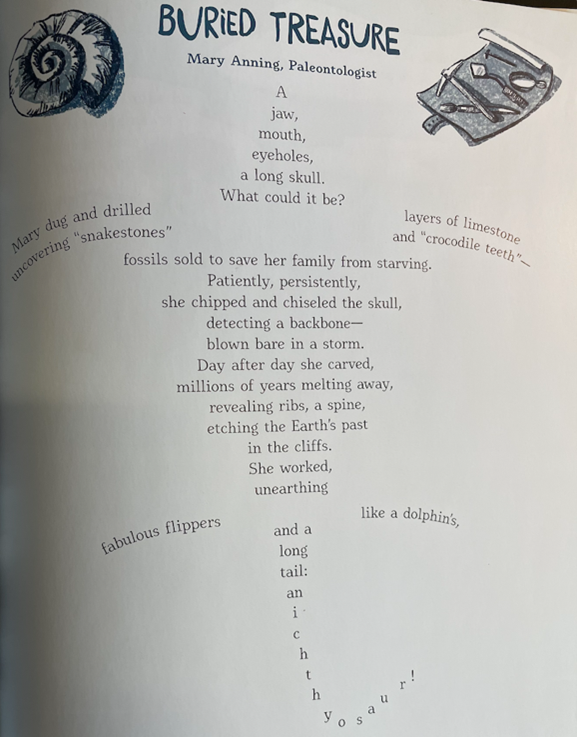
There are two main ways to create a concrete poem. The first is referred to as an “Outline Poem.” The writer creates an outline of the subject of the poem or of an object that relates to the subject and fills in the outline with words or phrases. The words or phrases used to fill in the outline usually describe the subject or how it makes the writer feel in some way, provide information connected to the subject, or possibly tell a story related to the subject. Some examples of this technique for concrete poetry are provided in Figures 1 and 2.
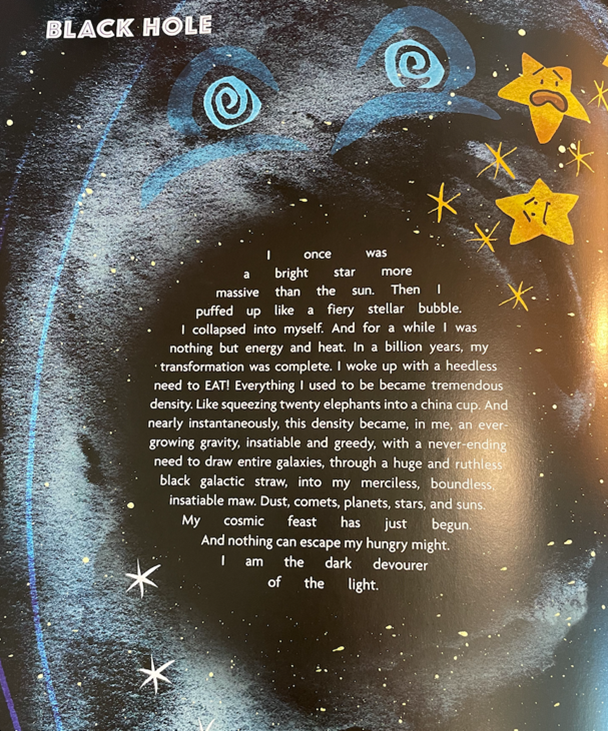
Figure 1: Black Hole

Note. From The Day the Universe Exploded My Head: Poems that Take You Into Space and Back Again, by Allan Wolf, 2019, Somerville, MA: Candlewick Press

Figure 2: Buried Treasure

Note. From Shaking Things Up: 14 Young Women Who Changed the World, by Susan Hood, 2018, New York, NY: HarperCollins.
My son and I recently spent an afternoon at a local bike park. Following the trip, he and I co-authored a concrete poem using the “Outline” technique. The video embedded below shows how I used questioning to help him come up with the words and phrases for the poem while I acted as a scribe. Image 3 shows the final poem we created.
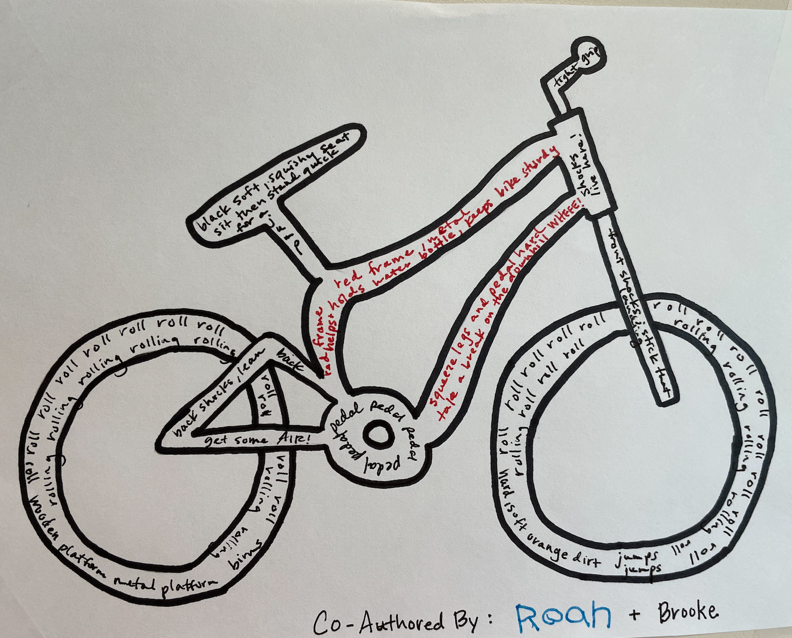
Figure 3: Mountain Bike

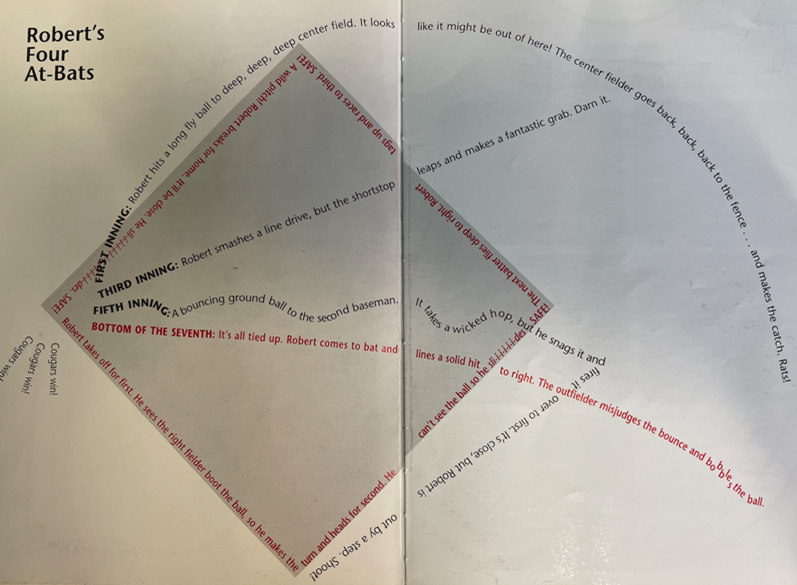
Another technique for creating concrete poems is to use the lines of words to make the lines of a drawing. One thing to note about this technique is that the subject does not have to be an object, but it does need to be something that can be drawn with “stick” figures. Examples of these poems are below.
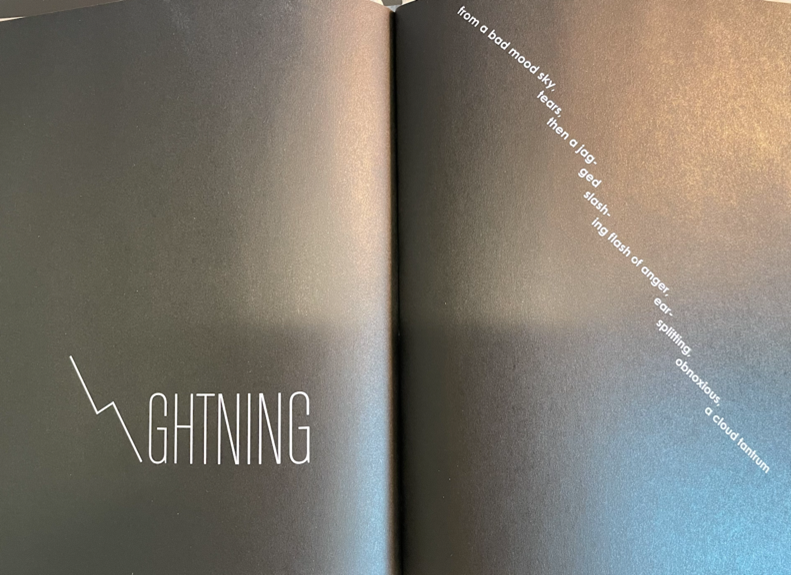
                                                Figure 4: Lightning

Note. From Wet Cement: A Mix of Concrete Poems, by Bob Raczka, 2016, New York, NY: Roaring Brook Press.

Figure 5: Robert’s Four At-Bats

Note. From Technically, It’s Not My Fault: Concrete Poems by John Grandits, 2004, New York, NY: Clarion Books.
Instructional Considerations for Concrete Poetry

When teaching students to write concrete poems, whether using the outline or drawing technique, consider these reminders.

  • Model, model, model! Planning instruction with the Gradual Release of Responsibility (Pearson & Gallagher, 1983) in mind will help students better understand the cognitive and physical aspects of composing concrete poems.
    • Use inquiry to analyze some exemplars like the ones provided above or those found in books listed in the references to help students take notice of the elements of concrete poems.Select a topic as a class and write a concrete poem together, with students offering the words and their arrangement while the teacher acts as a scribe. Use questioning, such as the type seen in the video above, to help students think about their subject and form written ideas from those thoughts.Invite students to co-author a concrete poem as a pair or small group.
    • Finally, provide opportunities for students to independently write concrete poems, get feedback from peers, and share their final drafts.
  • Concrete poems do not need to rhyme.
  • Concrete poems can be written on traditional paper or digitally. If using paper, suggest to students that they use a pencil when drafting the poems. This allows them to erase and move words around where needed.
  • Encourage students to play with the size, color, and shape of their letters to better capture the essence of the poem’s subject (e.g., I might write the word TTEEEETHH in different shapes and font sizes when writing about a shark). This helps to reinforce the reciprocal nature of reading and writing by providing students a chance to consider the purpose of their craft moves.

Writing Concrete Poetry to Reflect Content Area Learning

Writing to learn and writing about learning are necessary in content-area classrooms. While many argue and I can agree that these are different notions, writing concrete poems can accomplish the aim of both.

Writing, as discussed above, must involve a discussion of ideas, leveraging the social side of learning where knowledge is co-constructed, and misunderstandings can be clarified. Additionally, when and where questions arise to inform written ideas, further research may occur; thus, more learning takes place during the writing process. For example, a student in a 7th-grade science classroom is drafting a concrete poem about a cell as part of a Life Science unit. They may refer to class notes, talk with a partner, or watch a video about cells to (1) draw the outline of a cell and/or (2) write a line about the nucleus – possibly drawing it inside another shape that is made of letters spelling out “membrane,” given that the nucleus is enclosed in a membrane. The writing of the concrete poem has the potential to reinforce learning that has occurred, provide new content, and/or inspire ways to show learning.

Both the reading and writing of concrete poems present teachers in discipline-specific classrooms with innovative methods for motivating students to engage in the content. Given their interesting appearance and brief lines, concrete poems as supplementary texts in units of study to teach a specific topic (see Image 1 about the Black Hole and Image 2 about the female paleontologist Mary Anning, who, in the early 1800s, found complete fossils that laid the foundation for Darwin’s theory of evolution) may appeal to students who are reluctant to engage with textbooks and other longer documents. As an alternative to traditional analytical research papers and essays, writing concrete poems related to learning may motivate students to take a deeper interest in the content to present their learning in a creative way. I would also maintain that crafting a line of concrete poetry deepens comprehension and calls upon sophisticated critical thinking; taking a line from prose (e.g. an article or textbook) and rewriting it in one’s own words to fit a poetic style is rigorous cognitive work. With regards to standards related to research skills and speaking and listening, I would further suggest that students provide a reference list to accompany the poems and give presentations where they explain craft moves and inspiration for certain lines.

As a former middle grades ELA/Social Studies educator, I can attest that using concrete poetry in a content area classroom allows students to reimagine learned content creatively and critically while deepening and extending their understandings and knowledge. Give it a try and share your poems with me!

References

Eppley, C. (2015, January 21). Concrete Poetry of the Noigandres, 1958-1975. Retrieved from http://avant.org/event/noigandres/

Nesbitt, K. (2023). How to Write a Concrete Poem. Retrieved from https://poetry4kids.com/lessons/how-to-write-a-concrete-poem/

Pearson, P. D., & Gallagher, M. C. (1983). “The Instruction of Reading Comprehension,” Contemporary Educational Psychology, 8, pp. 317-344.

Children’s Literature References & More to Consider

Grandits, J. (2004). Technically it’s not my fault: Concrete poems. Clarion Books.

Grandits, J. (2007). Blue lipstick: Concrete poems. Clarion Books.

Hood, S. (2018). Shaking things up: 14 young women who changed the world. HarperCollins.

Raczka, B. (2016). Wet cement: A mix of concrete poems. Roaring Brook Press.

Wolf, A. (2019). The day the universe exploded my head: Poems to take you into space and back again. Candlewick Press.

Brooke Hardin is an Assistant Professor of Elementary Education at the University of South Carolina Upstate. Her research interests include writing development and instruction for intermediate and middle grades students, teaching and learning through technology and new literacies, literacy professional development and teacher education, and interdisciplinary approaches to reading, writing, and the utilization of Children’s Literature. Her years of experience as an elementary and middle grades classroom teacher and curriculum literacy specialist frame her research interests and commitment to teacher education.

Photo by Valentin Salja on Unsplash

Prisms, Pathways, and Portals: Disciplinary literacies as tools for possible futures

Teaching

This post is written by Michael Manderino. You can learn more about Michael at the bottom of this post.


“We cannot remake the world through schooling, but we can instantiate a vision through pedagogy that creates in microcosm a transformed set of relationships and possibilities for social futures, a vision that is lived in schools. This might involve activities such as simulating work relations of collaboration, commitment, and creative involvement; using the school as a site for mass media access and learning; reclaiming the public space of school citizenship for diverse communities and discourses; and creating communities of learners that are diverse and respectful of the autonomy of lifeworlds.”

New London Group, 1996

It often amazes me how prescient the text (quoted above), A Pedagogy of Multiliteracies: Designing Social Futures (1996) was and what it argued for just before the dawn of the 21st century. Now in the year 2023, using terms like 21st-century learning doesn’t resonate much as we are nearly a quarter way into the 21st century. I often question how much we have really taken up from the ideas even extracted from the quote above. While disciplinary literacies have been at the forefront of theory and research around adolescent learning, I believe that we need a future vision of the possibilities of disciplinary literacy. We need more than practices that simply reproduce knowledge.  We need an expansive theorizing of what disciplinary literacies can be or else we will continue to reinscribe old ways of knowing and doing for a future that is yet to be written.  

Despite a need for a widening of thought, we collectively find ourselves presented with seemingly predefined choices for where we need to stand pedagogically.  Dialogues have shifted to debates over everything from the “Science of Reading vs. Balanced literacy, Online reading vs. Offline reading, or the use of the canon vs contemporary fiction.  The pitting of the pedagogical constructs against one another creates a reductionist view of the complexities of teaching and learning.  Rather than reducing complex pedagogical constructs to binaries, perhaps we should be interrogating the possibilities for pedagogical expansion. While simple answers feel more reassuring, they do not account for the beautiful complexity of teaching and learning.

One reductionist view we might interrogate is the narrowing of what counts as disciplinary inquiry.  Expert novice studies have provided invaluable insights into what are core disciplinary practices yet can often be taken up as the singular way to approach disciplinary literacy.  Disciplinary literacy in its early conceptualization offered new ways to think about advancing knowledge building in content-area classrooms.   What follows is a set of possibilities for consideration of what might be taken up in research and practice around disciplinary literacies. Using the metaphors of pathways, prisms, and portals, I argue for the use of multidisciplinary, interdisciplinary, and transdisciplinary approaches in disciplinary inquiry.  

Pathways 

Photo by Caleb Jones on Unsplash

Disciplinary literacies can be pathways to explore through multidisciplinary perspectives. Pathways can be paved, worn by repeated traffic; serve as shortcuts or trails that lead to hidden beauty. Pathways can diverge or converge.  People use pathways to get somewhere or to meander. Sometimes along the path, new discoveries are made, or new paths are forged.   Pathways can serve as a metaphor for multidisciplinary inquiry. One may choose to look at a problem or topic from the lens of different disciplines. Like choosing a path or multiple pathways, inquiry can be shaped by one, two, or more disciplines. While it is critical to understand the beliefs, practices, texts, and tools used in a discipline like science or history, it is also important to see that inquiry questions can be approached from multiple disciplines. For example, we can look at a problem such as food scarcity from the perspectives of geography, economics, agriculture, and mathematics, to name just a few. We need to engage with the world from multiple perspectives that are often shaped across disciplines. Food scarcity is not a simple problem that can be understood or tackled from singular perspectives. If we only hyperfocus on singular disciplines, we may lose the forest through the trees.  

Prisms  

Photo by Braxton Apana on Unsplash

Disciplinary literacies can also be prisms for seeing new possibilities. Using singular lenses to problem solve or problem pose does not account for the complexity of the problem. Prisms can reflect and refract light to illuminate the full spectrum of colors that are being absorbed. Prisms help us see things in a new light. We can think of interdisciplinary inquiry as a tool for seeing the full spectrum of perspectives around topics and problems. Interdisciplinary inquiry relies on the interconnected nature of disciplinary practices and perspectives. If we expand notions of disciplinary literacy to interdisciplinary, we add the nuances of the comparative and contrastive beliefs, tools, texts, and approaches to understanding phenomena. For example, the role of art, music, and literature provides indispensable insights into complex phenomena that cannot be fully explained through a historical or scientific analysis. By using interdisciplinary inquiry as a prism, students have access to new ways of seeing the world and their role in the world.  

Portals 

CC0 Public Domain

Disciplinary literacies can serve as portals to newly designed futures. During the Covid-19 pandemic, author Arunduti Roy (2020) argued that the pandemic could serve as a portal to new social possibilities. The notion of portals to new dimensions or time/space scales is one that is speculative and hopeful. To see disciplinary literacy as opening portals to solving wicked problems to create more just worlds is a goal that makes learning consequential. Portals also lead to the unknown. Much like disciplines themselves, portals are unsettled terrain and are absent critical voices who are often erased or silenced. To account for these silences and erasures, transdisciplinary research is conceptualized as a way to be inclusive of multiple perspectives not simply from the top down (academia) but also from the ground up (lived experiences). A transdisciplinary approach to inquiry opens opportunities for problem-posing and solving that values indigenous and local knowledge and its relation to disciplinary traditions. This expansion of disciplinary literacies offers opportunities for youth to engage in knowledge production and critique that affirms and sustains the rich tapestry of knowledge that shapes our worlds. For example, a former student and colleague, Diana Bonilla articulated the need for plant biology units to also incorporate the familial and indigenous use of plants for medicinal and culinary purposes in Latinx communities. To keep those practices obscured from disciplinary knowledge reduces our humanity and reason for understanding disciplinary perspectives. Transdisciplinary inquiry opens portals to a more inclusive and just learning environment.  

Provocations for future practice 

I hope the metaphors of pathways (multidisciplinary inquiry), prisms (interdisciplinary inquiry), and portals (transdisciplinary inquiry) provide provocations for future practice. Are there spaces in your curriculum that warrant a multidisciplinary or transdisciplinary approach? How might we redesign our inquiry questions to open possibilities for interdisciplinary braiding of knowledge and knowledge-building practices? How might we use this space to share ideas and iterate collectively? To me, this is an inflection point in education that we can see as filled with possibilities for drawing on the passions and inquisitive dispositions of youth to expand learning activities rather than reducing learning to a series of disconnected tasks.  Youth deserve opportunities to remake our world and to design social futures in spaces that are lived in and out of school.


Michael Manderino is an associate professor of literacy education at Northern Illinois University.  He taught high school social studies for 14 years and served as a literacy coach, literacy coordinator, and Director of Curriculum of a two-high school district for 5 years.

Follow on Twitter at @mmanderino

Email: mmanderino@niu.edu

Cover Image Photo by Robynne Hu on Unsplash
The Power of Parallel Reading

Teaching

This post is written by Charlene Aldrich. For more about Charlene, please visit the bottom of this page. The webinar recording for this material is embedded at the bottom of post.


How do we get students to read at home? We probably have to require it. We know in lower school, students are asked to read 15-20 minutes every evening. Students have free choice; parents monitor the requirement by initialing a document. But how can that requirement morph into a habit that positively affects the student’s academic future?  “Let them choose” becomes the mantra. When given open choices, it’s human nature to struggle. 

BUT when we provide themes, topics, or text sets to choose from, we make a choice manageable. It’s then that students fulfill our targeted purpose for outside reading. It’s then that students look at titles as a way of previewing the content of the text. It’s then that they engage in ‘reading to find out.’ It’s a win-win.

“I don’t have time to hunt down reading selections and/or books!” cry many content-area teachers everywhere.  And maybe teachers won’t have the extra time during their first or second year of teaching. Or the first or second month of the year.  HOWEVER, when teaching and planning become automatic, time becomes available to investigate the themes and text sets curated and available online. Content-area teachers can introduce reading selections of all genres; these support the ELA curriculum and provide background, cultural understanding, or applications of specific content-area curriculum.  This is where the idea of parallel reading emerged – collaborating across the content areas in ways that grow overall literacy proficiency AND reinforce content-area learning.

Parallel – side by side, never touching. Reading – the crosstie that connects content areas. Juxtaposed with another discipline, text is a way to connect things that would otherwise run side by side. Through parallel reading, teachers approach their content from a literacy mindset. Take math, for example.  One might say that reading is not necessary to do the math.  However, knowing ‘pi’ is essential, but where did it come from?  WHO first used it for achieving a measurement?  WHEN did it come about? WHY was it necessary? A planning question becomes, “Who were the movers and shakers beginning at the onset of mathematical thinking and going forward?”

How do you implement your new mindset?

  1. Review the major topics of your curriculum.  OR
  2. Look at the calendar for events or holidays. OR
  3. Look at the school calendar for half-days and identify a theme, especially those that are more social than curriculum related.
  4. Ask students what ideas they would like to explore, then factor their ideas into your curriculum and text set search.
  5. Ask the librarian to identify a wide range of texts and genres that connect to your theme or topic. 
  6. Search in the following text set resources for reading selections connected to the theme or topic.
  7. Construct your curated list for your students to choose an interest to read and share.
  8. Most of all, limit the rabbit holes that you might find yourself in as you realize the plethora of choices that you can provide to your students.  

Arousing curiosity and satisfying it with reading develops a positive attitude toward reading.  It empowers students to read to ‘find out why’. While the answers to those questions are easily found with a Google search, connecting to the culture of the times happens best when biographies or primary sources are available for reading.

Text of all kinds becomes the primary connection between every content area. Students who read first-hand accounts of the Jim Crow era have a deeper understanding of the literature of that time. The struggle of the Indigenous people has a more significant impact when seen through their eyes in diaries, songs, and poetry. Understanding the building process of the pyramids or the Roman aqueducts connects math with sociology or history.

I alluded to curated text sets above and encourage you to investigate some of my favorite resources. NewsELA, ReadWorks, CommonLit are just a few places to find digital text sets created and classified by readability, theme, topic, holiday, and current events. One of my favorite articles is in NewsELA regarding Halloween and how much money is spent: nine billion dollars in 2018! Each of the above resources contains a wide variety of stand-alone reading/writing projects for those short classes on short days where there’s no time for an entire lesson!

Your teaching librarian can also curate book sets that support your curriculum. Other grade-level teachers may welcome the opportunity to collaborate on reading and writing assignments. Making connections across content-areas strengthens learning and increases the likelihood of creating lifelong learners.

Ponder my truisms about lifelong learning:

  • Learning requires reading from diverse perspectives.
  • Linking new learning to prior learning lays a foundation for future application.
  • Social consciousness is developed when empathy is aroused.
  • Citizenship has a whole new meaning when students discover that the ‘yous’ of this world are more important than the “I”. 

Parallel reading projects grow a body of students who will begin thinking outside of their high school, content-area silo. That is certainly how they will live upon graduation. Stereotype book reports don’t have to be the outcome of parallel reading. How would your students like to communicate their reading experience to others? Encourage them to move beyond summaries (which can be found online) to how their perspectives have shifted because of the reading selection.  

Try it. Identifying the selections is half of the fun! What’s the other half? Sharing them with your students.  Through themes and topics, students can connect with text in ways outside of a required curriculum text. They can take ownership of their reading which just might result independent readers and learners.   

Photo by Johannes Plenio on Unsplash

Charlene Aldrich is an instructor in the Office of Professional Development at the College of Charleston. While content-area literacy is her specialty, she also teaches Assessments in Reading, Foundations in Reading, and Instructional Practices as required by South Carolina for recertification. She serves as the Treasurer of LiD 6-12.

Complicated, and Worth It: Fashioning Links in Literacy

Teaching

This post is written by Jason D. DeHart, PhD. Read more about Jason at the bottom of this post.


Were I to conduct a thematic analysis of my career in literacy so far, “I don’t like to read” would rise to prominence as an often-stated reality.  Even if students feel that they are capable readers, they do not always express connection and engagement with the texts that they encounter in school settings.

This was true in my time as a middle school teacher, it is a theme that has inspired my scholarship, and it is a mantra that continues to resonate in the K-12 setting in which I am working now. When I consider the types of texts that continue to be honored – voices from hundreds of years ago, many of which include problematic language related to ethnic, racial, and gender identities – it is no small wonder that instant buy-in is so rare.

While there are many potential solutions to discuss, the word that also comes to mind in my thematic thinking is linking. This notion of linking speaks directly to the work of Literacy in the Disciplines in terms of thinking about the strands of critical inquiry that can be fashioned between and among content areas and types of texts. As I start a new semester, I am continuing to revisit the ways I can make content rich and relevant for my students through thoughtful connections between and among content areas, types of texts, and voices old and new.

The Rising Voices

Text selection is a key part of this process. When I first began teaching my students, they were reading Steinbeck’s outsider report of migrant farm workers in Of Mice and Men. That same year, in 1937, a book called Their Eyes Were Watching God was published. I was fascinating by this cultural dichotomy and struck by the opportunity to find a voice from the intersections of gender and ethnicity that could broaden my students’ perspectives about the lived experiences of people in the past. Zora Neale Hurston was, famously, an anthropologist, and her attention to ethnographic detail shows up in her writing.

I then worked with students across my courses to trace this literary journey to Alice Walker, who was instrumental in bringing attention once more to Zora Neale Hurston’s work in more recent times. This conversation between authors across time was one that I could discover and share with my students, linking to their current stories as part of American culture(s). It is both a linking of time and a critical inquiry that travels through a chain of inspiration.

In addition to Hurston and Walker, we read Jason Reynolds, Jericho Brown, and additional contemporary voices who have shared about facets of America that are simply not discussed in many canonical works. It is also important to me to choose works not simply because I am drawn to them personally, but as a way of filling in a gap that exists in what students might have discovered in literature so far.

Critical Analysis and Honest Stance

At one time, suggesting that a revered work of literature contains problematic content would have caused me insecurity. I desperately wanted to be a “good English teacher”, and I thought that meant holding the classics up on clouds. At this point in my teaching career, I recognize the value of honestly evaluating the limitations of thought and experience represented by literary canonical figures. In this way, I can be clearly critical about what it means to be an inside or outside voice related to a particular topic or way of being, and I can invite my students to think critically about these questions of authorship, as well.

I feel that this approach honors my students’ intelligence and acumen in noting these inconsistencies in human stories, as well as their awareness of the absence of some stories in what they have discovered in curriculum so far. This critical stance is not only possible in English class, but can lead to inquiry in history and social studies courses, discussions of equity and equal access in science and health care, and questions of ethics in technology courses, to note a few possibilities.

Asking students to evaluate an author biographically, not to simply suggest that they did not know better than to use language at a certain period in time, but to consider authors’ biases and positionalities is part of deep thinking and ethical work. This need not be a full lecture on the author’s history, but rather a point-by-point glimpse at some major details about them, considered historically alongside literature.

Ways of Reflecting

Finally, all of this critical work requires some kind of outlet. I cannot imagine teaching a class about virtually any topic and not having my students respond in some way each day, either in a paragraph, a sentence, or a few take-away words. I embrace videoed content as students have created zeitgeist poems and adapted key narrative scenes in groups, using their cell phones as one-stop shops for moviemaking. I embrace the visual, not just in thinking about remembering vocabulary words, but in sharing multimodally and symbolically about reading and viewing experiences.

A question stem to encourage this kind of response might be something like: Locate or create three images that represent your thinking about the representation of political unrest in Before We Were Free by Julia Alvarez, or Create an infographic to help us understand the setting and context of Elie Wiesel’s Night.

In this way, students can explore links between and among stories that have existed for some time, as well as those that need to be (re)told. Moreover, as I have explored in this post, students can become aware of, critique, and even compose links between historical and contemporary voices, and engage in the process using tools and approaches that build their mathematical, artistic, and technological skills.

Teaching and learning is truly a linking and connected process, from past to present and across multiple literacies. All of this rich complexity requires attention, but I have found the conversation to be worth the time.


Jason D. DeHart is a passionate educator, currently teaching English at Wilkes Central High School in Wilkesboro, North Carolina. He served as a middle grades English teacher for eight years and an assistant professor of reading education at Appalachian State University from 2019 to 2022. DeHart earned his PhD from The University of Tennessee, Knoxville.

Photo by Michal Matlon on Unsplash
Wicked Problems

Teaching

Many important societal problems are neither simple nor easily solved; they are wicked problems. 1 A wicked problem is a social or cultural challenge that involves many social systems and groups, has unpredictable outcomes, and defies typical problem-solving techniques. 2

Wicked problem is a phrase originally used in social planning to describe a problem that is difficult or impossible to solve because of incomplete, contradictory, and changing requirements that are often difficult to recognize. It’s important to note that the word (wicked) is used to denote resistance to resolution, rather than evil. 3

Systems Theory

Because of complex interdependencies, the effort to solve one aspect of a wicked problem may reveal or create other problems. We make sense of this through systems theory, or the the interdisciplinary study of systems. These systems are cohesive groups of interrelated, interdependent components that can be natural or human-made.

Every system has causal boundaries and is influenced by its context, defined by its structure, function and role, and expressed through its relations with other systems. A system is more than the sum of its parts as it can express synergy, or the interaction or cooperation of two or more organizations, substances, or other agents to produce a combined effect greater than the sum of their separate effects. Systems can also show emergent behavior, or an unanticipated side effect of bringing together a new combination of capabilities. Emergent behaviors can be either beneficial, benign, or potentially harmful, but in all cases they are very difficult to foresee until they manifest themselves.

Addressing Wicked Problems

To address a real-world, wicked problems a transdisciplinary lens is needed to support educators and students as they engage with this content in ways that extend beyond traditional academic boundaries 4 Transdisciplinarity is a research or educational approach that seeks to challenge disciplinary boundaries to create a holistic perspective that enables inputs across scientific and non-scientific communities. 5 Looking at a problem and context through a transdisciplinary lens allows one to construct meaning in more authentic contexts where disciplines intersect, combine, and work together. 6

Illustrator: Uğur Orak

What could be described as a wicked problem is really a situation in which we’re recognizing the power and irregularity of evolving systems. In education, we want to provide learning opportunities for students that are valid representations of the challenges they’ll encounter in the real world. This calls for a greater amount of flexibility on the part of the teacher. Given the lack of structure, and problems with validity, reliability, and access of open digital information, educators need to be more flexible and tolerant as they engage in the learning process. 7 Teachers need to have an appreciation for the complexities, pitfalls, challenges, and opportunities that exist when using open, digital information in the classroom. 8 Educators must constantly re-envision what it means to be educated, and what it means to be literate as technology advances. Through the careful use of texts, tools, and pedagogy there is an opportunity to effectively achieve Friere’s goal that teachers should be learners, and learners should be teachers. 9

Students also bear a great deal of responsibility when engaging with wicked problems in the classroom. Students must display the discipline, responsibility, persistence, and flexibility required to work as an active participant in these interactions. In this process, students must take an active role in learning, and reconsider the concept of “school.” 10 In a classroom in which teachers empower students to wrestle with wicked problems, students may have to take a leadership role in the crafting and revision of new learning process or product. 11 12

Conclusion

We we prepare youth to enter their futures, it is important to be honest with learners and let them know that the systems, policies, and practices that govern our spaces may not always make sense. As we address wicked problems it is important to consider all of the contexts and contingencies that impact the these decisions. As learners in a globally connected community, we need to continue to evolve with these incomplete, contradictory, and changing challenges from a systems perspective.

When we think about pedagogy or curriculum in terms of content areas or disciplines, these arbitrary designations limit the creativity and perspective that youth need as they prepare for their futures. This siloed view of teaching, learning, and assessment stunts youth from fully engaging with meaningful experiences.

Adding complexity to this wicked problem of considering these opportunities in learning environments is that as we debate whether to include them in classes, the wicked problems themselves evolve, intensify, and metastasize. Educators need to evolve and reset paradigms around teaching, learning, and power as the challenges persist. 

Content originally posted at https://wiobyrne.com/wicked-problems/

Photo by Markus Winkler on Unsplash
Webinar: Transdisciplinarity as a Gateway to Critical Literacy

Announcements

Literacy in the Disciplines, 6-12 (LiD) is pleased to announce our next after-school Webinar Series session.

Traversing, Transforming, Transcending, and Transgressing wicked problems in the classroom.

Many critical societal problems are neither simple nor easily solved; they are wicked problems (Zellner & Campbell, 2015). A wicked problem is a social or cultural challenge that involves many social systems and groups, has unpredictable outcomes, and defies typical problem-solving techniques (Rittel & Webber, 1973). To address real-world, wicked problems, a transdisciplinary lens is needed to support educators and students as they engage with content in ways that extend beyond traditional academic boundaries (Alford & Head, 2017). Students experience deeper learning and start thinking outside the box when their teachers collaborate to present different aspects of the same subject across various disciplines. (Mauser et al., 2013). A transdisciplinary lens allows one to construct meaning in more authentic contexts where
disciplines intersect, combine, and work together (Rice, 2013). This session will define transdisciplinarity and provide teachers with techniques to expand critical literacy opportunities in their classrooms.

When: This webinar was held on Tuesday, December 28th, 2022, 6:00 – 7:00 pm ET.

The slide deck for the presentation is embedded below.

The video recording of this session is available below.

Cost: Free. LiD6-12 is funded by the South Carolina Middle Grades Initiative.

This session featured Dr. W. Ian O’Byrne.

Cost: Free. LiD6-12 is funded by the South Carolina Middle Grades Initiative.

This session will feature Dr. W. Ian O’Byrne

Dr. W. Ian O’Byrne (@wiobyrne) is an associate professor of literacy education at the College of Charleston in South Carolina. His research focuses on individuals’ dispositions and literacy practices as they read, write, and communicate in online and/or hybrid spaces. Ian is the author of many journal articles and book chapters focusing on initiatives ranging
from online and hybrid coursework, integrating technology in the classroom, computational thinking, and supporting marginalized students in literacy practices. His work can be found on his website or in his weekly newsletter.

Please share this professional learning opportunity with your colleagues.

Follow and like Literacy in the Disciplines, 6-12 on Twitter.

Photo by Hans-Peter Gauster on Unsplash

Webinar: What does Critical Literacy have to do with my Teaching?

Announcements

Literacy in the Disciplines, 6-12 (LiD) is pleased to announce our next after-school Webinar Series session.

What does Critical Literacy have to do with my Teaching?

Learning through a critical literacy lens encourages students to take steps toward identifying potential solutions to current, real-world problems (Vasquez et al., 2019). They can do this when educators ask
them to explore “personal, sociopolitical, economic and intellectual border identities” when they read (Bishop, 2014, p. 52), and to promote valid, thoughtful critique of the power structures they either are subjected to or that are upheld in their classrooms. This session will define critical literacy and provide frameworks and techniques for teachers to begin exploring this concept in their classrooms.

When: Tuesday, November 22nd, 2022, 6:00 – 7:00 pm ET.

The recording of this event is embedded below.

Cost: Free. LiD6-12 is funded by the South Carolina Middle Grades Initiative.

This session will feature Drs. Rachelle Savitz and Jennifer D. Morrison.

Dr. Rachelle S. Savitz is an associate professor of reading/literacy at East Carolina University. Her scholarship investigates teacher self-efficacy, literacy within the disciplines, and the use of culturally sustaining pedagogy and practices. She worked across the grade levels as a reading teacher, literacy coach, reading interventionist, and music teacher. She has three published/in-press books and has been published in such journals as Teaching and Teaching Education, Literacy Research and Instruction, Whiteness and Education, and Journal of Adolescent & Adult Literacy. She serves as the President of LiD 6-12.

Dr. Jennifer D. Morrison is a Clinical Assistant Professor at the University of South Carolina and a National Board Certified Teacher. She worked as a middle and high school English teacher and instructional coach for 19 years. Her research agenda focuses on teacher induction, literacy attainment (particularly digital and multimodal), and teacher inquiry processes. She has been published in such journals as: English Journal, Journal of Adolescent and Adult Literacy, Talking Points, Principal Leadership, and Educational Leadership. She serves as the interim Vice President and Secretary of LiD 6-12.

Please share this professional learning opportunity with your colleagues.

Use digital spaces and poetry to share a walk in your world

Research

The #WalkMyWorld project started as a community focus on poetry and multimodal exploration; it then developed into a community of inquiry. Participants explored the experiences of others by responding to and authoring multimodal poetry. In #WalkMyWorld, educators and students created a social space of engagement to explore civic uses of social media. This exploration served as an opportunity to consider the media literacies at play as the group participated as a community of writers. 

Guided by carefully-crafted learning events, participants took photos, authored short pieces, and filmed small glimpses of their lives. At weekly intervals, they documented their “walks” using photo and video capture tools that easily allow users to share content with others. By collecting snippets of their worlds that seemed trivial one at a time, participants experienced the magic that, when strung together, these digital “gatherings” presented narratives of very human things: pain, beauty, joy, friendship, and wonder. 

During the project, instructors were able to target specific educational objectives revolving around (but not limited to) explorations with poetry. With the understanding that creating and sharing digital content in online spaces might be a novel and even scary experience, instructors also charged participants to grapple with what to share and how. This raises questions between educators and learners as they contemplate how and how much to share. Accordingly, thoughtful experimentation online, connection with digital texts and tools, and play ultimately serve as valid, if not crucial, educational outcomes. 

This project encouraged educators and students in elementary school through higher education to engage in social scholarship practices. Social scholarship utilizes the Internet and other communication technologies to evolve the ways in which scholarship is conducted. Like many other social scholarship projects #WalkMyWorld connected formal scholarship with informal Internet-based social practices while embodying specific values (e.g., openness, collaboration, transparency, access, sharing). #WalkMyWorld evolved into a space that allowed participants to explore the characteristics of online information and educational opportunities by allowing them to share and develop (a) writing lifeworlds, (b) communities of inquiry, (c) media literacies and (d) expanded perspectives of narrative writing. These skills have proven to be integral to the way teachers view themselves as professionals in online and hybrid educational spaces.

The trailer shared above was created for a session on the project released at the K12 Online website. The full video for the session is available below.

Work with the 2014 version of the #WalkMyWorld Project was printed in the MIT Civic Media Reader.

Results from the 2015 iteration of the #WalkMyWorld Project were also presented at the annual conference of the Literacy Research Association. Work from this session by Wise and O’Byrne was later published in the Literacy Research: Theory, Methods, and Practice journal.

The #WalkMyWorld Project was also highlighted in a publication by Rish and Pytash in NCTE’s Voices from the Middle and the accompanying podcast.

Lastly, in 2017 this project served as a motivating factor in this chapter on mentored open online communities (MooCs) as a third space for teaching and learning in higher education.

Photo by Jon Tyson on Unsplash

What’s in a Name?

Teaching

By: Antoinetta J. Rogers

“Schooling is the process by which you institutionalize people to accept their place in a society… Education is the process through which you teach them to transform it.”- Dr. Jeff Duncan-Andrade

What’s in a name? 

This is a very common and loaded question.  Asunción Cummings Hostin, Euphemia LatiQue Sumpter, Uzoamaka Nwanneka Aduba, and Antoinetta Jamika Rogers prove there is always a story behind a name.  

Asunción Hostin is an American lawyer and a very intelligent, articulate, and charismatic cohost of the Daytime Emmy Award winning talk show The View.  She is commonly known as Sunny Hostin.  During an interview with People Magazine, Sunny stated that when she began working on Court TV with Nancy Grace, the famed legal commentator, she had a difficult time pronouncing her name.  Acknowledging that Sunny was indeed quite talented, Nancy Grace feared that because most people may find it difficult to pronounce her name that she shorten it to make it easier to pronounce. So, instead of Asunción Hostin, Sunny Hostin is the famous household name.  Euphemia LatiQue Sumpter is an American actress.  Known for her flair, fortitude, and fascinating role on the highly acclaimed series Tyler Perry’s The Haves and Have Nots, she mentioned in an interview that although she was beautiful and talented the name Euphemia just was not “it.”  So, instead of Euphemia Sumpter, Tika Sumpter is the famous household name.

Uzoamaka Nwanneka Aduba is a dynamic, vibrant, and effervescent, Nigerian American actress who is best known for her roles in the Netflix series Orange is the New Black and the film Miss Virginia. She is commonly known as Uzo Aduba.  A video surfaced of Uzo stating that she hated her name.  The hate seemed to stem from other people having a difficult time pronouncing it. Growing up in a small New England town, she explained that there were not a lot of Nigerian Americans. Uzoamaka means “The road is good.”  What was quite noticeable in her candid oration was the visible mentioning of teachers finding it difficult to pronounce her name.  One day upon returning home from school, she casually asked her mom to call her Zoey. Her mom simply stated that if people can learn to say Tchaikovsky, people will and would learn to pronounce Uzoamaka.

So, what does an English teacher from a small rural town in South Carolina have in common with the aforementioned Hollywood stars?  Antoinetta Jamika Rogers is my name.  Nobody calls me by my first name Antoinetta, instead I go by Jamie.  Antoinetta has ten letters, four syllables and is often pronounced as (An-tw-un-Et) instead of (An-tw-un-Et-Uh).  So, growing up Jamie was more adaptable and easier than Antoinetta.  It became my nickname. Nicknames are convenient, but seldom created as a courtesy or in favor of the person in which the shortened name is given.  What’s in a name? Absolutely everything! A person’s name is a huge and important part of a person’s cultural identity; therefore culturally responsive teaching is very imperative and quite a necessity to say the least in an ever changing and evolving world.

Culturally Responsive Teaching

Photo by sydney Rae on Unsplash

Culturally Responsive Teaching is the practice of teaching cultural competence.  States and school districts already have educational standards and curriculums established that are usually adjusted and molded according to society’s norms.  However, in the classroom it is so important that teachers make it a norm to not only teach, but practice cultural competence. Cultural competence is the ability to understand, communicate with, and effectively interact with people across cultures. One’s own awareness of cultural competence includes developing positive attitudes towards cultural differences and gaining knowledge of cultural practices and world views. I realized that regardless of the demographics of students I teach, classrooms should be increasingly diverse with diverse teaching materials, methods, and strategies.  If the demographics are all the same, this does not mean that cultural competence and sensitivity should not be inclusive. All students should feel welcomed into a learning environment that celebrates diversity and multiculturalism. Most curriculums and lessons include an aspect of diversity, but it should be woven into the atmosphere of the classroom.

Real World Implications

Photo by Markus Spiske on Unsplash

According to the Center for the Professional Education of Teachers (CPET), school practices currently reflect the norms of monolingual, white, middle class students, which often excludes students who come from diverse cultural and linguistic backgrounds. Students who are excluded from these norms are often viewed through a deficit lens.  South Carolina College and Career Ready Standards are the standards that I am required to use as a certified classroom teacher.  So, the overall goal is for students to be prepared to enter an institution of higher learning, the workforce, and/or the military.  Not only should students be academically prepared, but students should be culturally prepared as well.  Thus, a simple yet complex task of accepting and pronouncing an individual’s name can possibly have an everlasting positive impact.

Society has a habit of associating certain sounding names with certain races and ethnicities. According to the National Bureau of Economic Research Issue No. 9. “Employers’ Replies to Racial Names,” a job applicant with a name that sounds like it might belong to an African-American – say, Lakisha Washington or Jamal Jones – can find it harder to get a job. Despite laws against discrimination, affirmative action, a degree of employer enlightenment, and the desire by some businesses to enhance profits by hiring those most qualified regardless of race, African-Americans are twice as likely as whites to be unemployed and they earn nearly 25 percent less when they are employed.  Pronouncing an individual’s name correctly and accepting that the name may have cultural attachment to it is important for the advancement of society. 

Classroom Applications

I make sure that I pronounce a student’s name correctly as well as the student’s peers in my class because names represent a heritage, a lineage, and a legacy. This is also common courtesy and a sign of respect.  A name is a representation that we should be proud of and not something that anyone, in this case specifically students, should have to worry about changing or shortening in the future, because we live and exist in a society where certain names make people uncomfortable for a quick minute or two.  If teachers discuss or present this topic in the classroom and really show and teach through experiments, instructional strategies, and projects, this can begin to turn the tide and become the norm therefore possibly preventing society from having a perception of “racial names.”   

 The world is a colossal entity that embodies diverse, multicultural, racial, ethnic, and linguistic backgrounds.  If students are taught to be culturally competent and responsible people, then as the world continues to progress and move forward, teachers will be a major part of molding and shaping well- rounded culturally aware individuals. Awareness promotes respect and acknowledgement.  In foresight, these individuals will not haste to say names such as Asunción, Euphemia, Uzoamaka, and Antoinetta because of their phonetic pronunciation, but make embracing and sharing the importance of all names and all things that represent heritage, culture, and diverse backgrounds the standard.

About the Author

Antoinetta J. Rogers has seven years of teaching experience and currently teaches Secondary English at Richland Northeast High School.

Photo by Volodymyr Hryshchenko on Unsplash

Data over Assumptions: Determining How Our Schools Engage in Family-School Partnerships

Collaboration

By: Dr. Jennifer D. Morrison

Photo by Dave Craige on Unsplash

In 2016, the University of South Carolina Language & Literacy faculty members decided to overhaul the Masters in Education degree requirements. The then current program was outdated and focused on very narrow conceptions of literacy, who owned it, and how it was to be taught. Because we all hailed from strong critical theory backgrounds, we knew a social justice thread was imperative. Through this lens, as we examined individual courses as well as the program as a whole, we began to ask questions such as: who owns literacy?  How do we want to present this? What about funds of knowledge and out-of-school literacies?  This line of questioning led us to realize that nowhere in our program did we account for parental and community involvement in students’ literacy learning.  This, to us, was a huge gap that needed to be filled. We decided to redesign a course entitled “Guiding the Reading Program,” changing it from a third assessment course to one on literacy leadership with a focus on developing skills that would assist teachers in employing community and family resources in school and district literacy practices and policies. I was the initial instructor for this course and looked to my experiences, as an instructional coach and administrative intern, to help me build the curriculum and key assessment experiences. 

Tough Conversations and Deep Reflection

When discussing family involvement, it is not uncommon to hear educators talk about how many parents attend PTSA meetings, come to Open House/Curriculum Nights, or support the band/athletic boosters. However, it becomes important to really consider which parents are involved and what percentage of the school they represent.  It is often eye-opening to realize large swaths of families are un- or under-represented at school events. For example, as the instructional specialist at a middle school in Maryland, I was part of a school leadership team who specifically sought to broaden our parent involvement, not only in how they were involved but also in who was involved.  We had a very active and invested community; so, when we collected data about who was coming into our school for social and academic activities and who was not, it was surprising to see we had almost no members of our Latino families represented. This required us to conduct deep reflection and address cultural divides. We thought we were providing appropriate communication with our families by sending home notices in backpacks and posting on our school’s social media and websites. However, when we asked members of the Latino community why we had limited attendance, they indicated to us more personal means of communication were needed. When we started picking up the phone and personally calling families, we found they were significantly more responsive; we had to bridge a cultural divide we did not realize we had built, to ensure all families felt welcome. This is not an uncommon experience that emerges once school leadership teams and teachers delve mindfully, deeply, and honestly into the degree to which families and community members are truly involved in schools. 

The Work

Figure 1

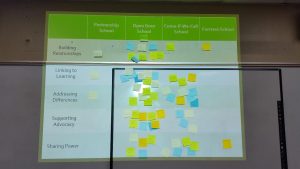
In my class, one of the early activities I ask teachers to complete is a pair of inventories regarding parental involvement practices.  The first is Salinas, Epstein, and Sanders’s (2012) An Inventory of Present Practices of School, Family, and Community Partnerships. It identifies six ways parents can be involved in schools (called “types” in this instrument) including: parenting, communicating, volunteering, home-learning, decision-making/leadership, and community collaboration. School members are asked to consider the degree to which statements listed under each type are true and in what grade levels. These responses help illuminate both traditional and nontraditional means of involvement and also show if there are patterns or trends in participation. I then pair this inventory with a second evaluation instrument from Beyond the Bake Sale (Henderson, Mapp, Johnson & Davies, 2007). This instrument uses five domains (building relationships, linking to learning, addressing differences, supporting advocacy, and sharing power) to help educators identify which of four versions of family-school partnerships best describes their school (partnership, open-door, come-if-we-call, or fortress). To help them to see patterns, I ask students to identify which version of partnerships their schools represent for each domain and place a sticky note in the appropriate location (see Figure 1). While most people would say they have a partnership school, especially at the elementary level, many individuals are surprised with the results of this survey.  There are areas suggested, such as including parents in curricular decisions, many of my students have not ever considered.

Figure 2

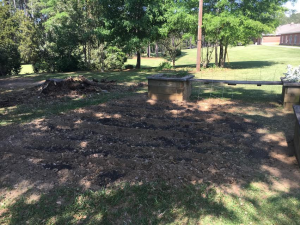
Between these two instruments, my students begin to get a clearer, and more accurate, picture of their schools’ strengths and needs with regard to parent and community partnerships. They are then asked to develop a family and community partnership grounded in the data they have collected from these two sources. I encourage them to think about how they can move their school to a higher version within one domain of the Beyond the Bake Sale rubric while also using some of the descriptors from the Epstein inventory to help frame goals and action steps. The projects that have emerged from this project have been organic, deeply-embedded in individual school needs, centered on literacy, and overall impactful. One resulting project was discussed in this blog by Hannah Kottraba in June when she wrote about her family heritage project. Other examples have included virtual science activities where parents and students engage in disciplinary literacy to solve scientific problems; pre-k students engaging in pen pal writing and subsequently building a garden with members of an assisted care facility (see Figure 2); online interactive math resources (focused on literacy needed for word problems); workshops that coach family members how to support reading with all ages of students; family culture exhibits; writers’ gallery celebrations; and international student shadowing days where high school students serve as hosts for international graduate students learning about America’s education system. Many of these projects addressed family and community populations who are often underrepresented in schools, and several have become multi-year or ongoing events.

It is important to remember that such projects are many times singletons, snapshots that occur once as a result of a course; the impetus being the need to complete a class assignment. I am not so naïve as to think these class assignments have suddenly made every school my students teach at a Partnership School. What is important is the paradigm shift that occurs as teachers undergo this process. They begin to seek out ways to better meet the criteria established by these two inventories; they become more attuned to cultural differences that may be acting as a barrier to some families and making them feel unwelcome with the school space; and they become more appreciative of the funds of knowledge parents and family members bring with them.

About the Author

Dr. Jennifer D. Morrison is an instructor at the University of South Carolina. Her experiences include being a middle and high school English teacher, gifted education resource teacher, and instructional coach.  She earned her Ph.D. at the University of Nevada, Reno, in Language, Literacy, and Culture.  She is a National Board Certified Teacher (AYA/ELA), an alumnus of the Teaching Shakespeare Institute at the Folger Theater in Washington, D.C., and has won multiple awards for teaching and writing including NCTE’s Paul and Kate Farmer English Journal Award and AERA’s Dissertation Award in Research on Teacher Induction. Currently, her research focuses on adolescent, digital, multimodal, and disciplinary literacies as well as narrative and qualitative methodologies.