Disciplinary Literacy (DL) is an orientation to the work of teaching that (re)claims a focus on action: knowing how to do, to use, to apply, to act, to verb. This requires an instructional focus on process and application over receiving and demonstrating knowledge. It is therefore a form of resistance to the version of schooling that is ruled by accountability metrics – where tests, credits, and other metrics have become a school’s reason for being rather than tools to measure and improve it. In this way, it is radical: it affects the fundamental nature of what teachers imagine can and should happen in class with students. And, its absence is a signal of the slow creep of oppressive policies that can become naturalized as how we ‘do school’ in the US.
In too many middle and high school classrooms, content knowledge has been divorced from the communities that produce, apply, and critique it outside of classroom settings. In that divorce, we have lost the connection to the purpose that motivates and the audience that gives meaning to the structure of the text and task (See Figure 1).
Figure 1. An expanded purpose-audience-format triangle
A DL orientation is essentially a suit for custody – for deeper connection – to each of these. Otherwise, it requires educators to work against the grain of typical curricula and related tasks (e.g. testing and test preparation, data collection, and classroom sorting). We have to pause business as usual to do a standalone project that brings authentic context into focus. We have to look up from representations of knowledge and re-present or re-frame them in ways that allude to their purpose in the world.
In my experience, instruction that is oriented towards application and use exists as the exception rather than the rule in core academic classes. However, it is more likely to be found in the courses that do not count for graduation or in the enrichment opportunities that are reserved for those who do well: a choir that performs, an auto shop that repairs, a science elective that grows or conserves, or a language class that visits another culture. I suspect that this is because these areas are the least tested and the most likely to have educators or curricula directly connected to the doing: playing music for performance rather than for a quiz on what it includes; fixing a car to make it run again, rather than for a matching test on the names of engine parts. The more academic and abstract knowledge is, the less likely it is to stay connected to use. These tenuous marriages of knowing and doing exist on the margins of academic experiences as reminders that specialized literacies are not necessarily harder than general literacy.
Texts reflect the particularities of their purposes, processes, and the conditions in which they were produced. For example, jazz musicians are likely to play off of a lead sheet rather than a full score showing every detail of every instrument’s parts. They need a text that shares a basic structure across collaborators so that they can improvise within it. Conductors need a detailed account of every part so that they can understand how all parts contribute to the whole and understand everything that might be happening simultaneously. The texts match the tasks. Though a conductor’s score might seem infinitely more challenging than a single part or a simplified lead sheet, their use of it may actually be quite simple. Unlike a lead sheet where each symbol contains a lot of information that might be highly consequential, conductors are really only following patterns across pages and parts – not reading every symbol of every line.
This is similar to the way that an actor might do a close reading of a single part of a single scene with lots of repetition of their own lines but would never try to read 30 pages of a play that way for homework. A director might likewise review a scene to visualize blocking. This process may not prepare them to do the kind of activity that might be found in an English classroom divorced from the text’s uses (e.g. a quiz question on a vocabulary word found on one of the pages they skimmed), but it will prepare them for the work they are doing with the text. Their purpose for reading influences their process for reading, and the amount or type of text with which they engage. The way we orient ourselves to the task of reading a text assigned for English class sets and limits students’ access to the context, meaning, and motivation. The literate process (e.g. reading for blocking, close reading, skimming for patterns, extrapolating from summary) may actually be a simpler cognitive task if it is specified instead of general. And, specialized tasks are more likely to resonate with a set of purposes and meaningful contexts. When texts are connected to a discipline – communities that produce, critique, and interpret them – students have the benefit of the sense of purpose and meaning to support their motivation and guide their inferences.
Disciplinary connection is not a feature of the text itself, but of the framing or relationship between the text and what students are doing with it: is their activity connected to a purpose and process that align with the particularities of some use? Or are they reading a text for a generic reason that is divorced from any specific purpose and process? This divorce makes the reading inherently harder because we use the larger context to predict and confirm meaning, and the larger purpose to ignite and sustain motivation.
About the Author
Dr. Gabriel is Professor of Literacy Education at the Neag School of Education at the University of Connecticut. She is author of more than fifty refereed articles, and author or editor of seven books for literacy teachers, leaders, and education researchers. Rachael currently teaches courses for educators and doctoral students pursuing specialization in literacy, and is Editor in Chief of The Reading Teacher. A former teacher and reading specialist, Rachael’s research is focused on: literacy instruction, leadership, and intervention, as well as policies related to teacher development and evaluation. Her current projects investigate how educators and school leaders build collective capacity, state literacy policies, and discipline-specific literacy instruction.
Inspiration: Why Data Interpretation and Analysis?
When I was first introduced to the concept of disciplinary literacy last semester, I found myself reflecting on my own educational experiences. I’ve always felt like I processed information differently from my peers. I often struggled to understand certain concepts and found myself repeatedly reteaching to myself what I had learned. Over time, I realized I had never fully understood my learning style and how it affected my academic success. This realization made me think about my future students. I never wanted them to feel the same way I did—to feel like they weren’t “smart enough” because they couldn’t identify their learning style. I wanted to create a classroom environment where all students could thrive, no matter how they learned.
For my final project in Multiple Literacies in Secondary Education, I was tasked with exploring a literacy skill focusing on its application in a specific discipline. As part of the assignment, I had to design a project where I took on the role of an agriculture teacher, teaching other agriculture educators about a literacy strategy they could use in their classrooms. After much thought, I chose visual comprehension as my literacy skill as I’m a visual learner myself. However, as I dug deeper into the research, I found a significant gap in resources related to agricultural literacy. There was very little research connecting disciplinary literacy with agriculture. Recognizing how vital data in agriculture is—especially in areas like plant and soil sciences—I decided to take a STEM-based approach and adapt the research to fit the agricultural context. Agriculture, Food, and Natural Resources (AFNR) often relies on data analysis, which pulls together basic concepts from chemistry and biology. Without it, we can’t make informed decisions in farming, sustainability, or food production. So, I decided to explore this gap and make it the focus of my project.
Lesson Development: Structuring the Nearpod Lesson
When I first started developing my Nearpod lesson, I felt overwhelmed. The task seemed daunting, and I wasn’t sure where to begin. But then I shifted my perspective. I realized that one of my strengths is lesson planning—I love it! So, I approached the project like I would any other lesson: what’s the main topic (importance of agricultural literacy and visual comprehension in AFNR), and how can I teach it effectively? I structured the lesson to guide educators through understanding the connection between literacy and data interpretation in agriculture. I wanted to make sure that teachers could not only grasp the concept but also apply it to their own classrooms.
I began by explaining what visual comprehension is—the ability to understand, interpret, and extract meaning from visual representations of information. This includes images, diagrams, symbols, charts, graphs, maps, and other visual aids. Visual comprehension is a critical skill in education, as it helps students process complex data, recognize relationships between elements, and draw meaningful conclusions without relying solely on text. In agriculture, this skill is especially important for interpreting data related to crop production, soil quality, livestock growth, and environmental factors. For example, students might analyze weather maps to predict climate patterns, study livestock growth charts to assess health trends, or interpret soil composition diagrams to determine nutrient levels. By strengthening students’ visual comprehension skills, educators can help them navigate and analyze agricultural data more effectively, improving their overall agricultural literacy.
After establishing the importance of visual comprehension, I introduced how data in agriculture—whether it’s about crop yields, soil quality, or livestock growth—can be interpreted through visual means, such as graphs, charts, and diagrams. From there, I incorporated faded scaffolding, a strategy where teachers provide support initially and gradually reduce it as students become more independent. I chose Nearpod because it allows for real-time interaction. The platform provided an opportunity for educators to engage with the content at their own pace, ask questions, and even participate in a matching game to reinforce the concepts.
Disciplinary Literacy Connection: Why Does This Matter in Agriculture?
Disciplinary literacy in agriculture is crucial. It’s not just about reading and writing—it’s about thinking critically and analyzing data, skills that are essential in any agricultural or STEM-related field. This lesson connects literacy skills with real-world applications in agriculture, helping students develop problem-solving abilities vital for solving pressing issues in the agricultural industry. As global populations rise and the demand for food increases, the agricultural sector faces more complex challenges. One of the most pressing issues is climate change, which directly impacts food production through rising temperatures, shifting weather patterns, and increased frequency of extreme weather events such as droughts, floods, and hurricanes.
These changes threaten crop yields, disrupt planting and harvesting cycles, and contribute to soil degradation, making it harder to sustain food production. Addressing these challenges requires innovative solutions driven by data analysis and critical thinking. We need thinkers and problem-solvers who can interpret data to make informed decisions—whether it’s optimizing crop production, implementing sustainable farming practices, or assessing environmental impacts. By integrating faded scaffolding, we help students build their independence so they can think critically about agricultural issues, analyze data, and develop solutions. This method prepares them for real-world problem-solving in agriculture and beyond, equipping them to tackle climate-related agricultural challenges and contribute to a more sustainable future.
Impact: Why is This Lesson Important?
This lesson is important because data interpretation is at the core of solving many challenges in agriculture specifically and science generally. The ability to analyze trends, patterns, and data points is not just a useful skill—it’s essential for the sustainability of food production systems around the world. For agriculture students, especially those entering the workforce, the ability to interpret agricultural data is a key competency. This lesson empowers them to see the bigger picture, connecting literacy to real-world agriculture.
Beyond the classroom, these skills prepare students for a wide range of careers in the agricultural and STEM fields. Agronomists, for example, study soil and crop health, using data to determine the best ways to grow the food we eat every day. Precision agriculture specialists use technology like drones and GPS mapping to help farmers apply fertilizers and water more efficiently, which helps keep grocery store prices stable and reduces environmental impact. Agricultural engineers design better irrigation systems and farm machinery to improve food production, ensuring that fresh fruits, vegetables, and grains make it to consumers’ tables. Even beyond the farm, these skills impact daily life. Food scientists analyze production data to ensure that the milk, meat, and packaged foods in stores meet safety and quality standards. Agricultural economists study supply chains and pricing trends to help farmers and businesses keep food affordable. Environmental consultants work to balance agricultural production with sustainability, ensuring that future generations can continue to rely on farming for food, fuel, and fiber.
By helping students develop these critical thinking and analytical skills, we are not only preparing them for careers in agriculture but also ensuring that consumers continue to have access to safe, affordable, and sustainably produced food.
Final Thoughts: What Did I Learn from This Experience?
Throughout this project, I discovered a noticeable lack of research on disciplinary literacy in agriculture, particularly in relation to data interpretation. I believe this gap exists because agriculture education is often region-specific, with AFNR (Agriculture, Food, and Natural Resources) classes only offered in certain districts and locations. However, as the global population continues to grow, the importance of agriculture—both as a science and as a vital industry—has never been greater. Agriculture is deeply rooted in scientific principles, from soil chemistry to genetics and environmental sustainability, making literacy strategies like faded scaffolding and data analysis essential for student success.
These strategies will help prepare future agricultural professionals to interpret complex information, solve real-world problems, and address the challenges facing the industry. Looking ahead, I am excited to apply and test these methods in my methods block, helping students develop the critical thinking skills necessary for success in agricultural science.
About thePresenter
Alicia Machuca is a senior dual majoring in Interdisciplinary Agriculture and Education at Sam Houston State University. Passionate about teaching, she is dedicated to creating an accessible and meaningful learning experience for her future students. Alicia’s goal is to represent and uplift students who share similar backgrounds and experiences, ensuring that every child feels valued and empowered in the classroom. She hopes to inspire a love for agriculture in her students, just as it has inspired her.
Literacy extends beyond English Language Arts (ELA) classrooms—it’s essential in every subject, from science to history, math, and the arts. Disciplinary literacy focuses on equipping students to read, write, and think like experts in each field. By integrating discipline-specific literacy strategies, we enhance student learning across all subjects. To support this, we can leverage Diane Sweeney’s Student-Centered Coaching Model, which shifts the focus from simply delivering content to achieving specific student outcomes.
But how can instructional coaches effectively guide teachers in incorporating disciplinary literacy strategies? By blending Student-Centered Coaching with co-planning, co-teaching, and insights from experts like Jim Knight and Elena Aguilar, we can create a powerful framework for elevating literacy instruction across disciplines.
What is Disciplinary Literacy?
Stephen Sawchuk in Education Week (2024) suggests that the concept of disciplinary literacy extends beyond simply reading and understanding the vocabulary associated with each content area. Implementing disciplinary literacy practices equips students with the skills needed to navigate and interpret the texts and concepts unique to each academic discipline. In an interview with Sawchuk, Tim Shanahan described disciplinary literacy as “the recognition that each field has a different body of text and different types of text that readers have to read, and that readers really have to have a different stance,” highlighting the need for specialized approaches to literacy. This goes beyond general reading comprehension; it’s about empowering students to approach science like scientists, history like historians, math like mathematicians, and art like artists. Each discipline has its own language, ways of thinking, and methods for analyzing and communicating ideas.
For example, scientists prioritize precision and evidence, historians emphasize sourcing and perspective, mathematicians focus on logical reasoning, and artists explore symbolism and creative interpretation. In ELA, students dive into analyzing themes, character development, and literary devices.
To effectively implement disciplinary literacy, educators must adopt approaches that prioritize student learning and mastery of discipline-specific skills. This is where good instructional coaching models become invaluable in driving meaningful progress.
Using Student-Centered Coaching to Drive Disciplinary Literacy
Diane Sweeney’s Student-Centered Coaching Model focuses on student learning rather than teacher performance. In this model, coaching centers on student work, using it to inform and guide the instruction provided by the teacher. It emphasizes setting student-centered goals, utilizing data to drive instruction, and measuring progress based on student outcomes. When applying this approach to disciplinary literacy, the question shifts from “What strategies can we teach?” to “How can we ensure students master the literacy skills specific to each discipline?”
To make this model actionable, we can draw on the coaching stances, dispositions, and stems from Jim Knight and Elena Aguilar to guide our work. This approach allows us to blend these frameworks in a way that supports teachers in integrating disciplinary literacy across content areas. This link provides steps for Instructional Coaches to co-plan and co-teach with student-centered disciplinary literacy goals and various coaching approaches and dispositions in mind. This link provides possible Disciplinary Literacy coaching questions organized by discipline.
In his interview with Sawchuk, Tim Shanahan shared his experience co-teaching with a laboratory science teacher, highlighting the overwhelmingly positive response from students. To create similar positive learning moments, let us now explore specific examples of how disciplinary literacy can be applied across different content areas to enhance student learning through the Student-Centered Coaching Model.
Disciplinary Literacy Lessons Across Content Areas
1. English Language Arts (ELA): Analyzing Themes and Literary Devices
Student-Centered Goal Example: “Students will analyze how authors use literary devices to develop themes.”
Lesson Idea: Use Ray Bradbury’s The Pedestrian to explore symbolism. Co-plan a close reading where students annotate for the various literary devices and discuss their impact on the theme of isolation.
Coaching Tip: Co-teach by modeling a think-aloud on identifying literary devices, then observe students as they practice the skill. Co-teach by modeling a think-aloud on word choice and its impact on theme then observe students as they practice using the assigned text.
2. History: Evaluating Primary Sources
Student-Centered Goal Example: “Students will analyze primary sources for bias and perspective.”
Lesson Idea: During a unit on the American Revolution, co-plan a lesson where students compare the Declaration of Independence with Loyalist responses.
Coaching Tip: Use a “One Teach, One Coach” approach. While the teacher leads a primary source analysis, the coach observes how students identify bias while progressing toward the learning target.
3. Science: Reading Technical Texts
Student-Centered Goal Example: “Students will extract key information from scientific articles.”
Lesson Idea: Co-plan a jigsaw activity where students read and summarize sections of a text on ecosystems, becoming “experts” on different parts. The students will then use a Claim, Evidence, and Reasoning graphic organizer to show their understanding of ecosystems.
Coaching Tip: Team-teach to model strategies for decoding complex vocabulary and text features and model how to write high-quality, scientific claims.
4. Math: Using Academic Vocabulary
Student-Centered Goal Example: “Students will use precise mathematical language in their explanations.”
Lesson Idea: Co-plan a lesson where students write about their problem-solving process using specific vocabulary.
Coaching Tip: Model how to incorporate academic language in explanations, then provide feedback as students practice.
Final Thoughts
By centering our coaching on the Student-Centered Coaching Model and incorporating insights from Jim Knight and Elena Aguilar, we can create a collaborative and empowering approach to disciplinary literacy. Knight (2019) emphasizes that, while collaborating with a coach, teachers should maintain significant autonomy over their learning. This allows teachers to engage meaningfully with their curricular goals. Additionally, Aguilar (2016) asserts that coaches should prioritize listening and allow teachers to drive the conversation. Through co-planning, co-teaching, and focusing on student outcomes, we ensure that literacy skills are integrated across disciplines, fostering deeper learning and student success.
Let’s continue to unlock the power of literacy across all classrooms—one co-planned lesson at a time. Happy coaching! If you would like to see a sample coaching cycle rooted in disciplinary literacy, click here. If you would like to see ways coaches can reflect on coaching practices that best support teachers in “making it stick,” read this blog.
Sweeney, D. (2011). Student Centered Coaching: A Guide for K-8 Coaches andPrincipals. Thousand Oaks: Corwin Press
About the authors:
Dr. Wanda Littlejohn has 24 years of experience in the field of education. Currently, she is an Instructional Specialist at Carolina High School where she provides ongoing support and professional development for teachers.Dr. Fran Rogers is an experienced educator in Greenville, SC with a diverse background in middle school and high school education. She has served in various instructional positions at the school and district levels, including classroom teacher, instructional coach, and Secondary Academic Instructional Specialist.
Kristie Camp continues to answer this question as she expands on the benefits of outdoor learning an environmental literacy. Read more about Kristie at the end of her blog.
Amanda (names changed) was not happy that we had brought the turtle back into our classroom, despite most of the class being excited about the prospect of having a class pet. She wrote in her journal that day, “I felt that we should have put him back, because didn’t we talk about how humans are messing up the environment this week while reading the whale shark chapter in World of Wonders? I really do hope we don’t mess this turtle caring business up.” Our weekly walks in the woods and the book we were reading together must have made a lasting impact on how Amanda viewed her role as an environmental steward. The rest of the class conceded she was right, and within a few days, we all participated in a rehoming ceremony for our turtle.
Studies have shown that positive experiences in nature develop long-lasting affective associations with the natural world, which often times translate into activism and advocacy for environmental causes (Křepelková, et al., 2020; Soga & Gaston, 2024). As a veteran teacher of 26 years in high school English language arts (ELA), I have found that outdoor learning not only serves as a powerful conduit to creative thinking and cooperative action, but it also lays a solid foundation for environmental literacy, as Amanda and her classmates demonstrated with returning the turtle to his home.
When I use the term environmental literacy, I refer to an individual’s ability and willingness to make ethical and research-based decisions about their environmental choices, as well as their desire to conserve natural resources (California, 2015; MAEOE, 2024; NAAEE, 2024). Environmental literacy does not manifest itself only at the individual level; it is also a cooperative and collective move toward learning how to participate in civic life for the good of all living creatures (California, 2015; MAEOE, 2024; NAAEE, 2024). Teachers who provide opportunities for cooperative learning outdoors foster those affective connections that just might grow into cooperative action toward sustainability that benefits us all.
As children grow older, their time outside seems to diminish. Students today have spent less time playing outside than previous generations (Schilhab, et al., 2018; Selhub & Logan, 2012; Williams & Wainwright, 2016; Zeng, et al, 2021). The less time students spend outdoors corresponds with an increase of time spent behind screens (Barrette, 2022; Jackson, et al., 2020). The increased time behind screens instead of outside has implications for teens’ academic progress and their overall wellbeing (Hicks, et al., 2021; Kuo, et al., 2018). Increased screen time paired with fewer opportunities for spending time outside and with others has contributed to rising mental health challenges and physical ailments for teens (Abenes, 2022; Barrette, et al., 2022; Hedderson, 2023) as well as a reduced ability to concentrate and more difficulty communicating with peers socially (Abenes, 2022; Nadeem & Van Meter, 2023). In addition, digital immersion has often lured students into relying too heavily on artificial intelligence to the detriment of their own originality and creativity (Daniel, et al, 2023; Zhao & Watterson, 2021).
Engaging with the physical environment and interacting with nature through multiple senses offer ways to mitigate some of the detrimental effects of too much screen time, and outdoor learning can benefit teens’ health and academic progress. Outdoor spaces are conducive for sensory experiences and creative activities that incorporate artifacts within the setting (Asfeldt, et al., 2020; Beames, et al., 2012; Quay & Seaman, 0216; Selhub & Logan, 2012). Lessons that reconnect students with the physical world and its artifacts offer sensory experiences that employ both cognitive and kinesthetic processing, thereby providing a more memorable and meaningful learning experience. If the context of the classroom expands so that students interact in a tactile way with the physical world that surrounds them, then their attention turns outward, opening the way for creative and imaginative expression simply because they have new physical experiences from which to think and create (Beames et al., 2012; Carpenter & Harper, 2016; Quay & Seaman, 2016). It also opens the way for environmental stewardship as students first learn to love their local landscapes, and that love often spurs protection advocacy for broader ones.
During our outdoor adventures, Amanda reminded us that we needed to leave Gerald the turtle in his natural habitat, but Jake taught us about his early childhood in the Philippines and told us stories about how he and his cousins would put spiders on a stick to see if they would fight.
Several of us responded in disbelief: “You didn’t really pick up spiders and put them on a stick, did you?”.
“Yes, we did. Let me show you,” Jake replied.
Within a few minutes he had a spider on a stick and had us looking for a companion to place beside it. About three of us leaned in, not blinking, as Seth placed a smaller spider within inches of the larger one. We didn’t even have time to pull out our phones to start filming before the larger spider whipped out its web and wrapped the smaller one into its death blanket.
After our exhalations of astonishment and awe, we began to toss questions at Jake about his childhood. “We didn’t know you were born in the Philippines! When did you come to the US? Do you speak another language?” Jake kindly told us about his family in the Philippines and his move to the United States in elementary school. In his journal that day, he wrote about how that day’s experiences brought back memories he hadn’t realized he had forgotten. The rest of us walked away with a little more thorough understanding of each other. We were able to relate to the natural world in ways unique to our cultural experiences, which created a more democratic and cooperative learning environment for us all.
Before I share more examples from our outdoor classroom, I must acknowledge the privilege that I enjoy. Our school has numerous places for outdoor lessons — courtyards, access to the track and practice fields, and a wooded area across the street from the school where the cross-country team runs — and my current and previous principals have encouraged my use of our green spaces. I understand that not all teachers have access to safe outdoor spaces and supportive administration, but just about any outdoor space can be made into an engaging classroom, and I hope researching the benefits of green spaces in schools will fuel the movement to provide outdoor learning space for all students.
Here are some ways I have found to take class outside for numerous benefits, including participating in memorable content lessons, building classroom community, and cultivating environmental literacy. Of course, the examples come from an ELA class, but the process is easily adaptable to just about any discipline.
String Journals
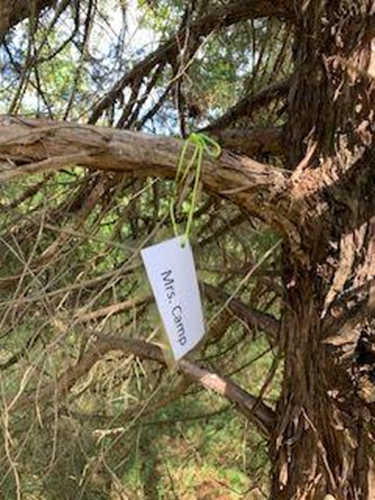
I learned about string journals when I spent a week studying Thoreau at the Walden Woods Project in their summer program, Approaching Walden, in 2019. I took what I learned and adapted it for my class in the fall of 2020. I printed and laminated a name tag for each student and attached a waterproof twine.
Students found a place in the woods where they wanted to return throughout the semester, and they hung their tags there. Each time we went to the woods for an outdoor lesson, we began with a moment of observation and writing at our string journal spots. By the end of the semester, students had a time-lapsed set of descriptive writing that detailed changes in the spot from August to December. This lesson works for writing instruction as easily as it will for scientific notetaking or geological study. Students can practice sketching and documenting the environment as a professional naturalist, archeologist, or geographer might.
Photo Essays
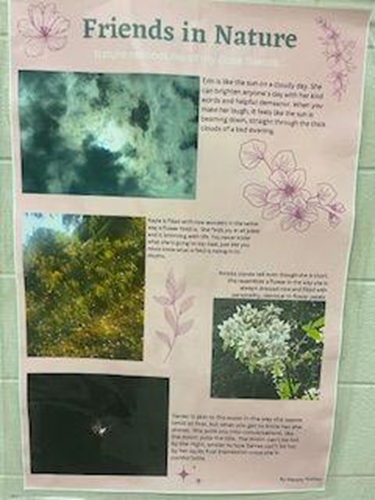
Students can create a photo essay (such as in the model of Humans from New York, for example) from images taken while outside around campus. Students learn to select images carefully for symbolic purposes while making the most of limited written text space. The content of photo essays is dependent on the content being taught (for example, artistic expression or documentation of natural change over time) and therefore adaptable for any discipline. Social studies classes might focus on natural resources or local history, whereas world language classes might center vocabulary acquisition.
Art Collections, Collages, and Memory Jars
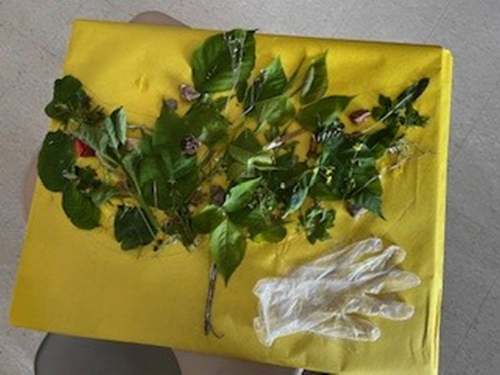
While outside, our class has collected interesting artifacts from the woods including a mysterious jawbone, persimmons, and unique leaves and wildflowers. Students have also brought back live creatures – caterpillars, unknown white creepers, and our pet turtle – even though we cannot keep those as part of a collection. The collections represent students’ adventures outdoors, and a story almost always accompanies the item selected, which forms the basis for original writing, full of sensory imagery and emotive language that I don’t often see in their traditional classroom assignments. We have also made art collages from artifacts gathered outside and students articulated reasons for the items they chose to include, again extending their understanding of symbolism and metaphor.
Yet, a biology class might create a leaf collection to be labeled and categorized. A geology class might collect rocks and minerals for a similar display. A math class might collect examples of different shapes or different representations of the same angle or slope.
Using Aimee Nezhukumatathil’s (2020) example in her chapter, “Firefly Photinus Pyralis” in her nature memoir World of Wonders, In Praise of Fireflies, Whale Sharks, and Other Astonishments, we collected items from the woods to store in memory jars for our class as a way to commemorate our outdoor adventures together. What physical representations do we want to keep as memories of our shared experiences outside? These collections can also provide materials for a multimodal art display in an art class or indicators of geographical descriptors for one’s local environment (for example, what do we find in the woods that demonstrate we live in a foothills region?) in geography class.
Blood Pressure Checks
After reading an article about forest bathing and how spending time outside reduces people’s blood pressure, we decided to put the article to the test. Our school nurse graciously helped us by taking each student’s blood pressure before we went outside and again when we came in after our walk outside. We recorded the data anonymously and analyzed it; while our findings didn’t necessarily align with those in the article, the process of analyzing the data gave us a chance to critically analyze the article and consider reasons our results might not have aligned with those in the formal study. This activity fits just as well in a math, health, or science class as it does in an ELA class.
Nature Poetry
Studying mentor texts from professional nature writers provides us with a model for poetic language and symbolic representation. I include picture books as mentor texts, as well, and then encourage students to create and illustrate as they are inspired to do. Modern nature poets such as J. Drew Lanham, Ada Limón, and Aimee Nezhukumatathil provide accessible and representative poetry that inspires students to see beyond their cursory look at their school environment. Yet, students might also model scientific writing from professional naturalists and even film moments in nature following models of nature documentaries. The point is to create as professionals in the field create — whether that professional is a poet, an ornithologist, filmmaker, or a historian.
There are so many more opportunities for taking high schoolers outside for interactive learning, and the resource list I have provided here will spur many more new ideas. Regardless of the lesson, the magic of the outdoor classroom lies in students’ physical interaction with the natural environment coinciding with the shared experiences among classmates. Too often our classes seem almost virtual despite the number of bodies all sitting in a room together. Standardized curricula and mandated benchmarks tie us to screens, and the classroom itself comes with traditional expectations of what academic writing looks like and what acceptable school performance is defined as. By the time they reach their junior year in high school, many students have compartmentalized school behaviors and school literacies as quite different from their authentic lives and literacies. Too often this compartmentalizing results in stilted, perfunctory work within the classroom.
The outdoor classroom does not hold those same expectations, and without these expectations, students are free to pursue joint adventures and open themselves up to conversations and experiences. These small lessons that still fulfill requirements of curriculum standards have the potential to provide positive experiences with nature that form the affective connections later leading to activism and advocacy.
Taking students outside brings interaction with the material world, such as trees, animals, and plants, and this material engagement prepares students for self-reflective questions, such as
How are humans connected to the natural world?
What is my personal relationship to the natural world?
Do others see the natural world the same way I do? Why or why not?
What are my obligations to the natural world?
Strong memories developed through physical interaction with nature and shared experiences among classmates can be the starting point for meaningful place-based learning and environmental literacy, as Amanda taught us all when she urged us to leave our turtle in his natural habitat.
Ms. Camp is a PhD candidate in Language and Literacy at the University of South Carolina (USC). A National Board Certified Instructor, she has taught English Language Arts at Gaffney High School in Gaffney, SC, for 26 years. She has served as an AP English Assesser, a National Writing Project teacher consultant, and an adjunct instructor with Spartanburg Community College, Limestone University, and USC. She shared her experiences with outdoor learning in an article published in English Journal in 2023, and she was awarded a Teacher Researcher Grant from National Council of Teachers of English in 2024 to help fund her dissertation study that investigates the influence of an outdoor setting on high school students’ writing practices.
Ms. Kristie Camp is a PhD candidate who has taught English Language Arts for 26 years. Her webinar provides a picture of how to grow environmental literacy in an outdoor classroom.
Flashback to our theme on Financial Literacy! Due to publisher error, Derrick Shepard’s blog was delayed. So, it is now time to hear how Dr. Shepard supports this quote by Jane Bryant Quinn: “No one is born with a mind for personal finances.” Read more about our author at the end of his blog.
Sit with the above quote for a second before moving on. What comes to your mind after you read it? What feelings are elicited? Does the quote speak to you, to the students you are trying to instill a sense of understanding of financial literacy?
The Organisation for Economic Co-operation and Development (2019) defines “Financial literacy as knowledge and understanding of financial concepts and risks, as well as the skills and attitudes to apply such knowledge and understanding in order to make effective decisions across a range of financial contexts to improve the financial wellbeing of individuals and society, and to enable participation in economic life.”
The definition is holistic, but it is important to remember that a person’s understanding of financial literacy rests in their knowledge, understanding, attitudes toward financial literacy, and skills to implement a plan that incorporates all three. Now, revisit your thoughts and feelings about the above quote. Did anything change?
There is no denying that individuals need a basic understanding of financial literacy to navigate this capitalist society. Understanding how one’s credit score can impact everything from mortgage rates to credit card rates to the amount you pay for automobile insurance can help save money for the future. As educators, it is incumbent upon us to teach the 3 Rs and relay life skills, including financial literacy, to our students to help them grow into productive and responsible citizens. But how do we do it?
Our students live in a 24-hour, 365-day-a-year social media cycle that never ends. They are bombarded with messages every time they pick up their smartphones, and financial messages (e.g., how to make money) are prominent in the messaging. What I call “salespeople” (and I am being kind) promise riches with little to no effect. Ya, right. Other messages are more “old school” in that they speak to one’s athletic, musical, or artistic abilities to achieve the American Dream. Have you seen some commercials or music videos lately? An example of this is one of Toyota’s commercials for its Tundra Capstone. The actors promote the truck, which is nice and comes in at around $75000 as if it’s a status symbol to achieve to be accepted in the group. As educators, we know group interaction and acceptance are important for one’s development, especially during the pre-adolescent and adolescent years.
So, what messages are students receiving outside of the classroom regarding money?
Reflecting stopping point.
As educators vested in their students’ success, what do you know about them? I bet it’s a lot. You know their likes and dislikes. You know what their home lives are like to a degree. You know them, not as an aggregate reflection of a class roster. No, you know them as individuals with strengths and areas of growth. In knowing and considering this, remember this:
Financial Literacy IS NOT one size fits all.
To the best of your ability, you must consider individual demographics (e.g., racial identity, social class, ethnicity) when constructing an Individual Financial Education Plan (not be confused with an IEP, pun attended). Why is it so important that students’ financial education be individualized as possible? As Frederick Nietzche put it, “‘This-now my way: where is yours?” Thus, I answered those who asked me ‘the way.’ For the way-does not exist.!” As with an IEP, one’s Individual Financial Education Plan (IFEP) needs to be individualized because we all have different backgrounds, values, hopes, and aspirations.
I am not going to leave without some recommendations and resources.
The Psychology of Money (2021) by Morgan Housel is a terrific resource for taking a deeper dive into why we make the decisions we make regarding money. I tweaked his recommendations from the book to fit your students’ age demographics.
Have students not be too hard on themselves when things go wrong financially.
Setting financial goals is the first step, but as with any goal, things can, and most likely will, go wrong, and mistakes will be made. It is our responsibility to instill a sense of forgiveness in them.
Focus on wealth and not the ego.
Students are bombarded with messages to spend money. You have to have that new phone. Making saving cool can be (is) hard while living in an instant gratification society. Media does not make it any easier. However, we still need to figure out what makes our students tick and how to circumvent those messages to the best of our ability. Again, we know our students better than some algorithms. 😊
Time is their friend.
Saving $10 a month does not seem like a lot; however, compound interest is the 8th wonder of the world. Use a time horizon calculator to show them what savings look like today and in the future. There are tons of time horizon calculators out there. Here’s one: https://smartasset.com/investing/investment-calculator
You can replace money, but you cannot replace time.
Time is as precious as money. You can always get back money, but time is gone. We must impress upon our students to use their time wisely when it comes to finances. I can imagine you already do this in your role as an educator. Just put a twist on it and add the money.
Be nicer and less flashy.
This gets into social-emotional learning. Housel (2020) states that one “is impressed with possessions as much as you are (p. 209). He argues, instead, that we are looking for respect and admiration from our peers (Housel, 2020). Having kindness and being respectful are other ways to gain respect from our peers.
Save, baby, save!
Go back to recommendation #3.
Help your students define what “success” means for them.
I am going to address this recommendation with my counselor educator hat on. Part of being a good counselor is to be open and congruent with clients. As the saying goes, “Clients will only go as deep as you are willing to go with yourself.” With that in mind, we need to remember the core condition of Unconditional Positive Regard (for our students and ourselves) when we teach financial literacy. We need to be Congruent and be who we are with our students when we teach financial literacy, and, finally, we need to show Empathy for those, including ourselves, who are struggling to better themselves but not knowing what they do not know.
Help students define their “game.”
Financial success looks different for every student. What one considers a success may be an overreach or underreach for the next. There is no way. But, we can help our students reflect, critically think, and plan for a future that fits them.
Finally, I want to leave you with some financial resources that may assist you and your students in gaining a better understanding of personal finance.
The National Endowment for Financial Education (NEFE) champions effective financial education. They are the independent, centralizing voice that provides leadership, research, and collaboration to advance financial well-being.
The Consumer Financial Protection Bureau is a U.S. government agency dedicated to ensuring you are treated fairly by banks, lenders, and other financial institutions.
Khan Academy offers practice exercises, instructional videos, and a personalized learning dashboard that empowers learners to study at their own pace in and outside the classroom.
I hope you enjoyed reading this as much as I enjoyed writing it for you. The financial literacy journey is complex and ever-changing. But what does not change is our duty as educators to help our students grow and develop into the individuals we know they are capable of.
Dr. Derrick Shepard is an Assistant Professor at the University of Tennessee, Martin. His research interests include multiculturalism in counseling, social class awareness, skills related to counselor preparation and pedagogical practices in counselor education and supervision.
Dr. Stephanie Lemley develops socio-economic awareness as students experience disciplinary literacy in an agricultural setting. Read more about Dr. Lemley at the end of her blog.
As a literacy teacher educator and a PI or Co-PI on three United States Department of Agriculture/National Institute of Food and Agriculture (USDA/NIFA) grants for professional development in agricultural literacy, I have been fortunate to work with teachers across Mississippi on infusing agricultural literacy into their classroom instruction. Two of my grants have enabled me to create a summer professional development and then host the teachers on the university campus in the fall and spring for follow-up days. This school year I am working with colleagues from Agricultural Education, Leadership, and Communication, Poultry Science, and Food Science and 28 amazing K-12 teachers from across the state. The teachers’ experiences range from starting their first year of teaching to 25+ years in the classroom. We are currently working with content areas such as special education (e.g., gifted and inclusion classrooms), mathematics, ELA, science, welding, and agriculture. During a four-day, intensive workshop this summer, the teachers learned how to incorporate poultry science and food science content knowledge and lab investigations, literacy instruction, and socio-emotional learning (SEL) skills into their classroom.
This is important because most Americans are agriculturally illiterate (Taylor, 2021, July 7). In fact, in most cases, individuals are three generations removed from the farm, which means more and more people are not aware of where their food comes from (Brandon, 2012, March 30). The American Farm Bureau Foundation for Agriculture (2012) has created pillars of ag literacy, one of which is understanding the connections between agriculture and the environment. Hubert et al. (2000) posited that teachers can use agriculture as a topic to teach about the environment and the world around them. This focus on the natural world can also be a great way to infuse socio-emotional learning (SEL) skills into the curriculum as well (Carter, 2016).
Socio-emotional learning (SEL) skills is an “umbrella term used to describe psychological constructs such as personality traits, motivation, or values” (Danner et al., 2021). When teachers teach these skills to their students, they are helping them become efficient workers who know how to build trusting relationships with others, cope with change, serve as leaders, and produce creative solutions to solve problems (Danner et al., 2021). These skills include responsible decision making, self-awareness, self-management, and relationship skills (National University, 2022, Aug. 17). Agricultural topics are the perfect place to teach socio-emotional skills to students because of the diversity of content and emphasis on problem solving. For example, when discussing food choices, students are practicing the socio-emotional skill of responsible decision making; when working in groups to complete labs, students will be practicing the socio-emotional skills of social awareness and relationship skills.
Here’s an example of how teachers who work with me in the four-day workshop investigate the topic of ‘hunger in Mississippi’ through book readings (How Did That Get in My Lunchbox?: The Story of Food by Chris Butterworth, Maddi’s Fridge by Lois Brandt, and Free Lunch by Rex Ogle), online investigations, and proposed solutions to food waste in local communities. We tied the topic of hunger to a variety of Mississippi state science standards.
Table 1. Example Mississippi College-and-Career Readiness Standards for Science
Example Science Standards
L.K.1A Students will demonstrate an understanding of living and nonliving things. L.K.3A Students will demonstrate an understanding of what animals and plants need to live and grow.L.2.3A Students will demonstrate an understanding of the interdependence of living things and the environment in which they live. L.2.3A.1 Evaluate and communicate findings from informational text or other media to describe how animals change and respond to rapid or slow changes in their environment (fire, pollution, changes in tide, availability of food/water). L.5.3B Students will demonstrate an understanding of a healthy ecosystem with a stable web of life and the roles of living things within a food chain and/or food web, including producers, primary and secondary consumers, and decomposers. L.5.3B.1 Obtain and evaluate scientific information regarding the characteristics of different ecosystems and the organisms they support (e.g., salt and fresh water, deserts, grasslands, forests, rain forests, or polar tundra lands). L.5.3B.2 Develop and use a food chain model to classify organisms as producers, consumers, or decomposers. Trace the energy flow to explain how each group of organisms obtains energy. L.7.3 Students will demonstrate an understanding of the importance that matter cycles between living and nonliving parts of the ecosystem to sustain life on Earth. L.7.3.5 Design solutions for sustaining the health of ecosystems to maintain biodiversity and the resources needed by humans for survival (e.g., water purification, nutrient recycling, prevention of soil erosion, and prevention management of invasive species).
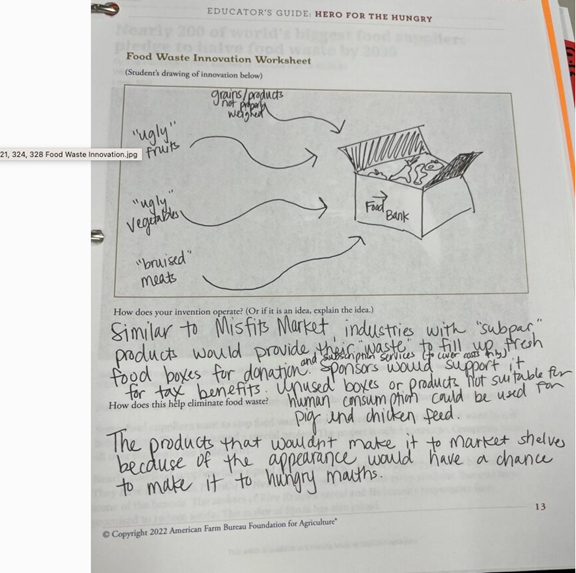
This initial foray into hunger allowed the teachers to learn more about this impactful issue across the state. For many, it reinforced information they already knew about their own community, but it was eye-opening for many to see how big of a problem it is statewide. For example, in looking at the free and reduced lunch data, many were surprised that some of the perceived ‘affluent’ counties in the state still had multiple schools with high percentages of free and reduced lunch. As such, this topic introduced them to a part of environmental and agricultural literacy—food literacy (Siegner, 2019). Food literacy is defined as “the scaffolding that empowers individuals, households, communities, and nations to protect diet quality through change and strengthen dietary resilience over time. It is composed of a collection of inter-related knowledge, skills, and behaviours required to plan, manage, select, prepare, and eat food to meet needs and determine intake” (Vidgen & Gallegos, 2014, p. 54). In addition, this investigation reinforced the SEL skill of social awareness—showing understanding and empathy to others—because it required them to reflect on their own students and how many of them might come to school hungry and need additional sustenance to stay focused during the school day. The second day, the teachers worked in groups to create an innovative way to address food waste in communities. This activity required them to think scientifically and utilize precise science and engineering terminology and design methods to create their solution. We chose this activity because many of the teachers had recently talked about how much food was wasted either at restaurants or at their schools during lunch and how they would like to put some of that food to good use in their community.
Figure 1. Food Waste Innovation
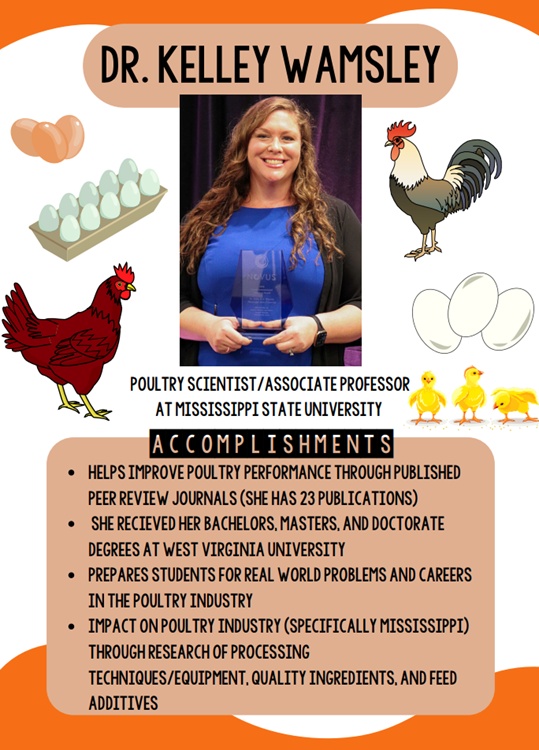
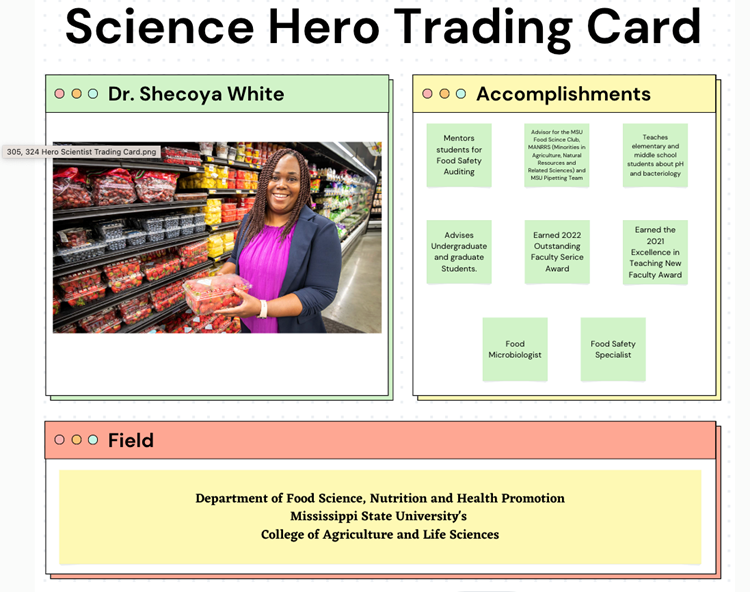
On the third day, the teachers, in groups, created hero scientist cards on a food science or poultry science scientist who has done work that impacts hunger in the state. This activity required the teachers to showcase a scientist who has had a positive impact in improving Mississippi’s environment and its agricultural industry. This activity also required the teachers to not only work on SEL skills such as relationship skills and self-management, but also to use discipline-specific terminology related to the food science or poultry science field when adding information to their trading card.
After the summer PD, the teachers returned to their classrooms and implemented lessons that we had done with them in their own teaching. Many used the agriculture texts to teach SEL skills and the food supply. They used the strategies and activities we taught them, and they also shared their new knowledge with their colleagues at their school site or in their district. During the fall follow-up day, the teachers continued to investigate hunger, but this time looked at it not just from a regional and state perspective but also a worldwide perspective. I chose to focus on hunger more broadly this time to show them how they could have their students consider hunger in their own community first (as we did in the summer) but then have them realize that hunger is not just a Mississippi problem—in fact it is a problem in our region, country, and world as well. The lesson and activities I implemented were also tied to state standards in the science, mathematics, social studies, and ELA standards.
Table 2. Example Mississippi College-and-Career Readiness Standards.
Mississippi College-and-Career Readiness Standards for Social Studies
Mississippi College-and-Career Readiness Standards for Science
Mississippi College-and-Career Readiness Standards for English/Language Arts
6.8 Examine how humans and the physical environment are impacted by the extraction of resources and by natural hazards 3. Assess the opportunities and constraints for human activities created by the physical environment.
ENV.4 Students will demonstrate an understanding of the interdependence of human sustainability and the environment. ENV.4.3 Enrichment: Research and analyze case studies to determine the impact of human‐related and natural environmental changes on human health and communicate possible solutions to reduce/resolve the dilemma.
RI.6.7 Integrate information presented in different media or formats (e.g., visually, quantitatively) as well as in words to develop a coherent understanding of a topic or issue.
First, they watched a video about the area of Memphis, TN, that is a food desert (see link in resources). The video was then tied into the National Agriculture in the Classroom lesson on ‘Hunger and Malnutrition (see link in resources). In this lesson, students investigate the importance of eating a variety of nutritious foods and explore diets around the world. The teachers were introduced to more health and food science terminology such as nutrient, undernourishment, food bank, staples, accompanying foods, and hunger. They then used the National Geographic website, What the World Eats, and answered the following questions:
Which country consumes the most calories in a day?
Which country consumes the fewest calories in a day?
Which country consumes the most 1) red meat, 2) grain, 3) sugar, and 4) fat?
Which country consumes the least 1) red meat, 2) grain, 3) sugar, and 4) fat?
After they had worked on this investigation, we discussed what they found across groups. These activities continued reinforcing SEL skills such as social awareness, relationship skills, and self-management as they negotiated group tasks. It also provided them an opportunity to continue to investigate environmental and agricultural literacies specifically food literacy. This is important because part of being agriculturally literacy involves understanding the food system and the importance of plants and animals to our environment. The workshop concluded with the teachers being introduced to two short films from Mississippi State University Films: one of which was on food insecurity, and one of which was on a local school district response to schools shutting down during the COVID-19 pandemic and getting food to the students who relied on school lunch as part of their food sources daily. These videos provided a real-world example of people using socio-emotional skills, such as responsible decision making, compassion, and relationship-building to make a difference in the local community. Further, the teachers learned about ways that community members are stepping up to help end food insecurity in their own backyards through the creation of local farmers markets and other means. This can help further develop their agricultural literacy knowledge because they have a deeper understanding of the food system.
I wanted to share these lessons and resources with my teachers because I wanted to show them how they could help their students become more agriculturally literate with a topic that is relevant to everyone—hunger and food. Over the school year, some teachers have emailed me to share how impactful these agricultural literacy SEL lessons have been for their students, particularly reading the book Free Lunch with their class and then investigating hunger in their community and where food comes from. Others expressed this in their delayed post follow up survey. For example, one teacher wrote that creating trading cards has been the most successful activity with their classes. They noted, “The kids love it and are all 100% into it.” Creating the trading cards on scientists allowed students to showcase their learning in a creative way. Another teacher wrote that participating this year helped them have “more opportunities for students to learn agriculture in different cultures, bringing awareness of food deserts and waste.” The teacher said the students particularly enjoyed exploring the National Geographic website and watching the videos about Memphis and food insecurity in the Mississippi Delta; learning about this topic had them think about what nutritious food was available to them on a regular basis outside of school. Another teacher wrote participating in the professional learning gave her “an enhanced sensitivity to food deprivation within my classroom.” These lessons over the past year opened this teachers’ eyes to hunger in their own students and the teacher has made it a priority to have nutritious snacks available for the students. Two others wrote, “All of the SEL!” for their response. Finally, one additional teacher wrote, “From ACRE 2.0, I’ve already used interactive simulations and hands-on experiments in my class. Next, I plan to add collaborative projects and real-world problem-solving tasks. These activities deepen understanding and build teamwork skills. Additionally, I’ll integrate more tech tools for personalized learning.”
References
American Farm Bureau Foundation for Agriculture (2012. Pillars of agricultural literacy. https://www.agfoundation.org/files/PillarsPacket062016.pdf
Brandon, H. (2012, March 30). At what cost the disconnect between agriculture and the public? https://www.farmprogress.com/commentary/at-what-cost-the-disconnect-between-agriculture-and-the-public-
Carter, D. (2016). A nature-based social-emotional approach to supporting young children’s holistic development in classrooms with and without walls: The socio-emotional and environmental education development (SEED) framework. International Journal of Early Childhood Environmental Education, 9-24.
Danner, D., Lechner, C.M., & Spengler, M. (2021). Editorial: Do we need socio-emotional skills? Frontiers in Psychology, 12, 1-3. 10.3389/fpsyg.2021.723470.
Hubert, D., Frank, A., & Igo, C. (2000). Environmental and agricultural literacy education. Water, Air, Soil Pollution, 123, 525-532. https;//doi.org/10.1023/A:1005260816483
Siegner, A.B. (2019). Growing environmental literacy: On small-scale farms, in the urban agroecosystem, and in school garden classrooms [Doctoral dissertation, University of California Berkeley]. UC Campus Repository. https://escholarship.org/content/qt4p16p53v/qt4p16p53v_noSplash_53f7a6e2917068410defb11335b7ac1b.pdf?t=q6z2hg
Mississippi Department of Education. (2023). Mississippi college-and-career readiness standards. https://www.mdek12.org/OAE/college-and-career-readiness-standards
This work is supported by the USDA/NIFA National Institute of Food and Agriculture, AFRI Agricultural Workforce Training Priority Area, award # 2022-08873.
Dr. Stephanie M. Lemley is an Associate Professor of Content-Area Literacy and Disciplinary Literacy Instruction in the elementary education program in the Department of Teacher Education and Leadership in the College of Education at Mississippi State University. She is the recipient of three USDA/NIFA grants on professional development in agriculturally literacy (either as PI or Co-PI) and in the last four years has worked with approximately 150 K-12 teachers across the state, either virtually or through face-to-face instruction, on infusing agricultural literacy into their classroom instruction. She can be contacted at smb748@msstate.edu .
We welcome Dr. Derrick Shepard to our conversation on Financial Literacy! In this webinar, he empowers teachers to explore financial literacy as a social means of communication, co-constructed through the lens of their other identities. Read more about Dr. Shepard below.
Dr. Derrick Shepard is an Assistant Professor at the University of Tennessee, Martin. His research interests include multiculturalism in counseling, social class awareness, skills related to counselor preparation and pedagogical practices in counselor education and supervision.
As a follow up to her webinar, Brooke Hardin expands on her resources for using multi-modal writing responses to engage students in writing.
In twenty years of teaching English Language Arts, helping students discover their “writerly life” has remained a passion. To live a writerly life means that individuals write often and with a fair amount of ease, that they see their everyday ordinary lives brimming with writing topics, and that they can use writing to reflect their ideas and potentially gain new ones. In order to begin to live a writerly life, one must be motivated to write. As teachers, engaging students in writing tasks can often be a challenge, but certain elements increase both students’ motivation for writing and their efficacy for writing tasks. Student choice in topic, modeling of strategies and techniques, consistent time to share, give, and receive feedback on writing, and invitations to write in varying modes have all been identified as ways to more likely engage students in writing. This post serves to provide strategies related to the latter idea, using various modes for writing and how these modes might inspire students to write and deepen their knowledge of disciplinary content.
What is Multimodal Writing? What Might it Look/Sound Like?
Multimodal texts are print-based and digital texts using more than one mode or semiotic resource to present meaning; mode is defined as a socio culturally formed resource to make meaning (Kress, 1010; Serafini, 2015). Authors have been exploring multimodal response for over a decade and have seen its potential to engage students in personal response and critical analysis of literature, while also developing their appreciation of genres (Dalton & Grisham, 2013). Expanding students’ literacy palette to include the modes of image, video, audio, and writing offers them more choices for how to develop and express their thinking about reading. When readers write about, interpret, or respond in some fashion to their transaction with a text, a new text is produced as the reader-turns-writer; that is, a writer or creator who seeks to express that experience with the text (Rosenblatt, 1994). Writing in a poetic form or creating a digital design as an aesthetic response to the reading positions the reader-turned-writer to adopt an aesthetic stance in which the student’s attention is focused on the lived-through experience of the reading: the emotions, moods, intuitions, attitudes, and tensions connected to the ideas and characters embodied in the text (Rosenblatt, 1994). Thus, one of the benefits of multimodal writing tasks is their potential to deepen comprehension and/or content learning.
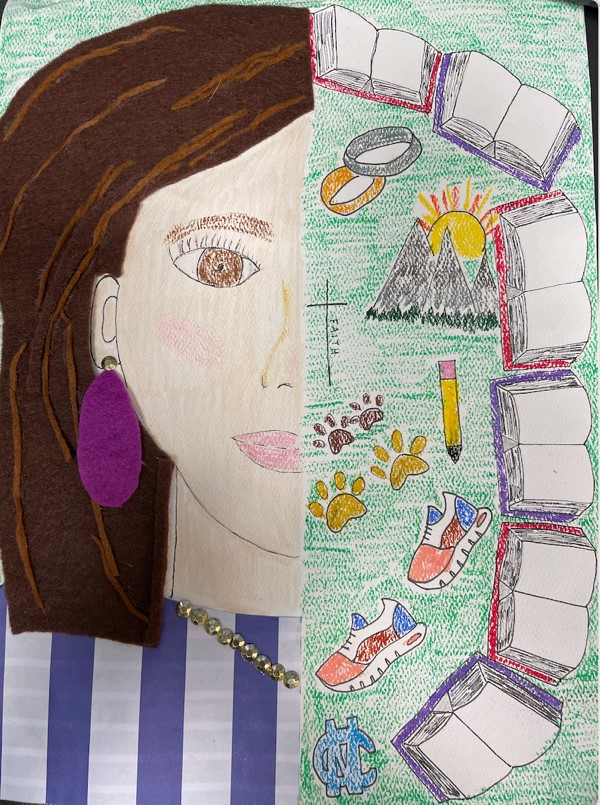
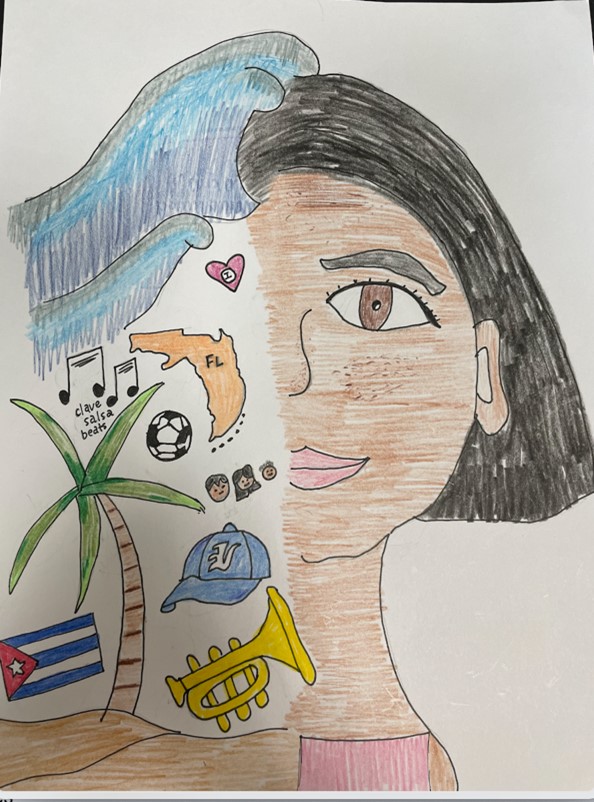
One strategy for multimodal writing is called a half-and-half portrait (see Image 1). To create this piece, a student would first “write” the portrait about themselves. The portrait is a visual representation of an individual done by drawing one half of the person’s face using physical features (i.e., hair style, eye color, nose shape) and then filling in the other half of the face with images, quotes, or other ideas that relate to the person’s attributes, interests, life experiences. Once a student has created a half-and-half portrait about themselves, they can apply the strategy to a character from text, historical or present-day figure, or any other person. For example, the physical side of the portrait is created using the features visualized by the reader based on descriptions in the text. The other half of the character’s face uses images and other ideas related to the character and inspired by evidence from the text. For example, students might read the middle grades novel Refugee by Alan Gratz, which portrays the refugee experience of three distinct, fictional adolescent characters. Students reading this novel could further explore and demonstrate their understanding of these characters through the creation of a half-and-half portrait (see Image 2).
Image 1: Personal ½ and ½ Portrait (created by author)
Image 2: Isabel from Refugee (created by author)
In addition to creating the portraits, students can also create video or audio recordings that explain the thinking behind their multimodal writings. Teachers might ask students to discuss both the materials used to create the portraits and the ideas represented in the portraits. In multimodal writing using a visual art form such as this portrait, selection of materials and images or quotes used should be as intentional as word choice is in written texts. An example of my explanation for my half-and-half portrait can be found using this link.
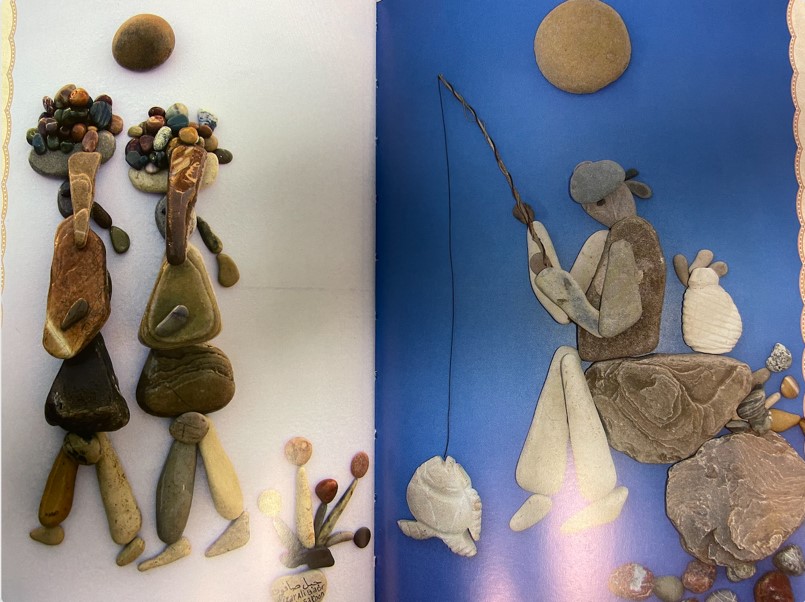
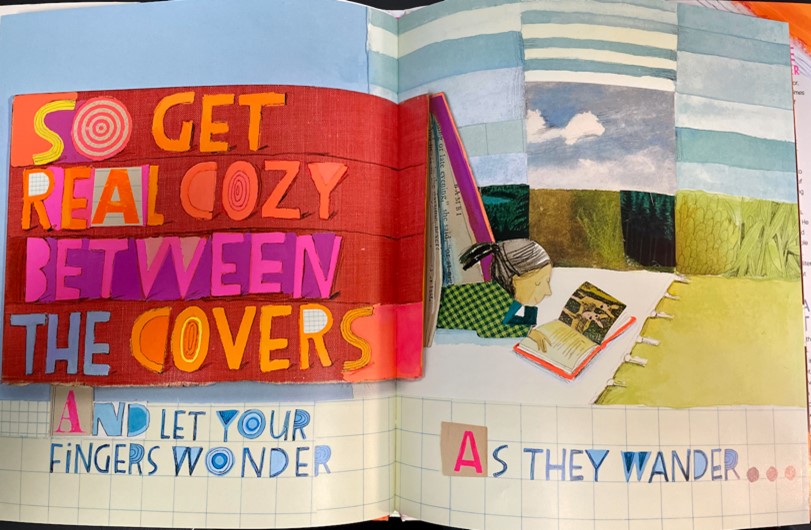
As with any new genre of writing, students need mentor texts they can reference for ideas and inspiration. Picture books, especially those that have been recognized for their illustrations, serve as some of my favorite mentor texts for multimodal writing with visual art (see Images 3 and 4).
Image 3: Illustrations made with stones in Stepping Stones: A Refugee FAmily’s Journey by Margaret Ruurs
Image 4:
Illustrations made with layered collage featuring book pages,
tattered book covers, neon paints, and cloth in How to Read a
Book by Kwame Alexander and illustrated by Melissa Sweet
Engaging Students in Writing with Poetry
Poetry is another genre that often engages students in writing tasks. Poetry is subjective and its structure can vary. Some forms, like haiku, have a particular form, but poetry can also be as simples as a collection of a person’s favorite words. The rules of writing become more relaxed in different types of poems, which allows students to tap into their creativity and use their voice to play with words, line breaks, and the appearance of the poem. Many poems are what I call “bite-sized;” thus, they are also less intimidating to write for more reluctant writers.
Definition Poems
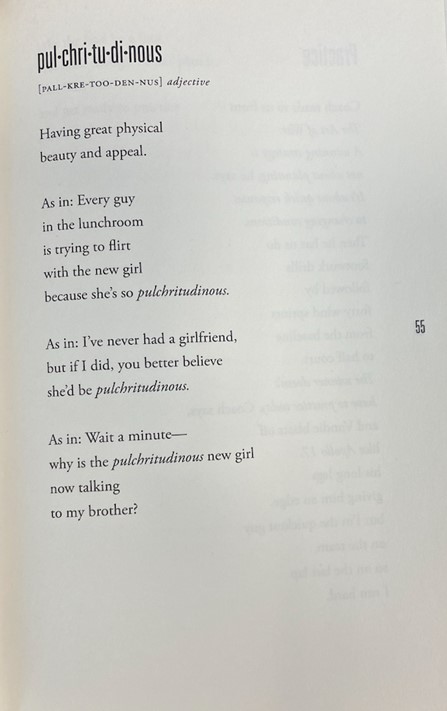
Definition poems are a specific type of poetry that follows a form but also holds space for students to use craft moves and have agency with the writing. This form of poetry is inspired by some of the pages from the middle grade novel The Crossover by Kwame Alexander (see Image 5). Written in verse, the novel features several poetic styles, including definition poems, that might serve as mentor texts for students poetic writing. The definition poem invites students to engage in writing while also enhancing their vocabulary knowledge and using learned content to create something new.
Image 5: Definition poem from The Crossover
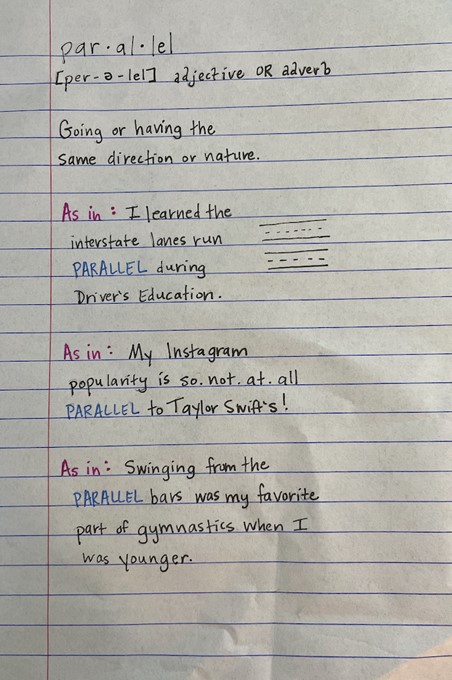
When teaching students to write definition poems, teachers should use the same principles they would use with teaching any other genre. Reference the mentor text, such as one of Alexander’s poems from The Crossover, and engage students in inquiry by asking them to take notice of how the author wrote the poem – that is, to think about and name aloud the “ingredients” used in the poem and what might be required for someone else to write the same style of poem. For example, teachers would point out how each stanza begins with “As in:” and how the vocabulary term is used in each stanza. Teachers might use a shared writing approach to co-author a definition poem with the whole class and invite students to co-author this kind of poem in pairs before they write one independently. Again, this kind of poem can be used with vocabulary from novels students read and to other content areas. See Image 6 for an example definition poem written about the math term parallel. As seen in the example, the poem offers students the opportunity to sustain their thinking about a word and its meaning and invites them to see how vocabulary terms are relevant to their lives. Additionally, these kinds of poems can serve as a piece of writing in a larger multimodal piece. For example, students might be invited to illustrate each stanza of the poem to add a visual layer.
Image 6: Example definition poem (created by author)
Use each word in the line as the end word in each line of your poem.
Keep the words in order.
Give credit to the original poet.
The new poem does not need to be about the same subject as the original poem, but they can be related in some way if the writer chooses to do so.
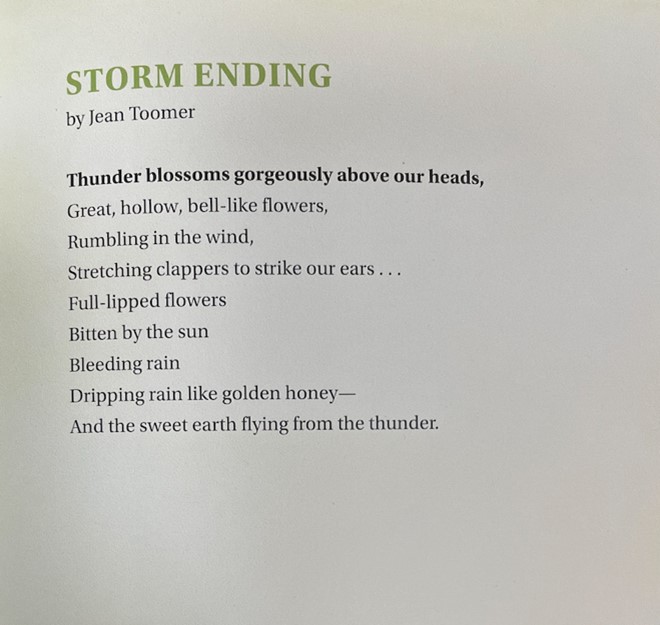
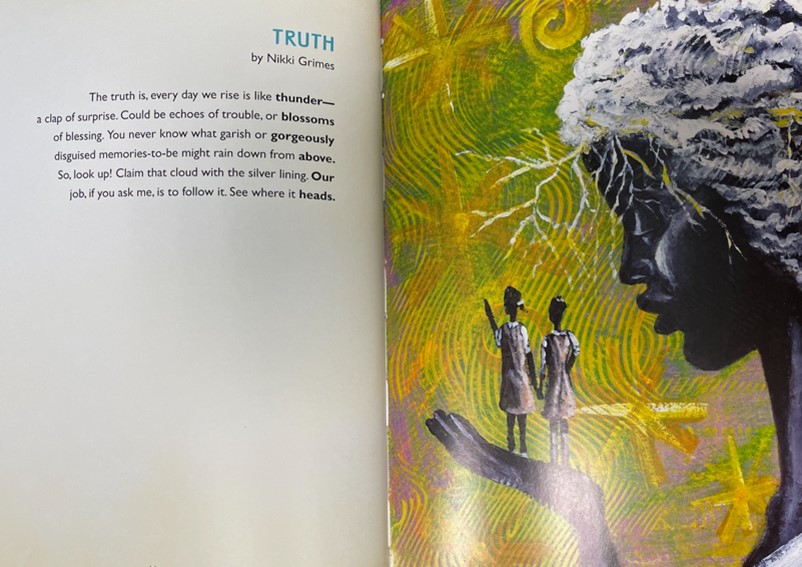
Inspired by Terrance Hayes, Nikki Giovanni wrote the book One Last Word, which is a book of golden shovel poems about the Harlem Renaissance. Using two of the poems from this book as mentor text (see Images 7 and 8), teachers can help students see how the poem is written and gain inspiration for their own writing.
Image 7: “Storm Ending” from One Last Word
Image 8: “Truth,” a poem written by Nikki Giovanni using a linefrom “Storm Ending” by Jean Toomer
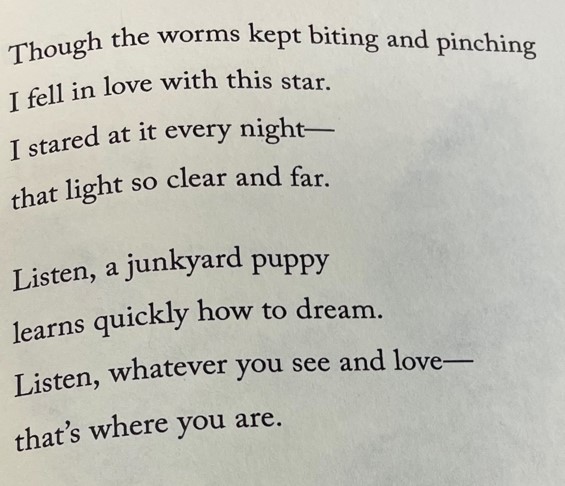
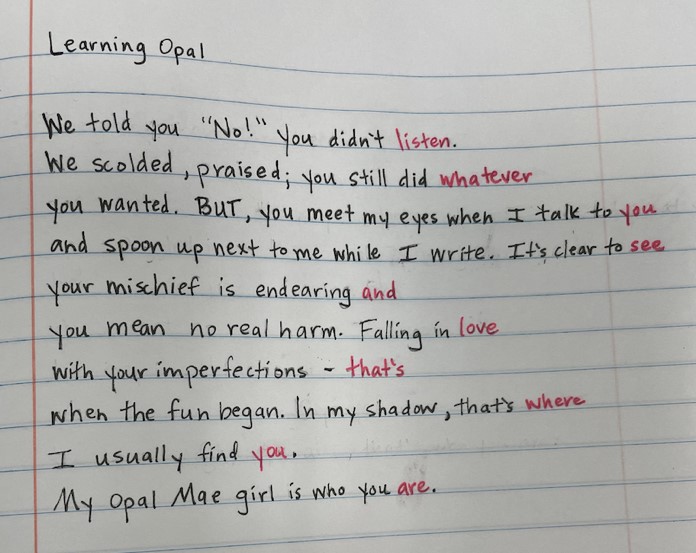
Teachers should immerse students in reading many different poems, invite them to bring in poems – including song lyrics – that they admire, to gain ideas and inspiration for writing their own golden shovel poems. Again, teachers may want to scaffold this kind of writing and co-author poems with students in a whole group setting before tasking students with writing one on their own. Golden shovel poems are complex but also provide students an opportunity to play with word choice, syntax, line breaks, and be creative in their writing. Inspired by a poem from Mary Oliver’s Dog Songs, I show students my own attempt at this poetic form (See Images 9 and 10).
Image 9: Excerpt from “Luke’s Junkyard Song” by Mary Oliver
Image 10: Golden shovel using the last two lines from “Luke’s Junkyard Song” (created by author)
Final Thoughts
No matter the strategy used, teachers must remember to embrace vulnerability and write alongside of students, both modeling the techniques and making the cognitive side of writing – word choice decisions, art medium choices, etc. – become evident and accessible for students. Writers need to see and hear other writers engaged in writing to discern the process and be inspired. Writers also need room for creativity. Each of the strategies offered here provides space for creativity and the opportunity for students to express themselves while also learning and showing their content knowledge.
References
Kress, G. (2010). Multimodality: A social semiotic approach to contemporary communication. London, UK: Routledge.
Rosenblatt, L. M. (1994). The transactional theory of reading and writing. In R. Ruddell et al. (Eds.), Theoretical models and processes of reading (4th ed). Newark, DE: International Reading Association.
Serafini, F. (2015). Multimodal literacy: From theories to practices. Language Arts, 92(6), 412-423.
Brooke Hardin is an Assistant Professor of Elementary Education at USC-Upstate. Her experience includes elementary and middle grades classroom teaching as as well as curriculum literacy specialist. This webinar reflects Brooke’s special interest in multi-model writing as a response to reading.
This webinar features Beth Shaver and provides resources for collecting Social Studies resources from multiple perspectives. Click here to access.
Elizabeth (Beth) Shaver is a doctoral candidate in the Department of Teacher Education and Learning Science at North Carolina State University with a concentration in Social Studies. She has taught social studies for fourteen years between California and North Carolina.