Exploring Mentor Texts

Teaching

This post is written by Charlene Aldrich. You can learn more about Charlene at the bottom of this post.


I’ve always been a strong believer in the power of reading to identify important information and to grow decision-making processes.  My mantra is, “Never tell someone what they need to know when they can find out for themselves by reading.”  So, when I saw the book Micro Mentor Texts by Penny Kittle come up in my Facebook feed, I was especially intrigued by the idea that students might not need to read ALL of Romeo and Juliet to become knowledgeable of Shakespeare, his cheeky quotes, and 16th-century literature.

I’m not trying to sell you on this book, instead, I AM trying to sell you on the idea that mentor texts don’t have to be complete works that students gloss over to “complete the assignment.”  Can it be that teachers can provide specific sample excerpts to achieve their literacy goals?

Spelling and Vocabulary

Research has affirmed the idea that successful readers and writers tend to have prolific vocabularies 1.

Useable vocabularies grow through listening and reading, speaking and writing2.  I continue to believe in the developmental nature of language to support literacy development as I watch my granddaughter on her preschool journey to beginning reading.  Her speaking vocabulary includes words and phrases such as “cheeky little rascal,” “plaster,” and “go through” because of her fascination with the very British show featuring Peppa and George Pig!  She may never read them in the same context, but the foundation has been laid for multi-meaning words if she sees these and similar words and phrases in reading selections.

What does this say to educators and about mentor texts?  Reading, writing, and oral language are tightly knit; introducing mentor texts as examples of effective writing “… promotes students to view, discuss, read, and create literature that affords opportunities for spelling and vocabulary development that are engaging, relevant and active”3.

Blog writers from ELA Matters share “3 Engaging Mentor Texts for Middle and High School”.  One that supports vocabulary development is My Name by Sandra Cisneros.  While the language is simple, Cisneros weaves it into rich literary devices such as imagery, simile, and metaphor. Students of all reading abilities see how to use their own vocabulary levels to develop descriptive works that require precise vocabulary.

Beyond spelling and vocabulary 

In addition to growing spelling and vocabulary, mentor texts contribute to the development of other traits of effective writing: organization, conventions, sentence fluency, and voice. Mentor texts are examples for students to follow as they develop their own ideas through these traits4. They can be below grade level to make the traits obvious; they can be on or above grade level to meet the standards that require complex texts. They can include a wide range of styles – from classical literature to graphic novels. Teachers can use them to develop critical thinking and persuasive arguments. Students can read memoirs in preparation for personal narratives. The inclusion of authors and diverse topics can even mentor acceptance and open-mindedness. And never overlook the power and pleasure of picture books for growing storytelling.

Mentor texts are not restricted to the ELA curriculum. As state standards have shown through the inclusion of disciplinary literacy requirements, each discipline contains its own set of unique formats, craft, and technical language. Thus, each content area teacher has the opportunity to include quality mentor texts for students to emulate as they meet the reading and writing needs of each discipline.  What do YOU enjoy reading in your discipline? How can students also find enjoyment in your choice of reading selections of your discipline?

My grandson introduced me to A Night Divided by Jennifer A. Nielsen. This book takes readers through life behind the Berlin Wall, beginning with the night it was built.  Social Studies/History courses are meant to provide multiple perspectives to ensure accurate representation of diverse experiences. This historical fiction book opens with vivid language to introduce a school-age girl’s reaction to the lack of freedom that was imminent. “There was no warning the night the wall went up.  I awoke to sirens screaming throughout my city of East Berlin. Instantly, I flew from my bed. Something must be terribly wrong.  Why were there so many?” Individual excerpts from the book can be extracted as a mentor text for writing essays that focus on the value of freedom. Using this text as a mentor, along with showcasing other fictional or nonfiction realities of this time period, can support students’ ability to also write about their own experiences with freedom or war.

Using Model Texts

Students NEED high-quality reading selections that challenge them to grow in their personal literacy skills; after all, literacy is power. In addition to meaning-making, model texts provide examples of effective composition techniques5. Using them effectively becomes the goal.  Robyn English (2021) offers this advice6:

  • Be familiar with the reading selection and what you want it to demonstrate
  • Be purposeful in your use; plan for single successes, not multiple attempts
  • Be knowledgeable of the strategy or characteristic being taught
  • Be flexible, returning to a single text for other purposes
  • Be generous, sharing them as you would any book in your classroom library

In Short

Students need positive role models for growing into responsible adults. Likewise, they need effective models of texts for growing their literacy strength. As English notes in her text listed above, “Mentor texts support a teacher in modeled reading or writing.”


Charlene Aldrich is an instructor in the Office of Professional Development at the College of Charleston. While content-area literacy is her specialty, she also teaches Assessments in Reading, Foundations in Reading, and Instructional Practices as required by South Carolina for recertification. She serves as the Treasurer of LiD 6-12.

Cover Photo by NEOM on Unsplash

Growing as a Literacy Leader

Teaching

This post is written by Erin Kessel. You can learn more about Erin at the bottom of this post.


What is a literacy leader? In my opinion, it is a highly qualified teacher in literacy instruction who provides valuable resources for other teachers to facilitate quality instruction. Providing highly qualified teachers with the opportunity to fill this role promotes growth in our field, allows these experienced teachers to stay in the classroom, and gives more novice teachers a mentor to support them. Today I will share with you my personal story as a literacy leader and the opportunities it provided me to grow as an educator while also growing others.

In 2020 I was offered an opportunity by my district to become a Multi-Classroom Teacher with a focus on literacy. The Multi-Classroom Teacher position was created in our district for master teachers, a designation determined by classroom observation and student performance data, who then co-taught across multiple classrooms with other teachers and apprenticed them in highly effective instruction. After 12 years in the classroom, mentoring beginning teachers, supervising interns, and leading PLCs, I was ready to grow as an educator and accepted the position. The goal was simple — mentor and model literacy instruction in five 3rd through 5th-grade classrooms where teachers had less than three years of teaching experience.

Through years of learning and applying strategies of Adaptive Schools and Cognitive Coaching, I began with a plan to actively listen to the teachers, identify needs, and establish goals to support them. I spent two weeks simply observing the literacy blocks of each classroom. I recorded objective, anecdotal notes and began to set my intentions for areas of targeted support with each teacher. The following descriptions are the focus areas based on my data for each teacher:

  • Teacher #1 – An experienced teacher assistant transitioning to a teacher with strong small group instruction skills but difficulty designing whole group literacy instruction where students experience a gradual release of responsibility of learning (Goal – To design whole group literacy lessons focused on scaffolding the learning for students).
  • Teacher #2 – A engaging third-year teacher who had powerful literacy instruction methods but lacked knowledge of how to incorporate collaborative learning within her classroom (Goal – To learn about, model, and engage in collaborative strategies).
  • Teacher #3 – A second-year teacher who had the “right stuff” as an educator but had never taken the time to build rapport with her students and felt a lack of community within her classroom (Goal – To build relationships with and learn about students as people including their likes, interests, and home life).
  • Teacher #4 – A compassionate second-year teacher who lacked organization and engagement strategies to encourage her students to want to learn (Goal – To learn about, model, and engage in Whole Brain Teaching strategies).
  • Teacher #5 – A first-year teacher who spent her clinical teaching year virtually due to COVID who lacked sufficient classroom management skills, therefore behaviors and disruptions were consistently affecting learning (Goal – To establish norms and routines in her classroom as well as create a concrete classroom management plan to hold students accountable of their actions and encourage them to want to learn).

After a week of collecting observational data, I set a time to meet with each teacher and have a goal-planning conversation. Within the Cognitive Coaching model, it is the coach’s job to lead the participant/s through the stages of a conversation where they identify their goals and set their own plan while the coach provides some potential strategies. I discovered this group had not been able to collaborate with an experienced teacher since their student teaching and therefore did not have access to guidance, resources, and tools for effective literacy instruction.

As a mentor teacher, I had the experience, knowledge, and resources to support each of these teachers’ goals. I asked the teachers to become observers for two weeks during their literacy block and allow me to facilitate learning in their classrooms while focusing on their specific needs. The teachers used an observer form to stay focused on my facilitation of the instruction specifically tied to their goals. I also attended their planning periods, where we collaborated to develop a library of lessons and resources. I built rapport and trust with each teacher, which allowed us to consistently hold reflective conversations focused on their goals and ways to incorporate the instruction they observed into the lesson plans we created.

(When these amazing teachers choose to dress in my Erin Kessel “iconic” daily outfit, I know I have made connections with my teachers)

I spent two weeks cultivating and facilitating different plans for each class and working with students of all ability levels while incorporating many diverse types of teaching strategies to model options of literacy learning. The following were ways I helped each teacher approach her goal:

  • Teacher #1 – We redesigned her schedule with a specific time set to introduce content, model, and allow students to practice and apply their learning. We also planned — and I modeled — how to provide differentiated opportunities in a lesson during whole-group instruction. We developed a presentation format (PowerPoint) for her lessons that guided her through the gradual release process.
  • Teacher #2 – I intentionally introduced the class to collaboration practices and strategies within the literacy block. Students participated in Learning-Focused Collaborative Pairs, Socratic methods of teaching, Kagan Cooperative Learning strategies, Adaptive School strategies, and other various strategies I have created through my own experiences. As this teacher observed these strategies being applied in her classroom, she saw student engagement increase, students’ understanding of content grow, and more students involved in class discussion. She then utilized the strategies she was seeing modeled.
  • Teacher #3 – Community meetings were established each morning before her literacy block, which engaged students with each other and utilized multimodal methods of literacy to prepare their brains for the day. Multiple community meeting processes were used where students expressed themselves as individuals and learned commonalities with each other. The teacher participated and learned about the students as individuals, and the students learned more about the teacher. The rapport became evident when students began to support each other during collaborative activities. They also entrusted the teacher with more personal information and would seek guidance in non-academic situations.
  • Teacher #4 –  Through modeling and professional development of Whole Brain Teaching, she was quickly able to establish daily routines through fun callbacks, engage in bodily-kinesthetic and verbal learning of literacy curriculum, and create a respect for her attention when deemed necessary. Her classroom management, routines, and classroom literacy instruction benefited from utilizing this program.
  • Teacher #5 – Through consistent use of expectations and norms and a structured schedule, the teacher replicated my modeled methods and saw improvement in the respect her students had for her. Through attending the planning periods, asking questions, requesting modeling of instruction, and assisting in designing literacy assessments, her understanding of literacy curriculum and how to facilitate it increased exponentially. She also benefited from the shared PowerPoint presentations we made during planning to guide her instruction.

After teaching in all classrooms, I began to see the value of my effort. I started noting strategies I used in their literacy blocks were now being used in other core content areas by these teachers. When we met to review our planning conversations, some teachers felt they had met their goal, and through planning conversations, we established new goals. Over the course of two years, I co-taught and co-planned with these teachers.

(As the shirts state, “Together through it all” was our motto as we worked side by side in their classroom every day.)

The experiences I had as a Multi Classroom Teacher and literacy leader within this school began to grow my need to share this role with others. I recently became a teaching instructor at East Carolina University, where I teach the READ courses to education major students. I can share my experiences and grow our future teachers as they explore their concentrations for their education degree. I encourage students to explore our Read Concentration program to help develop our next Literacy Leaders. I have spoken at multiple conferences on the value of literacy leaders and continue to speak on the benefits of this role in every school, especially schools with low teacher retention rates, as that is where they are most valuable and can make the greatest impact.


Erin Kessel is a teaching instructor in the Literacy Studies, English Education, and History Education Department at East Carolina University.  Previously, she was a Multi Classroom Literacy Leader, Facilitating Teacher, and a 4th grade teacher.  Erin’s work focuses on literacy leadership and developing literacy leaders as well as building a classroom community through literacy as she presents at the local, state and national level.Follow on Twitter @kessel_erin

Please cite this work: Kessel, E. (2023). Growing as a Literacy Leader. Literacy In The Disciplines. https://literacy6-12.org/growing-as-a-literacy-leader. CC BY 4.0 license.

Cover Photo by Markus Spiske on Unsplash

Writing Learning into Shape: Using Concrete Poetry to Explore & Reflect Content Knowledge

Teaching

This post is written by Brooke L. Hardin. To learn more about Brooke, please visit the bottom of this post.


What Is Concrete Poetry?

Concrete poetry, sometimes called shape poetry, is poetry whose visual appearance matches the subject of the poem. The words of the poem form a shape or shapes which illustrate the poem’s topic in visual form as well as through their literal meaning. This type of poetry has been used for thousands of years since the ancient Greeks began to enhance the meanings of their poetry by arranging their characters in visually pleasing ways back in the 3rd and 2nd Centuries BC (Nesbitt, 2023).

In the 1950s, a group of Brazilian poets known as the Noigandres developed a manifesto to define the work of concrete poetry and give us the name. The manifesto states that concrete poetry communicates its own structure: structure = content (Eppley, 2015).

How to Write Concrete Poetry

There are two main ways to create a concrete poem. The first is referred to as an “Outline Poem.” The writer creates an outline of the subject of the poem or of an object that relates to the subject and fills in the outline with words or phrases. The words or phrases used to fill in the outline usually describe the subject or how it makes the writer feel in some way, provide information connected to the subject, or possibly tell a story related to the subject. Some examples of this technique for concrete poetry are provided in Figures 1 and 2.

Figure 1: Black Hole

Note. From The Day the Universe Exploded My Head: Poems that Take You Into Space and Back Again, by Allan Wolf, 2019, Somerville, MA: Candlewick Press

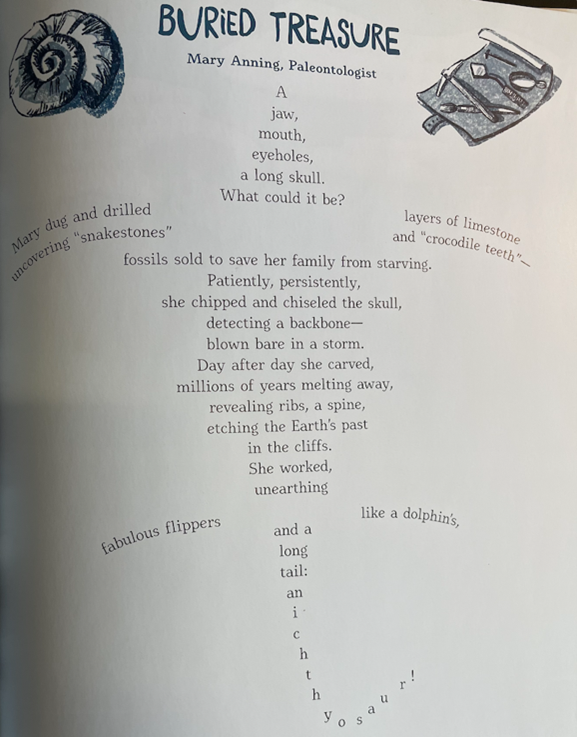
Figure 2: Buried Treasure

Note. From Shaking Things Up: 14 Young Women Who Changed the World, by Susan Hood, 2018, New York, NY: HarperCollins.

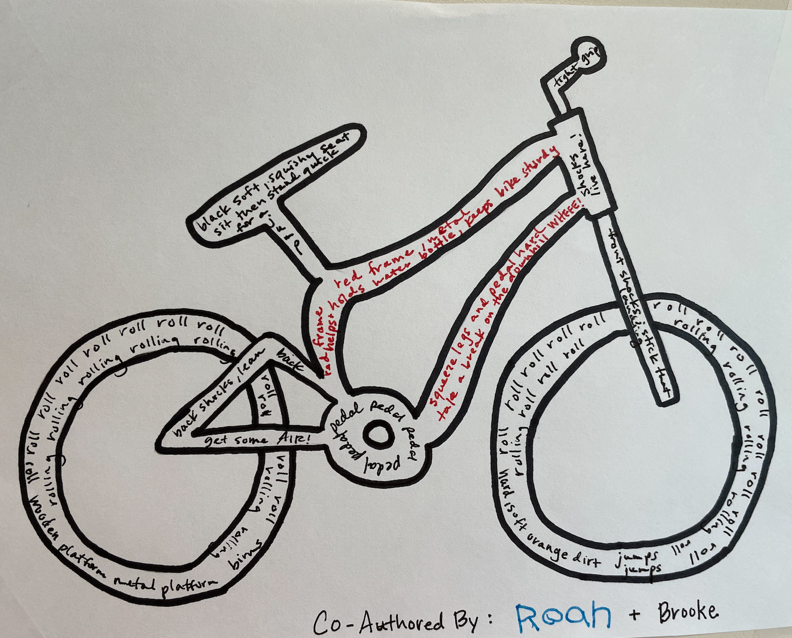
My son and I recently spent an afternoon at a local bike park. Following the trip, he and I co-authored a concrete poem using the “Outline” technique. The video embedded below shows how I used questioning to help him come up with the words and phrases for the poem while I acted as a scribe. Image 3 shows the final poem we created.

Figure 3: Mountain Bike

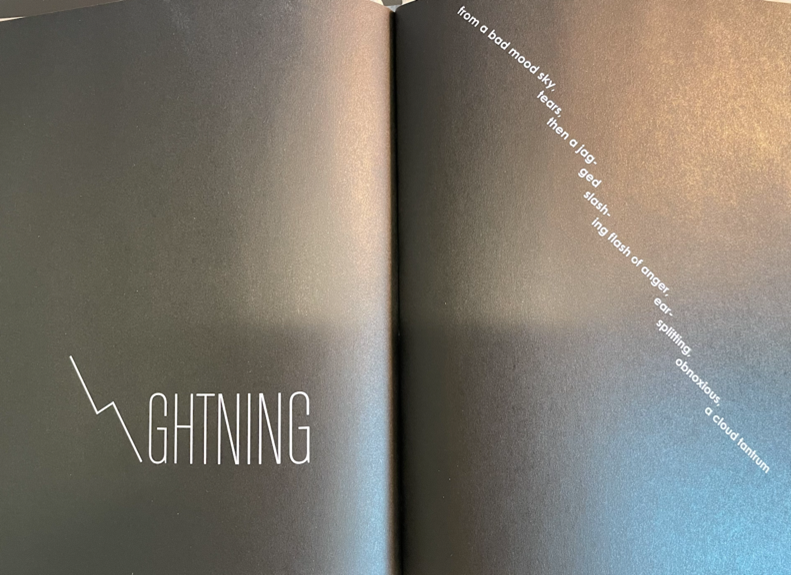
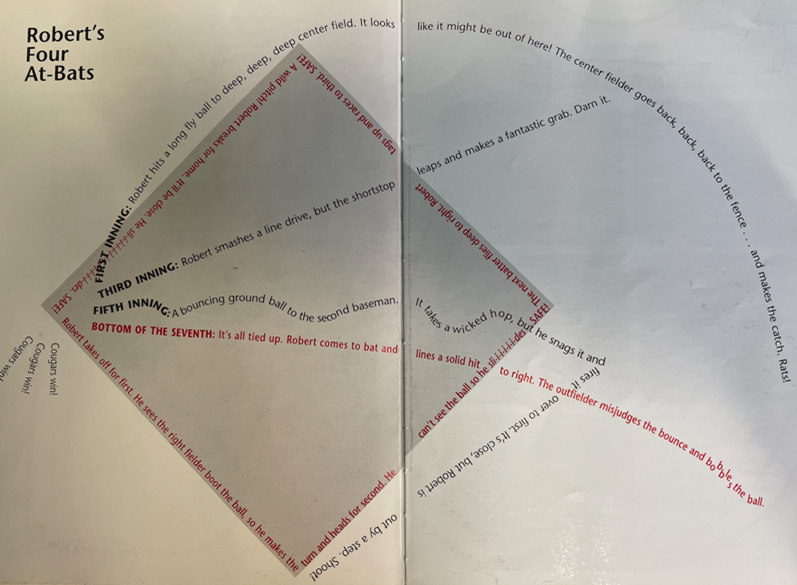
Another technique for creating concrete poems is to use the lines of words to make the lines of a drawing. One thing to note about this technique is that the subject does not have to be an object, but it does need to be something that can be drawn with “stick” figures. Examples of these poems are below.

                                                Figure 4: Lightning

Note. From Wet Cement: A Mix of Concrete Poems, by Bob Raczka, 2016, New York, NY: Roaring Brook Press.

Figure 5: Robert’s Four At-Bats

Note. From Technically, It’s Not My Fault: Concrete Poems by John Grandits, 2004, New York, NY: Clarion Books.

Instructional Considerations for Concrete Poetry

When teaching students to write concrete poems, whether using the outline or drawing technique, consider these reminders.

  • Model, model, model! Planning instruction with the Gradual Release of Responsibility (Pearson & Gallagher, 1983) in mind will help students better understand the cognitive and physical aspects of composing concrete poems.
    • Use inquiry to analyze some exemplars like the ones provided above or those found in books listed in the references to help students take notice of the elements of concrete poems.Select a topic as a class and write a concrete poem together, with students offering the words and their arrangement while the teacher acts as a scribe. Use questioning, such as the type seen in the video above, to help students think about their subject and form written ideas from those thoughts.Invite students to co-author a concrete poem as a pair or small group.
    • Finally, provide opportunities for students to independently write concrete poems, get feedback from peers, and share their final drafts.
  • Concrete poems do not need to rhyme.
  • Concrete poems can be written on traditional paper or digitally. If using paper, suggest to students that they use a pencil when drafting the poems. This allows them to erase and move words around where needed.
  • Encourage students to play with the size, color, and shape of their letters to better capture the essence of the poem’s subject (e.g., I might write the word TTEEEETHH in different shapes and font sizes when writing about a shark). This helps to reinforce the reciprocal nature of reading and writing by providing students a chance to consider the purpose of their craft moves.

Writing Concrete Poetry to Reflect Content Area Learning

Writing to learn and writing about learning are necessary in content-area classrooms. While many argue and I can agree that these are different notions, writing concrete poems can accomplish the aim of both.

Writing, as discussed above, must involve a discussion of ideas, leveraging the social side of learning where knowledge is co-constructed, and misunderstandings can be clarified. Additionally, when and where questions arise to inform written ideas, further research may occur; thus, more learning takes place during the writing process. For example, a student in a 7th-grade science classroom is drafting a concrete poem about a cell as part of a Life Science unit. They may refer to class notes, talk with a partner, or watch a video about cells to (1) draw the outline of a cell and/or (2) write a line about the nucleus – possibly drawing it inside another shape that is made of letters spelling out “membrane,” given that the nucleus is enclosed in a membrane. The writing of the concrete poem has the potential to reinforce learning that has occurred, provide new content, and/or inspire ways to show learning.

Both the reading and writing of concrete poems present teachers in discipline-specific classrooms with innovative methods for motivating students to engage in the content. Given their interesting appearance and brief lines, concrete poems as supplementary texts in units of study to teach a specific topic (see Image 1 about the Black Hole and Image 2 about the female paleontologist Mary Anning, who, in the early 1800s, found complete fossils that laid the foundation for Darwin’s theory of evolution) may appeal to students who are reluctant to engage with textbooks and other longer documents. As an alternative to traditional analytical research papers and essays, writing concrete poems related to learning may motivate students to take a deeper interest in the content to present their learning in a creative way. I would also maintain that crafting a line of concrete poetry deepens comprehension and calls upon sophisticated critical thinking; taking a line from prose (e.g. an article or textbook) and rewriting it in one’s own words to fit a poetic style is rigorous cognitive work. With regards to standards related to research skills and speaking and listening, I would further suggest that students provide a reference list to accompany the poems and give presentations where they explain craft moves and inspiration for certain lines.

As a former middle grades ELA/Social Studies educator, I can attest that using concrete poetry in a content area classroom allows students to reimagine learned content creatively and critically while deepening and extending their understandings and knowledge. Give it a try and share your poems with me!

References

Eppley, C. (2015, January 21). Concrete Poetry of the Noigandres, 1958-1975. Retrieved from http://avant.org/event/noigandres/

Nesbitt, K. (2023). How to Write a Concrete Poem. Retrieved from https://poetry4kids.com/lessons/how-to-write-a-concrete-poem/

Pearson, P. D., & Gallagher, M. C. (1983). “The Instruction of Reading Comprehension,” Contemporary Educational Psychology, 8, pp. 317-344.

Children’s Literature References & More to Consider

Grandits, J. (2004). Technically it’s not my fault: Concrete poems. Clarion Books.

Grandits, J. (2007). Blue lipstick: Concrete poems. Clarion Books.

Hood, S. (2018). Shaking things up: 14 young women who changed the world. HarperCollins.

Raczka, B. (2016). Wet cement: A mix of concrete poems. Roaring Brook Press.

Wolf, A. (2019). The day the universe exploded my head: Poems to take you into space and back again. Candlewick Press.


Brooke Hardin is an Assistant Professor of Elementary Education at the University of South Carolina Upstate. Her research interests include writing development and instruction for intermediate and middle grades students, teaching and learning through technology and new literacies, literacy professional development and teacher education, and interdisciplinary approaches to reading, writing, and the utilization of Children’s Literature. Her years of experience as an elementary and middle grades classroom teacher and curriculum literacy specialist frame her research interests and commitment to teacher education.

Photo by Valentin Salja on Unsplash

Literacy Behind Bars: Addressing Incarcerated Youth’s Literacy Needs

Research

Literacy in the Disciplines, 6-12 (LiD) is pleased to announce our next webinar.

Literacy Behind Bars: Addressing Incarcerated Youth’s Literacy Needs

Despite the fact that our country has less than 5% of the world’s inhabitants, we house almost 25% of the total prison population. As educators, we need not only to be aware that we are living in the “age of incarceration” (Hill, 2013), but also recognize the need to develop constructive responses to it. As educators, we have a social responsibility to design curriculum and pedagogy that expands literacy instruction in correctional facilities. This webinar will discuss a fourteen-year-old summer reading partnership between a university and the Department of Juvenile Justice. The presenter will share what she has learned from teaching and working with incarcerated youth.

When: This webinar was held on Thursday, May 18, 6:00 – 7:00 pm ET.

The video recording of this session is available below.

Cost: Free. LiD6-12 is funded by the South Carolina Middle Grades Initiative.

This session featured Dr. Mary Styslinger.

Dr. Styslinger is a professor of English and literacy education at the University of South Carolina where she directed the Midlands Writing Project and served as secondary program coordinator. She is a past president of the South Carolina Council of Teachers of English and currently co-edits South Carolina English Teacher. Her research interests include interweaving literacy into the English curriculum, teaching English for democracy and justice, and serving marginalized and at-risk youth. She is the author of Workshopping the Canon and co-editor of Literacy Behind Bars as well as articles published in English Journal, Voices from the Middle, Language Arts, and Journal of Adolescent and Adult Literacy. Her new book, Workshopping the Canon for Democracy and Justice, will be published by NCTE this summer.

Please share this professional learning opportunity with your colleagues.

Follow and like Literacy in the Disciplines, 6-12 on Twitter.

Photo by Boudewijn Huysmans on Unsplash

Discussion Grouping

Teaching

This post is written by Shannon Bosley. You can learn more about Dr. Bosley at the bottom of this post.


Discussion is a critical part of developing literacy for all content areas in a secondary setting, but it takes practice and planning for those rich academic discussions to take place. Teachers have told me they have avoided classroom discussion for a variety of reasons: time constraints, fears that the discussion could spiral out of control or even lead to disruptive behavior, worries about not having all the answers if additional questions are surfaced, etc. These are all valid concerns. Along with having pre-established norms and expectations, those concerns can all be alleviated with planning, practice, and protocol use.

Once you have decided the purpose of a discussion, created your guiding questions, and determined the protocol to use, you need to think about how you will group the students. (If you are unsure of which protocol to use, check out the School Reform Initiative’s listing of protocols.) These groupings can be affected by the content, the purpose, the protocol being used, the number of students in the class, or even the furniture or structure of the room. As a 25+ year educator, a piece of advice… don’t let secondary students select for themselves; be strategic. Some considerations to think about when planning for grouping are:

  • Heterogeneous groups or homogenous groups?
    • Skill level – Do you want the groups to be students of similar skill levels or a variety? This could also be affected by the protocol you selected. For example, if you selected Socratic Seminar, did all students receive and read the same text prior to the session? If the readings were differentiated, then that may be a factor in determining the groups.
    • Student interest – grouping students of similar interests could help with engagement.
    • Student diversity – grouping students of different backgrounds or genders can allow for unique perspectives to be shared.
    • Group size – Are there certain roles each person has within the protocol? Too many in a group can lead to some students being left out of the conversation.
  • Are there any students who need specific considerations due to an IEP, EL status, behavior plan, etc.? Does a particular student need to be or not be with another?
  • Are there any social dynamics currently happening that could affect the groups? A reasonable question to consider when working with adolescents.
  • How will the groups be communicated to the students? Will there be a list posted on the board or screen? Are students already sorted into named groups and you are utilizing those?
  • Do I need to consider furniture movement for the discussion? And if so, does my classroom management address movement in the classroom?
  • What supports will my students need? Graphic organizer, sentence stems, etc.

If this is the first time to attempt a certain protocol, remember to practice first. Students cannot be expected to be experts on the first try. A practice discussion session focused on a lighter issue such as pop culture topic not only helps the students learn the protocol but you as the teacher can access the interactions of the groupings and make needed adjustments while making sure your discussion norms and expectations are being followed. Take notes on how things went, have students reflect on the discussion, and make changes to the groups as needed.

Students need guidance and practice to engage in academic discussions. It takes time for students and teachers to learn what works and adhere to your norms and expectations. If the first time doesn’t go well, that’s ok! Try again. You could think about a different protocol, changing the groupings, adding a graphic organizer, or revising your guiding questions. Check out the planning checklist below for help in getting ready and reflecting so that your next classroom discussion is even more engaging and productive.

Planning for Academic Discussions Checklist

Planning:Notes:Reflections:
Do I have any IEP, behavior or social needs I need to consider? Does the topic have any impact on how the groups are determined?    
I determined the protocol for the discussion…Have the students used/practiced this protocol?  
How do the desks/tables need to be arranged for the protocol? Do the groups need to be able to see the board/screen?    
How do the desks/tables need to be arranged for the protocol?Do the groups need to be able to see the board/screen?    
What is the best grouping size for this protocol?    
How will I communicate the groups to the class?    
What resources do I need to have ready for use during the discussion? (graphic organizer, sentence stems, etc.)  
Is there any follow-up, exit ticket, etc. required for students to submit?Is there an evaluative tool for me to use during the discussion or after?    

Cover Photo by Kier in Sight on Unsplash

Shannon Bosley, Ed.D., is a 25-year K-12 educational veteran who has served as a middle language arts teacher, school librarian, instructional coach, district technology and curriculum coordinator, and educational consultant. She earned her doctorate in Leadership Studies at Xavier University where she studied reading engagement and leadership effectiveness for school principals. Currently, she is the Principal Investigator (PI) of a Small Business Innovation Research (SBIR) grant from the Institute of Educational Sciences. Her research project examines the Sustainable Coaching and Adaptive Learning for Education (SCALE) model that Reading Ways uses to bring research-based practices to classrooms nationally. Shannon is passionate about promoting adolescent literacy and continues to research reading engagement and motivation for both adolescents and adults.

Please connect with Shannon on Twitter (@shan_bosley) or via email: shannon@readingways.org

Prisms, Pathways, and Portals: Disciplinary literacies as tools for possible futures

Teaching

This post is written by Michael Manderino. You can learn more about Michael at the bottom of this post.


“We cannot remake the world through schooling, but we can instantiate a vision through pedagogy that creates in microcosm a transformed set of relationships and possibilities for social futures, a vision that is lived in schools. This might involve activities such as simulating work relations of collaboration, commitment, and creative involvement; using the school as a site for mass media access and learning; reclaiming the public space of school citizenship for diverse communities and discourses; and creating communities of learners that are diverse and respectful of the autonomy of lifeworlds.”

New London Group, 1996

It often amazes me how prescient the text (quoted above), A Pedagogy of Multiliteracies: Designing Social Futures (1996) was and what it argued for just before the dawn of the 21st century. Now in the year 2023, using terms like 21st-century learning doesn’t resonate much as we are nearly a quarter way into the 21st century. I often question how much we have really taken up from the ideas even extracted from the quote above. While disciplinary literacies have been at the forefront of theory and research around adolescent learning, I believe that we need a future vision of the possibilities of disciplinary literacy. We need more than practices that simply reproduce knowledge.  We need an expansive theorizing of what disciplinary literacies can be or else we will continue to reinscribe old ways of knowing and doing for a future that is yet to be written.  

Despite a need for a widening of thought, we collectively find ourselves presented with seemingly predefined choices for where we need to stand pedagogically.  Dialogues have shifted to debates over everything from the “Science of Reading vs. Balanced literacy, Online reading vs. Offline reading, or the use of the canon vs contemporary fiction.  The pitting of the pedagogical constructs against one another creates a reductionist view of the complexities of teaching and learning.  Rather than reducing complex pedagogical constructs to binaries, perhaps we should be interrogating the possibilities for pedagogical expansion. While simple answers feel more reassuring, they do not account for the beautiful complexity of teaching and learning.

One reductionist view we might interrogate is the narrowing of what counts as disciplinary inquiry.  Expert novice studies have provided invaluable insights into what are core disciplinary practices yet can often be taken up as the singular way to approach disciplinary literacy.  Disciplinary literacy in its early conceptualization offered new ways to think about advancing knowledge building in content-area classrooms.   What follows is a set of possibilities for consideration of what might be taken up in research and practice around disciplinary literacies. Using the metaphors of pathways, prisms, and portals, I argue for the use of multidisciplinary, interdisciplinary, and transdisciplinary approaches in disciplinary inquiry.  

Pathways 

Photo by Caleb Jones on Unsplash

Disciplinary literacies can be pathways to explore through multidisciplinary perspectives. Pathways can be paved, worn by repeated traffic; serve as shortcuts or trails that lead to hidden beauty. Pathways can diverge or converge.  People use pathways to get somewhere or to meander. Sometimes along the path, new discoveries are made, or new paths are forged.   Pathways can serve as a metaphor for multidisciplinary inquiry. One may choose to look at a problem or topic from the lens of different disciplines. Like choosing a path or multiple pathways, inquiry can be shaped by one, two, or more disciplines. While it is critical to understand the beliefs, practices, texts, and tools used in a discipline like science or history, it is also important to see that inquiry questions can be approached from multiple disciplines. For example, we can look at a problem such as food scarcity from the perspectives of geography, economics, agriculture, and mathematics, to name just a few. We need to engage with the world from multiple perspectives that are often shaped across disciplines. Food scarcity is not a simple problem that can be understood or tackled from singular perspectives. If we only hyperfocus on singular disciplines, we may lose the forest through the trees.  

Prisms  

Photo by Braxton Apana on Unsplash

Disciplinary literacies can also be prisms for seeing new possibilities. Using singular lenses to problem solve or problem pose does not account for the complexity of the problem. Prisms can reflect and refract light to illuminate the full spectrum of colors that are being absorbed. Prisms help us see things in a new light. We can think of interdisciplinary inquiry as a tool for seeing the full spectrum of perspectives around topics and problems. Interdisciplinary inquiry relies on the interconnected nature of disciplinary practices and perspectives. If we expand notions of disciplinary literacy to interdisciplinary, we add the nuances of the comparative and contrastive beliefs, tools, texts, and approaches to understanding phenomena. For example, the role of art, music, and literature provides indispensable insights into complex phenomena that cannot be fully explained through a historical or scientific analysis. By using interdisciplinary inquiry as a prism, students have access to new ways of seeing the world and their role in the world.  

Portals 

CC0 Public Domain

Disciplinary literacies can serve as portals to newly designed futures. During the Covid-19 pandemic, author Arunduti Roy (2020) argued that the pandemic could serve as a portal to new social possibilities. The notion of portals to new dimensions or time/space scales is one that is speculative and hopeful. To see disciplinary literacy as opening portals to solving wicked problems to create more just worlds is a goal that makes learning consequential. Portals also lead to the unknown. Much like disciplines themselves, portals are unsettled terrain and are absent critical voices who are often erased or silenced. To account for these silences and erasures, transdisciplinary research is conceptualized as a way to be inclusive of multiple perspectives not simply from the top down (academia) but also from the ground up (lived experiences). A transdisciplinary approach to inquiry opens opportunities for problem-posing and solving that values indigenous and local knowledge and its relation to disciplinary traditions. This expansion of disciplinary literacies offers opportunities for youth to engage in knowledge production and critique that affirms and sustains the rich tapestry of knowledge that shapes our worlds. For example, a former student and colleague, Diana Bonilla articulated the need for plant biology units to also incorporate the familial and indigenous use of plants for medicinal and culinary purposes in Latinx communities. To keep those practices obscured from disciplinary knowledge reduces our humanity and reason for understanding disciplinary perspectives. Transdisciplinary inquiry opens portals to a more inclusive and just learning environment.  

Provocations for future practice 

I hope the metaphors of pathways (multidisciplinary inquiry), prisms (interdisciplinary inquiry), and portals (transdisciplinary inquiry) provide provocations for future practice. Are there spaces in your curriculum that warrant a multidisciplinary or transdisciplinary approach? How might we redesign our inquiry questions to open possibilities for interdisciplinary braiding of knowledge and knowledge-building practices? How might we use this space to share ideas and iterate collectively? To me, this is an inflection point in education that we can see as filled with possibilities for drawing on the passions and inquisitive dispositions of youth to expand learning activities rather than reducing learning to a series of disconnected tasks.  Youth deserve opportunities to remake our world and to design social futures in spaces that are lived in and out of school.


Michael Manderino is an associate professor of literacy education at Northern Illinois University.  He taught high school social studies for 14 years and served as a literacy coach, literacy coordinator, and Director of Curriculum of a two-high school district for 5 years.

Follow on Twitter at @mmanderino

Email: mmanderino@niu.edu

Cover Image Photo by Robynne Hu on Unsplash

Using the Four States of Competence as a Framework for Unpacking our Literacy Practices

Teaching

This post is written by Jennifer D. Morrison. Read more about Jennifer at the bottom of this post.


Over the past twenty years that I have served as an instructional coach, staff development specialist, teacher educator, and National Board candidate mentor, it has been clear to me how important it is to engage in being not only a reflective practitioner but also a professional capable of clearly unpacking my practice. Zeichner and Liston (2014) point out that excellent teachers, and by extrapolation excellent educational leaders, are often not aware of what they have learned and how they enact their practices. They have “tacit knowledge” that is known but not articulated; enacted but not explained. While it may be acceptable for teachers and educational leaders to operate in day-to-day spaces with this tacit knowledge, it does not foster growth of the self or others. If leaders cannot clearly understand and articulate the curricular, instructional, pedagogical, and relational decisions they are making as well as provide the rationale for those decisions, they cannot effectively serve in the leadership capacity needed to facilitate change within a school environment.

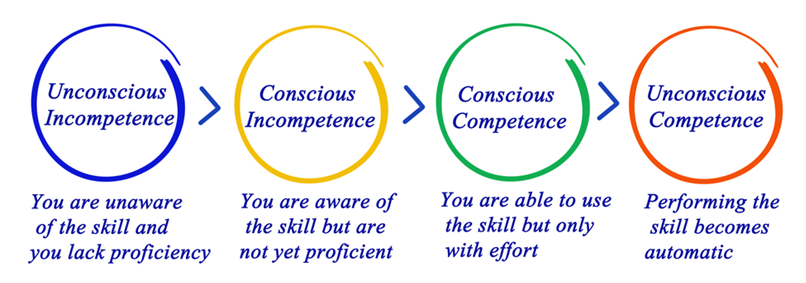
Burch (1974) developed a model of the Four States of Competence to help explain the processes in which an individual engages as s/he learns new skills.

As preservice teachers, we are unconsciously incompetent — we don’t know what we don’t know.  We stumble through our teaching, not knowing what we should be doing, if we are doing it right, or even what questions to ask.  As we begin to acknowledge our lack of knowing, we move into being consciously incompetent; we now know exactly how little we understand about the subject. It then becomes our mission to learn more, try more, figure out what works and what doesn’t in our attempts to improve. As we seek answers and help, practice, make adjustments, and are acutely aware of our growth, we shift to conscious competence. We know what we are doing and why we are doing it. We have grown; we now know things, and it shows.  When these practices gain a level of automaticity — where we no longer have to think about every little action we take and why — we become unconsciously competent.  “Right” is now a feeling, a sense that has developed with thought and practice. Any time we move into a new learning space, such as being a literacy coach or administrator, we begin the process again.  

This is usually where discussion of Burch’s model ends. However, I advocate for another step. In all my leadership roles, it has been necessary for me to step back into the conscious competence space. Why? Because when I am coaching a teacher in how to differentiate a lesson or teaching adult students about implementing a literacy strategy, it is not enough for me to say: “Yeah, I just do it, and it’s right. Here, watch me.”  That does not encourage growth in those with whom I am working.  I have to unpack what I am able to do automatically and make it transparent. I have to show that what I am doing is not by accident but the result of many years of experience, lots of reading and reflecting, and lots of corrected mistakes. I have to be able to say: “This is how you do it, and this is why it works.”  If I am unconsciously competent, I am not able to provide that form of instruction; and afterall, effective leaders are ultimately teachers. My ability to consciously understand my competence assists others in their moving from incompetence to competence. In order to be reflective teachers and effective literacy leaders, it is important for us to deconstruct the places where we are unconsciously competent.  We must be able to understand what we are doing, why we are doing it, how we can improve it, and what might happen if we did it differently.  We need to look at what we do automatically with the eyes of an outsider, “making the familiar strange” (Mills, 1959).

What might this look like? This means first, reflecting on our processes and how we engage with literacy learning ourselves. Early in my teaching career, I was assigned an SAT/ACT prep class. My students overall did not do well on the reading comprehension sections of tests. At the same time, I was preparing for the GRE exam to apply for graduate school, and I regularly rolled out near perfect scores on the reading comprehension. For me to better help my students, I had to step back into conscious competence and metacognitively consider what exactly I was doing in my reading of these passages and in my answering of comprehension questions that led me to a successful outcome. How was I engaging with the text? What was I thinking as I read? What kinds of predictions was I making? How did I process the questions? What did I do with vocabulary I didn’t know? Where was I rereading, where was I paraphrasing, and why? Once I unpacked my own process, I could then effectively convey to my students what I did and why through think alouds and walking through examples.

The same can be said when working with preservice and inservice teachers. In workshops or professional learning sessions, it is not enough to provide the formula of how to do a particular technique or strategy; it is imperative to also provide the theoretical reasons and reflective process that undergird the strategy. For example, I often begin my courses by having students complete a literacy autobiography, an activity they can easily enact in their own classrooms. While we do the activity, however, I also parallel the steps with rationales and explanations for what we are doing and why. I walk them through the assignment by modeling my own autobiography first. I show not only what my literacy experiences have been but also how they have shaped me as an individual now. This includes delineating my resultant strengths, challenges, and biases. As we work through their autobiographies, I model for them the unpacking process. What was it like for them to read and write in different subjects when they were younger? Who influenced their literacy habits and preferences? What life experiences influenced their literacy habits and preferences? How have these experiences impacted their views of literacy now? How do these preferences, or reticences, impact the way they interact with literacy now? How can they move beyond the fear, shame, or negative feelings that might have accompanied literacy experiences? How might their experiences impact interactions with students who do or don’t view literacy in the same way they do? For individuals with literacy affinities, the questions help them to see why they have positive dispositions toward reading and writing and to unpack the tacit literacy knowledge that has become automatic. This is important because not only can they better recreate some of the experiences for their students, they are also better able to see the correlation between their experiences and how they view reading and writing, and why other people, including many of their students, may not have the same perspectives. I share with them that Bourdieu (2013) argues our habitus shapes our understanding of the world, our ways of knowing (epistemologies), and the attitudes/beliefs/biases we carry into relationships with others and our teaching spaces. In order to be able to teach children, we have to know where we come from, why we believe what we believe, and consider how we can interrupt the transmission of our unconscious biases, which can be done through engaging in conscious competence and reflexivity. Otherwise, we can inadvertently create environments filled with microaggressions toward particular students, which can deeply impact student learning.

Stepping back into conscious competence and engaging in reflection is, in many ways, emancipating (Zeichner & Liston, 2014).  By engaging in thoughtful, conscious teaching and leadership, we free ourselves, our teachers, and our students from the blind following of established routines, policies, and plans. It gives us the freedom — and responsibility — to question, to wonder, to consider, to criticize, to advocate, and to defend. Thinking is a political action, and “teaching is a subversive activity” (Postman & Weingartner, 1971). Reflective teaching and conscious competence empower us to be change agents within our own educational spheres, whether that is in our classrooms, schools, districts, or at home with our own children. We learn to be critical consumers of curricula and policy, and we find our voices to change the status quo. This is how we change the currently negative national narrative for our profession — one child, one classroom, one teacher at a time.

References

Bourdieu, P. (2013). Outline of a Theory of Practice. Cambridge Press. DOI: https://doi.org/10.1017/CBO9780511812507

Burch, N. (1974).  The learning stages model. Solana Beach, CA: Gordon Training International.  

Mills, C.W. (1959). The Sociological Imagination. New York: Oxford University Press. (40th anniversary edition, 2000).

Postman, N. & Weingartner, C. (1971). Teaching as a Subversive Activity. Delta Publishing.

Zeichner, K. & Liston, D. (2014). Reflective teaching: An introduction. Second edition. Erlbaum.

Dr. Jennifer D. Morrison is a Clinical Assistant Professor at the University of South Carolina and a National Board Certified Teacher in AYA/ELA. She earned her Ph.D. from the University of Nevada, Reno, in Language, Literacy, and Culture. She worked as a middle and high school English teacher and instructional coach for 19 years. Her research agenda focuses on teacher induction, literacy attainment (particularly digital and multimodal), and teacher inquiry processes. She has been published in such journals as English Journal, Journal of Adolescent and Adult Literacy, Talking Points, Principal Leadership, and Educational Leadership.

Cover Photo by Lindsay Henwood on Unsplash

The Power of Parallel Reading

Teaching

This post is written by Charlene Aldrich. For more about Charlene, please visit the bottom of this page. The webinar recording for this material is embedded at the bottom of post.


How do we get students to read at home? We probably have to require it. We know in lower school, students are asked to read 15-20 minutes every evening. Students have free choice; parents monitor the requirement by initialing a document. But how can that requirement morph into a habit that positively affects the student’s academic future?  “Let them choose” becomes the mantra. When given open choices, it’s human nature to struggle. 

BUT when we provide themes, topics, or text sets to choose from, we make a choice manageable. It’s then that students fulfill our targeted purpose for outside reading. It’s then that students look at titles as a way of previewing the content of the text. It’s then that they engage in ‘reading to find out.’ It’s a win-win.

“I don’t have time to hunt down reading selections and/or books!” cry many content-area teachers everywhere.  And maybe teachers won’t have the extra time during their first or second year of teaching. Or the first or second month of the year.  HOWEVER, when teaching and planning become automatic, time becomes available to investigate the themes and text sets curated and available online. Content-area teachers can introduce reading selections of all genres; these support the ELA curriculum and provide background, cultural understanding, or applications of specific content-area curriculum.  This is where the idea of parallel reading emerged – collaborating across the content areas in ways that grow overall literacy proficiency AND reinforce content-area learning.

Parallel – side by side, never touching. Reading – the crosstie that connects content areas. Juxtaposed with another discipline, text is a way to connect things that would otherwise run side by side. Through parallel reading, teachers approach their content from a literacy mindset. Take math, for example.  One might say that reading is not necessary to do the math.  However, knowing ‘pi’ is essential, but where did it come from?  WHO first used it for achieving a measurement?  WHEN did it come about? WHY was it necessary? A planning question becomes, “Who were the movers and shakers beginning at the onset of mathematical thinking and going forward?”

How do you implement your new mindset?

  1. Review the major topics of your curriculum.  OR
  2. Look at the calendar for events or holidays. OR
  3. Look at the school calendar for half-days and identify a theme, especially those that are more social than curriculum related.
  4. Ask students what ideas they would like to explore, then factor their ideas into your curriculum and text set search.
  5. Ask the librarian to identify a wide range of texts and genres that connect to your theme or topic. 
  6. Search in the following text set resources for reading selections connected to the theme or topic.
  7. Construct your curated list for your students to choose an interest to read and share.
  8. Most of all, limit the rabbit holes that you might find yourself in as you realize the plethora of choices that you can provide to your students.  

Arousing curiosity and satisfying it with reading develops a positive attitude toward reading.  It empowers students to read to ‘find out why’. While the answers to those questions are easily found with a Google search, connecting to the culture of the times happens best when biographies or primary sources are available for reading.

Text of all kinds becomes the primary connection between every content area. Students who read first-hand accounts of the Jim Crow era have a deeper understanding of the literature of that time. The struggle of the Indigenous people has a more significant impact when seen through their eyes in diaries, songs, and poetry. Understanding the building process of the pyramids or the Roman aqueducts connects math with sociology or history.

I alluded to curated text sets above and encourage you to investigate some of my favorite resources. NewsELA, ReadWorks, CommonLit are just a few places to find digital text sets created and classified by readability, theme, topic, holiday, and current events. One of my favorite articles is in NewsELA regarding Halloween and how much money is spent: nine billion dollars in 2018! Each of the above resources contains a wide variety of stand-alone reading/writing projects for those short classes on short days where there’s no time for an entire lesson!

Your teaching librarian can also curate book sets that support your curriculum. Other grade-level teachers may welcome the opportunity to collaborate on reading and writing assignments. Making connections across content-areas strengthens learning and increases the likelihood of creating lifelong learners.

Ponder my truisms about lifelong learning:

  • Learning requires reading from diverse perspectives.
  • Linking new learning to prior learning lays a foundation for future application.
  • Social consciousness is developed when empathy is aroused.
  • Citizenship has a whole new meaning when students discover that the ‘yous’ of this world are more important than the “I”. 

Parallel reading projects grow a body of students who will begin thinking outside of their high school, content-area silo. That is certainly how they will live upon graduation. Stereotype book reports don’t have to be the outcome of parallel reading. How would your students like to communicate their reading experience to others? Encourage them to move beyond summaries (which can be found online) to how their perspectives have shifted because of the reading selection.  

Try it. Identifying the selections is half of the fun! What’s the other half? Sharing them with your students.  Through themes and topics, students can connect with text in ways outside of a required curriculum text. They can take ownership of their reading which just might result independent readers and learners.   

Photo by Johannes Plenio on Unsplash


Charlene Aldrich is an instructor in the Office of Professional Development at the College of Charleston. While content-area literacy is her specialty, she also teaches Assessments in Reading, Foundations in Reading, and Instructional Practices as required by South Carolina for recertification. She serves as the Treasurer of LiD 6-12.

Complicated, and Worth It: Fashioning Links in Literacy

Teaching

This post is written by Jason D. DeHart, PhD. Read more about Jason at the bottom of this post.


Were I to conduct a thematic analysis of my career in literacy so far, “I don’t like to read” would rise to prominence as an often-stated reality.  Even if students feel that they are capable readers, they do not always express connection and engagement with the texts that they encounter in school settings.

This was true in my time as a middle school teacher, it is a theme that has inspired my scholarship, and it is a mantra that continues to resonate in the K-12 setting in which I am working now. When I consider the types of texts that continue to be honored – voices from hundreds of years ago, many of which include problematic language related to ethnic, racial, and gender identities – it is no small wonder that instant buy-in is so rare.

While there are many potential solutions to discuss, the word that also comes to mind in my thematic thinking is linking. This notion of linking speaks directly to the work of Literacy in the Disciplines in terms of thinking about the strands of critical inquiry that can be fashioned between and among content areas and types of texts. As I start a new semester, I am continuing to revisit the ways I can make content rich and relevant for my students through thoughtful connections between and among content areas, types of texts, and voices old and new.

The Rising Voices

Text selection is a key part of this process. When I first began teaching my students, they were reading Steinbeck’s outsider report of migrant farm workers in Of Mice and Men. That same year, in 1937, a book called Their Eyes Were Watching God was published. I was fascinating by this cultural dichotomy and struck by the opportunity to find a voice from the intersections of gender and ethnicity that could broaden my students’ perspectives about the lived experiences of people in the past. Zora Neale Hurston was, famously, an anthropologist, and her attention to ethnographic detail shows up in her writing.

I then worked with students across my courses to trace this literary journey to Alice Walker, who was instrumental in bringing attention once more to Zora Neale Hurston’s work in more recent times. This conversation between authors across time was one that I could discover and share with my students, linking to their current stories as part of American culture(s). It is both a linking of time and a critical inquiry that travels through a chain of inspiration.

In addition to Hurston and Walker, we read Jason Reynolds, Jericho Brown, and additional contemporary voices who have shared about facets of America that are simply not discussed in many canonical works. It is also important to me to choose works not simply because I am drawn to them personally, but as a way of filling in a gap that exists in what students might have discovered in literature so far.

Critical Analysis and Honest Stance

At one time, suggesting that a revered work of literature contains problematic content would have caused me insecurity. I desperately wanted to be a “good English teacher”, and I thought that meant holding the classics up on clouds. At this point in my teaching career, I recognize the value of honestly evaluating the limitations of thought and experience represented by literary canonical figures. In this way, I can be clearly critical about what it means to be an inside or outside voice related to a particular topic or way of being, and I can invite my students to think critically about these questions of authorship, as well.

I feel that this approach honors my students’ intelligence and acumen in noting these inconsistencies in human stories, as well as their awareness of the absence of some stories in what they have discovered in curriculum so far. This critical stance is not only possible in English class, but can lead to inquiry in history and social studies courses, discussions of equity and equal access in science and health care, and questions of ethics in technology courses, to note a few possibilities.

Asking students to evaluate an author biographically, not to simply suggest that they did not know better than to use language at a certain period in time, but to consider authors’ biases and positionalities is part of deep thinking and ethical work. This need not be a full lecture on the author’s history, but rather a point-by-point glimpse at some major details about them, considered historically alongside literature.

Ways of Reflecting

Finally, all of this critical work requires some kind of outlet. I cannot imagine teaching a class about virtually any topic and not having my students respond in some way each day, either in a paragraph, a sentence, or a few take-away words. I embrace videoed content as students have created zeitgeist poems and adapted key narrative scenes in groups, using their cell phones as one-stop shops for moviemaking. I embrace the visual, not just in thinking about remembering vocabulary words, but in sharing multimodally and symbolically about reading and viewing experiences.

A question stem to encourage this kind of response might be something like: Locate or create three images that represent your thinking about the representation of political unrest in Before We Were Free by Julia Alvarez, or Create an infographic to help us understand the setting and context of Elie Wiesel’s Night.

In this way, students can explore links between and among stories that have existed for some time, as well as those that need to be (re)told. Moreover, as I have explored in this post, students can become aware of, critique, and even compose links between historical and contemporary voices, and engage in the process using tools and approaches that build their mathematical, artistic, and technological skills.

Teaching and learning is truly a linking and connected process, from past to present and across multiple literacies. All of this rich complexity requires attention, but I have found the conversation to be worth the time.


Jason D. DeHart is a passionate educator, currently teaching English at Wilkes Central High School in Wilkesboro, North Carolina. He served as a middle grades English teacher for eight years and an assistant professor of reading education at Appalachian State University from 2019 to 2022. DeHart earned his PhD from The University of Tennessee, Knoxville.

Photo by Michal Matlon on Unsplash

Teaching Word Roots in the Science Curriculum

Teaching

This post is written by Dr. Timothy Rasinski. Learn more about Dr. Rasinski at the bottom of this post.


Research has demonstrated that the size and depth of students’ vocabularies are associated with proficiency in reading comprehension. Words matter in reading. Words also matter in academic areas. In science, words are labels for key scientific concepts. Although learning science-related words is critical to success, teaching them can be challenging – many scientific ideas are new to students, and most scientific concepts are abstract. Asking students to look up and memorize words and their definitions in dictionaries or textbook glossaries is, at best, a short-term solution and, at worst, can lead students to deep disinterest in studying words.  

Another Approach – Word Roots

A word root is an umbrella term for a word part that carries meaning, including prefixes, bases, and suffixes. Importantly, our understanding of a new word’s meaning begins not with the prefix but with the base because the base is the root that provides the word’. Moreover, the ubiquitous nature of word roots means that they appear in many words – learning one word root can help readers understand many words. Since over 90 percent of all academic words (including science) are derived from Greek and Latin word roots, it seems that a comprehensive and efficient approach to teaching science vocabulary is to teach the word roots that underly the scientific concepts and words students will encounter in their science instruction. 

Here’s a year’s worth list (one per week) of some of the many science-related word roots (and their meanings) derived from Latin and Greek that students will encounter in their science instruction.   Interestingly, many of these roots also find their way into the vocabularies of other academic areas, such as math and social studies.  

You can easily see how these word roots are found in many science words and concepts, especially in longer scientific words that combine multiple bases, prefixes, and suffixes (e.g., abrupt, interruption,  photosynthesis, illuminate, orthodontist, biodiversity, sediment, subside, etc.).

How to Start with Word Roots

            There are many ways to include word roots in science and vocabulary instruction.   One of the simplest is to develop in students an awareness of and fascination for word roots.  This can be done by starting each week with a new word root and presenting students with the root, its meaning, and a list of words that contain that word’s roots.  Perhaps make a classroom visual display of the root, its meaning, and a list of related words (students could keep their own personal word journals with this information).   Then throughout the week, make quick references to the root, perhaps adding a new word each day to the display.   And, of course, when coming across new words containing the root in your instruction, draw students’ attention to the word, and its root.  Here’s an example using the “hydr(o)” word root:

A few minutes each day studying the targeted word root and reading texts containing word roots can go a long way to develop students’ understanding of science (and other academic areas), build their general vocabularies for reading and writing, and develop students’ fascination with words toward becoming a true “lexophile” (“lex” = word;  phile = love/lover).

Recommended Resources

Rasinski, T., Padak, N., Newton, R., & Newton, E. (2014).  Getting to the Roots of Science Vocabulary: 6-8.   Huntington Beach, CA:  Shell Education.  (find at www.tcmpub.com)

Rasinski, T., Padak, N., Newton, R., & Newton, E. (2014).  Building Vocabulary from Word Roots:  Kits for Grades 3 through 11.   Huntington Beach, CA:   Teacher Created Materials.  (find at www.tcmpub.com )

Dr. Tim Rasinski is a Professor of Literacy Education at Kent State University where he holds the Rebecca Tolle and Burton W. Gorman Chair in Educational Leadership.  A former classroom and reading intervention teacher, Tim is a member of the International Reading Hall of Fame and was recently identified to be among the top 2% of scientists in the world.

Tim’s Email is trasinsk@kent.edu You can follow Tim at @timrasinski1

Cover Photo by Arun Geetha Viswanathan on Unsplash