High Tech Means Missed Connections

Research

By: Dr. W. Ian O’Byrne, College of Charleston

The world has not seen a school shutdown on this scale before. According to UNESCO, roughly nine out of ten schoolchildren are out of school worldwide. As many school districts shut their physical doors for months, or the remainder of the year, there is an understanding that these closures are a serious threat to children’s academic progress, safety and social lives. 

To alleviate these concerns, there is hope that shifting to online learning will provide opportunities to lessen these losses and support learners. The challenge is not all schools, educators, parents, or children are equipped to effectively learn in digital spaces. Many of these challenges disproportionately impact low-income students and those with special needs.

Research suggests that 4 in 10 U.S. teens say they haven’t attended a single online or virtual class since schools closed.

With many millions of Americans working or attending virtual school from home during the coronavirus pandemic, the longstanding gap between those who have reliable, affordable internet and those who do not has never been so clear. Much has been made about the efforts to make sure students have the devices and internet access they need for online education. Yet in actuality, signing up for free, or low cost internet service is difficult, leading to students sitting in school or library parking lots to connect online.

US Schools Deploy Wifi Buses Amid Virus Pandemic

The vast majority of households with children have broadband internet, but there are still big disparities by income, race and the education level of parents. Many families are likely to rely on smartphones for Internet access and children in those households may not be able to use learning software that requires a tablet or computer. It is not unusual for students to try to complete schoolwork on a single cellphone. Educators need to be careful about expectations that all students can go completely online. 

Digital Divide

There are many ways to define “digital divide” as it relates to technology usage and equality, and it also has very specific meanings in the United States, as opposed to the remainder of the planet. Digital divide refers to the growing gap between the rich and poor as it relates to Internet access. The rich and educated are still more likely than others to have good access to digital resources. When it comes to education, the digital divide has especially far-reaching consequences.

Many of the reasons for the gap in the digital divide focus on access, education, income, as well as a number of demographic and socio-economic characteristics. To address the challenges of a digital divide, it is often helpful to think about the connections involved as we connect to the Internet.

  • What kind of technology? To what does the subject connect: fixed or mobile, Internet or telephone, digital TV, broadband, etc. 
  • Who is the subject? Who is the subject that connects: individuals, organizations, enterprises, schools, hospitals, countries, etc. 
  • Which attributes matter? Which characteristics or attributes are distinguished to describe the divide: income, education, age, geographic location, motivation, reason not to use, etc.
  • How to connect? How sophisticated is the usage: mere access, retrieval, interactivity, intensive and extensive in usage, innovative contributions, etc.
How to Define the Digital Divide

Due to the growing amount of information on the Internet and people’s increasing dependence on information, internet skills should be considered a vital resource in contemporary society. Complicating these issues of connection, are the problems that educators, parents, and students have with moving learning environments to online spaces. Recreating a classroom online is a logistical challenge that comes with a learning curve for students, teachers and parents. For children in low-income school districts, inadequate access to technology can hinder them from learning the tech skills that are crucial to success in today’s economy. 

Rural Connections

Urban and rural areas in the U.S. feel the effects of the digital divide more than their suburban counterparts, with most of this stratification correlating with socioeconomic status and ethnicity. Overall, geographic disparity of income in the United States is best explained by first dividing the nation into regions and then further into urban and rural areas. This impacts youth as those raised in better socioeconomic conditions are more likely to have computers in their homes, attend better schools, and have more qualified teachers with better computer skills. The digital divide is exacerbated when America is split into areas of concentrated advantage juxtaposed with areas of concentrated disadvantage.

“Rural” is generally defined as a geographic area that is located outside towns and cities. Rural areas also contain many areas of inequalities of opportunity, including healthcare, education, and jobs. Examinations of these inequalities in the U.S., found the largest disparity in the South, and the least amount of inequality occurring in the West. 

Rural areas have an additional obstacle when it comes to digital access where high-speed internet can be sparse and expensive, or sometimes not even an option at all. In many rural areas, the only Internet options are near-obsolete DSL, satellite, or even dial-up. These internet access methods are often more costly, despite being less reliable and more easily affected by poor weather or infrastructure. 

Research suggests that even as technology becomes more ubiquitous, rural Americans remain less likely than urban and suburban Americans to have and use various digital technologies. This data suggests that rural users are less likely to have home broadband. Rural users increasingly use mobile devices, but rarely own a desktop or laptop, and even more infrequently own multiple devices. Lastly, this research suggests that rural Americans go online less frequently than their urban and suburban counterparts. 
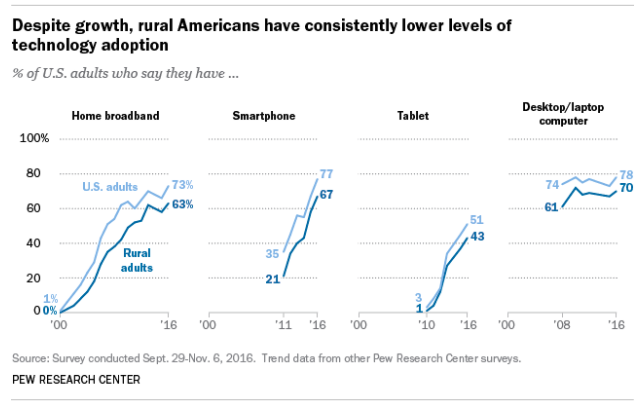
https://medium.com/@pewresearch/digital-gap-between-rural-and-nonrural-america-persists-53bec5ebc6de

Maintaining Rural Connections

Much of the mythology of rural America emphasizes the challenges and hardships that exist, even as we recognize the lack of educational and economic opportunity for residents. As we increasingly move to a globally connected society, there is a need to consider whether we are unfairly hindering rural youth without providing them with the access, skills, and knowledge necessary to survive and compete in today’s economy. 

A review of digital learning strategies for rural America (PDF) suggests rural school districts face many challenges that are substantively different from urban and suburban districts. These include:

  1. Decline in enrollment,
  2. Lack of computer and Internet access,
  3. Lack of high quality professional learning,
  4. Shortage of teachers,
  5. Inequitable course access,
  6. Gap in college and career achievement,
  7. Increase in underserved populations, and
  8. Lack of funding and resources.

The report suggests digital learning initiatives, directed by the state, or local, district/school programs can help alleviate some of these challenges. Specifically, they give guidance on four broad categories of online and blended learning options that can help rural schools and students. These include state virtual schools providing supplemental online courses and other services, course access programs, fully online schools, and consortium or regional service agencies.

It should be noted that there is also a need for better access to broadband Internet in rural areas. Perhaps there is also a need for improved state and regional policies that can improve the lives of digitally literate rural youth. Despite these challenges and opportunities, many youth are currently being left behind as our schools move online. 

To address these concerns in real-time, educators need to once again remember that not all students may be able to access and connect to digital learning spaces. A certain amount of creativity is needed as you make these transitions. Before you worry about specific tools to use, or automatically jump to video conferencing because you think it is expected, Stephen Merrill suggests the following mindsets:

  • Expect trial..and plenty of error – There will be mistakes made. Make peace with it.
  • Acknowledge the extraordinary – Focus on enrichment and meaningful activities.
  • Reduce the workload (for yourself and your students) – Focus on “need to know” and not “nice to know” in your courses.
  • No person is an island – We’re all in this together. Keep in contact.
  • Everyone thinks they can’t, before they can – You know how to teach. You will figure this out in time.
  • Mind the gap – Your work will be hard, but there are students facing more severe challenges.

Stay Connected

As our schools, communities, and systems close down, we cannot assume that all learners will be able to engage and connect online. We need to be intentional in uses of technology, and push for more informed, thoughtful instructional uses of technology. We need to advocate for privacy, security, and more informed uses of our data in these spaces. There is a need to educate, empower, and advocate for ourselves and our students. 

Together we can use this as an opportunity to forge a future for all that is more accessible and approachable. I also examine these questions from a parental lens at the Screentime Research Group and on my blog. Lastly, my weekly newsletter provides a weekly glimpse of the changing landscape in a rapidly changing, technological society. Together we can use these experiences to identify the broken parts of our system and hopefully build new ones to support all learners. 

About the Author

W. Ian O’Byrne, PhD is an assistant professor of literacy education at the College of Charleston in South Carolina. His research focuses on the dispositions and literacy practices of individuals as they read, write, and communicate in online and/or hybrid spaces. O’Byrne is the author of many journal articles and book chapters focusing on initiatives ranging from online and hybrid coursework, integrating technology in the classroom, ePortfolio systems, and supporting marginalized students in literacy practices. Ian is a former middle school and high school English Language Arts teacher. He can be found on Twitter (@wiobyrne) and his work can be found on his website (https://wiobyrne.com/). His weekly newsletter (https://digitallyliterate.net/) focuses on the intersections between technology, education, and literacy.

Assistant Professor, Department of Teacher Education, College of Charleston

Teacher Mom, Mom Teacher

Teacher Self-Care

By: Elinor Lister, Glenview Middle School English Teacher

Teacher-parent life or parent-teacher life?

Being a mom and a teacher has always made life interesting. There are many perks. Being off on holidays and breaks when your children are also off is probably the biggest perk. A teacher also understands the system and has an advantage, usually, when helping with school work and participating in teacher meetings and things.

Photo by Antonino Visalli on Unsplash

One negative that is ever-present, though, is the inability to participate in your child’s school day as easily as other parents often can. It’s not always possible to walk your child into school on the first day because it’s also your first day of school. You need to be in your own classroom greeting your new and nervous students. You aren’t able to attend all of the parties that take place throughout elementary school. To take off, create plans for your students, and figure out how to leave your classroom to attend your child’s party is often more difficult than the thirty minute party is worth. And don’t even think about joining the PTO or other committees because most take place during the school day. You have to worry about all of your extra children, so oftentimes your own child takes a back seat.

Now, there may be supermom teachers out there who disagree with me. They may take off to be present at all of their child’s events. If you can, that’s amazing. I salute you. In my experience of teaching for twenty years and being a mom for fifteen, I have found it to be very difficult. I adore teaching; it is my passion. I adore my children; they are my whole heart. However, there are instances every year where I have to make choices between my personal children and my classroom children. I imagine most mom teachers feel the same at some point. 

Then, COVID-19 hits… 

This changes the entire Mom Teacher, Teacher Mom experience and daily life. I’m still worried about my own children, but now that worry takes on an entirely different format. I have three children around me all day, trying to complete school work. At the same time, I am preparing lessons and working with my students only through my computer. The separation of my two lives is now gone. The two lives that I live have now merged into one – literally.

The two lives that I live have now merged into one – literally.

Initially, this brought about a few days of complete craziness. Every child of mine needed help with work, while I was creating lessons for students and answering emails for what felt like the entire day. This insanity was not sustainable. As have most homes across our state and country, I needed a solution and a schedule. 

Photo by Andrew Neel on Unsplash

My district set my office hours from nine to twelve every day. During this time, it has worked out very well for my children to complete any school work alone that they can do without help. After twelve, we get lunch, and then I help each one of them complete their work. It’s a long process, but it has been working for us. 

Teacher-Parent, Parent-Teacher Tips

Throughout this process I have learned a few things that have been very valuable: 

  1. Embrace the fact that my children can complete their lessons at any point in the day. One positive of learning at home is that it’s flexible. If we want to stay up late watching a movie as a family or doing something else fun, why not. They can sleep in. They can do some work and take a break to go play or get a snack. (Although in truth we’re all snacking a bit too much at my house.) This truth allows less stress for both them and me. If I’m busy with something for school or something for the house, they can do other things until I’m free to help them. 
Photo by Krsto Jevtic on Unsplash
  1. Embrace the fact that my students also have very different schedules right now. Even though my office hours are from 9-12, many of my students are not working then or maybe aren’t even awake then. I get emails from students in the afternoons and evenings when they’re actually working. I have decided to check my email once in the afternoon and once in the evening and answer whatever has come through. I also know that there will be late work turned in. In the midst of what’s going on, there are students who just don’t want to do work on some days. There are also students who are watching siblings and handling other household responsibilities. Many homes don’t look like mine, and I need to allow for that flexibility with my students. As teachers, we can’t say, “Well normally they would have to complete this homework at home,” or “Normally they would only have two days.” There is nothing normal about this time and this way of learning. 

Teachers often want more freedom, and now … we have it.

  1. Embrace that this lack of normal should mean my lessons aren’t normal. Students are not sitting in class, able to focus on me or an activity like they typically would. And let’s face it, even sitting in class, that focus is sometimes sketchy. At home, they have siblings, food, phones, pets, televisions, video games, any number of things that to them beat out school work. Many of them also have working parents who may not even be home during the day. Their entire schedule is upside down. As a teacher, why would I offer something that I would struggle to get them to do or focus on if they were sitting in my classroom? State testing has been lifted!!! This is the time to engage our students. Allow them to explore and research, to be creative, to actually enjoy learning something about a subject. We should use interactive websites, create hyperdocs, give creative projects, find interesting articles and stories to read, and let them write expressively. Teachers often want more freedom, and now a positive in all of this is that we have it. 
  1. Embrace that I truly can be Mom Teacher and Teacher Mom right now. Not every teacher is a mother or still has children at home, but this lesson can apply to all of us. Yes, being stuck at home stinks. Yes, we miss our students terribly. Yes, we really wish we could go back to normal life. BUT, when we have no control over the situation, we need to focus on what we can control and focus on what is good about the situation. I have been able to spend more time with my children in the last four weeks than I have in a long time. Yes, I live with them, but we have been able to stop and breathe and enjoy each other’s company. I am still teaching, and they are still learning, but we are able to also just be. We have done art projects, had baking contests, put together puzzles, watched movies, read books, and played outside. We are normally going a hundred miles an hour from one thing to the next – soccer, guard, volleyball, church, homework, dinner, etc. But right now, I get to be a little more mom than teacher. I am still a teacher; I am still preparing engaging lessons and helping my students. For once, though, I’m not having to choose between the two. 

Teachers are often the worst about taking care of themselves. We worry about everyone else first. During this time when things are not normal, how about we work on self-care, enjoying some downtime, and making memories. Our normal school lives will be back before we know it. For now, let’s make sure we are okay, our children are okay, and our students are okay.

About the Author

@elinorlister on Twitter

Elinor Lister has taught high school and middle school English for twenty years and currently teaches eighth grade English in Anderson, South Carolina, at Glenview Middle School. She was the District Teacher of the Year for Anderson Five for the 2018-2019 school year. Elinor holds a Bachelor’s in English from Erskine College, a Master’s in Educational Technology from Lesley University, and a Master’s in Administration from Gardner Webb University.

Photo by Allie Smith on Unsplash

What’s in the packet?

Teaching

By: Elizabeth McCauley McDonald, Manning High School Social Studies Teacher

Students A and B are in 11th grade. Student A reads at a 9th grade level and Student B at a 7th grade level. Student A has internet access at home and has transitioned to e-learning. Student A experiences some challenges understanding the work; however, they are able to attend virtual meetings with the teacher to get additional help. Student B does not have a reliable internet connection at home, so Student B’s parents go to the school and pick up a packet, so that their child can continue to learn. Student B opens the packets and begins to…

Right now in South Carolina, and America as a whole, middle and high school students are forced by circumstances to become their own teacher.

Some students are even teachers to their younger siblings. In many homes, parents of elementary students are able to support their child’s learning, but that is not always the case for students in middle and high school. Fortunately for some middle and high school students, they have access to reliable internet and can attend Zoom meetings with their teachers, email teachers, or even look up tutorials or videos explaining content. But notice that I said some students. The reality is that many middle and high school students do not have that luxury.

During this time the inequities of our school systems are laid bare.

Some folks are content pretending that everything is alright and the children will be just fine, but what if they aren’t? 

Many schools have switched to an e-learning platform to provide instruction and instructional materials for their students. But what about students that do not have access to these platforms? 

Many students are faced with the reality of these teacher created packets we see folks talk about on personal and school district social media pages. 

So, what’s in the packets?

Well, it varies from district to district, school to school and sometimes teacher to teacher. There is one commonality found in most packets – reading activities. The goal of the reading activities seems to be for students to review and/or learn new content.

For science students, packets may include articles related to the field of science or secondary source material explaining science content. For history students, packets may include primary source documents, like letters or journals for analysis, or secondary source materials discussing content students need to review or learn. Math packets may include word problems allowing students to make real world connections to math concepts. English packets may include short stories or opportunities for students to engage writing with various prompts. 

For some students these types of activities are manageable. So, let’s talk about why these types of activities are manageable for those students. Well, if you’re like me, you teach content area literacy strategies in your classroom. We read daily in my class and use literacy strategies when we read. On my board when you walk in my classroom, you’ll always see a section titled, “Daily Reading Moment.” 

Many teachers are engaging in literacy practices in their classrooms. Teachers have students activate prior knowledge before reading texts, utilize activities while reading to increase student comprehension, and utilize activities after reading to assess comprehension. Many teachers focus on building vocabulary for students to be successful readers. Many classrooms across our state are classrooms where students are learning the literacy skills they need to tackle texts in the absence of their teacher. 

I’m a social studies teacher, but I am a firm believer that literacy is everybody’s business, but unfortunately not all educators feel the same. Some folks feel as though it’s the job of English or Language Arts teachers to teach reading and literacy skills. And, maybe these teachers have been able to get by with that mentality for a while, but what about now, when teachers expect students to read and learn information from packets?

Let’s talk about access

Let’s go back to Student B that we read about in the beginning of this post. What happens when Student B attempts to read the various materials in the packet, but lacks the reading skills and vocabulary knowledge to be successful? What happens when Student B comes face to paper with this touted packet, but has never read in the safe space of the classroom from which this assignment hails? 

What do we do now?

I know you care about your students and you want the best for them. The way for students to get the best is for teachers to give their best selves. 

Here is my charge for all of the educators across our state:

Photo by Reuben Hustler on Unsplash
  • Invest in your own professional development, during this time of self-distancing, to strengthen your implementation of literacy practices in your classroom.
  • Expand your repertoires of practice to include literacy strategies that will empower your students with the tools they need to deconstruct texts and gain meaning.
  • Enroll in a class about content area literacy.
  • Do a Google or YouTube search and learn about various literacy practices and literacy strategies.
  • Read the research. There are many research articles about best practices.
  • Reach out to folks that you know deliver professional development around content area reading strategies. 

My charge for educators knowledgeable in content literacy strategies:

If you have delivered professional development in content area reading and writing strategies, deliver a virtual professional development for your colleagues.

This is a call I will also need to answer. Why should we wait until our various summer academies to learn with and from our colleagues?

Will you join me?

In South Carolina, we know one of our biggest mountains to climb in education is increasing student literacy. We also know that our greatest tools we have to climb that mountain are the educators in South Carolina classrooms. When we enter our classrooms again, will you be a part of the change? Will you help us climb the mountain? Let’s do the work…together!

If something of this magnitude happens again, we do not want to leave our students to fend for themselves. Instead, we want to leave our students with the knowledge and practices necessary to take ownership of their learning.

About the Author

@MrsEM_McDonald on Twitter

Elizabeth McCauley McDonald is a high school social studies teacher in Manning, South Carolina, where she served as District Teacher of the Year for 2018-2019. She holds a Bachelor’s in Secondary Social Studies from Clemson University, a Masters in Education from Anderson University and a Masters in Educational Administration from the University of South Carolina. Elizabeth is currently pursuing a PhD. in Literacy, Language and Culture at Clemson University. Elizabeth also edits blogs for LiD.

If you are a South Carolina educator, complete this survey developed by LiD to learn more about the literacy teaching and learning in secondary classrooms in our state. (Link).

Photo by Fusion Medical Animation on Unsplash

Literacy in the Time of Coronavirus

Teaching

By: Dr. Todd Lilly, University of South Carolina

Is it time to sell the school building? Is this the end of school as we know it? They’re coming back, aren’t they?

Like… when this is over, things will go back to normal… right? RIGHT???

An English teacher friend of mine who plans to retire at the end of the year with 40 years texted me: “School closed. My career might end like this !”

Wait! End like what? What just happened? Suddenly, nothing is normal, and there is no assurance that it will ever be again.

So I emailed my graduate students, “What’s going on?”

About 15 years ago, I left the high school classroom to teach in the ivory towers of higher education. A few years ago, my wife and I joined the University of South Carolina where I reside in the virtual ivory tower of on-line learning. I’ve been practicing “social distancing” living vicariously through my graduate students who are all teachers and administrators in real classrooms… at least they were until a few days ago. So… let me share what they’ve been telling me and you can think about how their stories compare to your situation.

From a teacher up in Maryland: “So far, absolutely nothing is occurring in my school district… along with what I assume is the rest of the state. We have been given explicit directions not to communicate with classes, issue assignments, or post grades. We may have one-on-one communication with students via Canvas, but classroom instruction in any manner cannot occur because the school district is afraid of violating FAPE. Our schools are closed until 4/24.”

This was a recurring theme. Teachers told me they’ve been instructed to focus on remedial learning rather than introducing new material. This is to buy districts and states time to bring the new learning situations into compliance with the laws regarding the rights of students with exceptionalities.

One South Carolina special education teacher expressed her passionate concern: “We place a greater emphasis on the accountability than we do on the lessons that life provides.”  She was not the only respondent to say how much she missed her students. I’m sure they miss her too.

Literacy is not a stand-alone skill; it is a practice that is always situated in a context, and this time, the context changed literally overnight.

There has always been a disconnect between what the public thinks teachers do and what they actually do: Teachers spend all their after-school time on Facebook, sharing brownie recipes (with pictures). One parent scornfully asked on Facebook: “Are teachers still getting paid?”

We can forgive parents in their time of frustration, but the responses I have received these last few days tell the true story:  Both administrators and teachers are… well… overwhelmed. It merely went from “barely bearable” to “impossible.” More than one teacher used the word “triage.”

An administrator in Florence, SC acknowledged this when she reported: “I work at our central office and we have been working tirelessly to support teachers who are working 10 or more hours each day preparing, grading, and holding a minimum of four office hours to answer students’ questions.  Those were the guidelines for week one.  In week two, add teacher created videos at least once per week.  It is definitely harder this week, not just for teachers creating and executing these magnificent virtual lessons but also for our students who are definitely missing their teachers and friends.”

From Pennsylvania comes this teacher lament: “I need a break from education things. With the distance teaching, I feel I’m on call 24/7 and [constantly] feel obligated to check on my students.”

Another teacher wrote: “You know, when I first got your email I felt a little bit like ‘one more thing.’ However, when I started [writing], I couldn’t stop. It was an outlet I didn’t realize I needed. It was a lot like writing in a diary and very cathartic.”

She went on to talk about how her district (as of March 30) “… has been assigning Chromebooks to students (yesterday and today) and Comcast is offering 2 months of free WiFi. Now, the teachers have been told by our association that we must have Chromebooks in case we are ever subpoenaed for something relating to Special Education. There aren’t enough Chromebooks! I don’t even know about the WiFi. Some teachers, like myself, don’t want to go out to the school and risk getting sick to get a Chromebook. In this case, I wish someone would have just promised some sort of protection. … I’m in charge of making sure my department of 16 understands protocols for reporting child abuse and adhering to legislation concerning special needs students. The last text I sent them was at 10 pm last night and the first was at 6:30 am. Our central office updates us as much as they can but they are doing triage as well.” 

In the last couple weeks, literacy practices have gone way beyond the technology of pen and paper, and may never return. How does a parent go about contacting Comcast or AT&T Mobile or Spectrum? What are the restrictions? What are their rights? Obviously, for such dramatic concern, people are recognizing that on-line learning is not quite the same as its cinder block counterpart.

Teachers are discovering there is a whole new set of literacy skills that needs to be learned to make this work, and that takes time and more than a bit of self-confidence.  By now, all of us have had to confront the reality that there’s more to moving on-line than merely having the equipment.

An Orlando science teacher makes the following observations:

1) A common concern of teachers has been “how do we stop the students from just Googling answers?!?” My thought has often been “why are we asking students questions that have answers that can be found on Google?”

2) Another common barrier teachers have found is “How will students learn without a face to face lesson and me explaining the information to them?”

3) My personal greatest barrier transitioning online is how to generate effective, authentic, and meaningful dialogue in an asynchronous online course. How can we get students to engage, debate, revise their own understanding of content, and push the knowledge base of the collective whole forward in an online course?2) Another common barrier teachers have found is “How will students learn without a face to face lesson and me explaining the information to them?”

An upstate South Carolina STEM teacher talked via video about the “pressure teachers are now putting on themselves to mimic their synchronous, daily lessons and pedagogy in an asynchronous, virtual space.” He states that what he intends is not to be the “content giver,” but rather his plan is to provide his students with activities, including those provided by web applications such as, The Physics Aviary,  during which he can “go in and comment multiple times, giving feedback [during the process].” Scott prefers “open world” simulations that are not as linear as other platforms that are more prescribed and restrictive.

He talked about his future plans of investigating the multimodal options that digital literacy offers. This is an important literacy topic that deserves its own blog, hopefully in the near future on this site. If this caught your attention and you want to know more, check out this article.

What Scott and several of the other teachers have in common is that they are in the first generation of “digital natives” who are now of an age in which they are no longer novice teachers. Digital natives, those born into the digital age, never had to learn the required technical skills that are now so much in demand as we are forced headlong into cyberspace. Digital natives merely acquired this form of 21st Century literacy by living it. We older folks have had to learn it, much like having to learn a new language. Learning is a whole lot harder and more time-consuming than acquiring, but it can work just as well in the end.

So what might this look like in practice? Teachers are incredible problem-solvers; there are no limits to what you can create when presented an impossible situation.

Here are a few more things teachers couldn’t wait to tell me about:

A middle-school ELA teacher is using The Diary of Anne Frank as model for their own diary/journal/memoir, much like a pastiche. “For my seventh grade ELA classes, I modified an idea from Kelly Gallagher.  Students are reading Anne Frank: The Diary of a Young Girl as a text and using Google Slides to write daily journal entries to record this historical event from their perspective. Their creativity has been endless. They are writing poetry, posting links to news stories and videos, sharing acts of kindness, creating videos, and inserting pictures, selfies, and memes to the entries. I am hoping they find therapy in this opportunity for self-expression.” 

This teacher clearly recognizes and encourages her students’ expanded repertoire of literacy practices that transcend the traditional definition of literacy:

  • As we go into more social isolation, you might write reviews of movies, television shows, podcasts, video games to share with your classmates.  
  • Post pictures that you find in the media and/or your personal photos that share your experience.
  • Respond to any seed about the crisis you find interesting. A “seed” can be an article, a broadcast, a Ted Talk, a tweet, a photograph, a podcast, a film, an Instagram (or another online) post, a TikTok video, a political cartoon, a photograph—anything that spurs some thinking about the crisis.

An urban social studies teacher offered a litany of apps she had to master over a weekend: “Students are expected to use email, the school website, Canvas, and Google Classroom to submit assignments and [for teachers to] deliver instruction. We use various apps such as Remind, Flipgrid, Zoom, Loom, Screencastify, etc. that allow teachers and students to interact in real-time. I’ve had to learn to use flipgrid, commonlit, zoom, Edpuzzle, Newslea and make sure I understand how to do audio/video via Schoology.”

A South Carolina administrator wrote: “My daughter is writing short plays for theater class and selecting musical pieces for band based on the scores.  She is learning to read difficult pieces of music and is looking forward to a Google hangout practice session next week. I find it ironic that most of her writing takes place in theater and hardly any in her English and social studies classes at the moment.”

Hmmmm….

Several teachers wrote about the boredom their own children are enduring. From the Atlanta suburbs, a middle schooler amused herself (and now us) with her own artistic creation.

Teachers seem to love tapping into students’ creative energies. A North Carolina high school art teacher joyfully exclaimed, “I’m LOVING this!”  She went on to gush about her students “…experimenting with abstract forms of art production to produce compositions of still life items at home. [One class is creating ‘altered books’ [as an example of an] interesting approach to literacy… which requires students to use visual literacy as well as your normal reading and writing.  This project also requires sequencing which is yet another form of literacy. They turn their third story in tomorrow through a video platform and the entire finished project in two weeks.  I can add you to my digital class so you can see their work if you’d like…”

 Yes, I think we’d all like that…

She then alluded to the elephant in the room: What about THOSE kids: “We have been required to provide 8 weeks of online and ‘pencil and paper’ packets of instruction in 2-week blocks [for students without Internet access].  The packets should be as similar as possible to the electronic lessons and allow for the same learning goals to be achieved…  Students with no internet pick up packets at a drive-through at the school and every two weeks come to school to pick up more work and drop off what they have completed in a dropbox.  Paperwork must be quarantined for 2 days before teachers can [touch] it…”  

A high school social studies teacher added: “The district had to set up a plan to distribute food (breakfast and lunch) in grab-n-go methods…”

As responses keep trickling in, it’s clear that there’s been more than one elephant sheltering in place in our classrooms. Students who refuse to comply have been set free. They’re out there some place, and they might not come back: “I have had 3 of 90 students submit/complete any assignments on a daily basis. No more than ten of the 90 have yet logged into the system.”

I suspect it’s more about Herb Kohl’s “I Won’t Learn from You” than Shakespeare’s “… whining  school-boy, with his satchel and shining morning face, creeping like snail unwillingly to school.”  It’s a critical literacy issue that we (including you) will need to take up on this page sometime soon. We can’t end like this.

About the Author

Todd Lilly has over 40 years of teaching experience, the majority of which was invested in middle and high school ELA and theater classes in and around Rochester, NY. Over the past 10 years he has served on undergraduate and graduate faculties in Wisconsin and currently at the University of South Carolina. He earned his Ph.D. in Curriculum and Instruction at the University of Wisconsin-Madison. His research interests include out-of-school literacy practices and the stories of marginalized, disenfranchised students. He is married to Dr. Catherine Compton-Lilly who holds the John C. Hungerpiller chair in the College of Education, University of South Carolina.

Overwhelmed with Gratitude: Tips for Educators and Families during COVID-19

Teaching

By: Chanda Jefferson, 2020 SC Teacher of the Year

For educators and families across the nation, life as we knew it changed in the blink of an eye. Schools closed and immediate actions were taken to make sure learning continued in the midst of a crisis. Educators responded by developing distance learning plans, packets, tool-kits, and virtual class schedules for families to use at home. Then, parents began facilitating learning from home.

Judging by the response in the media, this remote learning thing was a little more difficult than expected. On day one, parents were posting elaborate schedules for students to follow and some teachers committed to virtual office hours, while others began teaching the entire school day. A few days later, the enthusiasm was gone! We began to see posts like these:

Teachers have always been awesome, but now the nation can see just how much patience, love, care, and hard work goes into teaching. 

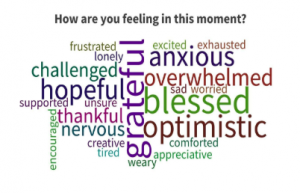
In the midst of all that is going on, I wanted to check on District Teacher Leaders. So, I set up a web meeting with the South Carolina State Teacher Forum. In an effort to capture the feelings of each teacher we asked, “How are you feeling in this moment?” We created a Word Cloud to capture responses. As we watched the screen, the first word to appear was overwhelmed. That word grew larger and larger, indicating that many teachers had also typed overwhelmed. Then, all of a sudden, words like hopeful, blessed, and optimistic started showing up. In the end, the largest word that formed in the middle of the cloud was grateful. 

By simply giving ourselves a moment to share how we were feeling, it reaffirmed that we are not alone in this. Processing our emotions together resulted in a rejuvenating meeting. It is my desire that this Word Cloud created by teachers can serve as a symbol of hope and positivity for educators and families across our state and nation. A reminder that in this challenging time, we all need to take a breath, and use gratitude to center our lives.

Why Gratitude?

According to Harvard Health Publishing, “In positive psychology research, gratitude is strongly and consistently associated with greater happiness. Gratitude helps people feel more positive emotions, reduce stress, relish good experiences, improve their health, and deal with adversity.” As we continue teaching during COVID-19, let’s make gratitude part of our daily routine!

Here are a few tips to incorporate gratitude into your day:

1. Write or record messages of gratitude. Thank those who are working daily to ensure children are fed, such as bus drivers and cafeteria workers. Thank people on the frontlines during this pandemic, such as healthcare workers, first responders, and essential workers. Last but not least, thank teachers, students, family members, and friends. Try leaving notes or sending messages once or twice a week.

2. Make a wall of gratitude. Use notecards, post-it notes, colored paper, or any paper that you have around the house to display what you are grateful for. Make it a family activity or part of your virtual class agenda.

3. Practice gratitude while washing your hands. During this crisis, it is recommended that we wash our hands frequently. So while washing your hands, begin to mentally express gratitude for people who have done something nice for you, your loved ones, or those helping others in need.

4. Practice mindfulness or pray with gratitude. During your quiet time, whether it is at the start of your day or end of the day reflection, make time to include what you are thankful for. My mom calls this counting your blessings.

5. Make gratitude part of your daily lessons with your family and students. During COVID-19, many companies have offered free resources for educators and families. Take a moment to check out the suggested resources and activities below to start your journey.

Educator and Family Resources: 

31 Benefits of Gratitude– (includes a science-backed guide to gratitude)

What we do all day– Family Gratitude Activities (includes many activities for families)

Mercy House Global– Free Gratitude Bundle (includes 24 global lessons for families)

Happy Humble Homes-Thankful All Year Resources (includes articles and resources)

As we navigate these uncertain times instead of being overwhelmed by stress, anxiety, fear, worry, or doubt, choose to be overwhelmed with gratitude. I am grateful for all of the amazing teachers, parents, and guardians who are continuing to educate students each day. Hang in there, we are all in this together!

About the Author

Chanda Jefferson is the 2020 South Carolina Teacher of the Year and a Secondary Science teacher in Fairfield County School District.