If you are reading this, you are probably an educator like me; your expertise is in the field of education. As we studied to be teachers, we also had to take other courses as well and had to comprehend challenging texts in those courses. It’s possible that these texts looked like a foreign language at times; they did for me! Attaching meaning to texts in each discipline was unique, and hopefully, your teachers were like mine, where they combined disciplinary literacy practices with content area literacy strategies as a part of their instructional process. [In general, content area literacy is the use of reading strategies across disciplines to comprehend what you read in any discipline, such as how summarization is a skill that can be applied regardless of content or field] These strategies blend into disciplinary literacy as content-area teachers begin to adapt the reading strategies for their specific discipline so that students are reading and writing as experts. For instance, while students in all disciplines can annotate a text as they read, how they annotate, and the types of codes they use will differ based on discipline. So, where does this leave disciplinary literacy in my eyes, and what does this mean for education?
Too often, we misunderstand the similarities and differences between content-area and disciplinary literacy, with people thinking they are disparate terms. While content-area literacy strategies support student comprehension, disciplinary literacy practices guide students to read, think, and communicate like experts in each discipline. However, within the disciplines, texts are specialized; vocabulary is precise. Reading strategies must morph to meet the challenge of reading and engaging with these diverse texts to move beyond surface-level or basic comprehension. The ability to read and communicate as an insider of certain disciplines results from reasoning, sociocultural practices, and engaging in inquiry as appropriate to the discipline (Carnegie Learning, 2024). These abilities grow stronger with teacher support, and disciplinary learning is practiced as students engage in the process of learning. The result is that teachers aren’t telling students what to do, what to know, and what to think; they are giving students the resources to acquire knowledge and the opportunities to apply it in new situations.
Personal Reflection of my Childhood Learning
And while I know this information now, I did not always understand the need for content area and disciplinary literacy. Therefore, I decided to reflect on my literacy teacher’s journey, and I invite you to think about what you remember about your journey, too. For instance, did you listen to someone read to you? Did you tell your own story to go with the illustrations in a picture book? Did you sing the alphabet and then match sounds with letters representing that sound? A healthy balance of these actions develops decoding and comprehension proficiency in the primary grades.
I learned about purposeful reading in the upper elementary grades—for entertainment or information. The text changed format, and its complexity grew. The way I read changed depending on what I was reading. My teachers modeled reading strategies for learning key vocabulary terms and for remembering complex concepts. Some teachers modeled unique practices specific to the discipline.
Personal Reflection as a Teacher Educator
Moving forward in my reflection, I reminisce about my teacher-educator experiences and consider the necessity of blending content area and disciplinary literacy so that all students can engage with their learning.
For almost ten years, I taught a required literacy recertification course, Content Area Literacy for Middle and High School Teachers. Ironically, I was also teaching college students who had graduated from high school and were underprepared for English Composition or College Algebra. I found myself working to develop literacy proficiency from two perspectives. It was enlightening. My college students demonstrated a lack of basic comprehension of text (content-area literacy); my in-service teachers taught through PowerPoint presentations, not expecting students to engage in a wide variety of complex text or purposeful learning that is part of the discipline (disciplinary literacy). Their students were graduating with the information teachers had vetted, not the ability to acquire and construct information independently.
About partway through those years, I became acutely aware that my teachers’ course was too focused on content-area literacy and not giving disciplinary literacy the attention it deserved. I had begun searching for a new textbook; the recent publications no longer used the two terms synonymously. My approach to content area reading and writing needed to make this change also. I began to differentiate content area literacy from disciplinary literacy with my in-service teachers while maintaining a blended approach using both. At the same time, my college expected me to teach integrated reading and writing to my underprepared college students as preparation for the discipline-specific texts they would encounter in their programs of study. I needed to blend the reading process, the writing process, content area literacy, and disciplinary literacy into an instructional model for constructing meaning from a wide variety of texts, both print and nonprint, for a wide variety of disciplines.
Disciplinary Literacy in Action
It appeared to me that many of my college students lacked the background knowledge and prior experiences to approach complex, disciplinary texts. We used class time for discussions, building shared knowledge to attack complex text. I layered key terms onto students’ vocabulary as they “read” images and other appropriate nonprint texts I had curated to elicit discussion. I guided their responses with open-ended questions, urging students to view the topic as an expert: Who might use this information? For what purposes?
Our primary reading source was an anthology of disciplinary texts: art, chemistry, history, psychology, biology, and literature. Students could apply content-area strategies while reading independently to grasp the general understanding of what they were reading. They discovered that reading diagrams was important in chemistry, timelines in history, examples or case studies in psychology, figurative language in literature, and images in art. Each discipline also carried its own key terms; familiar words took on new meanings appropriate to the discipline.
Responding to the text in each discipline became more than a test or writing a summary. Again, I used an open-ended question to guide students’ responses; what will you do with your new knowledge? Their thoughts, connections, and curiosities provided opportunities to demonstrate their understanding of real-world situations. According to Angela M. Banks, a doctoral student at Central Connecticut University, reading proficiency and disciplinary knowledge go beyond comprehension; they require complex skills: analysis, synthesis, organization, and evaluation (2024.) These skills are evidence of disciplinary literacy.
The Takeaway
My “underprepared” college students may have missed the high school experience of engaging in disciplinary literacy across their classrooms. They may or may not have been using content-area literacy strategies to gain a general understanding of a text. However, my class taught them how to blend the two to be more proficient college readers and writers. Providing this experience prepared them to construct meaningful information through complex text. Content-area literacy doesn’t end as disciplinary literacy begins; it blends into disciplinary literacy as students build competence and confidence to think like an expert.
Because the term disciplinary literacy is ever-evolving, I encourage you to return often to LiD’s blog as its writers continue to explore disciplinary literacy and what it looks like in the required and elective courses that students are choosing.
For additional information on the difference between CAL and DL, I refer you to
After over 20 years in higher education, Charlene Aldrich officially retired in 2024. She remains connected to the literacy community through Literacy in the Disciplines, 6-12; she spends her spare time at Pet Helpers in Charleston, SC, a no-kill shelter for fostering and adopting dogs, cats, and small animals.
In 2021, while teaching 5th grade in an elementary school in North Carolina, the Science of Reading movement took over NC. From 2021 until 2023, I was required by the state to complete the two-year-long LETRS (Language Essentials for Teachers of Reading and Spelling) program by Lexia Learning. While many teachers grumbled about the intensive training, I was often the positive one saying that I enjoyed the training and had learned so much from it. I was amazed at the story of how Mississippi drastically increased their reading scores after teachers completed this training and implemented it in their elementary classrooms. Hearing this information from esteemed scholars, I was optimistic about what this could do for NC schools. Unfortunately, I had fallen prey to the narrative that the LETRS way is THE only way.
Flash forward two school years, and I am now a Certified Reading Specialist working in a middle school with readers in grades 6-8. I earned a Master’s Degree in Reading and Literacy Education which taught me to research for myself. Through my program, I learned about the Reading Wars that have been going on for decades, which frequently change how reading is taught in elementary schools and how this feeds into middle school (like using the Science of Reading approach to help those who are not on grade level). However, before taking masters courses, I had not previously learned to question things and read about both sides, at least not when it came to recommended instructional practices. I listened to what I was told to do by my peers and administrators and went with it (and let’s be real, I still do in many ways since I want to keep my job, but I do it with a new outlook and include other practices, too). I trusted what I was told by those at higher levels than me, like most of us do. I think very highly of those who work above me and didn’t stop to consider that they were also doing what they were told.
So, what is there to question about the Science of Reading? Dr. Paul Thomas of Furman University states in his article series We Teach English in Times of Perpetual Crisis, that “Currently, no peer-reviewed, experimental/quasi-experimental studies show LETRS training improves student achievement in reading” (2024, pg. 16). Additionally, much of the research shared at the training connects to the founders and funders with only a few external data sources and studies. This is important if the goal is to say that one type of reading instruction, documented by the science of data exploration and analysis, is better than others.
That is not to say that LETRS is all bad. There are some GREAT pieces of information and strategies used in LETRS. For instance, LETRS taught me teaching cohesive devices to connect ideas in complex sentences, explicit vocabulary strategies, and comprehension strategies that can be used in upper elementary and middle grades. However, and this is a big revelation here, I have come to realize that this does not mean it is right for every student, in every classroom, across all grade levels. LETRS often provides a one-size-fits-all approach to teaching reading, and this is not an equitable way to teach all students who may or may not need all aspects of LETRS instruction. I also wonder about the types of texts emphasized in this program and how that impacts all students. Only using decodable texts that match a phonics lesson leaves out the opportunity for using culturally responsive texts that reach and reflect diverse students and their experiences, especially when thinking about this implemented through the middle grades. These lessons often do not consider linguistic diversity such as various dialects or accents, either. And, I dare say they even leave out our more advanced readers who do not need repetitive phonics daily. Therefore, I am learning how to question things, even when they sound good at first, and to explore potential biases with an awareness that I need to use critical literacy skills when I read articles and research all things connected to reading and the Reading Wars..
Through conversations about this topic with a friend, I started thinking about how I teach my ELA classes. Sure, there may be some strategies that LETRS taught me that are beneficial to some students, but there is much more that needs to be taught, especially at the secondary level. There are countless articles out there about the best way to teach reading (hence, the term ‘Reading Wars’ that indicates the back and forth of this), but the truly best way (in my humble opinion) is to take a little bit from everything. From my experience, teachers in the schools I have worked in ARE doing this! We read books, teach morphology, vocabulary, comprehension strategies, how to understand things in context, and more, intentionally thinking about the content and standard requirements and the students sitting in our classrooms. When it comes down to it, teachers are doing what they are supposed to be doing…which brings me back to the Science of Reading movement. One of Dr. Thomas’s main concerns with the Science of Reading is how it paints a narrative of ineffective teachers and takes away teacher autonomy. While the phonics-based LETRS, one enactment of the Science of Reading movement, may benefit K-2 classrooms, upper elementary may be better off using a more differentiated approach. Of course, it depends on the make-up of students in the classroom, and that’s where our teacher expertise comes in. We know our students. We know what works best for them, and we should be trusted to teach them in an equitable manner using a variety of approaches that cover all aspects of reading.
At this point, you may wonder why I wrote this blog post, as it shares my story of learning. I hope to encourage teachers to research for themselves when new policies and initiatives are introduced in their state. This is not to say to go against them but to teach with an outlook that understands both sides of the coin and multiple narratives regarding what works best for your students. Being informed on the good and the bad of policies set into place by others will allow us to teach with an equitable lens for all learners.
Olivia Moore works at East McDowell Middle School as a Reading Specialist. Her undergraduate and Master’s degrees are from East Carolina University – Go Pirates!! Her passion is reading, and she is determined to help all of her students feel confident with reading. Those who don’t enjoy reading just haven’t found the right book yet!
Literacy extends beyond English Language Arts (ELA) classrooms—it’s essential in every subject, from science to history, math, and the arts. Disciplinary literacy focuses on equipping students to read, write, and think like experts in each field. By integrating discipline-specific literacy strategies, we enhance student learning across all subjects. To support this, we can leverage Diane Sweeney’s Student-Centered Coaching Model, which shifts the focus from simply delivering content to achieving specific student outcomes.
But how can instructional coaches effectively guide teachers in incorporating disciplinary literacy strategies? By blending Student-Centered Coaching with co-planning, co-teaching, and insights from experts like Jim Knight and Elena Aguilar, we can create a powerful framework for elevating literacy instruction across disciplines.
What is Disciplinary Literacy?
Stephen Sawchuk in Education Week (2024) suggests that the concept of disciplinary literacy extends beyond simply reading and understanding the vocabulary associated with each content area. Implementing disciplinary literacy practices equips students with the skills needed to navigate and interpret the texts and concepts unique to each academic discipline. In an interview with Sawchuk, Tim Shanahan described disciplinary literacy as “the recognition that each field has a different body of text and different types of text that readers have to read, and that readers really have to have a different stance,” highlighting the need for specialized approaches to literacy. This goes beyond general reading comprehension; it’s about empowering students to approach science like scientists, history like historians, math like mathematicians, and art like artists. Each discipline has its own language, ways of thinking, and methods for analyzing and communicating ideas.
For example, scientists prioritize precision and evidence, historians emphasize sourcing and perspective, mathematicians focus on logical reasoning, and artists explore symbolism and creative interpretation. In ELA, students dive into analyzing themes, character development, and literary devices.
To effectively implement disciplinary literacy, educators must adopt approaches that prioritize student learning and mastery of discipline-specific skills. This is where good instructional coaching models become invaluable in driving meaningful progress.
Using Student-Centered Coaching to Drive Disciplinary Literacy
Diane Sweeney’s Student-Centered Coaching Model focuses on student learning rather than teacher performance. In this model, coaching centers on student work, using it to inform and guide the instruction provided by the teacher. It emphasizes setting student-centered goals, utilizing data to drive instruction, and measuring progress based on student outcomes. When applying this approach to disciplinary literacy, the question shifts from “What strategies can we teach?” to “How can we ensure students master the literacy skills specific to each discipline?”
To make this model actionable, we can draw on the coaching stances, dispositions, and stems from Jim Knight and Elena Aguilar to guide our work. This approach allows us to blend these frameworks in a way that supports teachers in integrating disciplinary literacy across content areas. This link provides steps for Instructional Coaches to co-plan and co-teach with student-centered disciplinary literacy goals and various coaching approaches and dispositions in mind. This link provides possible Disciplinary Literacy coaching questions organized by discipline.
In his interview with Sawchuk, Tim Shanahan shared his experience co-teaching with a laboratory science teacher, highlighting the overwhelmingly positive response from students. To create similar positive learning moments, let us now explore specific examples of how disciplinary literacy can be applied across different content areas to enhance student learning through the Student-Centered Coaching Model.
Disciplinary Literacy Lessons Across Content Areas
1. English Language Arts (ELA): Analyzing Themes and Literary Devices
Student-Centered Goal Example: “Students will analyze how authors use literary devices to develop themes.”
Lesson Idea: Use Ray Bradbury’s The Pedestrian to explore symbolism. Co-plan a close reading where students annotate for the various literary devices and discuss their impact on the theme of isolation.
Coaching Tip: Co-teach by modeling a think-aloud on identifying literary devices, then observe students as they practice the skill. Co-teach by modeling a think-aloud on word choice and its impact on theme then observe students as they practice using the assigned text.
2. History: Evaluating Primary Sources
Student-Centered Goal Example: “Students will analyze primary sources for bias and perspective.”
Lesson Idea: During a unit on the American Revolution, co-plan a lesson where students compare the Declaration of Independence with Loyalist responses.
Coaching Tip: Use a “One Teach, One Coach” approach. While the teacher leads a primary source analysis, the coach observes how students identify bias while progressing toward the learning target.
3. Science: Reading Technical Texts
Student-Centered Goal Example: “Students will extract key information from scientific articles.”
Lesson Idea: Co-plan a jigsaw activity where students read and summarize sections of a text on ecosystems, becoming “experts” on different parts. The students will then use a Claim, Evidence, and Reasoning graphic organizer to show their understanding of ecosystems.
Coaching Tip: Team-teach to model strategies for decoding complex vocabulary and text features and model how to write high-quality, scientific claims.
4. Math: Using Academic Vocabulary
Student-Centered Goal Example: “Students will use precise mathematical language in their explanations.”
Lesson Idea: Co-plan a lesson where students write about their problem-solving process using specific vocabulary.
Coaching Tip: Model how to incorporate academic language in explanations, then provide feedback as students practice.
Final Thoughts
By centering our coaching on the Student-Centered Coaching Model and incorporating insights from Jim Knight and Elena Aguilar, we can create a collaborative and empowering approach to disciplinary literacy. Knight (2019) emphasizes that, while collaborating with a coach, teachers should maintain significant autonomy over their learning. This allows teachers to engage meaningfully with their curricular goals. Additionally, Aguilar (2016) asserts that coaches should prioritize listening and allow teachers to drive the conversation. Through co-planning, co-teaching, and focusing on student outcomes, we ensure that literacy skills are integrated across disciplines, fostering deeper learning and student success.
Let’s continue to unlock the power of literacy across all classrooms—one co-planned lesson at a time. Happy coaching! If you would like to see a sample coaching cycle rooted in disciplinary literacy, click here. If you would like to see ways coaches can reflect on coaching practices that best support teachers in “making it stick,” read this blog.
Sweeney, D. (2011). Student Centered Coaching: A Guide for K-8 Coaches andPrincipals. Thousand Oaks: Corwin Press
About the authors:
Dr. Wanda Littlejohn has 24 years of experience in the field of education. Currently, she is an Instructional Specialist at Carolina High School where she provides ongoing support and professional development for teachers.Dr. Fran Rogers is an experienced educator in Greenville, SC with a diverse background in middle school and high school education. She has served in various instructional positions at the school and district levels, including classroom teacher, instructional coach, and Secondary Academic Instructional Specialist.
I started teaching high school biology midway through the 2009-2010 school year after completing the first semester of an alternative certification program for those hoping to teach in Chicago Public Schools (CPS). While this program eventually led to a master’s degree, I entered the classroom as a new teacher with no student teaching experience, and what can best be described as a crash course in education. I immediately adopted the grading policies of the teacher I replaced and continued using those policies for the next full school year. During this time I had very few conversations about grading. Nobody spoke to me about how to determine letter grades, which assignments to grade, whether or not to curve a test. I was flying solo until the building administration asked all departments to come to a consensus on grading policies. At this point, the science department decided not to accept any late work for a grade, and we justified this by saying students needed to be prepared for class, especially for lab work. If students did not complete prelabs on time, there was no point to doing the work after the lab. Looking back at this policy now, I want to cringe and shake myself.
My students at this time were freshmen, just making the transition into high school, and many of them traveled long distances to get to school. I taught at a selective enrollment high school, where all students had to pass an entrance test for admission and all classes were at the honors or AP level. Teachers in the building often justified rigid grading policies as “rigorous” and appropriate for the selective enrollment environment. However, many of us failed to consider who our students were outside of school. The high school was located on the far south side of Chicago but pulled students who qualified for a selective enrollment school from all parts of the city. CPS, however, did not provide transportation for these students. Students either needed to be driven by family, or they needed to use the CTA buses and trains to get to school on their own. It was not abnormal for student commutes to and from school to be over an hour long. Often this commute was done after students completed their after school sports, clubs, and other activities, leaving less time for students to complete school work at home. This school was a Title I school – most of the students received free or reduced lunch, and many had parents who worked multiple jobs or second- or third-shift jobs, leaving them home by themselves. And since all classes were at the honors or AP level, many teachers regularly assigned large amounts of homework, leaving students with hours of homework to complete each night.
This all started to change with a new building principal who started the 2012-13 school year by asking us what we think grades should mean and communicate to students and their families. We came to the agreement that grades should reflect what students know and can do in class. Then he asked us if that was what our grades actually showed. If a student forgets to do their prelab, but comes to my class and performs the lab activity perfectly and completes all the postlab work, should their grade reflect the missed prelab? Had I ever talked to my students about why they didn’t complete the prelab? Or why they had other missing assignments? The questions kept pouring in and I had no answers, at least no good ones.
These conversations continued all year at our building-wide meetings and the following year led to a pilot group of teachers testing out equitable grading practices that were modeled off of Standards Based Grading techniques. I have been using many of these grading policies for nearly a decade, and they have changed not only how I grade, but also how I talk to students about school, and how I talk to students about their lives. There are seven equitable grading policies that I use in my classes.
Standards-based learning objectives are provided each day to inform students of the expectations for class and the criteria for success (Guskey & Jung, 2009; Shippy et al., 2013).
Smaller formative assessments are given each time a standards-based objective is completed; some take a day, some take a few days to cover (Butler & Nisan, 1986).
A unit tracker is provided at the end of each unit for students to record their summative assessments, their mastery score on each, and determine their retake needs (Feldman, 2019; Iamarino, 2014).
I plan ahead for one retake day for each unit assessment to occur during class time after students receive their retake practice work (Feldman, 2019; Iamarino, 2014).
I do not assign homework. My courses are structured so that students have time during the class period to complete the necessary work (Feldman, 2019).
I provide ungraded formative assessments to students prior to summative assessments. These formative assessments are only used to provide students with feedback on their learning (Iamarino, 2014).
I provide students with rubrics for all summative projects and labs (Feldman, 2019).
These grading policies are more equitable for several reasons. First, they remove some implicit bias. I am a middle-class white woman from the suburbs of Chicago. I have never looked like the majority of my students. If I included things like effort, participation, or behavior in my grades, this could be impacted by implicit bias (DeCuir & Dixon, 2004). Next, by not including homework as a grade, I remove bias my students might face if they don’t have the time, space, or support at home to complete the homework. Those are things outside the control of students, and when we include homework in their grade we are grading them on social and familial structures they have no control over (Feldman, 2019; Ladson-Billings, 1995). I also provide them with information on what success looks like, and how they are progressing towards that goal (Guskey & Jung, 2009; Shippy et al., 2013). I give students the opportunity to demonstrate their learning more than once and provide additional time and opportunities for students who need them (Feldman, 2019; Iamarino, 2014). Every student can learn, but they don’t all learn the same way or at the same pace. Providing more individual support for students can help more students to achieve academic mastery (Ladson-Billings, 1995). I have found this last point to be the most important for me, especially in my current role. I teach many English Language Learners who are not only learning biology, but also how to read, write, speak, and understand a new language. If I were to simply grade a test and move on, many of my students would continue to struggle, not only in biology but also with their language learning. By incorporating practice work and test retakes, students are given the time and support to continue learning the content, but also the language objectives that are tied to the content. For example, my students are getting more practice with reading scientific texts, using data from a graph or figure to answer questions, or being able to justify a conclusion based on data. These are skills that they will use in every science class and are language-heavy. Giving them the opportunities to continue to master these skills makes them better at biology, but also more scientifically literate and better citizens.
References
Butler, R., & Nisan, M. (1986). Effects of no feedback, task-related comments, and grades on intrinsic motivation and performance. Journal of Educational Psychology, 78(3), 210–216. https://doi.org/10.1037/0022-0663.78.3.210
Decuir, J. T., & Dixson, A. D. (2004). “So when it comes out, they aren’t that surprised that it is there”: Using critical race theory as a tool of analysis of race and racism in education. Educational Researcher,33(5), 26-31. doi:10.3102/0013189×033005026
Feldman, J. (2019). Beyond standards-based grading: Why equity must be part of grading reform. Phi Delta Kappan, 100(8), 52-55.
Feldman, J. (2019). Grading for equity: What it is, why it matters, and how it can transform schools and classrooms. Corwin.
Guskey, T. R., & Jung, L. A. (2009). Grading and reporting in a standards-based environment: Implications for students with special needs. Theory Into Practice, 48(1), 53-62. doi:10.1080/00405840802577619
Iamarino, D. L. (2014). The benefits of standards-based grading: A critical evaluation of modern grading practices. Current Issues in Education, 17(2), 1-12
Ladson-Billings, G. (1995). Toward a theory of culturally relevant pedagogy. American Educational Research Journal, 32(3), 465–491.https://doi.org/10.3102/00028312032003465
Shippy, N., Washer, B. A., & Perrin, B. (2013). Teaching with the end in mind: The role of standards-based grading. Journal of Family & Consumer Sciences, 105(2), 14-16. doi:10.14307/jfcs105.2.5
About our Author
Laura Boyle, Ed.D Joliet Central H.S., Joliet, IL
Dr. Boyle is a recent graduate from the University of South Carolina Educational Practice and Innovation program with a STEM concentration. She has 15 years experience teaching life science courses including Biology, Environmental Science, and Anatomy. She taught for eight years in Chicago Public Schools and has spent the last seven years at Joliet Central High School. All of her experience is at Title I schools, serving students who are traditionally underrepresented in STEM fields. She has been working to implement equitable grading practices in her classroom for nearly 10 years and completed her dissertation on the impact of equitable grading practices on student outcomes and biology self-efficacy, for which she was the recipient of the 2024 Outstanding Achievement in STEM Education Doctoral Award.
Olivia Moore sheds light on the relationship between instruction, standardized testing, and equitable assessment in her blog this week. She will be a member of the panel featured in our upcoming webinar. For more about Olivia, see below.
As teachers, we sometimes feel we don’t have a say in the summative assessments we give, such as those meant to evaluate learning like an end-of-chapter test. Doing what we know is equitable can be difficult when so much rests on standardized test scores. This, in turn, leads to the belief that the assessment content is more important than learning and the information gathered from formative assessments that inform our teaching (Elish-Piper et al., 2022). This is dangerous because, as we know, teaching “to the test” is inefficient, inequitable, and often not enjoyable because it can lead to removing teacher autonomy and limiting what we can do with our students – think drill and kill teaching instead of teaching based on students’ interests and needs.
The Center for Enhancement of Learning and Teaching at Tufts University defines equitable assessments as “the on-going activities that allow students and instructors to understand student progress on meeting the course learning objectives” (Tufts, 2022). Therefore, to truly be equitable in our assessment practices, we need to focus on meeting the needs of all learners while we teach, gathering data through formative means, such as observations and conversations, during teaching. Additionally, we need to gather diagnostic data across a multitude of assessments every lesson, unit, month, and even across the year. You may be wondering what we need to do to make our assessment practices and teaching more equitable when we must use standardized, one-size-fits-all assessments that are only snapshots of student learning and not very accurate, with many wondering if they are even ethical. Below, I share a few things I consider and reflect on when I meet my students before and during assessments across the school year.
Get to know your students.
Knowing your students is the first step because if we want to understand what our students know or don’t know, we need to know them as people. We must understand and care about their identities. That is, who they are, what they think about themselves, and their funds of knowledge (Muhammad, 2020). The National Board for Professional Teaching Standards (NBPTS) states that accomplished literacy teachers use their knowledge of children to differentiate learning experiences for students (NBPTS, 2012). With that said, if we know we need to differentiate instruction, why don’t we differentiate assessments, too? If you know that Sally loves snowboarding, giving her a biography of a famous snowboarder for her comprehension assessment may align more with her interests, which impacts her motivation to read, ultimately, a part of creating equitable assessments. When students have more background knowledge on a topic, we can better see what they comprehend from the text (Fisher & Frey, 2020).
Get to know what you are assessing.
Using engaging texts within instruction is a start. However, we also want to consider how we assess students’ learning and if the assessment considers what a student already knows, capitalizing on students’ strengths to gather data on their needs. Let’s look at Carter. Carter is extremely bright, but his written expression and spelling are considered behind or low for a typical middle schooler his age. Students are required to engage in research and then share their learnings. Carter’s facial expressions and fidgeting show that he is stressed, possibly because this typically means writing a report, and he struggles with writing. If we want to reflect on the intent of the assignment, for students to demonstrate their learning, possible assessment modifications include Carter using a dictation program on his device to type for him, recording a video of himself sharing the information, or even reporting to you orally. Another potential modification comes in the form of what he writes. Carter loves rap music and did very well in the poetry unit. Therefore, maybe Carter would enjoy sharing his findings by creating his own rap song. This will allow Carter to demonstrate putting thoughts in writing and synthesizing information into a composition, aligning with concerns he isn’t writing. No, he may not be writing a research report, but he is writing. We always want to come back to what we mean to assess with the assignment or project. Is the goal to assess his ability to write words down on paper or his ability to research and put coherent thoughts together? Were you intending to assess spelling or his ability to share his learning? Assessment doesn’t always have to look “traditional”; it needs to align with the task at hand. If the goal for Carter is to research and synthesize information, then how he shares his learning doesn’t have to be in a written report.
By creating assessments that center students’ interests and strengths, the process builds confidence and efficacy. Carter used what he knew and loved, rap, to build from a starting point and then showcase his learning. This centers his growth versus what he can’t or won’t do, such as asking him to write a report or another assessment that would cause Carter to shut down. Therefore, when we create assessments, we want to think about the purpose of it and determine if it is designed to simply give a score or to inform how to support students’ learning better. Requiring Carter to write a research report or take a test may assess his learning; however, only the one that aligns with his interests is equitable for Carter.
Getting to know your biases.
While we all try not to make assumptions about our students, it is important to consistently reflect on how we learn about each and every student who steps into our classrooms. It is crucial that we only assume to know a child after getting to know them. Perhaps you have a special education student or an English Language Learner on your roster. Don’t assume you know who they are and what they can do because of a label given to them by someone else; it could impact how you teach them (Savitz & Kane, 2023). Think about Carter again. When Carter steps into your classroom, it could be easy to make assumptions about his reading and writing abilities. However, if you take time to get to know him and what he likes and excels in, where he is comfortable, and consider his strengths, you can create assessments to support his success in ways that work for him, such as changing how he demonstrates his learning. This is not just for Carter, though: Do this for ALL your students! Let them come in fresh each year. Don’t listen to the teacher in the grade below who talks about what a troublemaker Samantha is. Talk to Samantha yourself and get to know her yourself, and then consistently pay attention to her during instruction to formatively assess what she needs.
Getting to know students as people and not one test.
Lastly, remember that one test does not define a student’s capabilities or yours as a teacher. Even the code of ethics in those thick test training books says that making standardized test scores the only indicator of how well a student is learning is unethical. By gathering lots of ongoing data and creating more equitable assessments across the year, you will know (and be able to share with students and parents) the growth a child has made, regardless of their end-of-the-year test score. This positivity is needed when the stress of state testing starts to make our students feel like they aren’t smart enough to pass, when they may just not be good at taking a standardized assessment that isn’t equitable.
It is up to us to plan classroom assessments through an equitable lens. Therefore, I leave you with the following quote to ponder:
“As we shed our respective sources of blindness, perhaps we can envision a transformation in literacy assessment theory and practice, one that supports the pursuit of equity, opportunity, and rich learning.” – David Slomp and Bob Broad in Monsters, Inc.: Curing Ethical Blindness in an Era of Test-Based Accountability
References
Childress, J., Backman, A. C., & Lipson, M. Y. (2019). Reframing Literacy Assessment: Using Scales and micro‐progressions to provide equitable assessments for all learners. Journal of Adolescent & Adult Literacy, 63(4), 371–377. https://doi.org/10.1002/jaal.1016
Elish-Piper, L., Matthews, M. W., & Risko, V. (2022). Reading assessment to promote equitable learning: An empowering approach for grades K-5. The Guilford Press.
Fisher, D., & Frey, N. (2020). Improving adolescent literacy: Content area strategies at work (5 ed). Corwin.
Muhammad, G. (2021). Cultivating genius: An equity framework for culturally and historically responsive literacy. Scholastic.
National Board for Professional Teaching Standards. (2012). Literacy: Reading–Language Arts Standards. Author.
Slomp, D., & Broad, B. (2020). Monsters, inc.: Curing ethical blindness in an ERA of test‐based accountability. Journal of Adolescent & Adult Literacy, 64(2), 232–235. https://doi.org/10.1002/jaal.1077
Olivia Moore works at East McDowell Middle School as a Reading Specialist. Her undergraduate and Master’s degrees are from East Carolina University – Go Pirates!! Her passion is reading and she is determined to help all of her students feel confident with reading. Those who don’t enjoy reading just haven’t found the right book yet!
Kristie Camp continues to answer this question as she expands on the benefits of outdoor learning an environmental literacy. Read more about Kristie at the end of her blog.
Amanda (names changed) was not happy that we had brought the turtle back into our classroom, despite most of the class being excited about the prospect of having a class pet. She wrote in her journal that day, “I felt that we should have put him back, because didn’t we talk about how humans are messing up the environment this week while reading the whale shark chapter in World of Wonders? I really do hope we don’t mess this turtle caring business up.” Our weekly walks in the woods and the book we were reading together must have made a lasting impact on how Amanda viewed her role as an environmental steward. The rest of the class conceded she was right, and within a few days, we all participated in a rehoming ceremony for our turtle.
Studies have shown that positive experiences in nature develop long-lasting affective associations with the natural world, which often times translate into activism and advocacy for environmental causes (Křepelková, et al., 2020; Soga & Gaston, 2024). As a veteran teacher of 26 years in high school English language arts (ELA), I have found that outdoor learning not only serves as a powerful conduit to creative thinking and cooperative action, but it also lays a solid foundation for environmental literacy, as Amanda and her classmates demonstrated with returning the turtle to his home.
When I use the term environmental literacy, I refer to an individual’s ability and willingness to make ethical and research-based decisions about their environmental choices, as well as their desire to conserve natural resources (California, 2015; MAEOE, 2024; NAAEE, 2024). Environmental literacy does not manifest itself only at the individual level; it is also a cooperative and collective move toward learning how to participate in civic life for the good of all living creatures (California, 2015; MAEOE, 2024; NAAEE, 2024). Teachers who provide opportunities for cooperative learning outdoors foster those affective connections that just might grow into cooperative action toward sustainability that benefits us all.
As children grow older, their time outside seems to diminish. Students today have spent less time playing outside than previous generations (Schilhab, et al., 2018; Selhub & Logan, 2012; Williams & Wainwright, 2016; Zeng, et al, 2021). The less time students spend outdoors corresponds with an increase of time spent behind screens (Barrette, 2022; Jackson, et al., 2020). The increased time behind screens instead of outside has implications for teens’ academic progress and their overall wellbeing (Hicks, et al., 2021; Kuo, et al., 2018). Increased screen time paired with fewer opportunities for spending time outside and with others has contributed to rising mental health challenges and physical ailments for teens (Abenes, 2022; Barrette, et al., 2022; Hedderson, 2023) as well as a reduced ability to concentrate and more difficulty communicating with peers socially (Abenes, 2022; Nadeem & Van Meter, 2023). In addition, digital immersion has often lured students into relying too heavily on artificial intelligence to the detriment of their own originality and creativity (Daniel, et al, 2023; Zhao & Watterson, 2021).
Engaging with the physical environment and interacting with nature through multiple senses offer ways to mitigate some of the detrimental effects of too much screen time, and outdoor learning can benefit teens’ health and academic progress. Outdoor spaces are conducive for sensory experiences and creative activities that incorporate artifacts within the setting (Asfeldt, et al., 2020; Beames, et al., 2012; Quay & Seaman, 0216; Selhub & Logan, 2012). Lessons that reconnect students with the physical world and its artifacts offer sensory experiences that employ both cognitive and kinesthetic processing, thereby providing a more memorable and meaningful learning experience. If the context of the classroom expands so that students interact in a tactile way with the physical world that surrounds them, then their attention turns outward, opening the way for creative and imaginative expression simply because they have new physical experiences from which to think and create (Beames et al., 2012; Carpenter & Harper, 2016; Quay & Seaman, 2016). It also opens the way for environmental stewardship as students first learn to love their local landscapes, and that love often spurs protection advocacy for broader ones.
During our outdoor adventures, Amanda reminded us that we needed to leave Gerald the turtle in his natural habitat, but Jake taught us about his early childhood in the Philippines and told us stories about how he and his cousins would put spiders on a stick to see if they would fight.
Several of us responded in disbelief: “You didn’t really pick up spiders and put them on a stick, did you?”.
“Yes, we did. Let me show you,” Jake replied.
Within a few minutes he had a spider on a stick and had us looking for a companion to place beside it. About three of us leaned in, not blinking, as Seth placed a smaller spider within inches of the larger one. We didn’t even have time to pull out our phones to start filming before the larger spider whipped out its web and wrapped the smaller one into its death blanket.
After our exhalations of astonishment and awe, we began to toss questions at Jake about his childhood. “We didn’t know you were born in the Philippines! When did you come to the US? Do you speak another language?” Jake kindly told us about his family in the Philippines and his move to the United States in elementary school. In his journal that day, he wrote about how that day’s experiences brought back memories he hadn’t realized he had forgotten. The rest of us walked away with a little more thorough understanding of each other. We were able to relate to the natural world in ways unique to our cultural experiences, which created a more democratic and cooperative learning environment for us all.
Before I share more examples from our outdoor classroom, I must acknowledge the privilege that I enjoy. Our school has numerous places for outdoor lessons — courtyards, access to the track and practice fields, and a wooded area across the street from the school where the cross-country team runs — and my current and previous principals have encouraged my use of our green spaces. I understand that not all teachers have access to safe outdoor spaces and supportive administration, but just about any outdoor space can be made into an engaging classroom, and I hope researching the benefits of green spaces in schools will fuel the movement to provide outdoor learning space for all students.
Here are some ways I have found to take class outside for numerous benefits, including participating in memorable content lessons, building classroom community, and cultivating environmental literacy. Of course, the examples come from an ELA class, but the process is easily adaptable to just about any discipline.
String Journals
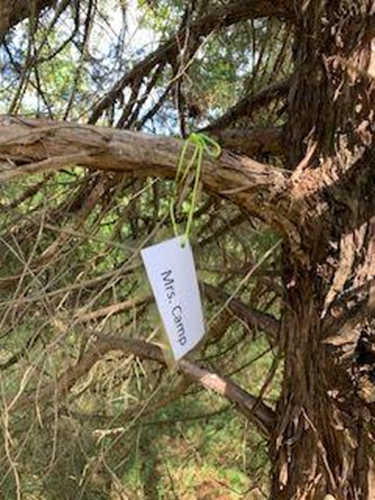
I learned about string journals when I spent a week studying Thoreau at the Walden Woods Project in their summer program, Approaching Walden, in 2019. I took what I learned and adapted it for my class in the fall of 2020. I printed and laminated a name tag for each student and attached a waterproof twine.
Students found a place in the woods where they wanted to return throughout the semester, and they hung their tags there. Each time we went to the woods for an outdoor lesson, we began with a moment of observation and writing at our string journal spots. By the end of the semester, students had a time-lapsed set of descriptive writing that detailed changes in the spot from August to December. This lesson works for writing instruction as easily as it will for scientific notetaking or geological study. Students can practice sketching and documenting the environment as a professional naturalist, archeologist, or geographer might.
Photo Essays
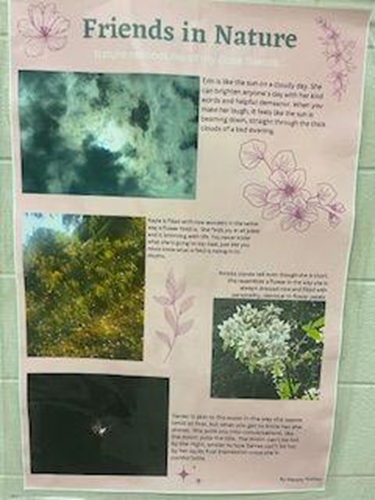
Students can create a photo essay (such as in the model of Humans from New York, for example) from images taken while outside around campus. Students learn to select images carefully for symbolic purposes while making the most of limited written text space. The content of photo essays is dependent on the content being taught (for example, artistic expression or documentation of natural change over time) and therefore adaptable for any discipline. Social studies classes might focus on natural resources or local history, whereas world language classes might center vocabulary acquisition.
Art Collections, Collages, and Memory Jars
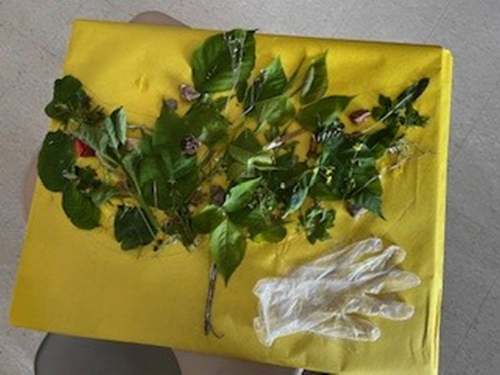
While outside, our class has collected interesting artifacts from the woods including a mysterious jawbone, persimmons, and unique leaves and wildflowers. Students have also brought back live creatures – caterpillars, unknown white creepers, and our pet turtle – even though we cannot keep those as part of a collection. The collections represent students’ adventures outdoors, and a story almost always accompanies the item selected, which forms the basis for original writing, full of sensory imagery and emotive language that I don’t often see in their traditional classroom assignments. We have also made art collages from artifacts gathered outside and students articulated reasons for the items they chose to include, again extending their understanding of symbolism and metaphor.
Yet, a biology class might create a leaf collection to be labeled and categorized. A geology class might collect rocks and minerals for a similar display. A math class might collect examples of different shapes or different representations of the same angle or slope.
Using Aimee Nezhukumatathil’s (2020) example in her chapter, “Firefly Photinus Pyralis” in her nature memoir World of Wonders, In Praise of Fireflies, Whale Sharks, and Other Astonishments, we collected items from the woods to store in memory jars for our class as a way to commemorate our outdoor adventures together. What physical representations do we want to keep as memories of our shared experiences outside? These collections can also provide materials for a multimodal art display in an art class or indicators of geographical descriptors for one’s local environment (for example, what do we find in the woods that demonstrate we live in a foothills region?) in geography class.
Blood Pressure Checks
After reading an article about forest bathing and how spending time outside reduces people’s blood pressure, we decided to put the article to the test. Our school nurse graciously helped us by taking each student’s blood pressure before we went outside and again when we came in after our walk outside. We recorded the data anonymously and analyzed it; while our findings didn’t necessarily align with those in the article, the process of analyzing the data gave us a chance to critically analyze the article and consider reasons our results might not have aligned with those in the formal study. This activity fits just as well in a math, health, or science class as it does in an ELA class.
Nature Poetry
Studying mentor texts from professional nature writers provides us with a model for poetic language and symbolic representation. I include picture books as mentor texts, as well, and then encourage students to create and illustrate as they are inspired to do. Modern nature poets such as J. Drew Lanham, Ada Limón, and Aimee Nezhukumatathil provide accessible and representative poetry that inspires students to see beyond their cursory look at their school environment. Yet, students might also model scientific writing from professional naturalists and even film moments in nature following models of nature documentaries. The point is to create as professionals in the field create — whether that professional is a poet, an ornithologist, filmmaker, or a historian.
There are so many more opportunities for taking high schoolers outside for interactive learning, and the resource list I have provided here will spur many more new ideas. Regardless of the lesson, the magic of the outdoor classroom lies in students’ physical interaction with the natural environment coinciding with the shared experiences among classmates. Too often our classes seem almost virtual despite the number of bodies all sitting in a room together. Standardized curricula and mandated benchmarks tie us to screens, and the classroom itself comes with traditional expectations of what academic writing looks like and what acceptable school performance is defined as. By the time they reach their junior year in high school, many students have compartmentalized school behaviors and school literacies as quite different from their authentic lives and literacies. Too often this compartmentalizing results in stilted, perfunctory work within the classroom.
The outdoor classroom does not hold those same expectations, and without these expectations, students are free to pursue joint adventures and open themselves up to conversations and experiences. These small lessons that still fulfill requirements of curriculum standards have the potential to provide positive experiences with nature that form the affective connections later leading to activism and advocacy.
Taking students outside brings interaction with the material world, such as trees, animals, and plants, and this material engagement prepares students for self-reflective questions, such as
How are humans connected to the natural world?
What is my personal relationship to the natural world?
Do others see the natural world the same way I do? Why or why not?
What are my obligations to the natural world?
Strong memories developed through physical interaction with nature and shared experiences among classmates can be the starting point for meaningful place-based learning and environmental literacy, as Amanda taught us all when she urged us to leave our turtle in his natural habitat.
Ms. Camp is a PhD candidate in Language and Literacy at the University of South Carolina (USC). A National Board Certified Instructor, she has taught English Language Arts at Gaffney High School in Gaffney, SC, for 26 years. She has served as an AP English Assesser, a National Writing Project teacher consultant, and an adjunct instructor with Spartanburg Community College, Limestone University, and USC. She shared her experiences with outdoor learning in an article published in English Journal in 2023, and she was awarded a Teacher Researcher Grant from National Council of Teachers of English in 2024 to help fund her dissertation study that investigates the influence of an outdoor setting on high school students’ writing practices.
Flashback to our theme on Financial Literacy! Due to publisher error, Derrick Shepard’s blog was delayed. So, it is now time to hear how Dr. Shepard supports this quote by Jane Bryant Quinn: “No one is born with a mind for personal finances.” Read more about our author at the end of his blog.
Sit with the above quote for a second before moving on. What comes to your mind after you read it? What feelings are elicited? Does the quote speak to you, to the students you are trying to instill a sense of understanding of financial literacy?
The Organisation for Economic Co-operation and Development (2019) defines “Financial literacy as knowledge and understanding of financial concepts and risks, as well as the skills and attitudes to apply such knowledge and understanding in order to make effective decisions across a range of financial contexts to improve the financial wellbeing of individuals and society, and to enable participation in economic life.”
The definition is holistic, but it is important to remember that a person’s understanding of financial literacy rests in their knowledge, understanding, attitudes toward financial literacy, and skills to implement a plan that incorporates all three. Now, revisit your thoughts and feelings about the above quote. Did anything change?
There is no denying that individuals need a basic understanding of financial literacy to navigate this capitalist society. Understanding how one’s credit score can impact everything from mortgage rates to credit card rates to the amount you pay for automobile insurance can help save money for the future. As educators, it is incumbent upon us to teach the 3 Rs and relay life skills, including financial literacy, to our students to help them grow into productive and responsible citizens. But how do we do it?
Our students live in a 24-hour, 365-day-a-year social media cycle that never ends. They are bombarded with messages every time they pick up their smartphones, and financial messages (e.g., how to make money) are prominent in the messaging. What I call “salespeople” (and I am being kind) promise riches with little to no effect. Ya, right. Other messages are more “old school” in that they speak to one’s athletic, musical, or artistic abilities to achieve the American Dream. Have you seen some commercials or music videos lately? An example of this is one of Toyota’s commercials for its Tundra Capstone. The actors promote the truck, which is nice and comes in at around $75000 as if it’s a status symbol to achieve to be accepted in the group. As educators, we know group interaction and acceptance are important for one’s development, especially during the pre-adolescent and adolescent years.
So, what messages are students receiving outside of the classroom regarding money?
Reflecting stopping point.
As educators vested in their students’ success, what do you know about them? I bet it’s a lot. You know their likes and dislikes. You know what their home lives are like to a degree. You know them, not as an aggregate reflection of a class roster. No, you know them as individuals with strengths and areas of growth. In knowing and considering this, remember this:
Financial Literacy IS NOT one size fits all.
To the best of your ability, you must consider individual demographics (e.g., racial identity, social class, ethnicity) when constructing an Individual Financial Education Plan (not be confused with an IEP, pun attended). Why is it so important that students’ financial education be individualized as possible? As Frederick Nietzche put it, “‘This-now my way: where is yours?” Thus, I answered those who asked me ‘the way.’ For the way-does not exist.!” As with an IEP, one’s Individual Financial Education Plan (IFEP) needs to be individualized because we all have different backgrounds, values, hopes, and aspirations.
I am not going to leave without some recommendations and resources.
The Psychology of Money (2021) by Morgan Housel is a terrific resource for taking a deeper dive into why we make the decisions we make regarding money. I tweaked his recommendations from the book to fit your students’ age demographics.
Have students not be too hard on themselves when things go wrong financially.
Setting financial goals is the first step, but as with any goal, things can, and most likely will, go wrong, and mistakes will be made. It is our responsibility to instill a sense of forgiveness in them.
Focus on wealth and not the ego.
Students are bombarded with messages to spend money. You have to have that new phone. Making saving cool can be (is) hard while living in an instant gratification society. Media does not make it any easier. However, we still need to figure out what makes our students tick and how to circumvent those messages to the best of our ability. Again, we know our students better than some algorithms. 😊
Time is their friend.
Saving $10 a month does not seem like a lot; however, compound interest is the 8th wonder of the world. Use a time horizon calculator to show them what savings look like today and in the future. There are tons of time horizon calculators out there. Here’s one: https://smartasset.com/investing/investment-calculator
You can replace money, but you cannot replace time.
Time is as precious as money. You can always get back money, but time is gone. We must impress upon our students to use their time wisely when it comes to finances. I can imagine you already do this in your role as an educator. Just put a twist on it and add the money.
Be nicer and less flashy.
This gets into social-emotional learning. Housel (2020) states that one “is impressed with possessions as much as you are (p. 209). He argues, instead, that we are looking for respect and admiration from our peers (Housel, 2020). Having kindness and being respectful are other ways to gain respect from our peers.
Save, baby, save!
Go back to recommendation #3.
Help your students define what “success” means for them.
I am going to address this recommendation with my counselor educator hat on. Part of being a good counselor is to be open and congruent with clients. As the saying goes, “Clients will only go as deep as you are willing to go with yourself.” With that in mind, we need to remember the core condition of Unconditional Positive Regard (for our students and ourselves) when we teach financial literacy. We need to be Congruent and be who we are with our students when we teach financial literacy, and, finally, we need to show Empathy for those, including ourselves, who are struggling to better themselves but not knowing what they do not know.
Help students define their “game.”
Financial success looks different for every student. What one considers a success may be an overreach or underreach for the next. There is no way. But, we can help our students reflect, critically think, and plan for a future that fits them.
Finally, I want to leave you with some financial resources that may assist you and your students in gaining a better understanding of personal finance.
The National Endowment for Financial Education (NEFE) champions effective financial education. They are the independent, centralizing voice that provides leadership, research, and collaboration to advance financial well-being.
The Consumer Financial Protection Bureau is a U.S. government agency dedicated to ensuring you are treated fairly by banks, lenders, and other financial institutions.
Khan Academy offers practice exercises, instructional videos, and a personalized learning dashboard that empowers learners to study at their own pace in and outside the classroom.
I hope you enjoyed reading this as much as I enjoyed writing it for you. The financial literacy journey is complex and ever-changing. But what does not change is our duty as educators to help our students grow and develop into the individuals we know they are capable of.
Dr. Derrick Shepard is an Assistant Professor at the University of Tennessee, Martin. His research interests include multiculturalism in counseling, social class awareness, skills related to counselor preparation and pedagogical practices in counselor education and supervision.
Dr. Stephanie Lemley develops socio-economic awareness as students experience disciplinary literacy in an agricultural setting. Read more about Dr. Lemley at the end of her blog.
As a literacy teacher educator and a PI or Co-PI on three United States Department of Agriculture/National Institute of Food and Agriculture (USDA/NIFA) grants for professional development in agricultural literacy, I have been fortunate to work with teachers across Mississippi on infusing agricultural literacy into their classroom instruction. Two of my grants have enabled me to create a summer professional development and then host the teachers on the university campus in the fall and spring for follow-up days. This school year I am working with colleagues from Agricultural Education, Leadership, and Communication, Poultry Science, and Food Science and 28 amazing K-12 teachers from across the state. The teachers’ experiences range from starting their first year of teaching to 25+ years in the classroom. We are currently working with content areas such as special education (e.g., gifted and inclusion classrooms), mathematics, ELA, science, welding, and agriculture. During a four-day, intensive workshop this summer, the teachers learned how to incorporate poultry science and food science content knowledge and lab investigations, literacy instruction, and socio-emotional learning (SEL) skills into their classroom.
This is important because most Americans are agriculturally illiterate (Taylor, 2021, July 7). In fact, in most cases, individuals are three generations removed from the farm, which means more and more people are not aware of where their food comes from (Brandon, 2012, March 30). The American Farm Bureau Foundation for Agriculture (2012) has created pillars of ag literacy, one of which is understanding the connections between agriculture and the environment. Hubert et al. (2000) posited that teachers can use agriculture as a topic to teach about the environment and the world around them. This focus on the natural world can also be a great way to infuse socio-emotional learning (SEL) skills into the curriculum as well (Carter, 2016).
Socio-emotional learning (SEL) skills is an “umbrella term used to describe psychological constructs such as personality traits, motivation, or values” (Danner et al., 2021). When teachers teach these skills to their students, they are helping them become efficient workers who know how to build trusting relationships with others, cope with change, serve as leaders, and produce creative solutions to solve problems (Danner et al., 2021). These skills include responsible decision making, self-awareness, self-management, and relationship skills (National University, 2022, Aug. 17). Agricultural topics are the perfect place to teach socio-emotional skills to students because of the diversity of content and emphasis on problem solving. For example, when discussing food choices, students are practicing the socio-emotional skill of responsible decision making; when working in groups to complete labs, students will be practicing the socio-emotional skills of social awareness and relationship skills.
Here’s an example of how teachers who work with me in the four-day workshop investigate the topic of ‘hunger in Mississippi’ through book readings (How Did That Get in My Lunchbox?: The Story of Food by Chris Butterworth, Maddi’s Fridge by Lois Brandt, and Free Lunch by Rex Ogle), online investigations, and proposed solutions to food waste in local communities. We tied the topic of hunger to a variety of Mississippi state science standards.
Table 1. Example Mississippi College-and-Career Readiness Standards for Science
Example Science Standards
L.K.1A Students will demonstrate an understanding of living and nonliving things. L.K.3A Students will demonstrate an understanding of what animals and plants need to live and grow.L.2.3A Students will demonstrate an understanding of the interdependence of living things and the environment in which they live. L.2.3A.1 Evaluate and communicate findings from informational text or other media to describe how animals change and respond to rapid or slow changes in their environment (fire, pollution, changes in tide, availability of food/water). L.5.3B Students will demonstrate an understanding of a healthy ecosystem with a stable web of life and the roles of living things within a food chain and/or food web, including producers, primary and secondary consumers, and decomposers. L.5.3B.1 Obtain and evaluate scientific information regarding the characteristics of different ecosystems and the organisms they support (e.g., salt and fresh water, deserts, grasslands, forests, rain forests, or polar tundra lands). L.5.3B.2 Develop and use a food chain model to classify organisms as producers, consumers, or decomposers. Trace the energy flow to explain how each group of organisms obtains energy. L.7.3 Students will demonstrate an understanding of the importance that matter cycles between living and nonliving parts of the ecosystem to sustain life on Earth. L.7.3.5 Design solutions for sustaining the health of ecosystems to maintain biodiversity and the resources needed by humans for survival (e.g., water purification, nutrient recycling, prevention of soil erosion, and prevention management of invasive species).
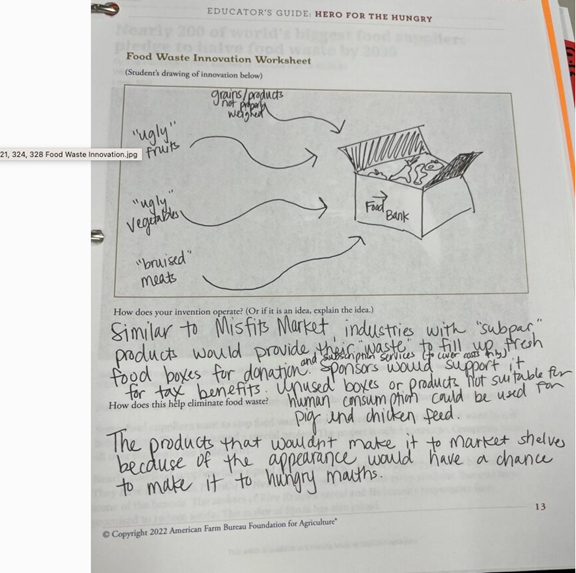
This initial foray into hunger allowed the teachers to learn more about this impactful issue across the state. For many, it reinforced information they already knew about their own community, but it was eye-opening for many to see how big of a problem it is statewide. For example, in looking at the free and reduced lunch data, many were surprised that some of the perceived ‘affluent’ counties in the state still had multiple schools with high percentages of free and reduced lunch. As such, this topic introduced them to a part of environmental and agricultural literacy—food literacy (Siegner, 2019). Food literacy is defined as “the scaffolding that empowers individuals, households, communities, and nations to protect diet quality through change and strengthen dietary resilience over time. It is composed of a collection of inter-related knowledge, skills, and behaviours required to plan, manage, select, prepare, and eat food to meet needs and determine intake” (Vidgen & Gallegos, 2014, p. 54). In addition, this investigation reinforced the SEL skill of social awareness—showing understanding and empathy to others—because it required them to reflect on their own students and how many of them might come to school hungry and need additional sustenance to stay focused during the school day. The second day, the teachers worked in groups to create an innovative way to address food waste in communities. This activity required them to think scientifically and utilize precise science and engineering terminology and design methods to create their solution. We chose this activity because many of the teachers had recently talked about how much food was wasted either at restaurants or at their schools during lunch and how they would like to put some of that food to good use in their community.
Figure 1. Food Waste Innovation
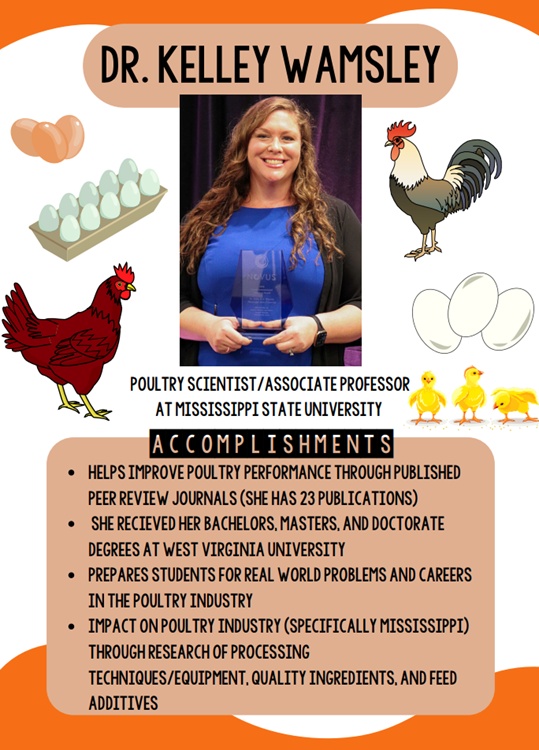
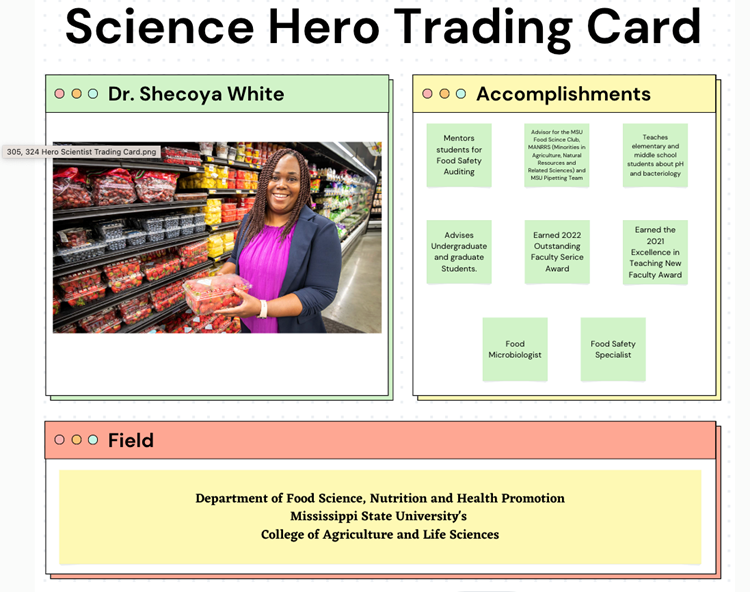
On the third day, the teachers, in groups, created hero scientist cards on a food science or poultry science scientist who has done work that impacts hunger in the state. This activity required the teachers to showcase a scientist who has had a positive impact in improving Mississippi’s environment and its agricultural industry. This activity also required the teachers to not only work on SEL skills such as relationship skills and self-management, but also to use discipline-specific terminology related to the food science or poultry science field when adding information to their trading card.
After the summer PD, the teachers returned to their classrooms and implemented lessons that we had done with them in their own teaching. Many used the agriculture texts to teach SEL skills and the food supply. They used the strategies and activities we taught them, and they also shared their new knowledge with their colleagues at their school site or in their district. During the fall follow-up day, the teachers continued to investigate hunger, but this time looked at it not just from a regional and state perspective but also a worldwide perspective. I chose to focus on hunger more broadly this time to show them how they could have their students consider hunger in their own community first (as we did in the summer) but then have them realize that hunger is not just a Mississippi problem—in fact it is a problem in our region, country, and world as well. The lesson and activities I implemented were also tied to state standards in the science, mathematics, social studies, and ELA standards.
Table 2. Example Mississippi College-and-Career Readiness Standards.
Mississippi College-and-Career Readiness Standards for Social Studies
Mississippi College-and-Career Readiness Standards for Science
Mississippi College-and-Career Readiness Standards for English/Language Arts
6.8 Examine how humans and the physical environment are impacted by the extraction of resources and by natural hazards 3. Assess the opportunities and constraints for human activities created by the physical environment.
ENV.4 Students will demonstrate an understanding of the interdependence of human sustainability and the environment. ENV.4.3 Enrichment: Research and analyze case studies to determine the impact of human‐related and natural environmental changes on human health and communicate possible solutions to reduce/resolve the dilemma.
RI.6.7 Integrate information presented in different media or formats (e.g., visually, quantitatively) as well as in words to develop a coherent understanding of a topic or issue.
First, they watched a video about the area of Memphis, TN, that is a food desert (see link in resources). The video was then tied into the National Agriculture in the Classroom lesson on ‘Hunger and Malnutrition (see link in resources). In this lesson, students investigate the importance of eating a variety of nutritious foods and explore diets around the world. The teachers were introduced to more health and food science terminology such as nutrient, undernourishment, food bank, staples, accompanying foods, and hunger. They then used the National Geographic website, What the World Eats, and answered the following questions:
Which country consumes the most calories in a day?
Which country consumes the fewest calories in a day?
Which country consumes the most 1) red meat, 2) grain, 3) sugar, and 4) fat?
Which country consumes the least 1) red meat, 2) grain, 3) sugar, and 4) fat?
After they had worked on this investigation, we discussed what they found across groups. These activities continued reinforcing SEL skills such as social awareness, relationship skills, and self-management as they negotiated group tasks. It also provided them an opportunity to continue to investigate environmental and agricultural literacies specifically food literacy. This is important because part of being agriculturally literacy involves understanding the food system and the importance of plants and animals to our environment. The workshop concluded with the teachers being introduced to two short films from Mississippi State University Films: one of which was on food insecurity, and one of which was on a local school district response to schools shutting down during the COVID-19 pandemic and getting food to the students who relied on school lunch as part of their food sources daily. These videos provided a real-world example of people using socio-emotional skills, such as responsible decision making, compassion, and relationship-building to make a difference in the local community. Further, the teachers learned about ways that community members are stepping up to help end food insecurity in their own backyards through the creation of local farmers markets and other means. This can help further develop their agricultural literacy knowledge because they have a deeper understanding of the food system.
I wanted to share these lessons and resources with my teachers because I wanted to show them how they could help their students become more agriculturally literate with a topic that is relevant to everyone—hunger and food. Over the school year, some teachers have emailed me to share how impactful these agricultural literacy SEL lessons have been for their students, particularly reading the book Free Lunch with their class and then investigating hunger in their community and where food comes from. Others expressed this in their delayed post follow up survey. For example, one teacher wrote that creating trading cards has been the most successful activity with their classes. They noted, “The kids love it and are all 100% into it.” Creating the trading cards on scientists allowed students to showcase their learning in a creative way. Another teacher wrote that participating this year helped them have “more opportunities for students to learn agriculture in different cultures, bringing awareness of food deserts and waste.” The teacher said the students particularly enjoyed exploring the National Geographic website and watching the videos about Memphis and food insecurity in the Mississippi Delta; learning about this topic had them think about what nutritious food was available to them on a regular basis outside of school. Another teacher wrote participating in the professional learning gave her “an enhanced sensitivity to food deprivation within my classroom.” These lessons over the past year opened this teachers’ eyes to hunger in their own students and the teacher has made it a priority to have nutritious snacks available for the students. Two others wrote, “All of the SEL!” for their response. Finally, one additional teacher wrote, “From ACRE 2.0, I’ve already used interactive simulations and hands-on experiments in my class. Next, I plan to add collaborative projects and real-world problem-solving tasks. These activities deepen understanding and build teamwork skills. Additionally, I’ll integrate more tech tools for personalized learning.”
References
American Farm Bureau Foundation for Agriculture (2012. Pillars of agricultural literacy. https://www.agfoundation.org/files/PillarsPacket062016.pdf
Brandon, H. (2012, March 30). At what cost the disconnect between agriculture and the public? https://www.farmprogress.com/commentary/at-what-cost-the-disconnect-between-agriculture-and-the-public-
Carter, D. (2016). A nature-based social-emotional approach to supporting young children’s holistic development in classrooms with and without walls: The socio-emotional and environmental education development (SEED) framework. International Journal of Early Childhood Environmental Education, 9-24.
Danner, D., Lechner, C.M., & Spengler, M. (2021). Editorial: Do we need socio-emotional skills? Frontiers in Psychology, 12, 1-3. 10.3389/fpsyg.2021.723470.
Hubert, D., Frank, A., & Igo, C. (2000). Environmental and agricultural literacy education. Water, Air, Soil Pollution, 123, 525-532. https;//doi.org/10.1023/A:1005260816483
Siegner, A.B. (2019). Growing environmental literacy: On small-scale farms, in the urban agroecosystem, and in school garden classrooms [Doctoral dissertation, University of California Berkeley]. UC Campus Repository. https://escholarship.org/content/qt4p16p53v/qt4p16p53v_noSplash_53f7a6e2917068410defb11335b7ac1b.pdf?t=q6z2hg
Mississippi Department of Education. (2023). Mississippi college-and-career readiness standards. https://www.mdek12.org/OAE/college-and-career-readiness-standards
This work is supported by the USDA/NIFA National Institute of Food and Agriculture, AFRI Agricultural Workforce Training Priority Area, award # 2022-08873.
Dr. Stephanie M. Lemley is an Associate Professor of Content-Area Literacy and Disciplinary Literacy Instruction in the elementary education program in the Department of Teacher Education and Leadership in the College of Education at Mississippi State University. She is the recipient of three USDA/NIFA grants on professional development in agriculturally literacy (either as PI or Co-PI) and in the last four years has worked with approximately 150 K-12 teachers across the state, either virtually or through face-to-face instruction, on infusing agricultural literacy into their classroom instruction. She can be contacted at smb748@msstate.edu .
Dr. Christina Dobbs follows up her webinar with this blog to challenge instructors to create rubrics that grow writing literacy and result in positive student-teacher interaction. Read more about her at the end of the blog.
During the COVID-19 pandemic, I had planned a study of writing instruction at the university level that involved interviews with students and visits to introductory writing classes that would help understand how undergraduates had made the transition from high school to university writing. But fate intervened and doing work to observe in class instructional spaces became complicated as we began to teach and work from home, and so I made a decision to just keep interviewing undergraduates about their experiences. Eighty interviews later, I am so glad to have had the opportunity to talk deeply with a wide range of students about their experience of writing in school across their lives and whether and how they see themselves as writers.
This work, alongside some other work with my colleague Chris Leider from UMass Boston, has caused me to spend time thinking deeply about the feedback we explicitly and implicitly give to students about their writing. As a teacher, I always struggled to give feedback on writing in a timely way that still felt deeply engaged with the work, and students didn’t always use the feedback I gave them to improve their writing, which never felt good. This new work about more effective and culturally sustaining feedback for students has helped me to understand what might have worked better in my own classroom and even in my own experience as a writer myself.
Across the work Chris and I have done with teachers over time and what I learned about feedback from my interviews with undergraduates, I have come to a new approach to feedback. Here are two lessons learned across those projects.
Lesson #1: Even if we didn’t know it, students remember our feedback, especially when they feel it was negative.
In talking with undergraduates about the feedback they received on their writing and times they felt proud of their writing, I was shocked by how much they remembered about feedback they had been given. Students relayed memories from elementary, middle, and high school as well as college, and sometimes they still felt strong emotions associated with those memories.
They described memories when a teacher had made them feel as though their ideas were worth engaging and that they had written something thought-provoking. They also described the positive experience of answering questions about their writing when feedback was given or feeling like their work inspired curiosity from the reader.
They also relayed moments when they got feedback that made them feel like their teachers had not really engaged with their ideas. This included times when they only got feedback on surface conventions or grammar, but it also included times when they just got a ‘good job’ or ‘great work’ too. Somehow this insubstantial positive feedback also made students feel as though they had not written ideas worth engaging.
Most importantly, the writers often described wanting to improve their work, but feeling as though some feedback they received was not helping them to do so. Some even described the feedback as showing them they actually would not be able to improve. They described teachers who made them feel as though they were already supposed to know everything before they took the class and those who clearly conveyed that they could improve.
This has led to a few ideas about giving feedback that I carry forward:
Asking questions about the content seems to matter to many writers.
Encouraging writers through feedback at various levels of the work, from the overall idea to the conventions, can support students in viewing their work as substantial.
Telling students that they can improve, and we will help them to do so explicitly can convey our belief in students’ potential for growth.
Lesson #2: It doesn’t matter what you say to students if your rubric says something else.
The rubrics we use to evaluate student writing often use harsh and deficit-driven language to separate students in particular categories. Rubrics will have category labels such as ‘unsatisfactory,’ ‘below expectations,’ or ‘warning’ to delineate performance, with upper category labels with headings like ‘outstanding’ or ‘excellent.’
Then within categories, the statements to describe various levels of performance will have language such as:
Writer has little or no control over sentence structure.
Reasoning is incoherent or unclear.
The use of language fails to demonstrate skill in responding to the task. (This example is from the ACT rubric.)
The designers of rubrics such as these likely did not think they were harshly commenting on students as writers; in fact, they likely thought they were only commenting on the piece of writing at hand and how well it communicates.
But the personal nature of writing and the ways that writers use feedback and comparison to others to drive their own writing self-efficacy (Pajares, 2003; Pajares & Johnson, 1996) makes it clear that writers likely internalize some of this commentary as about themselves, even if the teacher giving feedback did not mean it as such. Indeed, in my interviews with undergraduate students, they frequently described memorable feedback and harsh rubrics from many years earlier (going back to elementary) as drivers of whether they perceived themselves as writers in college years later.
Chris and I developed a question framework to help guide teachers in redesigning rubrics in ways that still convey critical feedback to students in ways that feel encouraging and supportive. We use these four questions to help teams of teachers we work with to revise rubrics to convey feedback in more supportive and equity-driven ways. The four questions (from Dobbs & Leider, 2021) are as follows:
Does the rubric’s scale of values for judging responses suggest that students have room to grow?
Do the tools emphasize development and purpose when it comes to language use?
Does the rubric feedback connect student language to audience?
Does the tool explicitly acknowledge that students have agency in choosing which of their language resources to use?
We use these questions not to shift the feedback away from various elements of the writing that we want to give feedback about, but rather to push us to phrase our thinking in a way that treats writers in humane and supportive ways.
So, we use these framing questions to rephrase headings and sentences on rubrics. What might have said ‘unsatisfactory’ before might say ‘still learning,’ ‘room to grow,’ or even ‘focus for next time.’ Where we might have said that ‘reasoning was incoherent,’ we might shift to say that ‘the writer’s reasons supporting their argument were challenging for the reader to understand.’
These sorts of changes convey to students that they can still be working on various elements of their writing, which all students are doing and is the purpose of schooling. They can also convey that writing feedback is not a matter of knowing how to do it ‘right’ or ‘wrong,’ but it is rather a matter of whether your communicative purpose was understood by the audience. It also conveys that students made choices about the writing they chose to put forward and that they can continue to improve that writing’s purpose, not just it’s perceived correctness on things like punctuation.
Over time, I’ve learned that giving feedback is meaningful to students in ways I had not always realized, and that making purposeful and specific choices in how to give feedback can make a huge difference in how students are able to take up the feedback we give them. That way, years down the road when they are in college and being interviewed, they will relay memories of feeling supported and confident as writers.
References
Dobbs, C. L. & Leider, C. M. (2021). A framework for writing rubrics to support linguistically diverse students. English Journal, 110(5), 60-68.
Pajares, F. (2003). Self-efficacy beliefs, motivation, and achievement in writing: A review of the literature. Reading and Writing Quarterly, 19(2), 138-158.
Pajares, F. & Johnson, M. (1996). Self-efficacy beliefs in the writing of high school students: A path analysis. Psychology in the Schools, 33(2), 163-175.
Dr. Christina L. Dobbs is an Assistant Professor in English Education. Her research interests include academic language development, the argumentative writing of students, and professional development for secondary content teachers. She is a former high school teacher in Houston, Texas, as well as a literacy coach and reading specialist.
Tori Young opens our March them with information that has shaped this addition to South Carolina High School Curriculum. Read more about Tori at the end of the blog.
Scrolling through social media, I often see young adults lamenting about why their teachers never taught them about taxes, credit, or interest rates. These adults feel lost and overwhelmed by the financial responsibility thrust upon them. While financial education may not look the same as it did fifteen years ago with Home Economics and Family and Consumer Science classes being defunded in several states, financial literacy is still integrated into many state standards through Social Studies and Freshman Readiness classes such as Economics or College and Career Readiness (CCR) classes. such as EPF.2.PR: “research and analyze the factors that impact personal income and long-term earning potential,” as an indicator in Economics and “students will be able to demonstrate productivity skills that will aid them in school and the workplace” as an objective in CCR.
Financial literacy is one of the few skills taught in schools that has a direct application to life for each student at the moment of learning it and in the future, regardless of their career goals. Knowing how to manage a budget, keep a healthy credit score, take out and pay off loans, and consider healthy investments are something every American adult has to consider on some scale every day. To understand income and expenses, a bank versus a credit union, and credit and debit are simple terms in financial literacy, but understanding them can greatly impact someone’s financial success. Knowing what options are available and what they mean helps consumers make smart financial decisions for themselves and their families, as well as avoid being taken advantage of by banks, loan companies, and businesses.
Lawmakers understand that when their constituents are financially literate, which means they can make better personal and business-related financial decisions, their states have greater economic success. Because of this, lawmakers over the past few years have begun to find ways to prioritize financial education through the standards of existing courses such as high school Economics and CCR courses that are already funded and required for graduation. Some states are even starting to require Personal Finance as a half-credit course, which teaches students how to balance a budget, plan for future expenses, understand banking and payment options, and choose appropriate loan and credit options for their personal goals. As financial literacy in middle and high school education is becoming a topic for our representatives, what should we know as teachers?
As of December of 2023, only 25 states require at least a half credit of personal finance, with five states and Washington D.C. not including personal finance in their standards (Nex Gen Personal Finance). However, the past two years have seen exponential growth in financial literacy in high school education because more politicians have seen the importance of young people becoming financially literate. In South Carolina, back in 2022, lawmakers passed 1.101 (SDE: Graduation Requirements) to require an additional half credit of Personal Finance for graduation beginning with the current freshman class of 2023-2024 (SC Dept of Ed). To meet this requirement, many high schools in SC now require Business Ed, CCR, or Social Studies teachers to step in to teach the course. Not only do these courses help students as individuals to be financially successful, but they help their communities and states as well when everyone has a better understanding of their finances. While only half of our country is requiring this skill to be taught, it is promising that more states will be joining them in the near future.
If you are wondering how this may apply to you as a middle or high school teacher, it has several impacts both in and out of the classroom! As a high school Economics teacher, I have found many skills from other disciplines necessary for my students to teach them personal finance effectively. We regularly calculate budgets, read data tables, and analyze graphs in class to analyze individual finance goals and overall economic patterns. Many of my students who struggle with personal finance struggle with mathematical and scientific literacy taught in the early years of schooling. For instance, the skills built in middle school science, learning about an X and Y axis, or in Algebra when dividing and working with decimals are crucial for students when they get to Personal Finance. You are building the infrastructure of financial literacy!
Financial Literacy makes up the second standard in the current SC Economics standards for social studies. The motive is that “financial literacy is imperative in making individual economic decisions regarding spending, careers, and setting short- and long-term financial goals. Decision-making and marginal analysis tools are essential in evaluating possible financial options. The ability to make wise choices can impact one’s standard of living and future earning potential” (2019 SSCCR). In order to achieve this goal, Economics teachers rely on a foundation of disciplinary literacy across the general education courses. From ELA, we ask students to research reliable sources and read news articles to find key information about the job market to determine if their career choice is feasible and realistic. From Mathematics, we require the ability to add and subtract to manage expenses and balance a budget as well as read a graph to evaluate the highs and lows of the cost of living. And from Science, we are gathering data from sources and testing different financial choices repeatedly to come to a sound conclusion.
We can all agree the weight of financial responsibility is heavy, for everyone. In turn, when these students graduate and begin their careers, whatever that may be, these students will have the knowledge needed to navigate financial independence. And maybe one day, when they are extremely wealthy, they will remember those of us who helped them get there. 😉
If you want to learn more about personal finance and financial literacy or access free curriculum, resources, and games for students, check out www.ngpf.org. If you are an Economics teacher and your state has implemented personal finance into your standards, check out www.econedlink.org and www.everfi.net for great resources and learning modules!
Tori Young is a high school social studies teacher in Anderson, South Carolina. She is currently working on her Master’s in Instructional Design and Learning Technology at Anderson University.