Photo by Murat Onder on Unsplash

Supercharging our Content Teaching with Language Objectives

Teaching

By: Samantha Rainwater, South Carolina High School English Teacher

Back to the Basics

Like every teacher during March of 2020, life threw me quite a difficult curveball: in the course of a few days, I needed to scrap all of the plans and dreams I established with my students and reimagine the rest of the year virtually. I don’t know how y’all handled it, but I was at a complete loss. My very organized book clubs, the brand new unit on The Kite Runner we had just launched, the highly-technical argument unit and Convince Me project we were in the thick of, all of it, upended. I had to start thinking about what—with my very limited time—I would focus on with my students. Ultimately, I decided that literacy through interesting and meaningful reading and writing would be my primary focus for the rest of the year. 

I bring this up specifically to discuss how, even as an English teacher, I have a lot of content that doesn’t fall under the “reading skills” category. However, literacy is the key to our students’ ability to access our content. If I wanted my students to be prepared for the next school year, the task was not to continue my content-heavy units or teach all the figurative terms they would encounter in English 3, but to make sure that students’ literacy skills continued to develop.
We’ve heard it all before, maybe from a district official or an administrator at the beginning of the year: We are all reading teachers. But let’s be real. We have standards and pacing guides and benchmark assessments and end-of-course tests and the list goes on. For content-area teachers, how can we possibly add on the task of developing students’ literacy? After all, they take ELA.

The Case for Disciplinary Literacy

I had a major revelation this year when it came to literacy, and I think in many ways my background as an English teacher kept me from this revelation sooner. Secondary education relies on literacy skills as a means of accessing content knowledge; however, literacy isn’t just literacy. There are two major theories regarding how literacy works: content-area literacy, which suggests reading strategies transfer between content areas (Vacca, Vacca, and Mraz 2011), and disciplinary literacy (Shanahan & Shanahan, 2012), which suggests and “acknowledges that different disciplines contain different purposes for language, ways of communicating, and requirements for precision” (Croce, 2017). While it’s important to understand that some reading strategies do transfer, it is also important to acknowledge the merits of disciplinary literacy. It’s not like kids learn to read, then immediately their literary lives are unlocked, and they can henceforth access all written knowledge presented in all subject areas. Each academic discipline has its own discourse styles and structures that students have to learn and master because they are so unique and different from the typical ways we engage and use language socially. The literacy and discourse structures that are taught in the ELA classroom might not be sufficient for students dealing with the very specific types of literacy present in the science or math classrooms. For this reason, the very best teachers of literacy in content-area classes are the content-area teachers themselves! I know, what does an English teacher have to say about literacy in other disciplines? But hear me out. It might even make teaching your content more effective.

An Example: Disciplinary Literacy in the Science Classroom

Science teaching, for example, depends on informational texts to communicate content knowledge, to teach facts to students. However, what happens when a student’s observations of the world around them do not match the facts being presented in the scientific texts they are reading? What understandings of the scientific method and peer review process do students have to understand in order to comprehend and learn from these texts? Consider the words of Croce (2017): 

“According to conceptual change theory, a number of conditions need to be met in order for a student to change his or her mind about a science concept. Would a student be considered a poor reader if those conditions were not met and the student did not change his mind (in other words, learn a concept) after reading the text? I would argue that a student is not a poor reader if he or she does not immediately change his or her mind about a science topic after reading a text. This is because when we assess students as readers of science, it is impossible to separate who a student is as a scientist from who he or she is as a reader (emphasis added) (Croce, 2015).”
Being an effective scientist depends on being literate in scientific discourse styles, specifically. If we expect students to learn how hurricanes are formed through reading a text, we have to approach the reading of that text as scientists, which requires different literacy foundations than what is required in their English class (and reading in science, math, and social studies often has different goals than in ELA). Scientific texts also have unique language patterns (i.e. cause and effect relationships in scientific sequences) that need to be explicitly taught to students. Students reading in their literature classes may never encounter those specific language patterns. When students are taught these discourse styles, they are then able to make sense of the content presented in these texts. 

First Steps: Introducing Language Objectives

I don’t think that we necessarily have to be reading specialists on top of our content-area and pedagogical expertise. I do think, though, that we need to be aware of how our disciplines use language and provide instruction for our students so language isn’t a barrier to learning the content. One of the most meaningful ways that I’ve started doing this in my own classroom is through language objectives. Language objectives are similar to content objectives in that they articulate what students’ will be able to achieve by the end of a lesson or period of time. The only difference is that while content objectives describe what students will know and be able to do, language objectives describe how students need to use language in order for the content to be accessible. If you need a place to start in terms of understanding how language should be used at different proficiency levels, I recommend viewing WIDA’s Can Do statements. 
As you are planning a lesson, ask yourself a few questions: What discipline-specific and general academic vocabulary do my students need to know to meet the content objectives? How is language functioning in this lesson (Are we listening to a speech made by an historical figure? Recording observations in a science experiment? Describing? Predicting? Comparing? What language styles and structures do we need to employ to do these things?) What language structures or grammatical features are common in this lesson? (Are we reading an academic text with frequent passive voice? Imperatives? Does the organization of the text need to be understood for students to comprehend it better?) What functional language is used during this lesson? What do I observe about my students’ needs when it comes to language? 

By doing this, we will become more aware how language works in our disciplines, and we can then work to lower the linguistic hurdles students need to overcome to understand and excel in our content. We can also take the answers to these questions and design focused objectives and direct instruction related to the language of our disciplines. The beauty of designing language objectives is that it occurs alongside the teaching of our content objectives; we don’t pause our instruction to teach language and grow literacy. This can happen with small mini-lessons embedded in the larger instruction for the day. For example, in a high school chemistry lesson, the language objective might be that “Students will be able to use adverbs of time in their lab report to describe their observations (first, next, later)” (Echevarria et. al, 2011). Maybe, in a math lesson, students need to understand the language of conditionality in order to solve a word problem. From there, you would design a language objective. This might take all of 10 minutes, but it will enable students to meet the task of writing their scientific observations within their lab reports. 

Developing and strengthening literacy specific to our disciplines is not a separate, full-time job. Instead, we can use language objectives to make our content teaching even more effective.

About the Author

Samantha Rainwater is the current English department chair at Richland Northeast High School in Columbia, South Carolina. She has eight years of teaching experience in the ELA classroom and is currently working to complete her ESOL certification. 

Strengthening the Generations Through Agricultural Literacy

Collaboration

By: Alonzo McDonald, South Carolina High School Agriculture Teacher

Photo by Jed Owen on Unsplash

Everybody knows the song, “Old McDonald had a farm.” Well, that song is about my dad. He’s the McDonald that had the farm…and the cows, and the peacocks, the ducks, the hogs and the mules. I’m the McDonald that took my passion for agriculture, which developed at a young age, and turned it into a career as an agricultural education teacher. Often, people believe teachers of elective courses are not concerned with literacy; however that is not the case. When teaching an elective course, you have to come up with creative ways to motivate students to engage in content literacy. I have found that I can foster student literacy through the community engagement of my students. 

One of the cornerstones of agricultural education programs is the desire to create productive citizens who serve their community. Through the Agricultural Education Program and Future Farmers of America (FFA) at Manning High School, students are molded into being model citizens that willingly give back to their community through various events and community partnerships that continue throughout the year. The motto of FFA reads “Learning to Do, Doing to Learn, Earning to Live, Living to Serve.” The last line, “living to serve” is one that I think the students grasp without even realizing it, because it becomes so embedded in our work in and out of the classroom. When you connect the last line of the motto with the first line, “learning to do,” students are equipped with the tools needed to successfully give back to the community that made them.

Photo by Kelly Sikkema on Unsplash

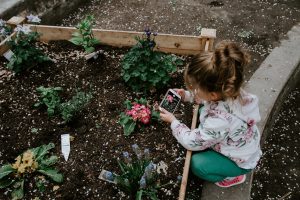
Through various in class activities, articles from agriculture magazines, and hands-on experiences students gain content knowledge they can put to use and pass on to younger students, in one of our strongest community partnerships, at Manning Early Childhood Center (MECC). Students within the agriculture program are able to explain the content that they have learned throughout the semester in a way the younger students are able to understand and use as they work on the raised bed garden at MECC. My students are able to teach these younger students how to transfer this knowledge into a useful skill (i.e. seed depth and spacing, watering needs, pollination, importance of fertilizer, plant parts, etc.) that can be used in the school garden. When my students are explaining to four and five year olds the needs of plants, and seeing that the younger kids are actually understanding it, brings me joy. As a teacher, being able to see the products of our toil is always rewarding. 

Photo by Cathy VanHeest on Unsplash

Having good role models for students to emulate is important. Through a consistent partnership with the Clarendon County Master Gardeners, my agriculture students have learned ways to pass on agriculture knowledge to others. The master gardeners model the ways in which experiential knowledge can be transferred through shared gardening experiences. My students then use what they have learned in their interactions with the master gardeners, with the students at MECC. The master gardener volunteers are able to bring in their real-world knowledge and experiences to help enhance the students understanding of not only the task-at-hand, but meaningful life experiences. Through this partnership, students are able to experience what it feels like to have someone giving back to the community and investing in the students at our school. As a result, students are more willing and eager to gain a better understanding of agriculture so that they can pay it forward.

Several students have gained a new appreciation for different aspects of agriculture because of these partnerships and have taken additional steps to further enhance their knowledge through research. Students are more willing to engage in learning, because they want to be able to share their knowledge with younger students and understand the information they learn from the master gardeners. As a result of community partnerships, students learn to use the agriculture content vocabulary, which supports their learning in my class and future agricultural classes they may take in the future.

Photo by Dan Meyers on Unsplash

Agriculture is an important part of today’s society that is sometimes overlooked. As the global population increases, we need to make sure that our appreciation for what agriculture provides continues to increase, so that we have future generations who are interested in agriculture and want to contribute to the field of agriculture. There are many initiatives and programs that are in place to encourage the younger generations to be more interested in agriculture. Through partnerships with different agricultural organizations, the youth are being exposed to the many different aspects of agriculture. My challenge to you is expose your students to some of the many different avenues that lead to the wonderful world of agriculture.

About the Author

Alonzo McDonald is an Agricultural Education Teacher at Manning High School, in Manning, South Carolina. Alonzo earned his Bachelor of Science in Agricultural Education from Clemson University. He also holds a Masters of Education in STEM Leadership from American College of Education.

Photo by Akshay Nanavati on Unsplash

Quaranteaching: We’re Not In Kansas Anymore

Teaching

By: Scott Buhr, South Carolina Physics Teacher

Photo by Hal Gatewood on Unsplash

I was 11 years old when I got my first trumpet. My grandfather bought it for me and I was thrilled. I couldn’t wait to learn how to play it. I had taken piano lessons for several years and I can remember my 11-year-old mind thinking, “The trumpet will be so much easier, it only has three buttons!” Silly right? I was taking my knowledge of the piano and superimposing it upon a completely different type of instrument. Sure, there are some things about playing the piano and the trumpet that are alike, but treating one like the other will leave your orchestra one instrument short. My piano literacy did not translate into trumpet literacy, who’d of thought?

Now twenty years later, I am an educator who thinks about the sort of transition that I went through from piano to trumpet on a daily basis. Each hour of the school-day, students arrive in my classroom from all sorts of differing classes—each one teaching them their own literacy practices. My job as a physics teacher is to teach my students how to think like a physicist. How do physicists solve problems? How do they think about the universe? How do they talk to each other about it? This is every teacher’s task. How do I get my students thinking like the professionals in this field think? 

“QUARANTEACHING”—THE STRANGE TRANSITION FROM FACE-TO-FACE, BRICK-AND-MORTAR, GOOD-OLE-FASHION SCHOOL TO THE WHAT-IN-THE-WORLD, CRAZY-LAND OF ELEARNING.

Enter Covid-19. Suddenly, every teacher has been thrust into the unknown world of “quaranteaching”—the strange transition from face-to-face, brick-and-mortar, good-ole-fashion school to the what-in-the-world, crazy-land of eLearning. This unbelievable turn of events has forced teachers to make a literacy transition of their own. From the face-to-face to the virtual. Like many educators right now, you might be struggling to transition from the face-to-face environment that you know so much about to a completely digital experience. If you, like me, found the recent upset to feel rather normal and stress-free, then you might be a digital native—someone who was brought up with today’s technology and whose use of it feels less like using a prosthetic and more like using a natural appendage. Or, perhaps you would not consider yourself a digital native, but are comfortable adopting new technologies and have been for some time. Either way, there are many people whose comfort level with using all sorts of technology is high and there are some whose comfort is low. If you are an educator reading this, you probably could go through the names of the people in your department and pick out the ones who seem to like using technology just because it exists, the ones who avoid it at all costs, and everyone in between. 

Now, I find myself in the comfortable position of being a digital native as well as having been enrolled in online grad classes for some time. My wife has taught virtually for years, and I am about to begin teaching my own virtual class. Many other teachers did not have my circumstances and were faced with the daunting challenge of online teaching with about two days notice. 

Here is the interesting bit. I haven’t noticed that technology integration has been the biggest hurdle for teachers. Indeed, many teachers have been surrounded by all sorts of technology for quite some time—both in and out of the classroom. No, from my perspective, the biggest struggle for many teachers hasn’t been “How does this thing (Zoom, Google Docs, etc. . . ) work?” But instead, “How do I put it all together to work for me and my students?” “How should it work?”

The biggest struggle for many teachers is not “How does this thing work?”, but instead “How should this thing work?”

Let me explain: 

I have seen many teachers share their plans of how they are going to replicate their classroom experience online. This includes bell work, short lectures, and even the possibility of taking tests online. These plans seem to elicit “oohs” and “aahs” for their elaborateness and are applauded for the fact that this teacher has created something so close to a brick and mortar classroom experience. Now don’t get me wrong, context is everything and there may be scenarios where any one of those strategies is really the best one for that particular age, class, or context. As a digital native though, here’s my two cents:

 Is replicating the brick-and-mortar experience the best way to provide eLearning? 

It is likely that your teacher-education program took a traditional approach to lesson planning and unit planning that involves students working linearly through materials as you guide them. This form very much fits the context of students who enter my classroom at the same time each weekday, stay about an hour, and leave with whatever, if anything, I have tasked them to do at home. Still doesn’t mean it is the best, but it certainly fits the context. Now, does a traditional lesson plan seem to fit our current context? Any online context? 

  Photo by Kari Shea on Unsplash

Perhaps the nuts and bolts of the eLearning technology is really not the biggest issue. Maybe our approach to teaching in this sort of environment is what needs the most attention. Most online courses that I have taken have offered me less direct instruction and more opportunities to create things based upon research I have set out to accomplish with resources that the instructor has provided. That is, I have taught myself for the most part and then created some sort of product based upon my learning. Sometimes this has worked really well and other times it hasn’t. 

The thing that has made this model the most successful is how the teacher approaches the class. If they take a “set it and forget it” approach, I am almost sure to be frustrated and unsure of what I am supposed to be doing. If, however, my first attempts on projects are met with specific, helpful feedback, then I am sure to thoroughly engage with the class. 

Educational technologists have long towed the line that technology is a tool, but today it seems that the technology is more a context or environment than merely a tool.

So did you catch the key? Feedback. In my face-to-face classes, I provide this in a thousand small ways. Verbal feedback, facial expressions, and body language are paired with my planned materials to facilitate my being able to accurately gauge and respond to student understanding. Without those tools in an eLearning environment, my students will experience the same frustration that I had from my own online teachers who seemed to treat the courses I was in like an automated machine. In an online environment, many excellent teachers likely struggle to provide the incredible feedback that they normally would when working face-to-face. Could it be that the pressure to make eLearning look and feel like a traditional classroom is the wrong approach? Educational technologists have long towed the line that technology is a tool, but today it seems that the technology is more a context or environment than merely a tool. If my students are primarily engaging with me and my course through hardware and software, then hasn’t that repositioned the technology to more than just a tool?  In fact, it becomes a whole different social discourse in which the ways we act, think, and communicate are quite foreign from the space of the traditional classroom. The literacy paradigm has changed. We’re not in Kansas anymore, Toto.

Personally I have faced this challenge with my honors physics students. I introduced them to a new online tool called MasteringPhysics as a part of my doctoral work. This platform provides immediate and elaborated feedback to my students, but many of them still struggled to connect with this feedback. This program is specifically designed to use a host of technological magic to give electronic feedback to students and yet they still struggle. How much harder it must be for new eLearning teachers to adjust to this new paradigm. 

Hopefully, educators all across the country will begin to pressure themselves into designing online lessons rather than teaching lessons online.

Reshaping your thinking isn’t easy. Even as a digital native, I have found myself trying to force my prior learning experiences as a student onto my current classes. It just feels “right” sometimes. My 11-year-old self had to learn to treat the trumpet as a completely different instrument complete with all new ways of thinking about music. It could well be that teachers who have been thrust into eLearning need the same kind of adjustment in their thinking. So have you felt pressure as a teacher to replicate face-to-face style learning in the virtual world? Was this pressure internal or external? Hopefully, educators all across the country will come out of quarantine with a fresh perspective of the advantages and disadvantages of eLearning and begin to pressure themselves into designing online learning using online literacies rather than teaching lessons online. This is going to require New Literacy Studies.

About the Author

  Photo by Kyle Gutschow

Scott Buhr is a high school physics teacher in Simpsonville, SC. He is a doctoral candidate at the U of SC College of Education studying Curriculum and Instruction. He has been involved with physics instruction, instructional design, and public speaking for nearly a decade. He was named in the Top Ten Teachers of the Year for Greenville County Schools in 2017-18 and shortly thereafter led his physics class to break a Guinness World Record. Scott also operates a small, gourmet popcorn business and actively ministers with his wife in their local church.