The Leadership Needed to Support Disciplinary Literacy Initiatives Webinar

Teaching

In this webinar, Dr. Ippolito will present multiple evidence-based ways for both formal and informal literacy leaders—principals, instructional coaches, and teacher leaders—to support disciplinary literacy initiatives across grade levels and content areas. This session is intended to support both teachers and leaders, as we collaboratively navigate disciplinary literacy work in a post-pandemic world.

When: March 30, 2023 6-7PM EST

Cost: Free

The following resources were shared during the webinar.

Jacy is a professor in literacy and leadership at the McKeown School of Education at Salem State University (Salem, MA), where he currently codirects graduate programs in Educational Leadership and the Center for Educational Leadership at SSU (CEL@SSU). Jacy’s work focuses on the intersection of literacy coaching, educational leadership, adolescent/disciplinary literacy, and school reform, and his most recent books include Disciplinary Literacy Inquiry & Instruction (2019), An UnCommon Theory of School Change (2019), Investigating Disciplinary Literacy (2017), and Cultivating Coaching Mindsets (2016).

For more about Jacy and his work, please visit:
www.visualcv.com/jacyippolito or
www.twitter.com/Jippolito

Cover Photo by Natalie Pedigo on Unsplash

How Can School Leaders Support Disciplinary Literacy?

Teaching

This post is written by Jacy Ippolito, Christina Dobbs, Megin Charner-Laird. You can read more about these authors at the bottom of this post.


When talking with school leaders interested in supporting disciplinary literacy (DL), one question we often ask is: “What kind of holding environment are you able and willing to establish for your teachers as they learn about and pilot disciplinary literacy practices?” Note that this question touches on three critical components: 1) the notion of a holding environment for teachers; 2) a focus on professional learning and piloting of DL practices; and 3) what leaders are able and willing to do to support these efforts. In our experience, we have found that all three components are necessary to foster rich disciplinary literacy work within and across content area classrooms. Let’s take a moment to explore each component in turn.

  • Holding Environments for Adult Learning

First, it is important for school leaders to understand that just as we establish and maintain holding environments for students to learn within classrooms, adult educators also need holding environments to support their professional learning. A holding environment is “a nurturing context in and out of which we grow, and can be a relationship, a series of relationships, carefully designed collaborative practices, or a complex organization like a school” (Drago-Severson & Blum-DeStefano, 2017, p. 52).

An effective holding environment meets learners where they are, and it also nudges them to grow and shift at a rate they can handle. In the words of school change researcher Michael Fullan (2016), an effective holding environment applies pressure and support. School leaders are well-positioned to provide both support and pressure within the larger context of a disciplinary literacy professional learning initiative. In terms of support, leaders can provide time, stipends, and resources (e.g., books, workshops, consultants, etc.) to jumpstart DL professional learning efforts. Regarding (gentle) pressure, leaders can incorporate DL questions and frameworks into their informal and formal evaluation efforts (e.g., “In your classroom, what does it mean to read/write/communicate like a historian, literary critic, mathematician, scientist? How have you made this explicit to students?” [Ippolito & Fisher, 2019, p. 54]). For more on how leaders can craft/incorporate DL-related questions into their informal and formal classroom observations and conversations, see “Instructional Leadership for Disciplinary Literacy” (Ippolito & Fisher, 2019).

  • Supporting Collaborative DL Professional Learning & Piloting of Practices

Second, school leaders need to be cognizant of helping to establish an effective holding environment (i.e., relationships and collaborations among teachers) that supports invention, adaptation, and risk-free piloting of new practices. Given that disciplinary literacy is still a young field of research and practice, very few codified ways of working have been established and backed by research. Thus, school leaders can set the tone for the work by encouraging teachers to form content-specific or cross-content area professional learning communities (PLCs). These PLCs can be led and facilitated by teacher leaders who have deep expertise in the content area standards and traditional practices. These teacher leaders can take on the role of lead learners (Charner-Laird et al., 2016). They can use discussion-based protocols to support looking at student work, tuning new DL lesson plans, and making sense of emerging student data. Furthermore, these teacher leaders can support colleagues, within PLCs, to engage in collaborative inquiry around new DL practices (Ippolito et al., 2019).

By encouraging the adaptation of existing practices, and the invention and piloting of new practices, school leaders can signal to teachers that they don’t expect perfection or mastery immediately. Instead, the leadership expectation is focused on teachers delving deeply into the reading, writing, and communication habits of minds and norms of practices within their disciplinary areas of expertise (e.g., biology, chemistry, world history, etc.). The essential question becomes: “How can we apprentice students into these discipline-specific ways of reading, writing, and communicating?” Teachers can also be encouraged to delve into their own students’ cultures, languages, and out-of-school ways of reading, writing, and communicating, in service of both bridging towards discipline-specific practices and perhaps at times reinventing those practices to more fully include students’ own funds of knowledge (Moje, 2015; Moll, 2015).

  • What Are Leaders Able and Willing to Do to Support?

Third, leaders need to consider a larger arc of professional learning than simply purchasing a book, setting up a one-time workshop, or encouraging PLCs to form and then stepping away. Wise leaders will consider establishing a cross-role committee of teachers, leaders, coaches, and specialists to design a DL professional learning initiative that might unfold over a period of a year or more (Dobbs et al., 2017). The initiative might include some initial shared learning experience (e.g., a summer institute or series of workshops led by an outside expert or district-based literacy leader). Following initial learning experiences about DL research and practice, teams of teachers might collaboratively inquire into new instructional practices as part of PLCs led by teacher leaders (Charner-Laird et al., 2016). Finally, new practices might be piloted, assessed, refined, and then shared more widely across teacher teams within and across content areas in a school or even across a district (Ippolito et al., 2019).

Leaders who are invested in this work will participate in all stages of this professional learning arc—from dipping into initial workshop learning experiences, to observing and participating in a few PLCs, to observing new classroom practices, to supporting the wider sharing of work across the school and district. Leadership participation signals the importance of the work and aligns informal and formal observations and evaluations with professional learning efforts.

Understandably, this work takes time and resources. Yet the results are worth it. As one middle school principal who led DL professional learning and teaching efforts across the pandemic recently noted: Disciplinary literacy work is meant to “activate and engage students as doers” as opposed to being “passive receivers of content.” His essential question to teachers became: “How do we begin to use disciplinary literacy as a way to strengthen students as doers in our disciplines?” By providing summer professional learning time with outside consultants, and then devoting whole-school and departmental faculty meeting time to collaborative DL professional learning, teachers made strides in adopting, adapting, and piloting DL practices. In this way, leaders can work alongside teachers to make disciplinary literacy a reality in K-12 classrooms.

References

Charner-Laird, M., Ippolito, J., & Dobbs, C. L. (2016). The roles of teacher leaders in guiding PLCs focused on disciplinary literacy. Journal of School Leadership, 26(6), 975-1001.

Dobbs, C. L., Ippolito, J., & Charner-Laird, M. (2017). Investigating disciplinary literacy: A framework for collaborative professional learning. Harvard Education Press.

Drago-Severson, E., & Blum-DeStefano, J. (2017). Tell me so I can hear you: A developmental approach to feedback for educators. Harvard Education Press.

Fullan, M. (2016). The new meaning of instructional change (5th ed.). Teachers College Press.

Ippolito, J., Dobbs, C. L., & Charner-Laird, M. (2019). Disciplinary literacy inquiry and instruction. Learning Sciences International.

Ippolito, J., & Fisher, D. (2019). Instructional leadership in disciplinary literacy. Educational Leadership, 76(6), 50-56.

Moje, E. B. (2015). Doing and teaching disciplinary literacy with adolescent learners: A social and cultural enterprise. Harvard Educational Review, 85(2), 254-278.

Moll, L. C. (2015). Tapping into the “hidden” home and community resources of students. Kappa Delta Pi Record, 51(3), 114-117.

Cover photo by Hannah Busing on Unsplash


Jacy Ippolito is a professor of literacy and leadership in the McKeown School of Education at Salem State University (Salem, MA), where he currently co-directs the graduate programs in Educational Leadership and is the co-founder and co-leader of the Center for Educational Leadership at the University (CEL@SSU). Jacy has worked as a reading specialist and literacy coach, and his research, teaching, and consulting focus on the intersection of coaching, leadership, adolescent/disciplinary literacy, and school reform. For more about Jacy’s books and articles, or to connect with him, visit www.visualcv.com/jacyippolito or www.twitter.com/Jippolito.

Christina L. Dobbs is an assistant professor and director of the English Education for Equity and Justice program at Boston University. Her research interests include language diversity and the language of schools and disciplinary communities, the argumentative writing of students, teachers’ beliefs about language, and professional learning for secondary teachers. Additionally, she writes about being a woman of color in the academy. She is a former high school English language arts teacher, as well as a literacy coach, reading specialist, creative writer, and native Texan. To connect with Christina, please find her at https://twitter.com/drcdobbs.

Megin Charner-Laird is a professor of elementary education and educational leadership in the McKeown School of Education at Salem State University (Salem, MA). She currently co-directs the graduate programs in Educational Leadership and is the co-founder and co-leader of the Center for Educational Leadership at the University (CEL@SSU). Megin worked primarily as a fifth-grade teacher, and she carries those experiences into her teaching, which focuses on teachers’ professional learning, teacher leadership, formal school leadership, and school change. To connect with Megin, please find her at www.twitter.com/drcharnerlaird.

Complicated, and Worth It: Fashioning Links in Literacy

Teaching

This post is written by Jason D. DeHart, PhD. Read more about Jason at the bottom of this post.


Were I to conduct a thematic analysis of my career in literacy so far, “I don’t like to read” would rise to prominence as an often-stated reality.  Even if students feel that they are capable readers, they do not always express connection and engagement with the texts that they encounter in school settings.

This was true in my time as a middle school teacher, it is a theme that has inspired my scholarship, and it is a mantra that continues to resonate in the K-12 setting in which I am working now. When I consider the types of texts that continue to be honored – voices from hundreds of years ago, many of which include problematic language related to ethnic, racial, and gender identities – it is no small wonder that instant buy-in is so rare.

While there are many potential solutions to discuss, the word that also comes to mind in my thematic thinking is linking. This notion of linking speaks directly to the work of Literacy in the Disciplines in terms of thinking about the strands of critical inquiry that can be fashioned between and among content areas and types of texts. As I start a new semester, I am continuing to revisit the ways I can make content rich and relevant for my students through thoughtful connections between and among content areas, types of texts, and voices old and new.

The Rising Voices

Text selection is a key part of this process. When I first began teaching my students, they were reading Steinbeck’s outsider report of migrant farm workers in Of Mice and Men. That same year, in 1937, a book called Their Eyes Were Watching God was published. I was fascinating by this cultural dichotomy and struck by the opportunity to find a voice from the intersections of gender and ethnicity that could broaden my students’ perspectives about the lived experiences of people in the past. Zora Neale Hurston was, famously, an anthropologist, and her attention to ethnographic detail shows up in her writing.

I then worked with students across my courses to trace this literary journey to Alice Walker, who was instrumental in bringing attention once more to Zora Neale Hurston’s work in more recent times. This conversation between authors across time was one that I could discover and share with my students, linking to their current stories as part of American culture(s). It is both a linking of time and a critical inquiry that travels through a chain of inspiration.

In addition to Hurston and Walker, we read Jason Reynolds, Jericho Brown, and additional contemporary voices who have shared about facets of America that are simply not discussed in many canonical works. It is also important to me to choose works not simply because I am drawn to them personally, but as a way of filling in a gap that exists in what students might have discovered in literature so far.

Critical Analysis and Honest Stance

At one time, suggesting that a revered work of literature contains problematic content would have caused me insecurity. I desperately wanted to be a “good English teacher”, and I thought that meant holding the classics up on clouds. At this point in my teaching career, I recognize the value of honestly evaluating the limitations of thought and experience represented by literary canonical figures. In this way, I can be clearly critical about what it means to be an inside or outside voice related to a particular topic or way of being, and I can invite my students to think critically about these questions of authorship, as well.

I feel that this approach honors my students’ intelligence and acumen in noting these inconsistencies in human stories, as well as their awareness of the absence of some stories in what they have discovered in curriculum so far. This critical stance is not only possible in English class, but can lead to inquiry in history and social studies courses, discussions of equity and equal access in science and health care, and questions of ethics in technology courses, to note a few possibilities.

Asking students to evaluate an author biographically, not to simply suggest that they did not know better than to use language at a certain period in time, but to consider authors’ biases and positionalities is part of deep thinking and ethical work. This need not be a full lecture on the author’s history, but rather a point-by-point glimpse at some major details about them, considered historically alongside literature.

Ways of Reflecting

Finally, all of this critical work requires some kind of outlet. I cannot imagine teaching a class about virtually any topic and not having my students respond in some way each day, either in a paragraph, a sentence, or a few take-away words. I embrace videoed content as students have created zeitgeist poems and adapted key narrative scenes in groups, using their cell phones as one-stop shops for moviemaking. I embrace the visual, not just in thinking about remembering vocabulary words, but in sharing multimodally and symbolically about reading and viewing experiences.

A question stem to encourage this kind of response might be something like: Locate or create three images that represent your thinking about the representation of political unrest in Before We Were Free by Julia Alvarez, or Create an infographic to help us understand the setting and context of Elie Wiesel’s Night.

In this way, students can explore links between and among stories that have existed for some time, as well as those that need to be (re)told. Moreover, as I have explored in this post, students can become aware of, critique, and even compose links between historical and contemporary voices, and engage in the process using tools and approaches that build their mathematical, artistic, and technological skills.

Teaching and learning is truly a linking and connected process, from past to present and across multiple literacies. All of this rich complexity requires attention, but I have found the conversation to be worth the time.


Jason D. DeHart is a passionate educator, currently teaching English at Wilkes Central High School in Wilkesboro, North Carolina. He served as a middle grades English teacher for eight years and an assistant professor of reading education at Appalachian State University from 2019 to 2022. DeHart earned his PhD from The University of Tennessee, Knoxville.

Photo by Michal Matlon on Unsplash

Planting the Seed of Comprehension in Agriculture and Science Classrooms

Teaching

This post is written by Stephanie M. Lemley. You can find out more about Stephanie at the bottom of this post.


For the past two years, I have had the privilege of working primarily with grades 6-12 Mississippi agriculture and science teachers through  a grant entitled Agricultural Sciences Professional Development (ACRE).  This professional development for agricultural literacy grant is funded by the U.S. Department of Agriculture, National Institute of Food and Agriculture. In this grant, teachers participate in an intensive, two-week summer institute where they learn animal science, plant science, and meat science content as well as literacy strategies, pedagogy, and teacher leadership. The teachers also participate in two follow-up days—one in the fall semester and one in the spring semester. As a content-area literacy and disciplinary literacy teacher/educator, I work with the teachers on infusing comprehension, writing, and vocabulary strategies into their classroom practice. During the summer institute, the teachers keep an interactive notebook (either hard copy with a spiral notebook or a digital version on a site such as Canva.com) to record their lab data, literacy strategies, and notes from presentations. Previous research on interactive notebooks in science classrooms has shown that  such tools can support students’ communication of science understandings (Wilmes & Siry, 2019). 

One strategy that has been impactful for both cohorts of teachers is the carousel (Adams & Leininger, 2017). This strategy promotes productive talk in the classroom. On the first day of ACRE, I post chart paper labeled with the different livestock species—dairy cattle, beef cattle, small ruminants (goats/sheep), equine (horses), and swine around the room. I divide the teachers into small groups and have them circle the room, two minutes at each station, recording as much background knowledge about each livestock species as they can. As they rotate around the room, they read what others wrote, correct any misconceptions, and record their own information in a different color marker. At the end of the summer institute, we revisit the carousel to record new knowledge from ACRE.

Image: ACRE teachers completing the carousel about different livestock species.

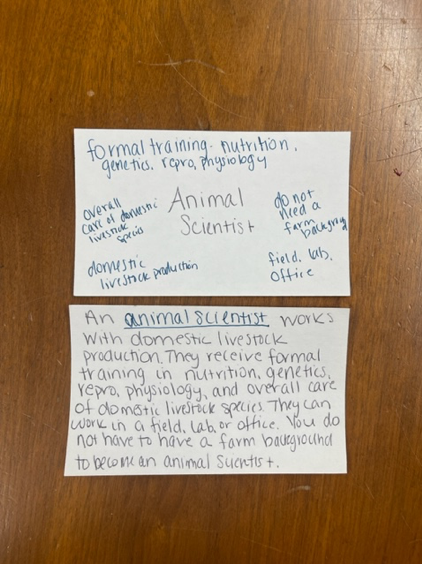
Another strategy that I teach and we practice in our summer institute is magnet summaries (Buehl, 2014). A magnet summary is a strategy where students construct meaningful summaries, in their own words, about a topic or concept. As a piece of text is read, magnet words—key terms or concepts—are identified from the reading and are organized into a summary.

At our summer institute, I modeled, and we completed together a magnet summary on the term ‘animal scientist’. We introduced this topic to the teachers because the majority of the presenters throughout our two weeks together were practicing animal scientists from the university. We utilized two texts– American Society of Animal Science’s (ASAS) entry on “What is Animal Science?” and the Occupational Outlook Handbook’s entry on Agricultural and Food Scientists.

Image: A magnet summary on the term ‘animal scientist’.

Once we completed the first magnet summary together, the teachers completed another one on a Mississippi commodity (e.g., broilers, cattle, catfish, corn, cotton, horticulture crops, peanuts, rice, sweet potatoes, etc.) utilizing three sources—the Mississippi Farm Bureau Commodity Facts, the Mississippi Agriculture Commodity Directory from the Mississippi Department of Agriculture and Commerce, and the Mississippi State University MS Agricultural and Forestry Experiment Station (MAFES) Mississippi Commodities list.

Images: Magnet summary on the Mississippi commodity ‘soybeans’.

Both of these strategies translated well into classroom practice for our teachers. In our fall follow up, one teacher noted, “The carousel strategy worked well because students enjoyed going back after lessons to see how much they learned.” Another teacher noted that the compilation of strategies in the interactive notebook the students are keeping “allows them make connections with content throughout the term.”

References

Adams, S., & Leininger, G. (2017). But I’m NOT a reading teacher! Literacy strategies for career and technical educators. Coppell: Sandy +Gwen Always Learning.

Buehl, D. (2014). Classroom strategies for interactive learning (4th ed.). Newark: International Reading Association.

Wilmes, S.E.D., & Siry, C. (2019). Science notebooks as interactional spaces in a multilingual classroom: Not just ideas on paper. Journal of Research in Science Teaching, 999-1027. doi: 10.1002/tea.21615

*This work is supported by the Agriculture and Food Research Initiative’s Professional Development for Agricultural Literacy priority area, grant no. 2021-67037-34210, project accession no. 1025666, from the U.S. Department of Agriculture, National Institute of Food and Agriculture.


Stephanie M. Lemley is an Associate Professor at Mississippi State University where she works with pre-service and in-service teachers on incorporating literacy strategies into their agricultural teaching practices. 

Cover Photo by Jonathan Kemper on Unsplash

Wicked Problems

Teaching

Many important societal problems are neither simple nor easily solved; they are wicked problems. 1 A wicked problem is a social or cultural challenge that involves many social systems and groups, has unpredictable outcomes, and defies typical problem-solving techniques. 2

Wicked problem is a phrase originally used in social planning to describe a problem that is difficult or impossible to solve because of incomplete, contradictory, and changing requirements that are often difficult to recognize. It’s important to note that the word (wicked) is used to denote resistance to resolution, rather than evil. 3

Systems Theory

Because of complex interdependencies, the effort to solve one aspect of a wicked problem may reveal or create other problems. We make sense of this through systems theory, or the the interdisciplinary study of systems. These systems are cohesive groups of interrelated, interdependent components that can be natural or human-made.

Every system has causal boundaries and is influenced by its context, defined by its structure, function and role, and expressed through its relations with other systems. A system is more than the sum of its parts as it can express synergy, or the interaction or cooperation of two or more organizations, substances, or other agents to produce a combined effect greater than the sum of their separate effects. Systems can also show emergent behavior, or an unanticipated side effect of bringing together a new combination of capabilities. Emergent behaviors can be either beneficial, benign, or potentially harmful, but in all cases they are very difficult to foresee until they manifest themselves.

Addressing Wicked Problems

To address a real-world, wicked problems a transdisciplinary lens is needed to support educators and students as they engage with this content in ways that extend beyond traditional academic boundaries 4 Transdisciplinarity is a research or educational approach that seeks to challenge disciplinary boundaries to create a holistic perspective that enables inputs across scientific and non-scientific communities. 5 Looking at a problem and context through a transdisciplinary lens allows one to construct meaning in more authentic contexts where disciplines intersect, combine, and work together. 6

Illustrator: Uğur Orak

What could be described as a wicked problem is really a situation in which we’re recognizing the power and irregularity of evolving systems. In education, we want to provide learning opportunities for students that are valid representations of the challenges they’ll encounter in the real world. This calls for a greater amount of flexibility on the part of the teacher. Given the lack of structure, and problems with validity, reliability, and access of open digital information, educators need to be more flexible and tolerant as they engage in the learning process. 7 Teachers need to have an appreciation for the complexities, pitfalls, challenges, and opportunities that exist when using open, digital information in the classroom. 8 Educators must constantly re-envision what it means to be educated, and what it means to be literate as technology advances. Through the careful use of texts, tools, and pedagogy there is an opportunity to effectively achieve Friere’s goal that teachers should be learners, and learners should be teachers. 9

Students also bear a great deal of responsibility when engaging with wicked problems in the classroom. Students must display the discipline, responsibility, persistence, and flexibility required to work as an active participant in these interactions. In this process, students must take an active role in learning, and reconsider the concept of “school.” 10 In a classroom in which teachers empower students to wrestle with wicked problems, students may have to take a leadership role in the crafting and revision of new learning process or product. 11 12

Conclusion

We we prepare youth to enter their futures, it is important to be honest with learners and let them know that the systems, policies, and practices that govern our spaces may not always make sense. As we address wicked problems it is important to consider all of the contexts and contingencies that impact the these decisions. As learners in a globally connected community, we need to continue to evolve with these incomplete, contradictory, and changing challenges from a systems perspective.

When we think about pedagogy or curriculum in terms of content areas or disciplines, these arbitrary designations limit the creativity and perspective that youth need as they prepare for their futures. This siloed view of teaching, learning, and assessment stunts youth from fully engaging with meaningful experiences.

Adding complexity to this wicked problem of considering these opportunities in learning environments is that as we debate whether to include them in classes, the wicked problems themselves evolve, intensify, and metastasize. Educators need to evolve and reset paradigms around teaching, learning, and power as the challenges persist. 

Content originally posted at https://wiobyrne.com/wicked-problems/

Photo by Markus Winkler on Unsplash

Webinar: Transdisciplinarity as a Gateway to Critical Literacy

Announcements

Literacy in the Disciplines, 6-12 (LiD) is pleased to announce our next after-school Webinar Series session.

Traversing, Transforming, Transcending, and Transgressing wicked problems in the classroom.

Many critical societal problems are neither simple nor easily solved; they are wicked problems (Zellner & Campbell, 2015). A wicked problem is a social or cultural challenge that involves many social systems and groups, has unpredictable outcomes, and defies typical problem-solving techniques (Rittel & Webber, 1973). To address real-world, wicked problems, a transdisciplinary lens is needed to support educators and students as they engage with content in ways that extend beyond traditional academic boundaries (Alford & Head, 2017). Students experience deeper learning and start thinking outside the box when their teachers collaborate to present different aspects of the same subject across various disciplines. (Mauser et al., 2013). A transdisciplinary lens allows one to construct meaning in more authentic contexts where
disciplines intersect, combine, and work together (Rice, 2013). This session will define transdisciplinarity and provide teachers with techniques to expand critical literacy opportunities in their classrooms.

When: This webinar was held on Tuesday, December 28th, 2022, 6:00 – 7:00 pm ET.

The slide deck for the presentation is embedded below.

The video recording of this session is available below.

Cost: Free. LiD6-12 is funded by the South Carolina Middle Grades Initiative.

This session featured Dr. W. Ian O’Byrne.

Cost: Free. LiD6-12 is funded by the South Carolina Middle Grades Initiative.

This session will feature Dr. W. Ian O’Byrne

Dr. W. Ian O’Byrne (@wiobyrne) is an associate professor of literacy education at the College of Charleston in South Carolina. His research focuses on individuals’ dispositions and literacy practices as they read, write, and communicate in online and/or hybrid spaces. Ian is the author of many journal articles and book chapters focusing on initiatives ranging
from online and hybrid coursework, integrating technology in the classroom, computational thinking, and supporting marginalized students in literacy practices. His work can be found on his website or in his weekly newsletter.

Please share this professional learning opportunity with your colleagues.

Follow and like Literacy in the Disciplines, 6-12 on Twitter.

Photo by Hans-Peter Gauster on Unsplash

Webinar: Tensions & Supports Between Culturally Responsive-Sustaining Pedagogy & Disciplinary Literacy

Uncategorized

Literacy in the Disciplines, 6-12 (LiD) is pleased to announce our next after-school Webinar Series session.

Tensions and Supports Between Culturally Responsive-Sustaining Pedagogy and Disciplinary Literacy.

What are Culturally Relevant and Sustaining Pedagogies? What is Disciplinary Literacy? Understanding Ourselves, Our Curriculum, and Our Students. Building Students’ Cultural Competence in Disciplinary Literacy: How Can We Do It? Tensions in Disciplinary Literacy and CSP.

The video recording and the associated slides for the session are available at the bottom of this page.

When:  Thursday, June 23, 2022, 6:00 – 7:00 pm ET.

Where: Please register here for the July session.  A Zoom link will be sent one day before the session.

Cost: Free. LiD6-12 is funded by the South Carolina Middle Grades Initiative.

This session will feature Drs. Rachelle Savitz and Britnie D. Kane.

Dr. Rachelle S. Savitz is an assistant professor of adolescent literacy at Clemson University having been a K-12 literacy coach/interventionist and high school reading teacher. She is the recipient of Association of Literacy Educators and Researcher’s Jerry Johns Promising Researcher Award, American Reading Forum’s Gary Moorman Early Career Literacy Scholar Award, finalist for International Literacy Association’s Timothy and Cynthia Shanahan Outstanding Dissertation award, as well as Secondary Reading Council of Florida’s Reading Teacher of the Year award. She has published articles on inquiry-based learning, analysis and use of young adult literature, and response to intervention.

Britnie Delinger Kane is an Associate Professor of Literacy Education at The Citadel’s Zucker Family School of Education. Broadly, her research interests focus on DL and instructional coaching. Dr. Kane has published in Teachers College Record, the Journal of Teacher Education, the American Educational Research Journal, the Journal of the Learning Sciences, and elsewhere. She serves as the Literacy Program Coordinator at her home institution, the Associate Director of the Lowcountry Writing Project, and the Vice President of LiD 6-12.

Please share this professional learning opportunity with your colleagues.

Disciplinary Literacy in Action: Mathematics Problem-Solving through Collaborative Inquiry 

Teaching

By: Lindsey Douglas, English teacher at Gettys Middle School. 

Literacy is often wrongly associated with only the humanities, namely English Language Arts and Social Studies. However, as contemporary studies suggest, disciplinary literacy is a necessary educational shift to meet the demands of the twenty-first century student as they participate in literacies of varied subjects (Lent & Voigt, 2019). The heart of disciplinary literacy is an accurate understanding of how content knowledge is constructed and how literacy (reading, writing, viewing, reasoning, and communicating) supports the knowledge of the respective content (Lent & Voigt, 2019). 

For that reason, I teamed up with an experienced, award-winning math educator who is considered an expert in her field. We collaborated and co-taught a lesson, with each teacher valuing the other’s expertise. While the text in Math may look different than texts in my English Language Arts class, we define a text as anything a student can see, interpret, and assign meaning. 

Introducing the Lesson

Our first text of the lesson was an image. The images used in the lesson were found on reasonandwonder.com. We introduced the lesson with visual literacy in which students “read” the image to interpret, evaluate, and understand the meaning. We posed two questions for the students to prompt their thinking: What do I notice and What do I wonder? The students first worked independently. Before students began reading the text, we discussed what it means to both “notice” and “wonder.” The classes acknowledged that the skill of “noticing” is what we call observing, and that of “wonder” is to inference. Like Lent suggests, “we want students to know how to interrogate texts rather than simply read them” (Lent, 2015, p.109). 

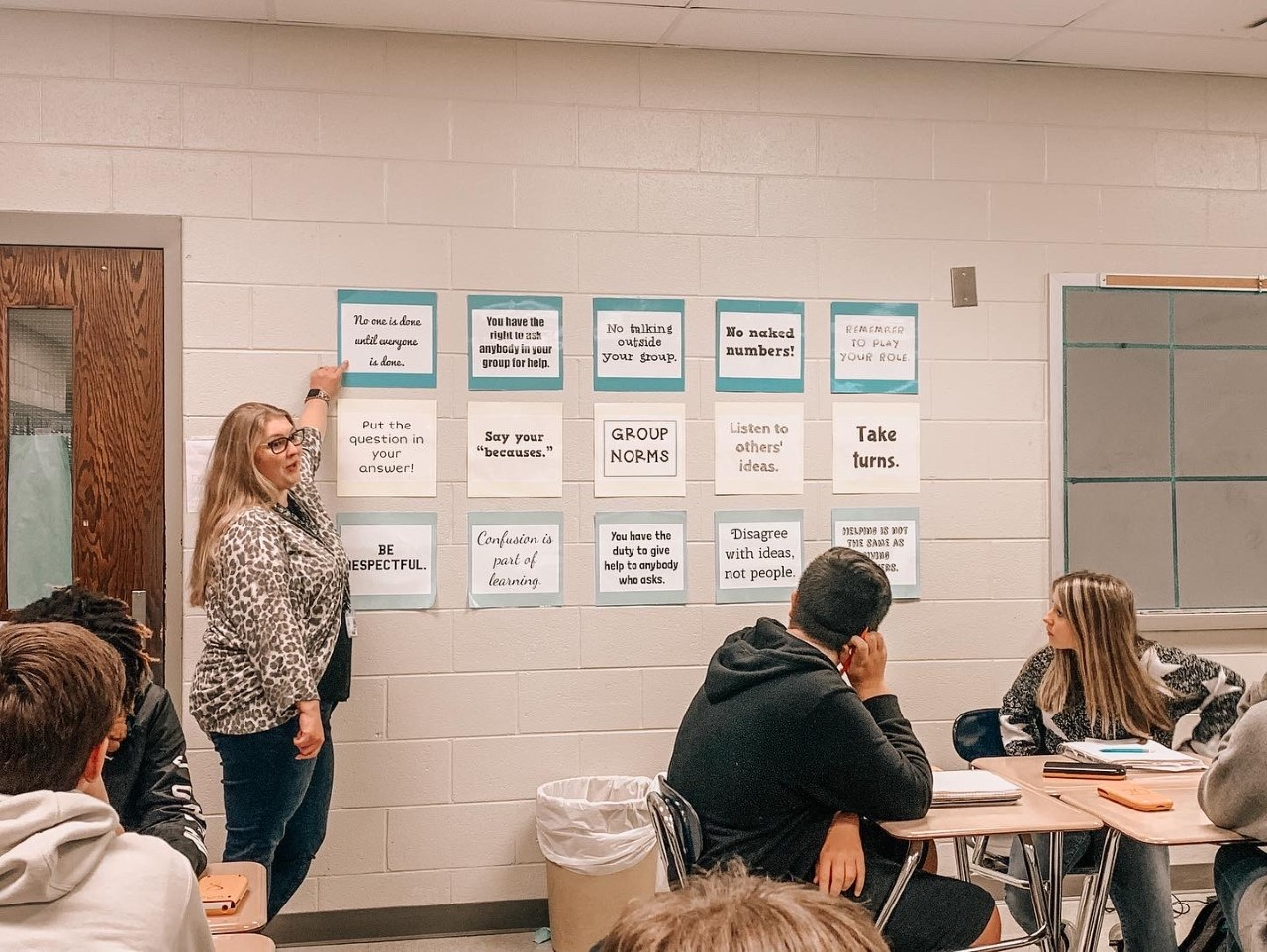
Academic discourse is a critical cornerstone of a Math Disciplinary Literacy classroom. Following the image was both a small group discussion and class discussion of the students’ discoveries. However, before discussing their findings, the Math teacher reestablished group norms.

The group norms of this classroom include: 

  • No one is done until everyone is done 
  • You have the right to ask anybody in your group help
  • No talking outside your group
  • No naked numbers
  • Remember to play your role
  • Put the question in your answer
  • Say your “becauses” 
  • Listen to others’ ideas 
  • Take turns
  • Be Respectful
  • Confusion is a part of learning
  • You have the duty to give help to anybody who asks
  • Disagree with ideas, not people 
  • Helping is not the same as giving answers 

Many of the group norms reiterate the marriage between content and literacy such as “say your because” and “put the question in your answer.” 

After the small groups discussed their answers, the teacher jotted down their responses on the board. The conversation with the whole class continued until a student finally responded with “The phone is charging!” From that response, the teacher shifted to the second sentence starter posed to students, “I Wonder…”, in which the students start sharing inferences based on the image. Eventually, a student says, “What time will the phone be charged?” 

Solving the Problem

Once students land on this essential question, the lesson then shifts to the “second act” where students attempt to solve the problem. The Math teacher then asks the students to make a “too low, too high, and just right” guess at what time the phone will be charged if it is 5% at 9:02. Asking students to estimate a too high, too low, and just right answer is critical thinking and at the heart of student’s mathematical practice standards. (SCCCR.MP 1-7). In just one sentence, a too high, too low, and just right guess allows students to use reasoning and analysis to create a path to problem solving. After students shared some guesses, the teacher shared three more images, revealing the next three stages of charging.

The teacher then told the class: “Now we are going to represent data. Four representations of math are words, tables, graphs, and equations. Please remember to answer your questions in the form of a sentence.” She also reminded students of one of the group norms: say your becauses. For the math teacher, it is important that students represent Math in all four representations every lesson. This representation of data reiterates the importance of students developing a deeper mathematical knowledge. The students first represented math through words, so they moved onto representing it in a chart. 

Before they began developing their charts, the teacher and the class worked together to define their variables for this situation (x=minutes of charging since 9:02; y=battery percentage).

XY
0
8
12
24
5
14
19
33

After creating the chart, the teacher asked, “using the data in your table, can you determine the type of relationship between these two variables?” The class consensus was that it is a positive relationship and appears nearly linear.

The teacher then told the class, “For now, let’s assume it is nearly linear. If this is true, could we use the data to write an equation to use for prediction when the phone will be fully charged?” 

Y = 1.17x + 4.88

100 = 1.17x + 4.88 

X ≈ 81.3 

Therefore, they determined the phone will be charged approximately 81 minutes after 9:02, or 10:23. After they solve the equation, the teacher then revealed the answer to show the students by slowly showing the progression over time. 

The slow reveal built suspense, and ultimately curiosity from the students. As Lent states, “The process of wondering, formulating questions, and thinking through concepts while respecting multiple viewpoints is as much the goal as certitude about a concept” (Lent & Voigt, 2019, p 111). If Math is the aspirin, then teachers must create the headache. Not a migraine, but a “cognitive conflict” or a “disequilibrium” (Meyer, 2015). This headache is created through the processes of wondering, questions, and thinking. And at just the right time, with just the right amount of curiosity and inquiry, the aspirin is given to the students in a sigh of relief (and frustration!). 

At this point, the class has represented math in three different ways: words, charts, and equations. The last representation is a graph. After the final reveal, the teacher says to the class, “What happened? We assumed that it would continue charging at the same rate. But as we start charging batteries, it actually gets slower. It starts slowing down.” 

The Importance of Disciplinary Literacy and Collaboration

While there may be hesitation for educators to pedagogically shift towards a disciplinary literacy approach to instruction, collaboration and co-teaching narrows the gap. Disciplinary Literacy is not merely reading and writing across the content, but rather placing literacy within the discipline itself. Lent explains, “…While practice is still important, the emphasis has shifted from only teaching the principles of math to helping students develop a deeper mathematical knowledge– and such instruction often includes collaboration” (p 155). I am thankful for Math teachers who take transformative action about the way in which they think about their content. I am thankful for a school where disciplinary literacy is a school-wide initiative. But most of all, I am thankful for literacy itself and its rightful place in all disciplines across all curriculums. 

References: 

Lent, R. C. (2016). This Is Disciplinary Literacy: Reading  Writing, Thinking, and Doing… Content Area by Content Area. Corwin.

Lent, R. C. & Voigt, M. M. (2019). Disciplinary Literacy In Action: How to Create and Sustain a School-wide Culture of Deep Reading, Writing, and Thinking. Corwin.

Meyer, Dan. 2015, 17, June).If Math Is The Aspirin, Then How Do You Create The Headache? Dy/dan. https://blog.mrmeyer.com/2015/if-math-is-the-aspirin-then-how-do-you-create-the-headache/ 

About the Author

Lindsey Douglas is a Clemson University graduate in English Literature, Secondary Education, and a Masters in Literacy K-12. Lindsey is a third year English teacher and is the 8th grade English Department Head at Gettys Middle School. She is passionate about disciplinary literacy and helping teachers embed literacy practices into their content. She also coaches volleyball and enjoys spending time outdoors, and reading.

About the Collaborator

Ashley Weaver is a National Board Certified Teacher and math nerd with 13 years of experience teaching middle schoolers. She teaches with the belief that all students can learn math and achieve at high levels and hopes to instill a love for learning in her students. When she isn’t teaching or learning about teaching, she enjoys reading and spending time with her husband and daughter.

Photo by Murat Onder on Unsplash

Supercharging our Content Teaching with Language Objectives

Teaching

By: Samantha Rainwater, South Carolina High School English Teacher

Back to the Basics

Like every teacher during March of 2020, life threw me quite a difficult curveball: in the course of a few days, I needed to scrap all of the plans and dreams I established with my students and reimagine the rest of the year virtually. I don’t know how y’all handled it, but I was at a complete loss. My very organized book clubs, the brand new unit on The Kite Runner we had just launched, the highly-technical argument unit and Convince Me project we were in the thick of, all of it, upended. I had to start thinking about what—with my very limited time—I would focus on with my students. Ultimately, I decided that literacy through interesting and meaningful reading and writing would be my primary focus for the rest of the year. 

I bring this up specifically to discuss how, even as an English teacher, I have a lot of content that doesn’t fall under the “reading skills” category. However, literacy is the key to our students’ ability to access our content. If I wanted my students to be prepared for the next school year, the task was not to continue my content-heavy units or teach all the figurative terms they would encounter in English 3, but to make sure that students’ literacy skills continued to develop.

We’ve heard it all before, maybe from a district official or an administrator at the beginning of the year: We are all reading teachers. But let’s be real. We have standards and pacing guides and benchmark assessments and end-of-course tests and the list goes on. For content-area teachers, how can we possibly add on the task of developing students’ literacy? After all, they take ELA.

The Case for Disciplinary Literacy

I had a major revelation this year when it came to literacy, and I think in many ways my background as an English teacher kept me from this revelation sooner. Secondary education relies on literacy skills as a means of accessing content knowledge; however, literacy isn’t just literacy. There are two major theories regarding how literacy works: content-area literacy, which suggests reading strategies transfer between content areas (Vacca, Vacca, and Mraz 2011), and disciplinary literacy (Shanahan & Shanahan, 2012), which suggests and “acknowledges that different disciplines contain different purposes for language, ways of communicating, and requirements for precision” (Croce, 2017). While it’s important to understand that some reading strategies do transfer, it is also important to acknowledge the merits of disciplinary literacy. It’s not like kids learn to read, then immediately their literary lives are unlocked, and they can henceforth access all written knowledge presented in all subject areas. Each academic discipline has its own discourse styles and structures that students have to learn and master because they are so unique and different from the typical ways we engage and use language socially. The literacy and discourse structures that are taught in the ELA classroom might not be sufficient for students dealing with the very specific types of literacy present in the science or math classrooms. For this reason, the very best teachers of literacy in content-area classes are the content-area teachers themselves! I know, what does an English teacher have to say about literacy in other disciplines? But hear me out. It might even make teaching your content more effective.

An Example: Disciplinary Literacy in the Science Classroom

Science teaching, for example, depends on informational texts to communicate content knowledge, to teach facts to students. However, what happens when a student’s observations of the world around them do not match the facts being presented in the scientific texts they are reading? What understandings of the scientific method and peer review process do students have to understand in order to comprehend and learn from these texts? Consider the words of Croce (2017): 

“According to conceptual change theory, a number of conditions need to be met in order for a student to change his or her mind about a science concept. Would a student be considered a poor reader if those conditions were not met and the student did not change his mind (in other words, learn a concept) after reading the text? I would argue that a student is not a poor reader if he or she does not immediately change his or her mind about a science topic after reading a text. This is because when we assess students as readers of science, it is impossible to separate who a student is as a scientist from who he or she is as a reader (emphasis added) (Croce, 2015).”

Being an effective scientist depends on being literate in scientific discourse styles, specifically. If we expect students to learn how hurricanes are formed through reading a text, we have to approach the reading of that text as scientists, which requires different literacy foundations than what is required in their English class (and reading in science, math, and social studies often has different goals than in ELA). Scientific texts also have unique language patterns (i.e. cause and effect relationships in scientific sequences) that need to be explicitly taught to students. Students reading in their literature classes may never encounter those specific language patterns. When students are taught these discourse styles, they are then able to make sense of the content presented in these texts. 

First Steps: Introducing Language Objectives

I don’t think that we necessarily have to be reading specialists on top of our content-area and pedagogical expertise. I do think, though, that we need to be aware of how our disciplines use language and provide instruction for our students so language isn’t a barrier to learning the content. One of the most meaningful ways that I’ve started doing this in my own classroom is through language objectives. Language objectives are similar to content objectives in that they articulate what students’ will be able to achieve by the end of a lesson or period of time. The only difference is that while content objectives describe what students will know and be able to do, language objectives describe how students need to use language in order for the content to be accessible. If you need a place to start in terms of understanding how language should be used at different proficiency levels, I recommend viewing WIDA’s Can Do statements. 

As you are planning a lesson, ask yourself a few questions: What discipline-specific and general academic vocabulary do my students need to know to meet the content objectives? How is language functioning in this lesson (Are we listening to a speech made by an historical figure? Recording observations in a science experiment? Describing? Predicting? Comparing? What language styles and structures do we need to employ to do these things?) What language structures or grammatical features are common in this lesson? (Are we reading an academic text with frequent passive voice? Imperatives? Does the organization of the text need to be understood for students to comprehend it better?) What functional language is used during this lesson? What do I observe about my students’ needs when it comes to language? 

By doing this, we will become more aware how language works in our disciplines, and we can then work to lower the linguistic hurdles students need to overcome to understand and excel in our content. We can also take the answers to these questions and design focused objectives and direct instruction related to the language of our disciplines. The beauty of designing language objectives is that it occurs alongside the teaching of our content objectives; we don’t pause our instruction to teach language and grow literacy. This can happen with small mini-lessons embedded in the larger instruction for the day. For example, in a high school chemistry lesson, the language objective might be that “Students will be able to use adverbs of time in their lab report to describe their observations (first, next, later)” (Echevarria et. al, 2011). Maybe, in a math lesson, students need to understand the language of conditionality in order to solve a word problem. From there, you would design a language objective. This might take all of 10 minutes, but it will enable students to meet the task of writing their scientific observations within their lab reports. 

Developing and strengthening literacy specific to our disciplines is not a separate, full-time job. Instead, we can use language objectives to make our content teaching even more effective.

About the Author

Samantha Rainwater is the current English department chair at Richland Northeast High School in Columbia, South Carolina. She has eight years of teaching experience in the ELA classroom and is currently working to complete her ESOL certification. 

New Literacy Studies: For What It’s Worth…

Research

By: Dr. Todd Lilly, University of South Carolina

(For what it’s worth, this blog is peppered with a few hyperlinks to entertain the reader and to illustrate New Literacy Studies… for what it’s worth. Enjoy!)

Here’s a scene you might recognize: Everyone is concerned about the mental health of the young prince. The father of his fiancé finds him alone in a room in the castle, absorbed in a book. “What do you read, my lord?” The prince stops reading, flips through his book as if to try to find an answer to this most-important question. Then, as if making an astonishing discovery, he answers: “Words. Words. Words!”

I know what you’re thinking: “I’m not an English teacher! What’s this got to do with me?” Well… In the context of New Literacy Studies…Plenty. For what it’s worth, there was certainly a whole lot more in the prince’s book than words, and that should interest all of us.

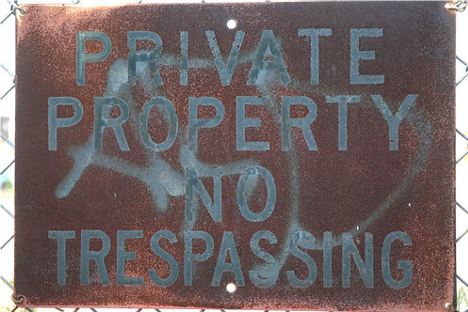
Our house backs up to a popular public recreation area, so our Home Owners’ Association (HOA) posted signs: “Private Property/ No Trespassing!”

Many third graders would have no trouble sounding out the words:

“Pr…Pr… Pr  as in Pretzel”

“Tr…Tr…Tr… as in Truck”

Hmmmm… I have no idea why the ‘ATE’ in “ PRIVATE” shouldn’t be pronounced like “8” or why the ‘ei’ in “eight” should. What exactly is a ‘ə’ anyway? “I’m not a reading teacher!” Anyway, that’s the gist of old literacy studies.            

So, maybe we secondary teachers don’t actually know all that much about Old Literacy Studies, but still, we get the idea: If kids know enough rules to sound out words, they can read just about anything we give them, whether it’s a social studies text book or Hamlet. It’s an autonomous design: Learn to decode and you have power. It’s that simple.

Well… actually, no, it’s not that simple. And neither are the literacy events and practices we expect students to engage in when they enter our classrooms. That’s where New Literacy Studies gets interesting.

About 30 years ago, just about the same time as “You’ve got mail!” several out-of-the-box smart people from a few English-speaking countries got together and kicked around the idea that literacy was more than decoding, semiotics, and semantics. In the mid-1990s they saw how the rise in popularity of digital technology had the potential to radically change the way people produced and consumed all kinds of texts. They got so excited about this “New” idea that they made plans to meet in a small New England town, New London, New Hampshire, just to talk about it. And they did. They came to be known as “The New London Group.” What was their conclusion?

This might be a good time to get up, stretch, visit the bathroom and/or the refrigerator, maybe do a little yoga… Ok, here goes:

They decided that literacy is a social event embedded in a complex web of power-laden social and technological contexts that all revolve around texts and language. (Yes, English teachers; that’s what Pygmalion, written a century ago was all about… “Duh!”). Another way of looking at it is that literacy exists by means of some technology (a book, a sign, a billboard…) in a social space between a producer and a consumer. It involves ways of speaking, thinking, acting, and believing, which would mean that one’s identity and membership in social groups can and does affect meaning. This mutation from literacy as merely decoding to literacy as a social practice was coined “the social turn.”

So there. Move over Gutenberg!

That’s pretty much what they could agree upon. I can imagine the discussion got a bit contentious when they started thinking about the definition of “text.” Is an embroidery of birds on a pillowcase a text? Seriously, that’s an important question in the context of multiliteracies, but we’ll save that for another blog.

For now, let’s consider the “No Trespassing” sign above as a text. It’s not a Falkner novel or a Shakespeare play, “but ’tis enough, ’twill serve.”

Someone created the sign, someone nailed it to a tree, and there are indeed people who have come along and read it. The sign successfully transfers an idea from the sign’s producer to the consumer: “Keep off OUR property!” The literacy event is accomplished. What more might these New Literacy folks say?

Well…plenty. They would point out that that the posting and reading of the sign was but an event, part of a larger practice that brought together myriad social and power connections. The sign was initially a reaction to a legal context. At our annual HOA meeting, our lawyer noted that if we hadn’t posted these signs, we would be liable for any damages incurred by anyone who stepped onto our property. (Don’t you just LOVE lawyers?)

There’s also, of course, a power dynamic. Who are these potential trespassers? We can only imagine them happening by and reading our message: We own something/ you don’t/ you can’t have it/ We deserve it/ You don’t. Nanananana…  “The sign said you got to have a membership card to get inside…Ugh!”

I’m sure y’all noticed the graffiti on the sign, probably a tag, a unique form of literacy that a certain group of people (in this case, graffiti writers) use to identify their work: Loosely translated, it says: “Hey, I’m somebody too!” And am I wrong to deduce a bit of anger and animosity?

If literacy, then, is all about contexts and social memberships, who gets to decide meaning? ELA teachers have heard this refrain before; it’s not new.

Student: “Mr. Lilly, I think Robert Frost’s ‘Stopping by Woods on a Snowy Evening’ is about Santa Claus.”

I can’t remember my reply, but now in my current life, I call forth the literacy gurus:

Louise Rosenblatt would have said, “Ok, a reader has a right to make meaning out of otherwise meaningless symbols.”

E.D. Hirsch might exclain: “Hogwash! Go ask Frost!”

Michel Foucault would look up from his bath: “Go for it kid ‘cuz Robert Frost is dead!”

Here’s some song lyrics that were a bit more popular than Frost when I was a kid:

“Paranoia strikes deep. Into your life it will creep. It starts when you’re aways afraid. You step out of line, the man come and take you away.”

–Stephen Stills

In the words of the great Yogi Berra: “It’s like déjà vu all over again.” For you youngins (“Ok, Boomer…”), long before Post Malone, Lizzo, Chance, JayZ/ Beyoncé; long before Justin and Taylor, even before Back Street Boyz and still further back before AC/DC there was the Buffalo Springfield. Band member Stephen Stills, in 1967, during the tumultuous years of the Vietnam War and Civil Rights, immortalized these words in his “For What It’s Worth” which rocketed to #7 on the Billboard Hot 100 chart.

Ok, what’s it about? Vietnam Protests? The Generation Gap? Was it a precursor to NWA? “Words, words, words.”

Nope, it was about an event in which riot police confronted a large gathering of young people who came together to protest a curfew in Hollywood, California. But to hundreds of thousands, it represented a division in America, an anti-establishment movement that exists to this day. If you don’t recognize the lyrics, I’ll bet if you click on the above link, you’ll recognize the tune. And if so, is the tune an integral part of the text? (If you actually click on that link, you’ve officially become involved in New Literacy Studies!)

Ok, that’s cool, but here’s the kicker: What happens to a text when it becomes older than the generation for which it was written? In the 1990s, about the same time the New London Group met in New Hampshire, the Buffalo Springfield band members (minus Neil Young, of course) all in middle-age, allowed their song to be used in a Miller Beer commercial. What?! An anthem of protest converted into an anthem of capitalism?! “Something’s happenin’ here. What it is ain’t exactly clear…”

Well, actually, it is quite clear. The baton had been passed to a new generation. The context, the setting, the medium, the identities and power dynamics of the producers and consumers had changed from social injustice to quaffing a cold one. If you think about it, it’s much like what kids experience when they march from math to social studies to ELA and to lunch, all in the course of a typical morning. Everything changes. Students might read the same word in each class’ lesson, (“plot,” for example), but it will have a totally different meaning as the bell rings and students march from one class to another. The fact that they can pull this off day after day demonstrates remarkable sophistication. No science teacher is going to accept a lab report written as a rhetorical composition. As soon as students cross the threshold into the science room, they abandon the aesthetics of poetry that defined the day’s ELA class and magically conform to the inductive reasoning espoused by Francis Bacon, whoever he was.

Where old school technology goes to die-
Alex Watson, CC.org

Nothing is benign; a literacy event is always at the intersection of competing contexts (identities, histories, cultures, purposes, technologies) that can wax and wane over time. While in the course of a single day, we demand students think like a historian, think like an artist, think like an author, think like a scientist, think like a mathematician, think like a musician; all of which require a different literacy practice.

This past March, those kids were sequestered to rooms in their home “castles” somewhere in the village or in places even Verizon won’t go. And at the flip of a switch we were found alone at our laptop at our kitchen table desperately trying to replicate the old literacy practices of a face-to-face classroom and project it onto the new, unseen, unfamiliar contexts of the students’ existence. We tapped out words that were meant to convey the same curriculum and the same standards, but we all sensed the inevitable: “Something’s happening here/ What it is ain’t exactly clear.” More than a few of us have been confronted students’ equivalent of “No Trespassing/ Keep Out;” maybe not in so many words,

This could be a very long, very hot summer!

Robert Davy “Protest” Licensed through Creative Commons

“What a field-day for the heat. A thousand people in the street. Singing songs and carrying signs. Mostly say, “Hooray for our sign!’…You step out of line, the man come and take you away. It’s time we stop, children, what’s that sound? Everybody look what’s going down…”

For what it’s worth, this New Literacy Studies stuff never gets old.

“It’s only words and words are all I have to take your heart away” –Shakespeare  (Just kidding; it was the Bee Gees, and if that makes a difference to you, welcome to New Literacy Studies!)

About the Author

Todd Lilly has been a teacher for over 40 years, the majority of which was invested in middle and high school ELA and theater classes in and around Rochester, NY. Over the past 10 years he has served on undergraduate and graduate faculties in Wisconsin and currently at the University of South Carolina. He earned his Ph.D. in Curriculum and Instruction at the University of Wisconsin-Madison. His research interests include out-of-school literacy practices and the stories of marginalized, disenfranchised students. He is married to Dr. Catherine Compton-Lilly who holds the John C. Hungerpiller chair in the College of Education, University of South Carolina