Explore how to leverage quality NGSS curricula to enact disciplinary literacy in your 6-12 classroom with this recorded webinar featuring Mary Starr, Executive Director of the Michigan Math and Science Leadership Network. Discover the hidden disciplinary literacy within NGSS-aligned materials and learn how to incorporate additional opportunities using science and engineering practices. This session focuses on helping science learners recognize and utilize literacy practices in their own learning. Watch now to gain valuable insights from this free webinar, originally presented on March 15th, and funded by a grant from the South Carolina Middle Grades Initiative.
About the Presenter
Mary is the Executive Director of the Michigan Math and Science Leadership Network and a leader of the Disciplinary Literacy Essentials initiative in Michigan. She has authored textbooks, provides NGSS professional learning and leadership support across Michigan and the US. Currently, Mary is a co-PI on an NSF grant called Learning in Places. When she’s not organizing, writing or providing learning opportunities she can be found working elbow to elbow with science teachers in the classrooms.
Stephanie: As a literacy teacher educator whose scholarship has primarily focused on agricultural literacy development in K-12 classrooms over the last 5 years, I have been fortunate to meet many dedicated, amazing K-12 Mississippi classroom teachers. Through four United States Department of Agriculture/National Institute of Food and Agriculture (USDA/NIFA) grants on professional development in agricultural literacy, I’ve been able to work with a wide range of teachers including gifted education, social studies, all elementary subjects, mathematics, welding, library, college-and-career readiness, science, and agriculture education. One of those rock star teachers is Mrs. Tammie Marlow, a 7th grade science teacher at Cleveland Central Middle School, in Cleveland, MS located in the heart of the Mississippi Delta. Tammie is an award-winning science teacher; she recently was awarded the Rural Teacher of the Year for her congressional district in Mississippi (an award given from the Program for Research and Evaluation for Public Schools housed at William Carey University). She participated in two of my USDA/NIFA grants in summer 2022/academic year 2022-2023 and summer 2023/academic year 2023-2024. The Agricultural Science Professional Development [ACRE] program focused on animal science, with a heavy emphasis on livestock, plant science, meat science, literacy instruction, and teacher leadership. The Agricultural Science Professional Development 2.0 [ACRE 2.0] program focused on poultry and food science, socio-emotional learning, and literacy instruction. Over those two years, Tammie took many of the ideas presented in these professional developments and incorporated them into her 7th-grade science class, expanding the curriculum to include a large focus on hands-on agricultural education. Below, I interview Tammie about her work at Cleveland Central Middle School in order to share with you many of the ways she has incorporated agriculture lessons into her classroom instruction.
Tammie, can you please share with readers your reasoning behind starting the Home-Garden-Science Club?
Tammie: The district that I teach in is the last district to consolidate in Mississippi. This brought many challenges, especially combined with the timing of the Covid epidemic. We are the only middle school in our district, and we serve as a bottle-neck transition to 6 local elementary schools plus students that move in from outside areas. Students were placed in this new environment and did not know their peers in this educational transition time in their lives. They didn’t have any time at school for downtime to visit and get to know each other. With this realization, my family and I decided to start an after-school program that would give them a safe place to meet, make new friends, and learn practical skills that will make their lives better. We called it Home-Garden-Science Club because we did everything including experiments, planting gardens, teaching students how to sew, holding cooking classes, and doing crafts together.
Picture: A student in the Cleveland Central Middle School Home-Garden-Science Club
This after school program has grown into an outdoor learning space that encompasses an outdoor classroom with electricity, a plowed field, an orchard, a tractor with attachments, multiple gardening tools, a three-door tractor shed with electricity and water, new fencing, and a greenhouse. This is a testament that people want to help, and when they see things happening, they will help. When we first started, we had students stand in line waiting their turn to use a hoe and shovel. We had to teach students how to use a water hose to water plants. You cannot assume that students know how to do what you know. It still amazes me to think that this all started from letting kids meet after school one day a week to have a safe place to have fun together and learn.
Picture: Students working in the garden at Cleveland Central Middle School
Stephanie: That sounds wonderful, Tammie. I know the students have enjoyed working in the garden and seeing the fruits of their labor with the produce it has yielded. Can you share with me some in-class, hands-on agriculture labs you have done with your students that have made an positive impact on their agricultural literacy development?
Tammie: Most students really enjoy lessons that they are involved in and take active parts in leading the learning activity, especially the labs that include food. I facilitate student-lead lessons in as many classes as I can. I believe students learn better when they have fun, can relate information to their personal lives in the real-world, and are physically active in the lesson with hands-on activities, literacy activities, maps, collections of specimens to explore/investigate, Guest Speaker interaction, field trips (actual and virtual) and labs that reinforce the standards. Project-based learning works well for all of my classes. Hydroponics, Micro-Green Farming, and Earth Cycles are 3 project-based lessons that we completed this year. Students really enjoyed constructing wildlife habitats. MSU Extension officers taught my 7th grade students how to use both power tools and hand tools in order to build the habitats.
For example, one of our state standards in 7th Grade Science is: “Explain how disruptions in cycles (e.g., water, oxygen, carbon, and nitrogen) affect biodiversity and ecosystem services (e.g., water, food, and medications) which are needed to sustain human life on Earth.” Together with an Ag student from MDCC, a USDA specialist, and my co- 7th Grade Science Teacher collected soybeans while at their prime and planned a Legume Lab for our students. Students were first given a pretest on soybeans and other legumes. The need was clear; they needed hands-on experience with soybeans or other legumes. Soybeans make up the number 1 top-row crop in Mississippi and come just behind poultry on the list of agricultural commodities. Most students didn’t know what soybean plants looked like even though they live in a rural area surrounded by large soybean farms. We held the Legume Lab outside and the USDA specialist showed us how they use toothpicks as a tool in the soybean programs. Students were given toothpicks to dissect the soybean plants which are legumes. They were to locate and dissect the nodules that house Nitrogen-Fixing Bacteria that are responsible for Nitrogen Cycling into usable forms for living things. This was probably one of the most valuable labs conducted by our 7th Grade Science students. They completed lab sheets, and we took lots of pictures to serve as evidence of their findings. These students now know what soybeans are and how important they are as a food source along with information they learned about Nutrient Cycling. We now grow soybeans, with the other plants, in our school garden and the Home-Garden-Science after school club cares for them. This is a much-needed lab for not just rural students but for every student. Students need to be educated about the importance of nutrient cycling, our land. and where our food comes from.
Picture: Students engage in the Legume Lab in class.
Further, I was so shocked to learn during ACRE that the Mississippi Delta is in the middle of a food desert. According to Uproot Mississippi (2024), Mississippi has been considered the most food insecure state for the last decade. Bolivar County, where Cleveland resides, had a population of over 6,500 individuals who experience food insecurities as of 2022, and an annual food budget shortfall of over $4,000 (Feeding America, 2025). Food insecurity is prevalent in this area where people don’t know when they’ll get their next nutritious meal that they can afford. This is the area where I was raised, and I never thought about food insecurity.
Stephanie: I was shocked to learn about food deserts and their prevalence in Mississippi as well. I know this has become an important topic to you. Can you describe ways in which your students have learned more about food deserts?
Picture: Students engage in the Legume Lab in class.
Tammie: I was raised on a 5-generation farm and we always had large gardens that we called “patches”. We had a “pea patch”, a “pumpkin patch”, a “green patch”, a “corn patch”, and other mini fields where we grew food for our families and the community. I have learned in my adult years that most people don’t live where they can grow their own food. After learning about the food deserts, I developed a research project for my students on food deserts and solutions that each student can be a part of. Because of this realization from the ACRE influenced project my 7th grade students are working with our community to plant a student-community food forest to help fight against food insecurity in the food desert in which we live.
Picture: Students presentation on overcoming community food insecurity.
As part of the solution students want to plant this food forest in a place where everyone could harvest fresh free food anytime they want to. The place they decided to do this was our local park because it has the land to plant the food-plants on and plenty of parking that would be safe for everyone. Students also learned that planting more trees can help with climate change by removing excess carbon dioxide from the atmosphere which will lessen the greenhouse effect. This can in turn keep our weather from having great fluctuations, decreasing droughts and floods. I am so proud of what my students have learned and their desire to help others. Students learn about problems, but they also need to learn how to be part of the solutions.
Picture: Garden beds at Cleveland Central Middle School
Stephanie: Last question Tammie. Can you provide me with an example of how you have intentionally provided opportunities for your students to reflect as a demonstration of their learning?
Tammie: Finally, as I introduce my students to real-world science problems, and they play a role in forming solutions, I have incorporated more literacy instruction teaching it with “more zest” in my classes after the training that I received in ACRE and ACRE 2.0. For example, to get students to write and learn more deeply about vocabulary, I use strategies such as journaling, ABC brainstorming sheets and Frayer models. In teaching my science vocabulary, I have put a greater emphasis on teaching my students morphology–affixes (prefixes and suffixes and root words).
Students also write lab reports after engaging in real world labs. We engage in close reading of various sources. I also have implemented a talking ball in class to help facilitate class discussions. Students have engaged in oral presentations and poster projects as well. This focus on literacy, coupled with the extensive hands-on learning in my science classroom (both indoors and outside) has provided my students with opportunities to deeply learn scientific and agricultural content as well as be able to communicate effectively about that content because I’ve prioritized the importance of reading, writing, and speaking like a scientist or agriculturalist in my classroom as well. Ultimately, I believe as teachers, we need to make sure that we aren’t just teaching content but how to be good stewards of our world. We only have these precious students for just a little time, we need to make sure we make the most of teaching them and giving them opportunities to be good stewards. I want to challenge every teacher to take part with their students in planting a food forest to help feed our world… one plant at a time.
Stephanie M. Lemley is an Associate Professor of Literacy Education in the Department of Teacher Education and Leadership in the College of Education at Mississippi State University. Her research agenda focuses on increasing agricultural literacy, through hands-on learning and instruction with agricultural texts, in the K-16 population. She can be reached at smb748@msstate.edu.
Mrs. Tammie Marlow is an award-winning science teacher at Cleveland Central Middle School in Cleveland, MS. She has taught for 25 years in Mississippi, Louisiana, Alabama, and North Carolina. In North Carolina, she was a parent liaison that tutored students after school, helped students in classes, and filled in for teachers. In Louisiana, she taught HeadStart in Plaquemine Parish and used the Pacing System in a Christian Outreach School for students that lived in the Marsh (we had a School-Boat instead of a School-Bus to transport our students). Tammie has taught US History, 8th grade science, Biology, Biology II, Aquatic Science, Science Skills, Environmental Science, and Forensics. She can be reached at tmarlow@cleveland.k12.ms.us.
Discipline Literacy focuses on how students read, write, and critically think about content in a certain field. To me, the most important way to teach is through modeling so that students can see and understand the expectations. Fisher and Frey (2020) highlight the importance of reading comprehension strategies, collaborative discussions, and writing-to-learn activities. These enable students to process information more deeply and develop expertise in their subjects.
Food and Nutrition connect to particular skills within the disciplines of Science, Math, and English. In our class, we cover many different standards that build and support one another. In this post, I will share our Food Truck Project where we apply the principles learned in Foods & Nutrition 2 by focusing on nutrition science, food safety, and meal preparation for diverse consumers.
Connecting the Food Truck Project with DL
As students dig into their Food Trucks, they engage with hands-on, interdisciplinary experience with various disciplinary literacies not just about the recipe they want to carry out but as a global phenomenon as each student develops skills and knowledge in a diverse approach that is interconnected to the world. This project links to numerous disciplines and content areas that allow students to apply and engage in different fields. The project challenges students to think critically, creatively, and analytically. Take a look at all the ways this project connects with literacy and other disciplines:
Science and Sustainability: Students investigate the ingredients they will use in their Food Truck recipes. Students create a concept of sustainability, food production, and the impact of climate on the global food system. Students share the impact of agricultural practices on the environment, the role of nutrition in personal and public health, and the importance of ensuring access to nutritious food for all; therefore, they connect their learning with real-world concerns about food and the environment.
Economics and Business: Students create a lean canvas model to support their Food Trucks. This model type is a tool designers use to map out a business or product’s key actors, activities, and resources, the value proposition for target customers, customer relationships, channels involved, and financial matters. It gives an overview to help identify requirements to deliver the service and more. Students research the food industry in different regions, understanding the food production, distribution, and consumption from where their truck region is based. This connects the global business landscape with hands-on entrepreneurial learning.
Cultural Connections: Students research and explore different global food traditions to understand how different cuisine reflects history, geography, and cultural values. As students understand these influences, they learn about the diverse perspectives and the global food systems.
Communication: Students use their communication skills by presenting their food truck concepts and writing promotional content. They learn to create marketing material that reflects cultural sensitivity and global awareness. This process involves developing marketing materials such as advertisements, social media posts, or flyers that not only showcase their menu but also reflect cultural sensitivity and global awareness.
History and Geography: Students learn historical and geographical influences on food as students trace ingredients and recipes through trade routes and migration. This shows students how food is a powerful tool for the world to understand as it is interconnected to history and cultures.
Mathematical Literacy (Scaling Recipes): Students use measurements and conversions to scale a recipe for a larger or smaller crowd. They adjust recipe measurements based on the food truck’s expected serving size and customers. Students research the ingredient list for a dish and work together to calculate the total cost of producing one serving. They then scale it up to 50 servings for staff on Food Truck Day.
Cooking: Students have a chance to prepare their menu item, ensuring they can execute it effectively under time constraints. They learn kitchen skills and techniques that align with the culinary discipline.
Life Skills: Students take on different roles—chef, server, cashier—allowing them to practice not only cooking but also customer service, teamwork, and handling food truck logistics. This aspect emphasizes the project’s interdisciplinary nature, involving skills in business, communication, and teamwork.
Community Engagement: On the day of the food truck event, students serve their menu items to school staff or possibly even fellow students. This is a fun, community-building experience and an opportunity for students to showcase their learning.
Writing: Students reflect on their experiences working on their Food Truck project, focusing on individual and teamwork contributions. Students reflect on their performance and identify ways of improvement. Students reflect on their experiences and how they relate to the standards covered in Food and Nutrition 2.
How Do I Enact this in my Classroom?
You may wonder how I set up this project in my classroom. First, students are divided into six different groups. These groups are created by the students with my guidance. Then, as a group, they work collaboratively to plan a menu that showcases their global cuisines while emphasizing health and social responsibility. Students collaboratively research and choose dishes from different cultures that highlight diverse culinary traditions and meet health-conscious guidelines. They must select recipes that offer a variety of nutrients, focusing on whole, unprocessed foods and ensuring the menu includes a good balance of macronutrients. Students discuss the environmental impact of food production and try to incorporate locally sourced, seasonal, or sustainably produced ingredients. Doing so allows the students to appreciate how different cultures approach food.
They also discuss who takes on which roles and when they will switch off. Roles include recipe development, budgeting, and marketing, allowing them to practice workplace readiness skills. As a team, the group moves beyond hypothetical discussion, and they take on the chef role as they cook their menus for school staff and students. This allows students to move beyond learning and discussing and ensure they follow sanitation and proper food handling techniques as they prepare their dishes.
Students also create presentations to share their culinary creations and the cultural significance behind them, enhancing our understanding of food’s role in cultural identity. Students reflect on their projects within their groups and individually to demonstrate how they connect to what they have learned, consider growth areas, and develop ways to self-improve for future projects. Therefore, this project reinforces our classroom learning and prepares them for real-world culinary careers.
If you’re a teacher looking to implement a Food Truck Project with a focus on culture and global awareness in your Food and Nutrition class, here’s how you can approach it:
1. Define Your Project’s Scope
This project concerns students working collaboratively to create a food truck business plan that showcases global cuisines while emphasizing health, sustainability, and cultural awareness. The ultimate goal is for students to apply what they’ve learned in food safety, nutrition, and meal preparation to a real-world entrepreneurial project, integrating knowledge from multiple disciplines.
2. Organize Your Students into Teams
Divide the class into groups (around six students per group). Each group will handle different roles—menu planning, marketing, budgeting, recipe development, and food prep. Let students have a say in forming their teams but provide guidance to ensure a balanced mix of skills and interests.
3. Research Global Cuisines and Nutritional Aspects
Each group will research a global cuisine to explore the historical, geographical, and cultural influences on food. Students will also consider the nutritional aspects of their chosen dishes and how to create balanced, health-conscious options.
4. Develop a Lean Canvas for the Business
Students will create a lean canvas model for their food truck to build an entrepreneurial mindset. This business tool helps them map out critical aspects like the target market, cost structure, value proposition, and sales channels. This model connects them with real-world business concepts and teaches them how to approach running a food business.
5. Address Interdisciplinary Connections
The project links to multiple disciplines:
Science: Students explore the science behind nutrition, food production, and sustainability.
Math: Students practice scaling recipes, converting measurements, and calculating costs.
English/Communication: Students write promotional content, create marketing materials (e.g., flyers, social media posts), and present their concepts to peers and staff.
Social Studies/History: They research the history and geography of the cuisines they’re exploring and how food travels through trade and migration.
Life Skills: Students learn teamwork, customer service, and logistics in a real-world setting.
6. Plan and Execute the Menu
Each group collaboratively designs a menu that balances health-conscious recipes with cultural authenticity. They will:
Consider how to prepare these dishes while following food safety protocols.
Discuss the environmental impact of the ingredients and try to source them sustainably.
Where possible, select locally sourced, seasonal, or organic ingredients.
Practice cooking and preparing dishes while keeping within their budget constraints.
7. Present and Serve
On the day of the food truck event, students can serve their food to staff and/or students. This allows them to practice their food safety knowledge and engage with the community. Students can share their presentations about the cultural significance of their menu items, explaining the dishes’ history and geographical context.
8. Reflect and Assess
After the event, students reflect on their project—individually and as a group. They’ll evaluate what went well, identify areas for improvement, and think about how this project connects to their future careers in culinary arts, nutrition, or business. They will also write about the learning process and the interdisciplinary connections they made throughout the project.
9. Build Real-World Connections
This project isn’t just about food; it’s about developing skills students can use in their everyday lives and future careers. They will learn to think critically about food systems, culture, and health, gain experience in marketing, budgeting, and customer service., and understand how food production impacts the environment and global health.
This project is designed to be a cross-curricular, hands-on learning experience that prepares students for the challenges of the real world while connecting what they’re learning in the classroom to issues like sustainability, cultural appreciation, and global awareness. By making learning interactive and tied to real-world experiences, you’re not just teaching them about food and nutrition—you’re empowering them to become responsible, informed global citizens and future leaders in their fields.
Good luck, and I’m sure your students will find the project engaging and inspiring!
Final Thoughts:
I believe my job is to connect their learning with my content area and other disciplines by engaging students in real-world experiences and learning. I believe that students need to connect their learning to other disciplines because this allows them to see what they are learning in a broader context. This will enable them to connect, understand, and engage in different reading, writing, and critical thinking approaches.
About TammyJo Hays
I am a Career and Technical Education instructor specializing in Family and Consumer Science for students in grades 9 through 12. I’m married to my high school sweetheart and the proud mom of two amazing boys. My family and I love creating lasting memories through camping, traveling, or simply enjoying an ice cream outing together. I believe the connections we build leave a meaningful mark on our journey, shining brightly for others to see. Faith and love for one another are at the heart of everything I do.
As I have been interacting with educators within classrooms and leading district professional learning, it has become apparent to me that despite a great deal of research energy being placed into distinguishing disciplinary literacy (DL) from content area literacy (CAL), this distinction has not carried sufficiently into professional learning practices. In fact, these ideas are still significantly conflated, with DL largely being represented by vocabulary instruction within subject-specific courses. While this can be an entry point for teachers seeking to embed DL practices into their instruction (Savitz, et al., under review), it is limiting and misrepresents DL’s opportunities for real-world problem-solving, interdisciplinary development, and critical thought. The subsequent goal of this blog, as well as the next three month’s themes, is to return to the defining and conceptualizing of DL from a practical standpoint.
Distinguishing Disciplinary Literacy and Content Area Literacy
Helping teachers and future educators distinguish DL from CAL is one of the challenges within the literacy coursework. Recognizing this is an oversimplified concept, I often begin by having students identify DL as the “what” of their teaching – the knowledge, skills, language, discourse, practices, and habits of mind contextualized to and specific within the subject areas (Ippolito et al., 2024; Lent & Voight, 2019). CAL, on the other hand, is the “how” of teaching; it constitutes content-neutral strategies and tools used to support students in attaining knowledge of the content (McKenna & Robinson, 2014; Ortlieb et al., 2024).
To help students better understand the concept behind DL, I ask them to follow a set of instructions they are given auditorily. They are told to follow these instructions to the best of their ability: “Virabhadrasana I, Prasarita Padottanasana, Trikonasana, Parivrtta Trikonasana”. I am usually met with dumbfounded looks. Then, I present the instructions in English: “Warrior I, Intense Leg Stretch, Triangle, Reverse Triangle.” Here, I often get students standing with their arms making a triangle over their heads. While students can decode the words – they understand the concept of a triangle or warrior – and some may even recognize the words are associated with yoga, most are not able to connect the words to the kinesthetic actions needed to perform these yoga poses (Morrison, 2024). This is because the task for this yoga sequence – and for literacy practices in specific disciplines – is not just to acquire information from a text but “rather to embody it in dynamic three-dimensional space, as it unfolds over time, in concert with other individuals” (Chandler-Olcott, 2017, p.151).
I then ask students to demonstrate their understanding of CAL and DL within their own subject area. One of my students, Angelina, explained it this way:
They [DL and CAL] are similar in that they both involve an understanding of how to navigate the topic. Disciplinary literacy involves understanding how the specific content area works—common vocabulary words that may not have the same meaning in other contexts, how to analyze and correct form in a P.E. setting, how to tell the difference between a rondo and trio in a music theory setting, or how to structure a haiku in a language arts setting, among other things. In short, it is everything one needs to be fluent and knowledgeable in the discipline. Content area literacy, however, is all about analyzing, synthesizing, summarizing, and questioning. It is the tools (sic) one needs to think critically about the information to gain a greater understanding of the content…This helps to reinforce the material, provoke focused thought, and engage the students in active learning, as is the goal of content area literacy.
Figure 1: Venn Diagram Showing Student Interpretation of DL and CAL
Another student, Alexis, demonstrated his conceptualization of CAL and DL through a graphic organizer (Figure 1). As can be seen in his example, he has shown the complexity and interaction of CAL and DL while also explaining the distinction between them. He identified content-neutral literacy strategies, like anticipation guides and accountable talk, as well as cross-disciplinary student practices, the 5 Es, as CAL used to support students’ learning. He explained that DL, in his case music literacy, is not just about the vocabulary and ability to read notation or the ability to play notes on a page. As he points out, DL is about students’ ability to “take a piece of music, study it, perform it, and fix any mistakes so they can put on the best performance they can.” In this example, we see how DL becomes about the complex “embodiment” (Chandler-Olcott, 2017, p. 151) of text because a performer who does not have strong DL will not be able to make the immediate pivots and corrections necessary within a performance circumstance.
Figure 2: Student Representation of Disciplinary Literacy and Content Area Literacy
Shifting the “Thinking Like” Mantra
Building on this idea of text “embodiment,” one of the prime mantras of DL has been to have students “think like experts” within the specific discipline, e.g. to “think like scientists” or “think like mathematicians” (e.g. Lent & Voigt, 2019). However, instruction within subject areas is really less about “thinking like an [expert]” and more about inhabiting the habits of mind – the perspectives and worldviews – that align with the discipline. It is about solving real-world problems and engaging in real-world experiences using the knowledge and epistemologies of specific disciplines in contextualized ways.
Here is a way I think about this. Four years ago when I moved to Texas, I decided to be a beekeeper because… “Save the bees!” I entered into this field with little knowledge and no skills related to beekeeping. However, as I have progressed in my learning to care for and provide for my hives, I have had to approach problems that arise in ways I would never have previously considered. Yes, I use vocabulary related to beekeeping – swarm, drone, absconding – and yes, I have gained a conceptual understanding of how bees gather pollen, make honey, and communicate with each other. However, I have had to gain knowledge through the reading, writing, communicating, and viewing practices master beekeepers engage in. This includes reading many, many articles, working with a mentor, and watching way too many YouTube videos at 1 AM in order to gather information that helps me make decisions that significantly impact the welfare of my hives. I have learned to “read” brood patterns on my frames to determine the health of my queen and make decisions about what I might need to provide the hive to ensure her strong production or, sometimes, her replacement. I have learned what bearding looks like and, given particular factors, if that means I have a potential swarm situation or if the bees are just getting fresh air.
Perhaps more importantly, I have noted my shift in thinking about my environment as it has become more “bee-centric”. I am adamant about planting native pollinator-friendly plants within my yard including using tiny purslane succulents as groundcover in lieu of mulch in order to feed the honey bees through Texas summer droughts. I do not spray or even pull out dandelion “weeds” because they are often the first food bees have in the spring. I see bees in other places and closely examine them, garnering information about their health and production from these observations. In essence, my view of the world has changed, and I operate in it differently because of my gaining DL on beekeeping. What is important here is that I have gained DL in beekeeping to conduct discourse with other beekeepers and to solve the problems we are all faced with (e.g. varroa mites, hive beetle infestations) through an embodiment of the discipline.
As we teacher leaders, teacher educators, and professional development leaders work toward greater DL implementation within classrooms, it is important for us to realize that discipline-specific vocabulary instruction – while a good entry point – is far from encompassing the complex and multifaceted conceptions undergirding DL.
References
Chandler-Olcott, K. (2017). Disciplinary literacy and multimodal text design in physical education. Literacy UKLA, 51(3), 147-153.
Ippolito, J., Dobbs, C., Charner-Laird, M, Uttaro, J. & Williams, J. (2024). Disciplinary Literacy Inquiry & Instruction (2nd ed.). Harvard Education Press.
Lent, R.C., & Voigt, M.M. (2019). Disciplinary literacy in action: How to create and sustain a school-wide culture of deep reading, writing, and thinking. Corwin Literacy.
McKenna, M.C. & Robinson, R.C. (2014). Teaching Through Text: Reading and Writing in the Content Areas. Pearson.
Morrison, J.D. (2018). [Paper presentation]. Disciplinary literacy in the “othered” courses: Valuing the related arts’ and physical education’s literacies. South Carolina Council for Teachers of English (SCCTE) conference. Kiawah Island, SC.
Morrison, J.D. (2024). Disciplinary literacy in the visual arts. In E. Ortlieb, B.D. Kane & E.H.Cheek (Ed.), Unpacking Disciplinary Literacies: From Research to Practice. New York, NY: Guilford.
Ortlieb, E., Kane, B.D. & Cheek, E.H. (2024). Disciplinary Literacies: Unpacking Research, Theory, and Practice. Guilford Press.
Savitz, R., Kane, B.D., Brown, C., Morrison, J.D., Aldrich, C. & O’Byrne, W.I. (in review). Secondary teachers’ self-efficacy in disciplinary literacy.
About the Author
Dr. Jennifer D. Morrison is an Associate Professor at Sam Houston State University in Huntsville, Texas. She was previously at the University of South Carolina. Her experiences include being a middle and high school English teacher, gifted education resource teacher, and instructional coach. She earned her Ph.D. at the University of Nevada, Reno, in Language, Literacy & Culture. She is a National Board Certified Teacher (AYA/ELA) and supports National Board candidates across the country. Additionally, she is an alumnus of the Teaching Shakespeare Institute at the Folger Theater in Washington, D.C. and has won multiple awards for teaching and writing include NCTE’s Paul and Kate Farmer English Journal Award and AERA’s Dissertation Award in Research on Teacher Induction. She has been published in a range of journals including English Journal, Journal of Adolescent and Adult Literacy, Educational Leadership, and Reading Research Quarterly. Currently, her research focused on adolescent, digital, multimodal, and disciplinary literacies as well as narrative and qualitative methodologies.
Once upon a time, there was an educational concept called disciplinary literacy. It changed and grew over time, experienced some setbacks, yet still offered hope for a better educational future for adolescent learners. Since this is a blog post about literacy, we may as well use story structure to our advantage–setting, characters, events, and even a little bit of conflict along the way. Like many stories (but certainly not all), it will be told in time order and according to the narrator’s understanding. For this reason, I hope that you will forgive any errors of fact or omissions.
While our story begins in 2008, it is only possible due to previous efforts of a wide cast of characters focused on researching literacy across many, many decades. For our purposes, however, we will only rewind to 2008. Prior to 2008, literacy was commonly understood as the ability to read and write in varied contexts, with an emphasis on the ability to decode texts and use information effectively. Efforts to support and extend students’ literacy abilities focused on reading and writing across the content areas, with slogans such as “all teachers are teachers of reading and writing.” While this understanding of literacy is certainly accurate, it is also incomplete. Timothy and Cynthia Shanahan published “Teaching Disciplinary Literacy to Adolescents: Rethinking Content-Area Literacy” in 2008, seeking to articulate the idea of a literacy progression from basic literacy to intermediate literacy and finally to disciplinary literacy. In this work, they highlighted distinct literacy practices required in disciplines such as history, science, and mathematics. For example, scientific fields value precision, technical vocabulary, and the interpretation of data and visual representations. History involves sourcing, contextualizing, and corroborating documents to construct narratives about the past. In mathematics, experts rely on symbolic representations, concise explanations, and logical reasoning. Within the field of literature studies, there is an emphasis on exploring multiple representations, figurative language, and themes. Their article called for teachers to explicitly model and scaffold the reading and writing practices of their disciplines.
However, literacy exists within interactions among the learner, task, and context. Enter the work of Elizabeth Birr Moje, who co-authored “The Complex World of Adolescent Literacy: Myths, Motivations, and Mysteries” in 2008 with Melanie Overby, Nicole Tysvaer, and Karen Morris. This work dispelled the myth that adolescents were not engaging in reading outside of school and articulated the need to connect students’ interests with academic literacy tasks by naming that youth are motivated to read texts that resonate with their personal interests, social identities, and cultural background. Building upon this work, Moje published “Foregrounding the Disciplines in Secondary Literacy Teaching and Learning: A Call for Change,” which advocated for developing disciplinary literacy instructional programs. This call emphasized that disciplinary literacy can provide all students with access to the specialized knowledge, skills, and practices of various fields, thus promoting educational equity.
As energy grew around the new concept of disciplinary literacy, additional researchers entered the scene. Instead of providing a broad definition of disciplinary literacy, some researchers offered explorations of particular components of disciplinary literacy. For example, Zhihui Fang and Mary J. Schleppegrell introduced the role of functional language analysis as a tool for educators to help students navigate complex disciplinary texts in 2010 with “Disciplinary Literacies Across Content Areas: Supporting Secondary Reading Through Functional Language Analysis” in 2010. Suggestions for application in various content areas include the following:
Science: Functional language analysis can help students unpack dense noun phrases and technical terms in order to understand complex concepts.
History: Analyzing the use of passive voice and nominalizations can reveal how historical events are presented and interpreted.
Mathematics: Understanding the precise language and symbolic representation aids in comprehending mathematical reasoning.
Also published in 2010, “Reading in the Disciplines: The Challenges of Adolescent Literacy” provided further insight into the specific literacy demands across various academic disciplines, contrasting content-area and disciplinary literacy examples. Additional ideas explored in the report include naming the difficulty that many students face as they transition from foundational and intermediate literacy skills to the advanced literacy demands in secondary schools; this difficulty is often compounded by increasing text complexity and assumptions that students already possess the skills needed to engage with complex texts. Researchers Carol D. Lee and Anika Spratley contributed to this publication and other research over time.
While many researchers were engaged in research and publication regarding disciplinary literacy over the next five years, the field was still lacking in a unifying framework that offered the promise of shifting educators’ overall approach to instruction in pedagogy. In 2015, Moje published “Doing and Teaching Disciplinary Literacy with Adolescent Learners: A Social and Cultural Enterprise.” This article provided the unifying structure that was sorely needed in the field–a teaching heuristic characterized by the 4Es: engage (engage students’ interest), elicit/engineer (identify existing skills), examine (guide students to critically examine texts, problems, or data), and evaluate (help students assess the quality of their work and thinking). This heuristic articulated not only the role of engaging adolescents in meaningful work aligned to their lives and community needs, but also the role of educators in planning for intentional instructional practices that apprentice students into the types of cognitive practices valued in various discourse communities.
Research continued after 2015, with many researchers digging deeper into the specific ways of not only reading and writing, but also speaking, listening, viewing, and thinking in various academic disciplines. While Sam Wineburg began researching the role of literacy within the field of history well before 2015, his work continues to be considered essential for educators in the field. As previously mentioned, the work of Fang and Schleppegrell focused on the literacies in scientific fields, along with Annemarie Palinscar and others. Deborah Ball, Judit Moschkovich, and Beth Herbel-Eisenmann provided insights into the intersection of language, literacy, and mathematics as well. Across the wide body of research into the concept of disciplinary, several key elements emerged:
Focusing on the language and literacy demands valued in various academic disciplines and professions, with a goal of making such literacy expectations visible to students through modeling.
Shifting toward student-centered learning for authentic purposes and audiences, with the teacher serving as the knowledgeable other, scaffolding and facilitating students’ learning.
Developing content knowledge alongside epistemological knowledge (understanding the ways disciplines construct and validate knowledge).
With such valiant research efforts, a reader might expect widespread implementation of disciplinary literacy. However, this was not the case. In many middle- and high-school settings, teaching content without attending to the literacy demands continued to be the status quo. Why was this the case? Perhaps it was due to the misunderstanding that disciplinary literacy was the “pinnacle” of literacy development, and therefore, not within the purview of “typical” or “struggling” learners. Perhaps it was the belief that disciplinary literacy approaches were simply a newly-branded version of content-area literacy approaches. Possibly educators were still struggling to identify what it might look like to align secondary settings to better support disciplinary literacy.
And, of course, there was a crisis called the COVID-19 pandemic that most certainly played a key role in this story. Nevertheless, the work continued.
How it’s Going
It is not a secret that, historically, key players in academia have tended to identify as White, upper-middle-class scholars. Unfortunately, this has prevented society from having a nuanced understanding of areas of study. Thankfully, we are starting to see broader representation in academic research of disciplinary literacy, both in terms of the students and educators serving as the primary focus of research efforts, as well as in terms of the researchers themselves. Since our story is a short story, we will only introduce a few such researchers here.
In “Culturally Sustaining Disciplinary Literacy for Bi/Multilingual Learners: Creating a Translanguaging Social Studies Classroom,” Garcia and Schleppegrell (2021) explore the intersections among disciplinary literacy approaches and culturally sustaining pedagogy; specifically, high-quality disciplinary literacy learning opportunities across subject areas that engage students in critically examining the world around them, interrogating accepted knowledge, contributing their own perspectives to shape that knowledge, and sustaining and developing the literacies needed to do this work.
Published in 2022 by Susan Watts-Taffe and colleagues, “Disciplinary Literacy in Action: High School Students Doing Research for Change” describes how disciplinary literacy practices were enacted among youth within the context of Youth Built Change, a science based program incorporating principles of Youth Participatory Action Research (YPAR). Highlighting two YPAR projects, one conducted in a predominantly Black and Latino/a suburban school and one conducted in a predominantly White rural school, specific examples of the disciplinary literacy practices of Believing, Knowing, Doing, and Communicating are illustrated.
Rachael Gabriel, a professor of literacy education at the University of Connecticut, has made significant contributions to the field of disciplinary literacy through her research and publications. Her 2023 book, Doing Disciplinary Literacy: Teaching Reading and Writing Across the Content Areas, emphasized the importance of engaging students as active participants in the authentic activities of each content area, such as conducting experiments in science, analyzing primary sources in history, or solving real-world problems in mathematics. In addition to offering practical suggestions for educators on implementing disciplinary literacy, Gabriel’s body of work integrates culturally sustaining pedagogies and neurodiversity inclusion within literacy approaches.
What’s Next
Our story doesn’t end here. Longstanding researchers in the area of disciplinary literacy, Christina L. Dobbs, Megin Charner-Laird, Jacy Ippolito, and Christine Montecillo Leider, recently published Critical Disciplinary Literacy: An Equity-Driven and Culturally Responsive Approach to Disciplinary Learning and Teaching. This book introduces a new theory of CDL that combines critical and disciplinary literacy approaches into a cohesive framework. It remains to be seen what sort of impact this work might have on the widespread implementation of disciplinary literacy.
All stories are certainly affected by the events that do happen, but they are equally affected by the events that did not happen. Our story is no different. There has not yet been a deep focus on defining disciplinary literacy in English language arts beyond literary analysis up to this point. Perhaps a new cast of characters will enter the field in the coming years, providing rich nuance to our current understanding. Research into the impact of COVID-19 on learners’ cognition and motivation and disciplinary literacy approaches might also add to our story.
Regardless, our story of disciplinary literacy is far from finished. What started in 2008 with the goal of articulating literacy practices beyond generic, content-area approaches has progressed to a varied field of study seeking to provide a deep understanding of specific sub-categories of disciplinary literacy study. To Be Continued…
References
Moje, E. B., Overby, M., Tysvaer, N., & Morris, K. (2008). The complex world of adolescent literacy: Myths, motivations, and mysteries. Harvard Educational Review, 78(1), 107–154. https://doi.org/10.17763/haer.78.1.54468j6204x24157
Dobbs, C. L., Leider, C. M., Ippolito, J., & Charner-Laird, M. (2024). Critical disciplinary literacy: An equity-driven and culturally responsive approach to disciplinary learning and teaching. Routledge.
Fang, Z., & Schleppegrell, M. J. (2010). Disciplinary literacies across content areas: Supporting secondary reading through functional language analysis. Journal of Adolescent & Adult Literacy, 53(7), 587–597. https://doi.org/10.1598/jaal.53.7.6
Gabriel, R. (2023). Doing disciplinary literacy: Teaching reading and writing across the content areas. Teachers College Press.
Garcia, M. H., & Schleppegrell, M. J. (2021). Culturally sustaining disciplinary literacy for bi/multilingual learners: Creating a translanguaging social studies classroom. Journal of Adolescent & Adult Literacy, 64(4), 449–454. https://ila.onlinelibrary.wiley.com/doi/epdf/10.1002/jaal.1129
Lee, C. D., Spratley, A. (2010). Reading in the disciplines: The challenges of adolescent literacy. Carnegie Corporation of New York.
Moje, E. B. (2008). Foregrounding the disciplines in secondary literacy teaching and learning: A call for change. Journal of Adolescent & Adult Literacy, 52(2), 96–107. https://doi.org/10.1598/jaal.52.2.1
Shanahan, T., & Shanahan, C. (2008). Teaching disciplinary literacy to adolescents: Rethinking content-area literacy. Harvard Educational Review, 78(1), 40–59. https://doi.org/10.17763/haer.78.1.v62444321p602101
Watts-Taffe, S., Vaughn, L. M., & Jacquez, F. (2022). Disciplinary literacy in action: High school students doing research for change. Journal of Adolescent & Adult Literacy, 65(4), 331–341. https://ila.onlinelibrary.wiley.com/doi/abs/10.1002/jaal.1211
About the Author
Jenelle Williams is a Literacy Consultant within the Leadership and Continuous Improvement unit at Oakland Schools, an intermediate school district supporting the 28 districts in Oakland County, Michigan. She joined the organization in 2017 following 18 years of experience in public schools at the elementary, middle, and high school levels. She has served as a classroom teacher, IB Middle Years Programme Coordinator, teacher leader, and educational technology coach. An IB Educator and Examiner since 2013, Jenelle leads professional learning workshops and marks e-assessments for the International Baccalaureate Organization. She holds an Education Specialist in Leadership degree and a Master’s degree in Reading and Language Arts through Oakland University. In addition, Jenelle serves as an Adjunct Professor in Grand Valley State University’s Graduate Program and a co-editor of The Michigan Reading Journal, a publication from the Michigan Reading Association. Jenelle is passionate about supporting teachers, building leaders, and central office administrators in the area of secondary literacy, and she is especially excited to be able to support Michigan’s work around disciplinary literacy through her role as Co-Chair of the statewide Disciplinary Literacy Task Force. She can be reached at jenelle.williams@oakland.k12.mi.us, and on Twitter at @JenelleWilliam6 and @GELN612Literacy.
If you are reading this, you are probably an educator like me; your expertise is in the field of education. As we studied to be teachers, we also had to take other courses as well and had to comprehend challenging texts in those courses. It’s possible that these texts looked like a foreign language at times; they did for me! Attaching meaning to texts in each discipline was unique, and hopefully, your teachers were like mine, where they combined disciplinary literacy practices with content area literacy strategies as a part of their instructional process. [In general, content area literacy is the use of reading strategies across disciplines to comprehend what you read in any discipline, such as how summarization is a skill that can be applied regardless of content or field] These strategies blend into disciplinary literacy as content-area teachers begin to adapt the reading strategies for their specific discipline so that students are reading and writing as experts. For instance, while students in all disciplines can annotate a text as they read, how they annotate, and the types of codes they use will differ based on discipline. So, where does this leave disciplinary literacy in my eyes, and what does this mean for education?
Too often, we misunderstand the similarities and differences between content-area and disciplinary literacy, with people thinking they are disparate terms. While content-area literacy strategies support student comprehension, disciplinary literacy practices guide students to read, think, and communicate like experts in each discipline. However, within the disciplines, texts are specialized; vocabulary is precise. Reading strategies must morph to meet the challenge of reading and engaging with these diverse texts to move beyond surface-level or basic comprehension. The ability to read and communicate as an insider of certain disciplines results from reasoning, sociocultural practices, and engaging in inquiry as appropriate to the discipline (Carnegie Learning, 2024). These abilities grow stronger with teacher support, and disciplinary learning is practiced as students engage in the process of learning. The result is that teachers aren’t telling students what to do, what to know, and what to think; they are giving students the resources to acquire knowledge and the opportunities to apply it in new situations.
Personal Reflection of my Childhood Learning
And while I know this information now, I did not always understand the need for content area and disciplinary literacy. Therefore, I decided to reflect on my literacy teacher’s journey, and I invite you to think about what you remember about your journey, too. For instance, did you listen to someone read to you? Did you tell your own story to go with the illustrations in a picture book? Did you sing the alphabet and then match sounds with letters representing that sound? A healthy balance of these actions develops decoding and comprehension proficiency in the primary grades.
I learned about purposeful reading in the upper elementary grades—for entertainment or information. The text changed format, and its complexity grew. The way I read changed depending on what I was reading. My teachers modeled reading strategies for learning key vocabulary terms and for remembering complex concepts. Some teachers modeled unique practices specific to the discipline.
Personal Reflection as a Teacher Educator
Moving forward in my reflection, I reminisce about my teacher-educator experiences and consider the necessity of blending content area and disciplinary literacy so that all students can engage with their learning.
For almost ten years, I taught a required literacy recertification course, Content Area Literacy for Middle and High School Teachers. Ironically, I was also teaching college students who had graduated from high school and were underprepared for English Composition or College Algebra. I found myself working to develop literacy proficiency from two perspectives. It was enlightening. My college students demonstrated a lack of basic comprehension of text (content-area literacy); my in-service teachers taught through PowerPoint presentations, not expecting students to engage in a wide variety of complex text or purposeful learning that is part of the discipline (disciplinary literacy). Their students were graduating with the information teachers had vetted, not the ability to acquire and construct information independently.
About partway through those years, I became acutely aware that my teachers’ course was too focused on content-area literacy and not giving disciplinary literacy the attention it deserved. I had begun searching for a new textbook; the recent publications no longer used the two terms synonymously. My approach to content area reading and writing needed to make this change also. I began to differentiate content area literacy from disciplinary literacy with my in-service teachers while maintaining a blended approach using both. At the same time, my college expected me to teach integrated reading and writing to my underprepared college students as preparation for the discipline-specific texts they would encounter in their programs of study. I needed to blend the reading process, the writing process, content area literacy, and disciplinary literacy into an instructional model for constructing meaning from a wide variety of texts, both print and nonprint, for a wide variety of disciplines.
Disciplinary Literacy in Action
It appeared to me that many of my college students lacked the background knowledge and prior experiences to approach complex, disciplinary texts. We used class time for discussions, building shared knowledge to attack complex text. I layered key terms onto students’ vocabulary as they “read” images and other appropriate nonprint texts I had curated to elicit discussion. I guided their responses with open-ended questions, urging students to view the topic as an expert: Who might use this information? For what purposes?
Our primary reading source was an anthology of disciplinary texts: art, chemistry, history, psychology, biology, and literature. Students could apply content-area strategies while reading independently to grasp the general understanding of what they were reading. They discovered that reading diagrams was important in chemistry, timelines in history, examples or case studies in psychology, figurative language in literature, and images in art. Each discipline also carried its own key terms; familiar words took on new meanings appropriate to the discipline.
Responding to the text in each discipline became more than a test or writing a summary. Again, I used an open-ended question to guide students’ responses; what will you do with your new knowledge? Their thoughts, connections, and curiosities provided opportunities to demonstrate their understanding of real-world situations. According to Angela M. Banks, a doctoral student at Central Connecticut University, reading proficiency and disciplinary knowledge go beyond comprehension; they require complex skills: analysis, synthesis, organization, and evaluation (2024.) These skills are evidence of disciplinary literacy.
The Takeaway
My “underprepared” college students may have missed the high school experience of engaging in disciplinary literacy across their classrooms. They may or may not have been using content-area literacy strategies to gain a general understanding of a text. However, my class taught them how to blend the two to be more proficient college readers and writers. Providing this experience prepared them to construct meaningful information through complex text. Content-area literacy doesn’t end as disciplinary literacy begins; it blends into disciplinary literacy as students build competence and confidence to think like an expert.
Because the term disciplinary literacy is ever-evolving, I encourage you to return often to LiD’s blog as its writers continue to explore disciplinary literacy and what it looks like in the required and elective courses that students are choosing.
For additional information on the difference between CAL and DL, I refer you to
After over 20 years in higher education, Charlene Aldrich officially retired in 2024. She remains connected to the literacy community through Literacy in the Disciplines, 6-12; she spends her spare time at Pet Helpers in Charleston, SC, a no-kill shelter for fostering and adopting dogs, cats, and small animals.
As a preview of his upcoming webinar, Dr. Paul Thomas shares compelling statistics and insight into historical reading wars. His response? Encouraging teacher voice in light of legislation that is poised to erase teacher autonomy and serving the individual needs of students.
Dr. Thomas is a Professor of Education at Furman University in rural South Carolina. His experience in teaching English in public schools preceded his tenure in higher education. He is widely published and the recipient of the George Orwell Award and Divergent Award for Excellence in 21st Century Literacies.
This webinar focuses on family literacy practices—the ways families engage with and learn from each other centered on reading, writing, speaking, and listening—with a particular focus on the rich and varied literacy practices of marginalized families.
Kristie Camp continues to answer this question as she expands on the benefits of outdoor learning an environmental literacy. Read more about Kristie at the end of her blog.
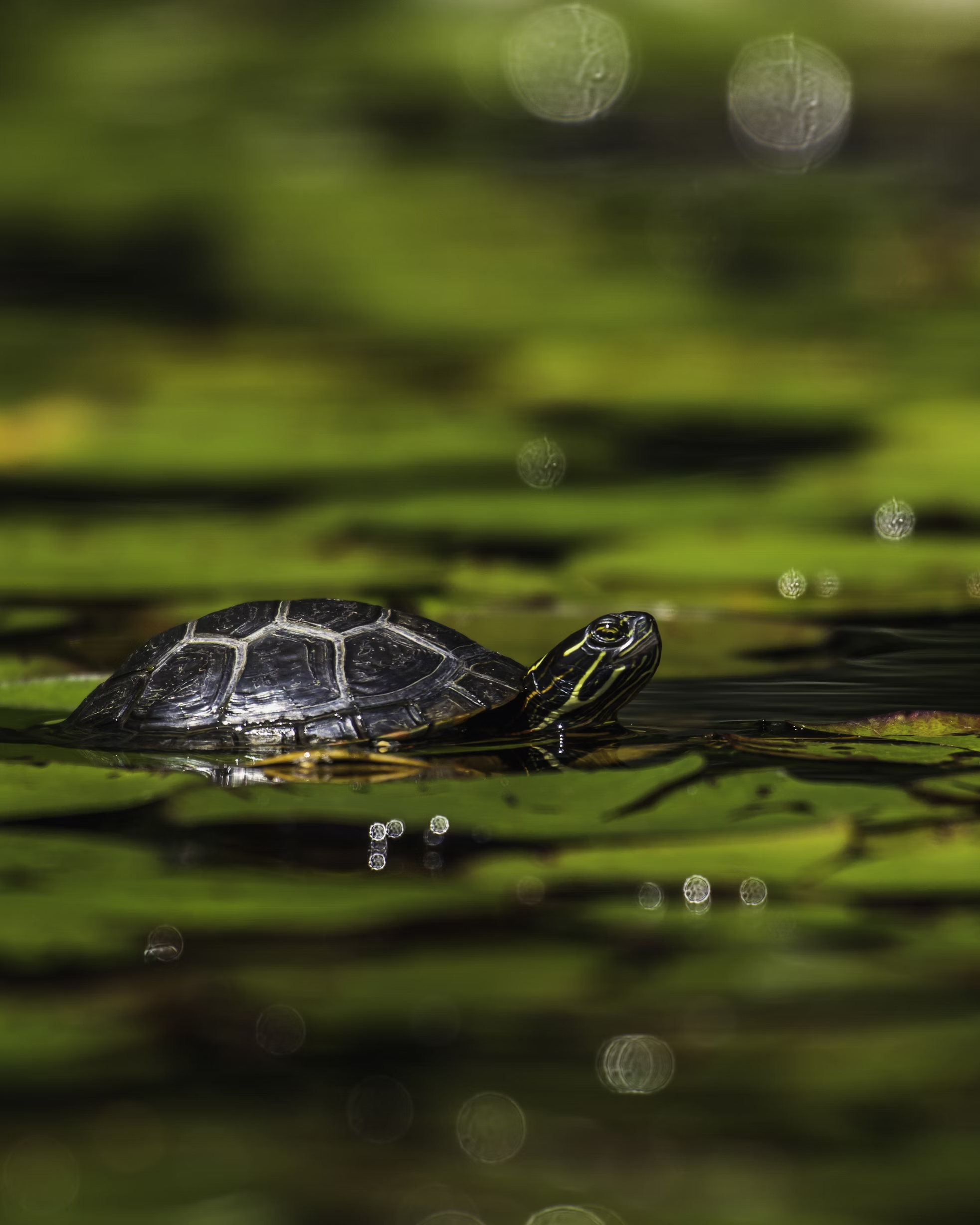
Amanda (names changed) was not happy that we had brought the turtle back into our classroom, despite most of the class being excited about the prospect of having a class pet. She wrote in her journal that day, “I felt that we should have put him back, because didn’t we talk about how humans are messing up the environment this week while reading the whale shark chapter in World of Wonders? I really do hope we don’t mess this turtle caring business up.” Our weekly walks in the woods and the book we were reading together must have made a lasting impact on how Amanda viewed her role as an environmental steward. The rest of the class conceded she was right, and within a few days, we all participated in a rehoming ceremony for our turtle.
Studies have shown that positive experiences in nature develop long-lasting affective associations with the natural world, which often times translate into activism and advocacy for environmental causes (Křepelková, et al., 2020; Soga & Gaston, 2024). As a veteran teacher of 26 years in high school English language arts (ELA), I have found that outdoor learning not only serves as a powerful conduit to creative thinking and cooperative action, but it also lays a solid foundation for environmental literacy, as Amanda and her classmates demonstrated with returning the turtle to his home.
When I use the term environmental literacy, I refer to an individual’s ability and willingness to make ethical and research-based decisions about their environmental choices, as well as their desire to conserve natural resources (California, 2015; MAEOE, 2024; NAAEE, 2024). Environmental literacy does not manifest itself only at the individual level; it is also a cooperative and collective move toward learning how to participate in civic life for the good of all living creatures (California, 2015; MAEOE, 2024; NAAEE, 2024). Teachers who provide opportunities for cooperative learning outdoors foster those affective connections that just might grow into cooperative action toward sustainability that benefits us all.
As children grow older, their time outside seems to diminish. Students today have spent less time playing outside than previous generations (Schilhab, et al., 2018; Selhub & Logan, 2012; Williams & Wainwright, 2016; Zeng, et al, 2021). The less time students spend outdoors corresponds with an increase of time spent behind screens (Barrette, 2022; Jackson, et al., 2020). The increased time behind screens instead of outside has implications for teens’ academic progress and their overall wellbeing (Hicks, et al., 2021; Kuo, et al., 2018). Increased screen time paired with fewer opportunities for spending time outside and with others has contributed to rising mental health challenges and physical ailments for teens (Abenes, 2022; Barrette, et al., 2022; Hedderson, 2023) as well as a reduced ability to concentrate and more difficulty communicating with peers socially (Abenes, 2022; Nadeem & Van Meter, 2023). In addition, digital immersion has often lured students into relying too heavily on artificial intelligence to the detriment of their own originality and creativity (Daniel, et al, 2023; Zhao & Watterson, 2021).
Engaging with the physical environment and interacting with nature through multiple senses offer ways to mitigate some of the detrimental effects of too much screen time, and outdoor learning can benefit teens’ health and academic progress. Outdoor spaces are conducive for sensory experiences and creative activities that incorporate artifacts within the setting (Asfeldt, et al., 2020; Beames, et al., 2012; Quay & Seaman, 0216; Selhub & Logan, 2012). Lessons that reconnect students with the physical world and its artifacts offer sensory experiences that employ both cognitive and kinesthetic processing, thereby providing a more memorable and meaningful learning experience. If the context of the classroom expands so that students interact in a tactile way with the physical world that surrounds them, then their attention turns outward, opening the way for creative and imaginative expression simply because they have new physical experiences from which to think and create (Beames et al., 2012; Carpenter & Harper, 2016; Quay & Seaman, 2016). It also opens the way for environmental stewardship as students first learn to love their local landscapes, and that love often spurs protection advocacy for broader ones.
During our outdoor adventures, Amanda reminded us that we needed to leave Gerald the turtle in his natural habitat, but Jake taught us about his early childhood in the Philippines and told us stories about how he and his cousins would put spiders on a stick to see if they would fight.
Several of us responded in disbelief: “You didn’t really pick up spiders and put them on a stick, did you?”.
“Yes, we did. Let me show you,” Jake replied.
Within a few minutes he had a spider on a stick and had us looking for a companion to place beside it. About three of us leaned in, not blinking, as Seth placed a smaller spider within inches of the larger one. We didn’t even have time to pull out our phones to start filming before the larger spider whipped out its web and wrapped the smaller one into its death blanket.
After our exhalations of astonishment and awe, we began to toss questions at Jake about his childhood. “We didn’t know you were born in the Philippines! When did you come to the US? Do you speak another language?” Jake kindly told us about his family in the Philippines and his move to the United States in elementary school. In his journal that day, he wrote about how that day’s experiences brought back memories he hadn’t realized he had forgotten. The rest of us walked away with a little more thorough understanding of each other. We were able to relate to the natural world in ways unique to our cultural experiences, which created a more democratic and cooperative learning environment for us all.
Before I share more examples from our outdoor classroom, I must acknowledge the privilege that I enjoy. Our school has numerous places for outdoor lessons — courtyards, access to the track and practice fields, and a wooded area across the street from the school where the cross-country team runs — and my current and previous principals have encouraged my use of our green spaces. I understand that not all teachers have access to safe outdoor spaces and supportive administration, but just about any outdoor space can be made into an engaging classroom, and I hope researching the benefits of green spaces in schools will fuel the movement to provide outdoor learning space for all students.
Here are some ways I have found to take class outside for numerous benefits, including participating in memorable content lessons, building classroom community, and cultivating environmental literacy. Of course, the examples come from an ELA class, but the process is easily adaptable to just about any discipline.
String Journals
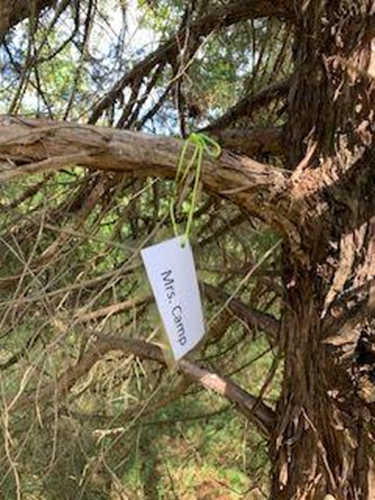
I learned about string journals when I spent a week studying Thoreau at the Walden Woods Project in their summer program, Approaching Walden, in 2019. I took what I learned and adapted it for my class in the fall of 2020. I printed and laminated a name tag for each student and attached a waterproof twine.
Students found a place in the woods where they wanted to return throughout the semester, and they hung their tags there. Each time we went to the woods for an outdoor lesson, we began with a moment of observation and writing at our string journal spots. By the end of the semester, students had a time-lapsed set of descriptive writing that detailed changes in the spot from August to December. This lesson works for writing instruction as easily as it will for scientific notetaking or geological study. Students can practice sketching and documenting the environment as a professional naturalist, archeologist, or geographer might.
Photo Essays
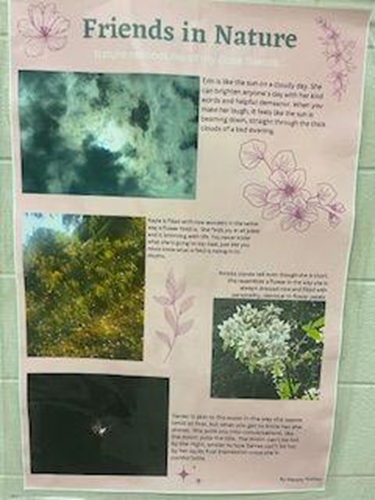
Students can create a photo essay (such as in the model of Humans from New York, for example) from images taken while outside around campus. Students learn to select images carefully for symbolic purposes while making the most of limited written text space. The content of photo essays is dependent on the content being taught (for example, artistic expression or documentation of natural change over time) and therefore adaptable for any discipline. Social studies classes might focus on natural resources or local history, whereas world language classes might center vocabulary acquisition.
Art Collections, Collages, and Memory Jars
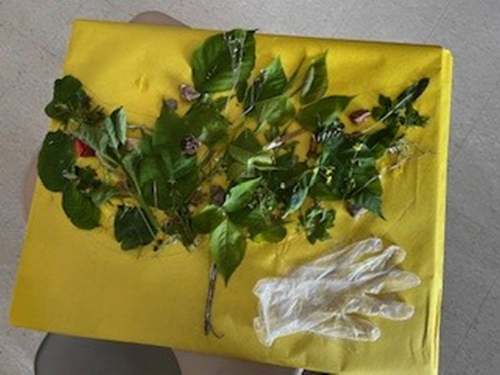
While outside, our class has collected interesting artifacts from the woods including a mysterious jawbone, persimmons, and unique leaves and wildflowers. Students have also brought back live creatures – caterpillars, unknown white creepers, and our pet turtle – even though we cannot keep those as part of a collection. The collections represent students’ adventures outdoors, and a story almost always accompanies the item selected, which forms the basis for original writing, full of sensory imagery and emotive language that I don’t often see in their traditional classroom assignments. We have also made art collages from artifacts gathered outside and students articulated reasons for the items they chose to include, again extending their understanding of symbolism and metaphor.
Yet, a biology class might create a leaf collection to be labeled and categorized. A geology class might collect rocks and minerals for a similar display. A math class might collect examples of different shapes or different representations of the same angle or slope.
Using Aimee Nezhukumatathil’s (2020) example in her chapter, “Firefly Photinus Pyralis” in her nature memoir World of Wonders, In Praise of Fireflies, Whale Sharks, and Other Astonishments, we collected items from the woods to store in memory jars for our class as a way to commemorate our outdoor adventures together. What physical representations do we want to keep as memories of our shared experiences outside? These collections can also provide materials for a multimodal art display in an art class or indicators of geographical descriptors for one’s local environment (for example, what do we find in the woods that demonstrate we live in a foothills region?) in geography class.
Blood Pressure Checks
After reading an article about forest bathing and how spending time outside reduces people’s blood pressure, we decided to put the article to the test. Our school nurse graciously helped us by taking each student’s blood pressure before we went outside and again when we came in after our walk outside. We recorded the data anonymously and analyzed it; while our findings didn’t necessarily align with those in the article, the process of analyzing the data gave us a chance to critically analyze the article and consider reasons our results might not have aligned with those in the formal study. This activity fits just as well in a math, health, or science class as it does in an ELA class.
Nature Poetry
Studying mentor texts from professional nature writers provides us with a model for poetic language and symbolic representation. I include picture books as mentor texts, as well, and then encourage students to create and illustrate as they are inspired to do. Modern nature poets such as J. Drew Lanham, Ada Limón, and Aimee Nezhukumatathil provide accessible and representative poetry that inspires students to see beyond their cursory look at their school environment. Yet, students might also model scientific writing from professional naturalists and even film moments in nature following models of nature documentaries. The point is to create as professionals in the field create — whether that professional is a poet, an ornithologist, filmmaker, or a historian.
There are so many more opportunities for taking high schoolers outside for interactive learning, and the resource list I have provided here will spur many more new ideas. Regardless of the lesson, the magic of the outdoor classroom lies in students’ physical interaction with the natural environment coinciding with the shared experiences among classmates. Too often our classes seem almost virtual despite the number of bodies all sitting in a room together. Standardized curricula and mandated benchmarks tie us to screens, and the classroom itself comes with traditional expectations of what academic writing looks like and what acceptable school performance is defined as. By the time they reach their junior year in high school, many students have compartmentalized school behaviors and school literacies as quite different from their authentic lives and literacies. Too often this compartmentalizing results in stilted, perfunctory work within the classroom.
The outdoor classroom does not hold those same expectations, and without these expectations, students are free to pursue joint adventures and open themselves up to conversations and experiences. These small lessons that still fulfill requirements of curriculum standards have the potential to provide positive experiences with nature that form the affective connections later leading to activism and advocacy.
Taking students outside brings interaction with the material world, such as trees, animals, and plants, and this material engagement prepares students for self-reflective questions, such as
How are humans connected to the natural world?
What is my personal relationship to the natural world?
Do others see the natural world the same way I do? Why or why not?
What are my obligations to the natural world?
Strong memories developed through physical interaction with nature and shared experiences among classmates can be the starting point for meaningful place-based learning and environmental literacy, as Amanda taught us all when she urged us to leave our turtle in his natural habitat.
Ms. Camp is a PhD candidate in Language and Literacy at the University of South Carolina (USC). A National Board Certified Instructor, she has taught English Language Arts at Gaffney High School in Gaffney, SC, for 26 years. She has served as an AP English Assesser, a National Writing Project teacher consultant, and an adjunct instructor with Spartanburg Community College, Limestone University, and USC. She shared her experiences with outdoor learning in an article published in English Journal in 2023, and she was awarded a Teacher Researcher Grant from National Council of Teachers of English in 2024 to help fund her dissertation study that investigates the influence of an outdoor setting on high school students’ writing practices.
Ms. Kristie Camp is a PhD candidate who has taught English Language Arts for 26 years. Her webinar provides a picture of how to grow environmental literacy in an outdoor classroom.